Publication ID: A3367
Compacted soil can cut crop yields by as much as 50% due to reduced aeration, increased resistance to root penetration, poor internal drainage, and limited availability of plant nutrients.
Soil compaction is the physical consolidation of the soil by an applied force that destroys structure, reduces porosity, limits water and air infiltration, increases resistance to root penetration, and often results in reduced crop yield. Most farmers are aware of compaction problems, but the significance is often underestimated. Compaction effects on crop yield can be a significant factor in today’s farm economy.
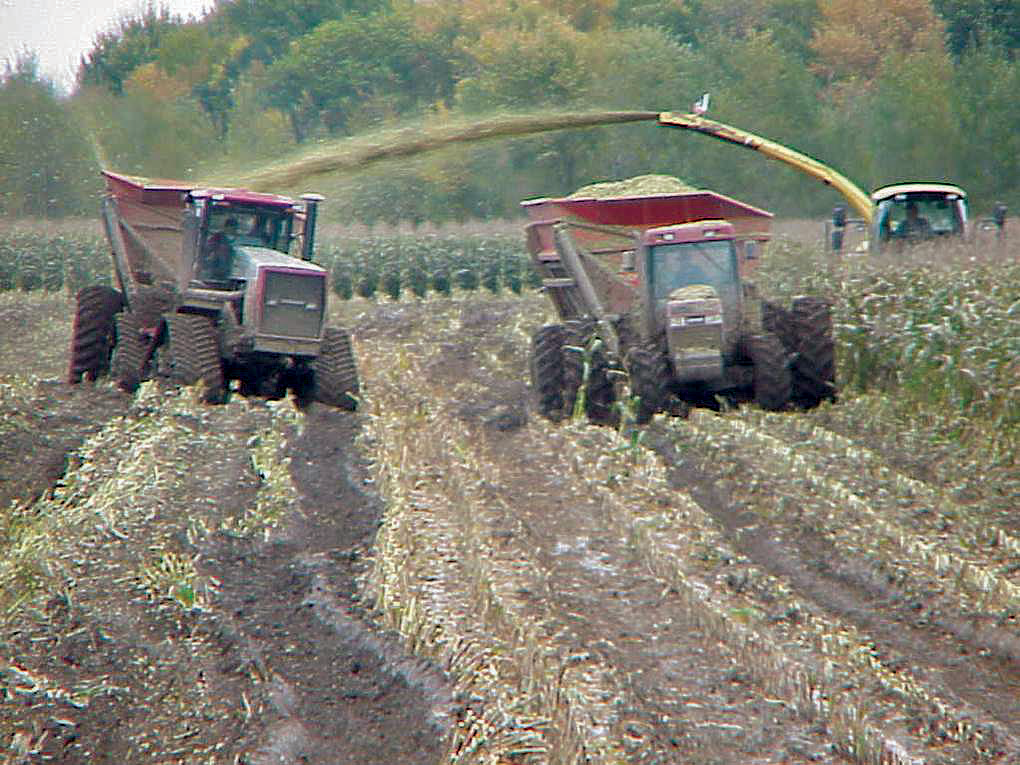
Recent changes in agricultural practices (such as an increased number of operations and larger equipment) have made soil compaction more common. Most yield-limiting compaction is caused by wheel traffic from heavy equipment, often when operations are conducted on wet soils (the photo above shows a prime example of the destructive damage caused by heavy equipment on wet soils). Significant compaction can also be caused by tillage and livestock. This bulletin describes the causes and effects of soil compaction, explains how to recognize the symptoms of compaction in soils and crops, discusses how to measure compaction, and provides methods to minimize compaction problems.
Causes of Compaction
A typical silt loam soil contains about 50% pore space, portioned at 25% water and 25% air by volume at field moisture capacity. Soil particles and organic matter occupy the remaining 50%. Soil compaction is a process that first occurs when the force from wheel traffic pushes aggregates together. If the applied force is great enough, the aggregates are destroyed. The result is a dense soil with few large pores that has poor internal drainage and limited aeration.
The problem of soil compaction is increasing for several reasons. Earlier planting schedules, larger equipment, and increased use of duals or flotation tires that encourage field operations on wetter soils are all responsible. Wheel traffic from heavy farm equipment is recognized as the major cause of soil compaction, although some compaction occurs from normal crop production practices.
Heavy machines with axle loads that exceed 10 tons increase the risk of compaction extending into the subsoil, compacting soils to a depth that cannot be removed by conventional tillage. Loaded combines and manure tankers commonly weigh 20 to 30 tons. These machines produce more compaction to greater depths as these loads overwhelm the bearing strength of the soil. Producers often feel that large loads can be offset by wider tires. While some reduction in pressure from a heavy load can be realized from larger tires, compensation for the increased load will not be realized, and the compaction effect will be distributed over a greater soil volume.
The type and condition of a soil affect the potential for compaction. Soils with low organic matter content tend to be more susceptible to compaction because they do not form strong aggregates (soil particles that are bound together). Clay soils, when wet, are highly compactible because the clay minerals have bound water around them, which acts as a lubricant, thus making it easier for the soil particles to move against each other. Sandy soils, which do not form aggregates, can also be compacted. Many sandy soils are used for vegetable crop production and are subjected to heavy loads and aggressive tillage and harvesting practices. Any soil type is most easily compacted when the soil water content is at or above field capacity, although at saturation the soil is not easily compacted since all pores are filled with water, which is not compressible. While operations on saturated soil may not compact at depth, the surface soil is easily puddled as it squashes outside the tire path. Under drier conditions, the soil-bearing strength increases, reducing the compactibility of the soil.
The trend toward continuous row crops, instead of crop rotations that include solid-seeded/deep-rooted crops such as alfalfa, increases the potential for soil compaction. Perennial alfalfa/grass mixture crops, because of their dense canopies and taproot systems, provide greater support at the soil surface than row crops and create channels deep into the soil that subsequent crops can use. Perennial crops also tend to favor aggregation, whereas row crops have been shown to have lower aggregate stability.
Aggressive tillage also increases the susceptibility of a soil to compaction because tillage reduces aggregate stability and reduces soil strength. Soils managed under no-till systems tend to have a somewhat denser surface, with greater bearing strength that develops over time as the soil consolidates. Moldboard plowing typically forms a dense layer of soil immediately below the tilled zone. During moldboard plowing, one tractor wheel usually operates in the furrow on soil which is never tilled. It is still possible to detect the plow layer in many soils even though a moldboard plow has not been used for years. Secondary tillage tools operations, especially disking, decrease aggregate stability and create a soil condition more susceptible to compaction by subsequent traffic.
The trend toward continuous row crops increases the potential for soil compaction.
Tips for Minimizing and Avoiding Soil Compaction
Proper tractor and machine setup and operation can minimize the effect of compaction, but improved management is the best solution for addressing compaction.
Manage Field Operations
- Avoid performing field operations on wet soils.
- Limit vehicle load and ensure proper weighting in tillage operations.
- Manage vehicle traffic within fields. Controlled-traffic farming systems, especially those that maintain surface crop residue, will serve to limit compaction and reduce soil erosion.
Address Drainage Problems
- Add organic materials to help build soil structure and increase soil strength.
- Rotate to tap-rooted forages to create channels in the soil that subsequent crops can use.
Remove Existing Compaction
- Use conventional tillage to remove compaction in the plow layer.
- Subsoiling may be required to alleviate deep compaction. Deep tillage should not be an annual practice due to its potential to destroy soil structure, bring infertile soil and stones to the surface, and may not be cost-effective.
Compaction Effects
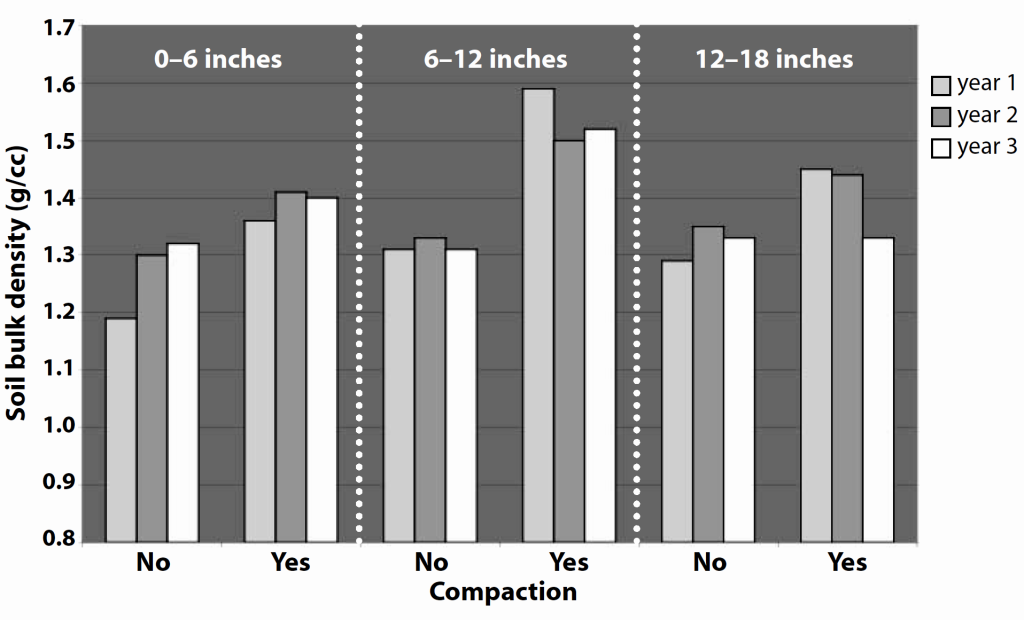
The impact of compaction on soil properties is typically less visible than its impact on plant development. The major effect of compaction is an increase in bulk density as soil aggregates are pressed closer together, resulting in a greater mass per unit volume. Compaction reduces the soil pore volume, resulting in less space for air and water in the soil. Most importantly, the large pores, responsible for much of the gas and water movement, are destroyed. Increased bulk density and reduced pore volume also reduce water infiltration into the soil. Less rainwater can move into excessively compacted soils, increasing the potential for runoff and erosion. Water may remain on the soil surface longer, especially in depressions and wheel tracks. Figure 1 shows that the effects of compaction persist for years, and are most notable at depths of 6 to 12 inches.
Figure 1. Change in bulk density over a 3-year period caused by a single pass with a 14-ton vehicle prior to seeding alfalfa on a silt loam soil
Compaction effects were evident throughout the study and were most notable at depths of 6 to 12 inches.
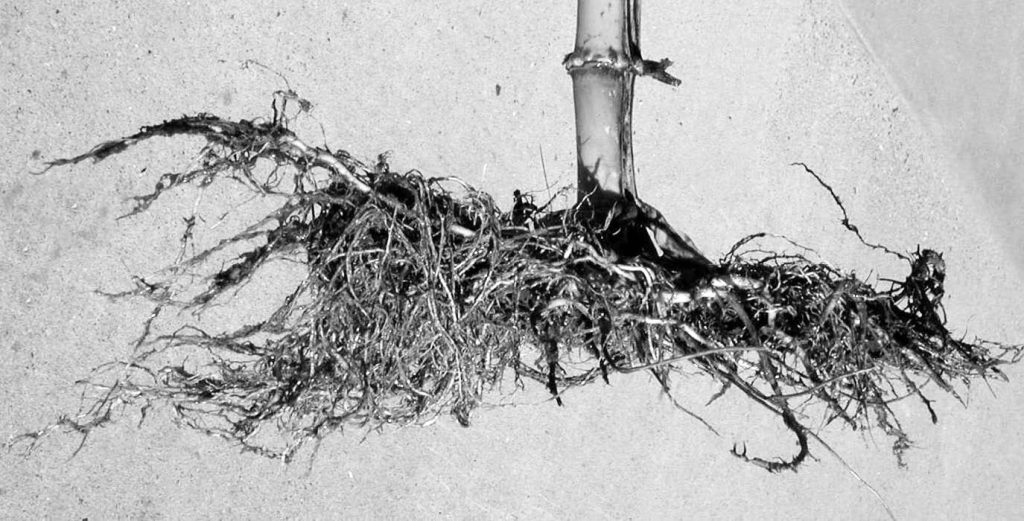
Soil strength is a measure of the ability of a soil to resist deformation from an applied force. Strength increases as soil particles become more tightly pressed together. Many researchers have reported major increases in soil strength because of excessive soil compaction. As soil strength increases, the plant roots must exert greater force to penetrate the soil. In some cases, the roots are unable to penetrate excessively compacted soil and grow laterally. “Pancake” root development is a classic example of root growth occurring under compacted conditions (figure 2). As roots grow down through the soil and encounter a restrictive layer, they spread horizontally and are unable to fully use moisture and nutrients below this layer, which often limits plant growth. The denser portion of the root mass shown in figure 2 is the response to row applied fertilizer. A complete blend of row-applied fertilizer is recommended for corn grown under suspected compacted conditions to compensate for the inability of the plant to explore the soil volume.
Figure 2. Roots of a Corn Plant
The roots of this corn plant were unable to penetrate the layer of compacted soil. In response, they spread out horizontally, creating a “pancake” effect. Such plants often exhibit stunted growth due to limited access to soil moisture and nutrients.
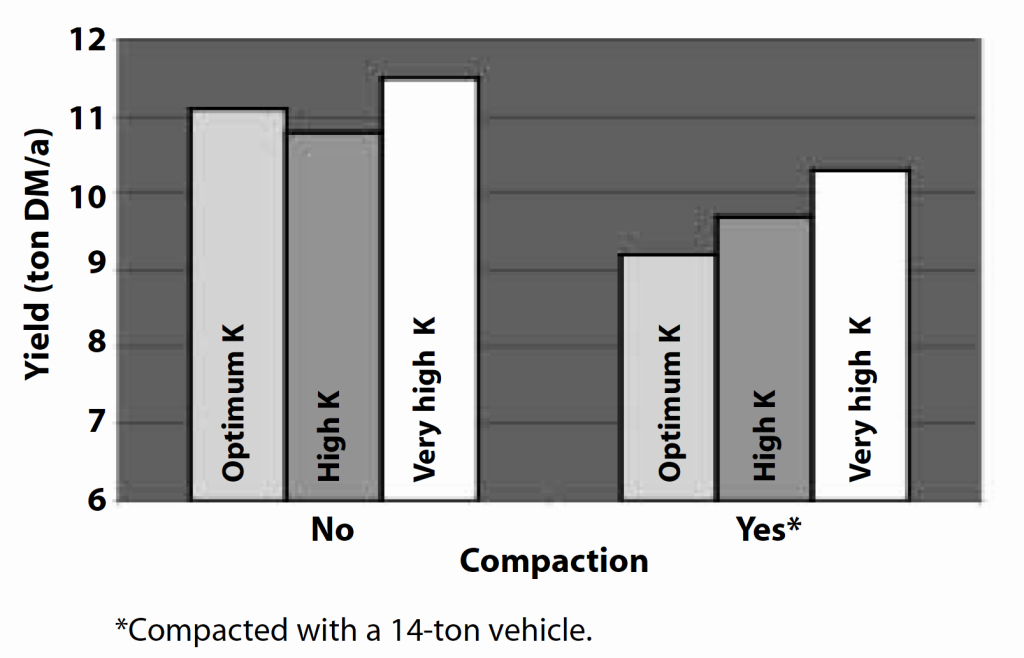
Compaction has been shown to affect nutrient uptake and may actually induce nutrient deficiencies. Reduced aeration in wheel tracks has been shown to increase the potential for denitrification, which could cause nitrogen deficiency if enough nitrogen is lost. Research has shown reduced potassium uptake on compacted soils. Potassium is absorbed from the soil solution across the root membrane by an active process that requires cellular respiration. If poor aeration reduces the oxygen content in the soil then potassium uptake will be reduced. Figure 3 confirms that a response to potassium fertilization can be observed on compacted soils, but often the response is not great enough to make up the yield difference found in the same soil had it not been compacted.
Figure 3. Effect of compaction and soil test potassium levels on total alfalfa yield over three seasons in Arlington, Wisconsin
Compaction affects plant emergence and development and is frequently observed near field entrances and in headlands. Excessive compaction can reduce plant emergence rates as well as stunt plant height throughout the growing season. Figure 4 shows the effect of moderate and heavy compaction on plant emergence and plant height of corn.
Yield loss caused by soil compaction is a major concern. Results from numerous studies throughout Wisconsin have shown yield losses ranging between 10 and 50%for a variety of crops. The magnitude of yield loss is most likely dependent on a number of factors, including soil type, degree of compaction, and seasonal weather variation that affects water availability. Table 1 shows the yield response from several studies that were measured under a “worst-case” scenario where the entire plot area was compacted. While it is unlikely that 100% of a field would be trafficked from conventional field operations, it is conceivable that up to 75% of a field might be tracked by a variety of traffic passes.
Figure 4. Effect of Compaction on Corn Emergence and Plant Height on a Silt Loam Soil at Lancaster, Wisconsin
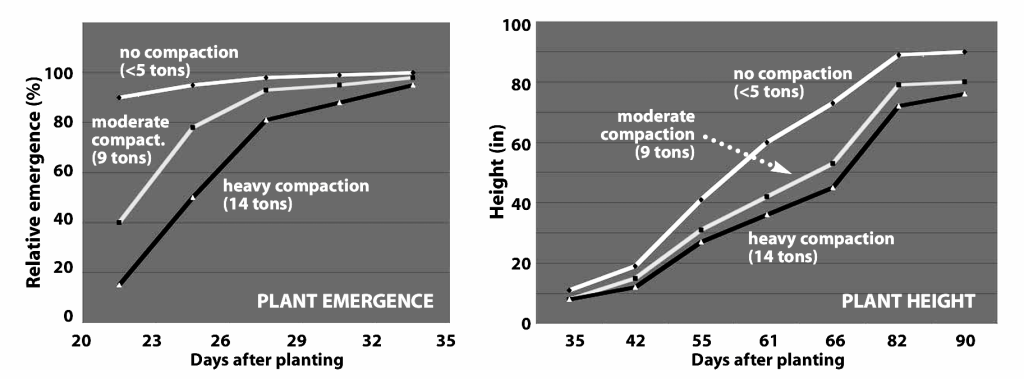
Table 1. Effect of Soil Compaction on Crop Yield in Several Wisconsin Studies
Studies comparing effects of none and heavy compaction levels.
| Crop | County | Units | Relative Compaction None | Relative Compaction Heavy |
|---|---|---|---|---|
| Alfalfa | Columbia | ton/a (DM) | 3.73 | 3.26 |
| Corn | Columbia | bu/a | 156 | 112 |
| Potato | Waushara | cwt/a | 458 | 440 |
Studies comparing effects of none, medium, and heavy compaction levels.
| Crop | County | Units | Relative Compaction None | Relative Compaction Medium | Relative Compaction Heavy |
|---|---|---|---|---|---|
| Corn | Grant | bu/a | 106 | 101 | 91 |
| Corn | Manitowoc | bu/a | 120 | 103 | 69 |
| Corn | Winnebago | bu/a | 156 | 152 | 142 |
Diagnosing Soil Compaction
Where compaction is suspected because of plant or soil symptoms, there are several methods that can be used to determine the extent and severity of compaction.
One of the simplest methods is to drive a steel or wooden stake 18 inches into the soil in a fence row that has not been tilled and has not received wheel traffic for a number of years. Then drive the stake into the soil in a representative area of the field where compaction is suspected. Note the relative effort required to drive the stake by counting the number of hammer blows needed to drive the stake to a specific depth in each area. If the effort required to drive the stake in the field is noticeably greater, the soil is likely compacted. Do this several times in each field to get an average assessment between noncompacted and compacted areas.
Another technique involves digging a small trench 2 feet deep across the crop row in several areas where compaction is suspected, as well as in areas where compaction is unlikely. The trench should be centered on the row with one side of the trench in an area free of wheel traffic. Use a knife or screwdriver to estimate the force required to penetrate the sidewall of the trench. Observe the force required to push the tool into the soil at 2-inch increments starting from the soil surface. If the force changes dramatically, the soil may be compacted. Recognize that some increase in penetration resistance is expected the deeper you go.
If the trench is dug during the growing season, evaluate root development and growth pattern. Any abnormality in root form and distribution, such as lateral growth, will likely be due to compaction. If compaction is caused by wheel traffic, more roots may be visible on the side of the row that did not receive wheel traffic.
A tool known as a cone penetrometer can be used to measure the force required to push a standardized steel cone into the soil. (Most agricultural mail order supply companies carry penetrometers.) If a compacted layer or area is encountered, the required force to penetrate the soil will increase, often showing as a higher reading on the instrument. Because penetration resistance is related to soil water content, it is important that a penetrometer be used when the soil is near its field capacity water content. This moisture content is generally not found throughout the soil profile during the summer unless a substantial rainy period has occurred; therefore, spring or fall is the best time to take readings. Take measurements at several locations to compare “good” and “bad” areas. Interpret the results carefully. Soil type, natural soil layers, soil water content, and compaction variability across the field will affect the penetration resistance. Also be sure to document the depth at which compaction was found to help determine if tillage can be used to remove the compacted layer.
A final method of diagnosing soil compaction is to measure the soil bulk density or the mass of dry soil in a known volume. Most farmers and crop consultants are not equipped to make this measurement. Soil bulk density is determined by quantitatively removing a core of soil over the depth of measurement, typically in 3- to 6-inch increments. Cores are then oven-dried to determine mass. Recognize that soil texture affects bulk density. Medium-and fine-textured soils generally have a lower bulk density than that of sandy soils, because aggregation creates larger structural units in the finer-textured soils. An estimate of total porosity can be made from the bulk density measurement assuming the particle density of most soil minerals is 2.65 g/cc. The calculation for determining porosity is shown below.
Total porosity (%) = [1 – (Bulk density/ Particle density)] x 100%
Minimizing Compaction
The best way to minimize compaction is to avoid field activities that have the potential to damage the soil. Whenever possible, do not conduct field operations on wet soils. Even delaying an operation a portion of a day to allow for some drying may make a big difference. There is always a temptation to operate on wet soils, because of the concern that timely field operations are needed to avoid large yield reductions from delayed planting or inferior crop quality if harvest is delayed. Modern agricultural equipment is equipped with options such as four-wheel drive, tracks, and duals or triples, which allow working in wet soils.
Equipment Maintenance and Management Tips to Reduce Compaction
While it may be considered impractical, an effort should be made to limit load when operating under wet soil conditions. This could mean only filling the grain tank or chopper box partially full, or only carrying a partial load of manure to the field. Excessive weight creates high soil loads that may exceed the soil-bearing strength depending upon soil water content. Such operations also use more fuel, but consideration would have to be given to the additional fuel used for multiple trips.
Delaying a field operation for even a portion of a day to allow for drying may make a big difference in minimizing compaction.
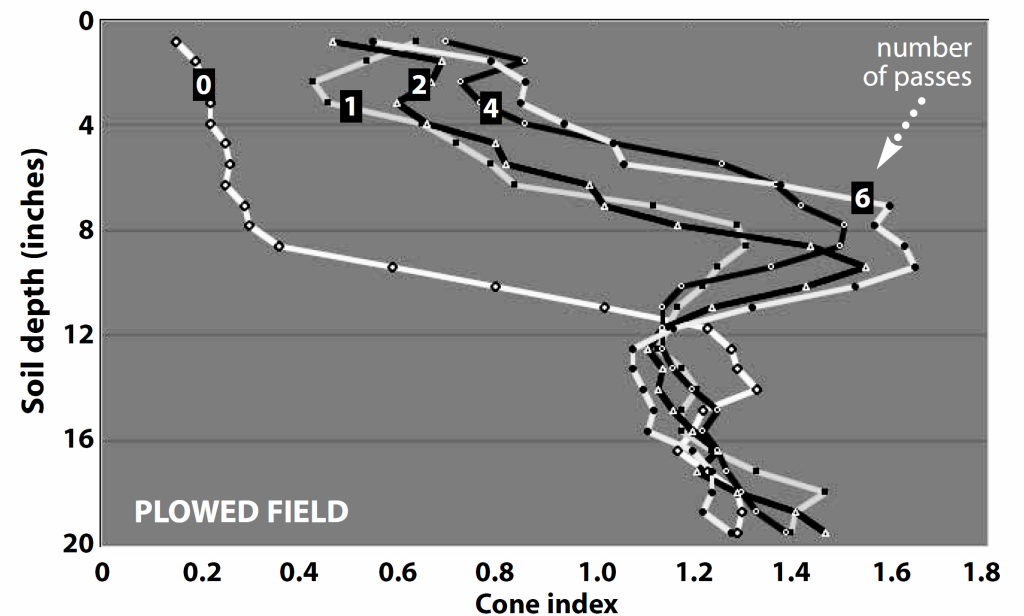
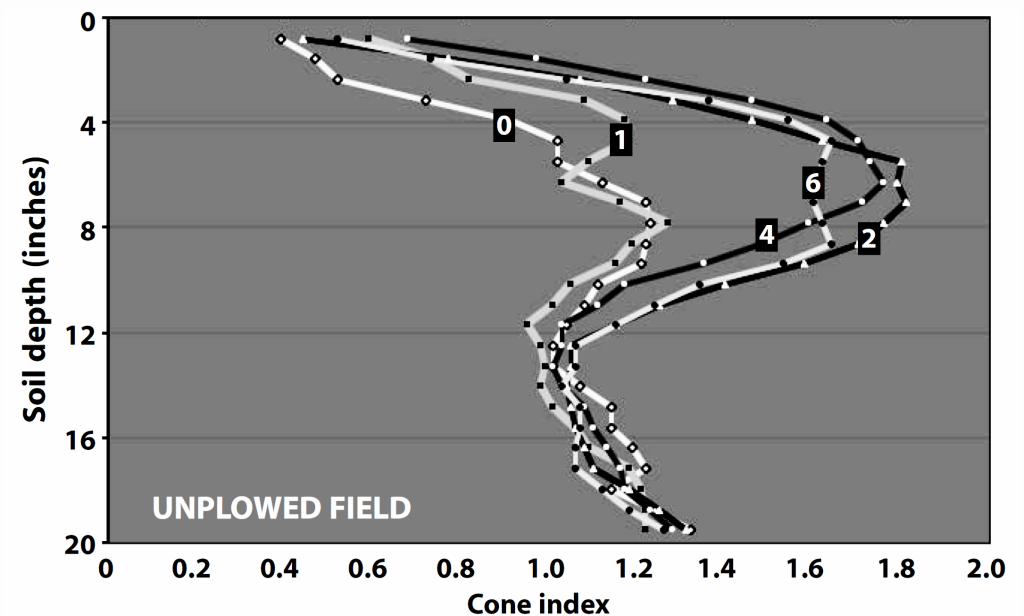
Eliminate unnecessary field operations, especially on wet soils. “Chasing the combine” to unload on-the-go results in extra wheel traffic in a field and compaction of a greater field area. If possible, unload combines on the road or in headlands. If fields are too long to make a harvesting round, confine traffic to a lane to unload partway across the field. Figure 5 shows penetration resistance measured after driving a large combine on a wet soil that was unplowed or recently chisel plowed. The unplowed soil appeared to handle one pass, but multiple passes increased resistance. All traffic on the plowed soil substantially
increased penetration resistance. In a plowed field, all passes increased resistance; the unplowed field was able to handle a single pass before resistance was noticeable. These data show that between 70–80% of the compaction occurs in the first pass, so decide carefully where and when to drive on a field.
Figure 5. Effect of number of passes of a 14.5-ton combine on penetration resistance of a silt loam soil
Use the recommended tire size and type, inflated to the proper pressure. Tires with larger tire footprints, such as radials or larger diameter tires, will cause less topsoil compaction; however, deep soil compaction will not change because it is
affected by total load, not by soil area contact. Tandem axles will also reduce
surface soil compaction, compared to a single axle, and compact less area than
dual systems. Tracks have more contact area than tires and cause the least amount of compaction. Recent design changes have improved tracks’ performance on hard surfaces.
Between 70–80% of compaction occurs during the first pass over the field.
Controlled-Traffic Farming
Controlled-traffic farming is a practice that is currently being implemented internationally, but has only been adopted to a limited extent in the USA. This system utilizes the same traffic lanes year after year, thereby sacrificing a small portion of the field in favor of having no wheel traffic in the majority of the field. Restricting traffic to specific lanes also provides a firm soil surface for more efficient tractor operation. It adapts well to conservation tillage systems such as strip-tillage, ridge-tillage, and no-tillage and is facilitated by GPS guidance systems and auto-steer features found on modern tractors. Equipment needs to be standardized to fit the wheel traffic pattern. As an example, a six-row planter and combine with 30-inch row spacing could be set up on a 120-inch wheel spacing. This system would create traffic on just one-third of the soil area;
actual traffic could be much less depending on tire size. Sprayer and fertilizer application equipment would be a multiple of this dimension. The adoption of controlled-traffic farming will require additional agronomic research, economic analysis, and improvements in machine design before the system becomes practical for diverse production agriculture found in Wisconsin.
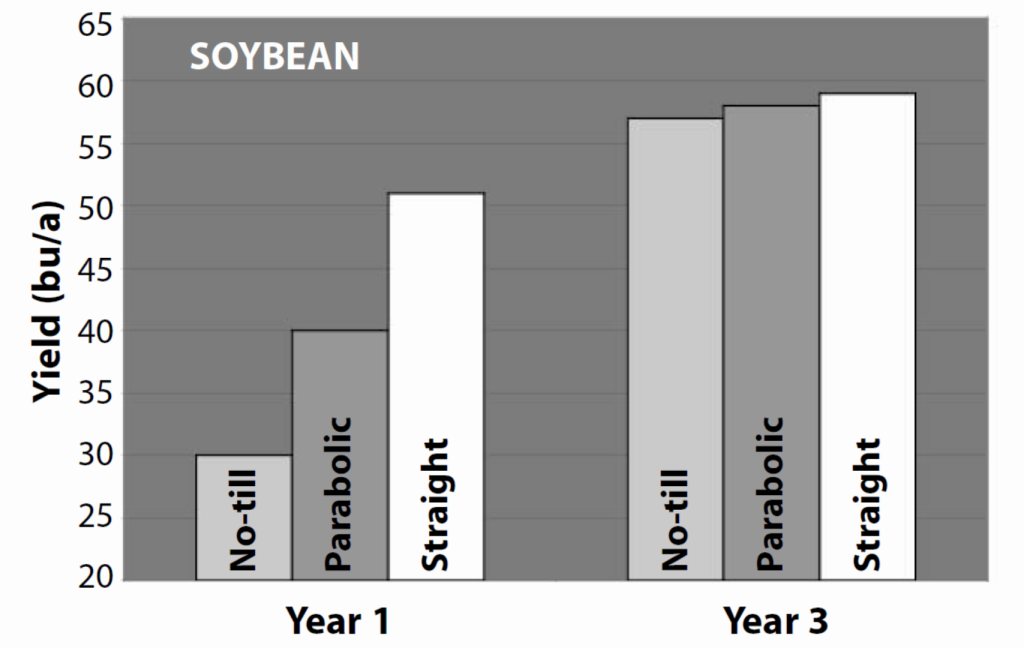
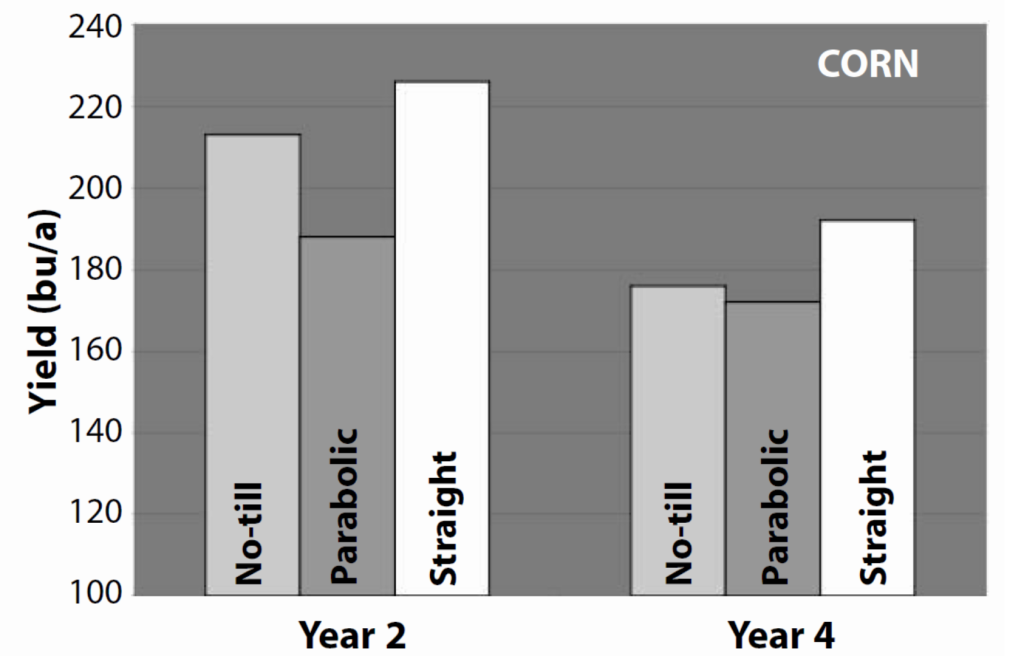
Figure 6. Effect of Subsoiler Type on Corn and Soybean Yield
Grown on a silty clay loam soil (Manitowoc County, Wisconsin).
Managing Compacted Soil
Where soil compaction is a persistent problem, economical methods of alleviating
it are needed. First consider surface and subsurface drainage improvements for poorly drained fields or portions of fields that contain problem areas. Adding organic material such as manure or organic byproducts will improve soil structure.
Other management practices that will help offset compaction include planting
cover crops or rotating with a forage crop.
Tillage is the common response for addressing soil compaction and is often necessary to remove ruts caused by operations during wet conditions. Surface compaction can be removed with a chisel plow run in the top 8 to 10 inches of soil. Deeper plowing with this tool is generally not efficient.
If compaction is found 11 to 18 inches deep, many producers consider subsoiling.
Subsoiling is an expensive practice and requires a substantial return in crop yield
to be justified. Typically 30 to 50 horsepower per shank is required to pull a subsoiler. Subsoiling should not be considered a permanent solution for compaction if the practices that caused the compaction are not modified. When a field is subsoiled, be sure to leave at least three untreated “check strips” that can be evaluated the succeeding year. This will allow the farmer to determine if subsoiling produced the expected results.
Subsoiling is generally conducted in the fall when soil conditions are somewhat
drier compared to those in the spring. An exception would be on sandy soils where most subsoiling is conducted in the spring.
There are two major types of subsoilers:
The first example is more aggressive and disrupts a considerable portion of the soil volume. Such shattering removes much of the bearing strength of the soil. It also buries most of the crop residue and requires a secondary tillage pass to create the seed bed. Straight-shanked tools are better adapted to conservation tillage systems and do not invert soil. Therefore, a secondary tillage pass is often not required. Figure 6 shows the results of research conducted on a silty clay loam soil in eastern Wisconsin where a straight-shanked tool, set on the same row spacing as the planter performed better than an aggressive tool equipped with parabolic shanks and wings. Yield was actually lower where the parabolic shank was used when compared to no-till in the years corn was grown.
Freezing and thawing will also aid in alleviating soil compaction, but only to a relatively minor extent. Wisconsin soils below the plow layer experience only one freeze-thaw cycle, and the amount of heaving at depth is relatively small. Freezing and thawing will help remove surface compaction but are of limited consequence for removing subsoil compaction. In the late 1990s, researchers in Minnesota investigated a historic wagon trail and still found measurable evidence of soil compaction over 100 years after its occurrence.
Farmers in the Midwest are becoming more interested in strip-tillage as a compromise between no-till and full-width tillage. No-till row crop production systems have been shown to have cooler and wetter soil conditions, and higher bulk density in the surface that contribute to slower emergence and in some cases reduced yield. A strip-tillage system controls traffic and loosens the soil in the future seed zone. The residue-free zone ensures early-season warming and conditions that are similar to those found with full-width tillage. The residue coverage in the field is typically only 10–15% less than that found in no-till systems.
Strip-tillage is generally conducted in the fall with a tool that creates an 8-inch-wide residue-free zone. Strip-tillage tools are equipped with coulters that first moves residue to the row center, followed by a soil-loosening knife that runs 8 to 12 inches deep, and then coulters that form a small ridge 2–4 inches high. All tillage is conducted on the desired row crop spacing.
Additional Reading
For more information on soils and soil management, see the following publications from UW–Madison Extension, Crops and Soils.
Originally Published: 2008