Publication ID: A4181
Managing Ground Pressure and Soil Compaction in Forage Harvest
Background
Ground Pressure Formula
Observations
Vehicle Weight
Tire Pressure
Measuring Compaction
Recommendations for Minimizing Wheel Traffic Impact
References
Your choice of tire and tire pressure may have a greater effect on ground pressure than you think
Alfalfa harvest is unique in that it requires many pieces of equipment to travel through the field from cutting to actual harvest. Whether it is being used for silage or dry hay, it normally requires at least four pieces of equipment, if not more, to harvest. One study found that transport vehicles alone made 1,370 passes within fields during a single season of alfalfa and corn silage harvest on an 8,000-acre farm (Harmon et al. 2018). With all this machine traffic through the field, soil compaction is a major concern when determining plant health and yield. Studies have shown partially compacted test plots had an average yield reduction of 7% over four years (Rechel et al. 2012). Given the potential for yield reductions, it is important for farmers to do everything possible to minimize ground pressure and thereby minimize soil compaction.
While it is impossible to eliminate all wheel traffic in a field, you can reduce the impact from the machines required to do the work. This can be done by making conscious decisions about the size of tires being used, the tire pressure, the vehicles being utilized in the field, and the paths those vehicles travel to complete the harvest task. This article reviews weights and ground pressures applied by various pieces of commonly used forage harvesting equipment.
Background
Information on vehicle weights, tire size, and tire pressure was gathered on examples of harvest equipment and tractors from multiple manufacturers to quantify applied ground pressures. Most manufacturers include the vehicle dry weight on their specification sheet, which provided much of the information used for this analysis. While many of the manufacturers included vehicle weight and typical tires used on their website, the tire pressure can vary based on application. Some weights and tire sizes were gathered and verified by visiting a local dairy and observing their equipment. This data was then used to complete the following calculation to determine the ground pressure for each vehicle (Šušnjar et al. 2011).
Ground Pressure Formula
This equation was chosen to calculate ground pressure because it includes tire pressure and type of soil in the calculation. Many other ground pressure calculations fail to include tire pressure in the calculation, which can cause a large discrepancy in calculated vs. actual ground pressure applied to the soil (Šušnjar et al. 2011).
To calculate the typical tire pressure,
Firestone’s Tire Pressure Calculator
(Firestone Tire and Rubber Company
n.d.) was used. Using this calculator, the user can select the vehicle type, front or rear axle for tire location, if duals or triples are installed, the tire size, and the load. The calculator then determines the recommended tire pressure for the selected scenario.
| P | Ground pressure caused by vehicle in psi |
| Gk | Weight carried by a single tire in pounds |
| Tire inflation pressure in psi | |
| Coefficient of soil type (set to 3 for hard soils) | |
| Tire width in inches | |
| Unloaded tire diameter in inches |
For self-propelled vehicles, an assumption of weight distribution was made for the front/rear tires. This weight distribution was assumed to be 40:60 for tractors, 60:40 for self-propelled forage harvesters, and 70:30 for swathers. This does not apply to mergers or balers as there is only one set of tires on these pull-type pieces of equipment. The minimum, maximum, and average weight of equipment used in analysis is summarized in table 1. For the calculations of hay wagon’s ground pressure, and estimation of weight of the full wagon was calculated using average densities for alfalfa found in an extension publication by Wiersma and Holmes (2000).
Table 1. Minimum and Maximum Weights of Typical Vehicles Used in Forage Harvest Operations
| Vehicle | Min (lbs) | Average (lbs) | Max (lbs) |
|---|---|---|---|
| Tractor | 10,000 | 23,000 | 36,000 |
| Chopper | 25,000 | 31,000 | 37,000 |
| Mower | 10,000 | 12,500 | 15,000 |
| Pull-type merger | 9,000 | 14,500 | 20,000 |
| Baler | 6,000 | 7,500 | 9,000 |
| Hay wagon | 8,000 | 38,000 | 68,000 |
| Box truck | 22,000 | 33,500 | 45,000 |
| Semi-truck | 35,000 | 53,000 | 71,000 |
Observations
Ground pressure as a function of vehicle weight was determined for seven types of agricultural harvest machinery (figure 1). The ground pressure of box trucks and semis (figure 2), is substantially higher than that of any agricultural vehicle. This is due to the relative narrow footprint of road tires and their high inflation pressure for operation. These two characteristics cause ground pressures that can be up to five times greater than pressures applied by an equal-weight tractor with agricultural off-road tires.
Figure 1. Vehicle Weight Vs. Ground Pressure for Agricultural and Transport Vehicles
Vehicle weight vs. ground pressure for both agricultural vehicles and transport vehicles. The narrow, high-inflation tires of road vehicles account for the substantial difference between agricultural and transport vehicles.
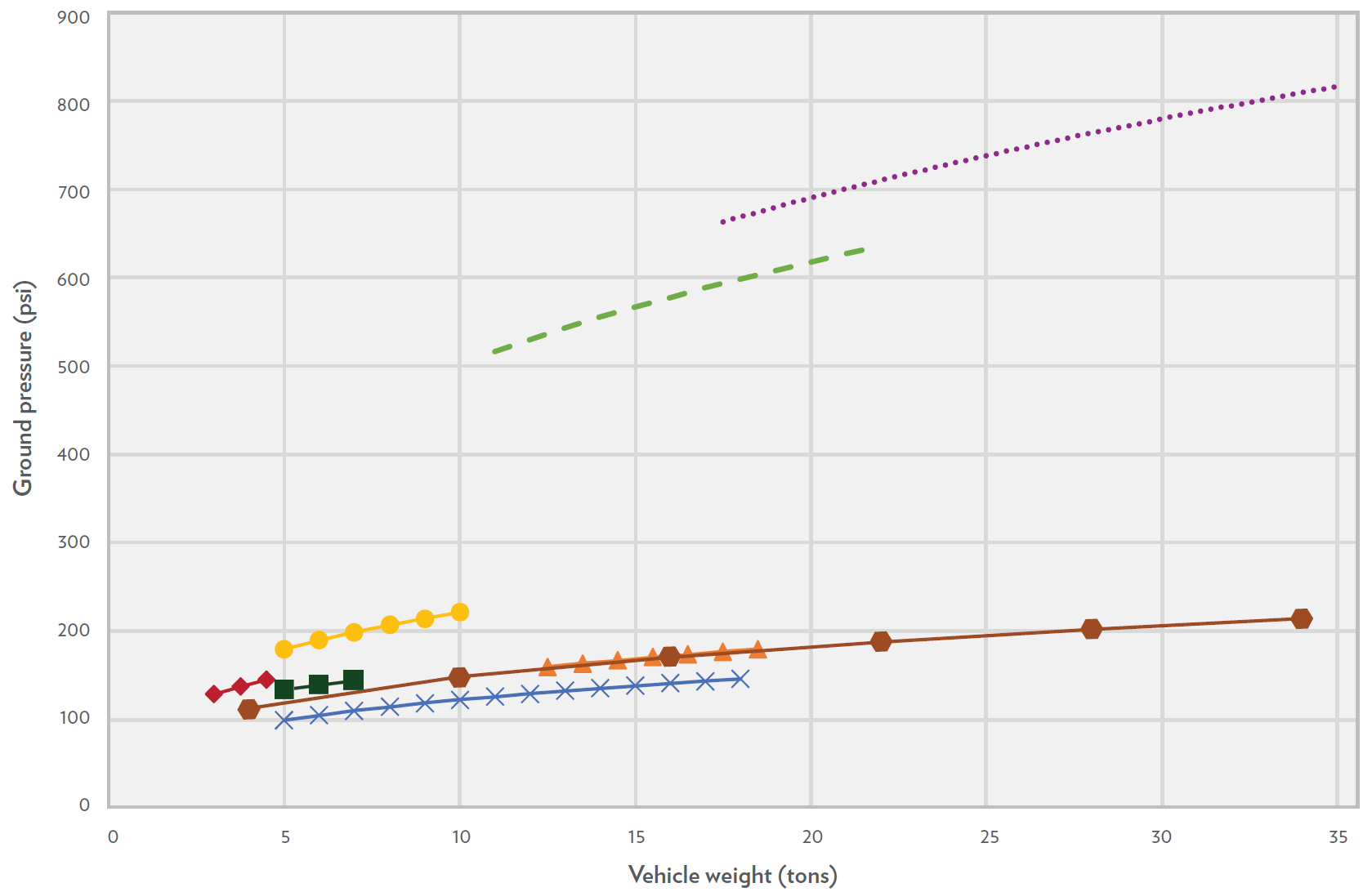
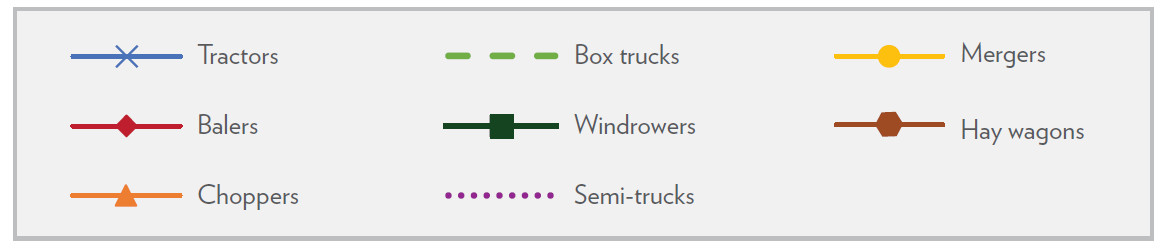
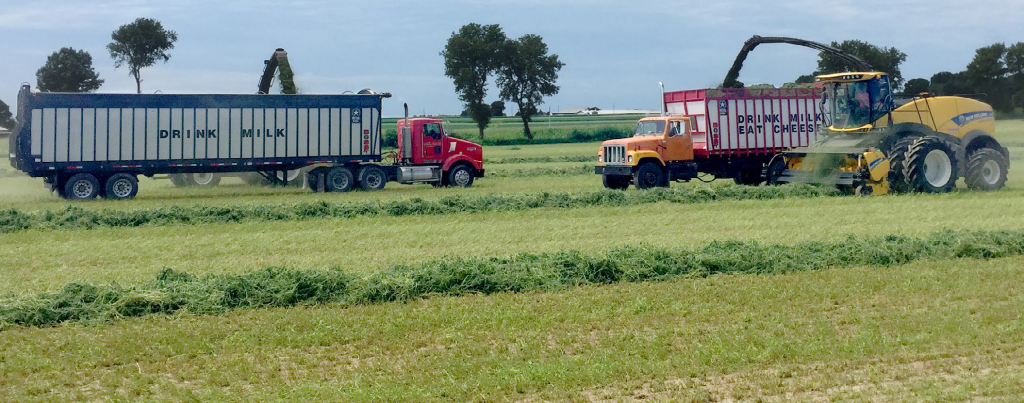
Figure 2. Image of a semi-truck (left) and box truck (right) being loaded
Although road vehicles are preferable when hauling down roads, their contribution to soil compaction is substantial.
Considering just the agricultural vehicles, it is noteworthy that the highest ground
pressure is caused by pull-type mergers, despite being half the weight of some choppers. With some of the larger mergers on the market reaching close to 20,000 lbs, it is hard to believe that there are only two tires carrying the entirety of the weight. Because of the fewer number and the smaller size of the tires, the merger’s contact area with the ground is much smaller than that of tractors or choppers which then causes the most ground pressure out of all the equipment used in forage harvest operations.
An important aspect to remember is that tire pressure is a large factor affecting
the applied ground pressure. As seen in equation 1, the tire pressure and ground
pressure have a linear relationship, which means that as tire pressure increases so will ground pressure (figure 3). Using a 17,000-lb tractor with 380/85R30 tires as an example, every 1-lb tire pressure increase results in the applied ground pressure to increase by over 7 lbs. As seen in figure 3, going from 5 psi to 25 psi can cause in increase of almost 150 psi in ground pressure. Table 2 shows the increase in ground pressure with every 1-lb increase of tire pressure (also referred to as the slope of the line). According to table 2, the heavier a vehicle is and the larger the tire is, the greater change in ground pressure for change in air pressure.
Figure 3. Tire pressure vs. ground pressure on a 17,000-lb tractor with 380/85R30 tires
Vehicle weight vs. ground pressure for both agricultural vehicles and transport vehicles. The narrow, high-inflation tires of road vehicles account for the substantial difference between agricultural and transport vehicles.
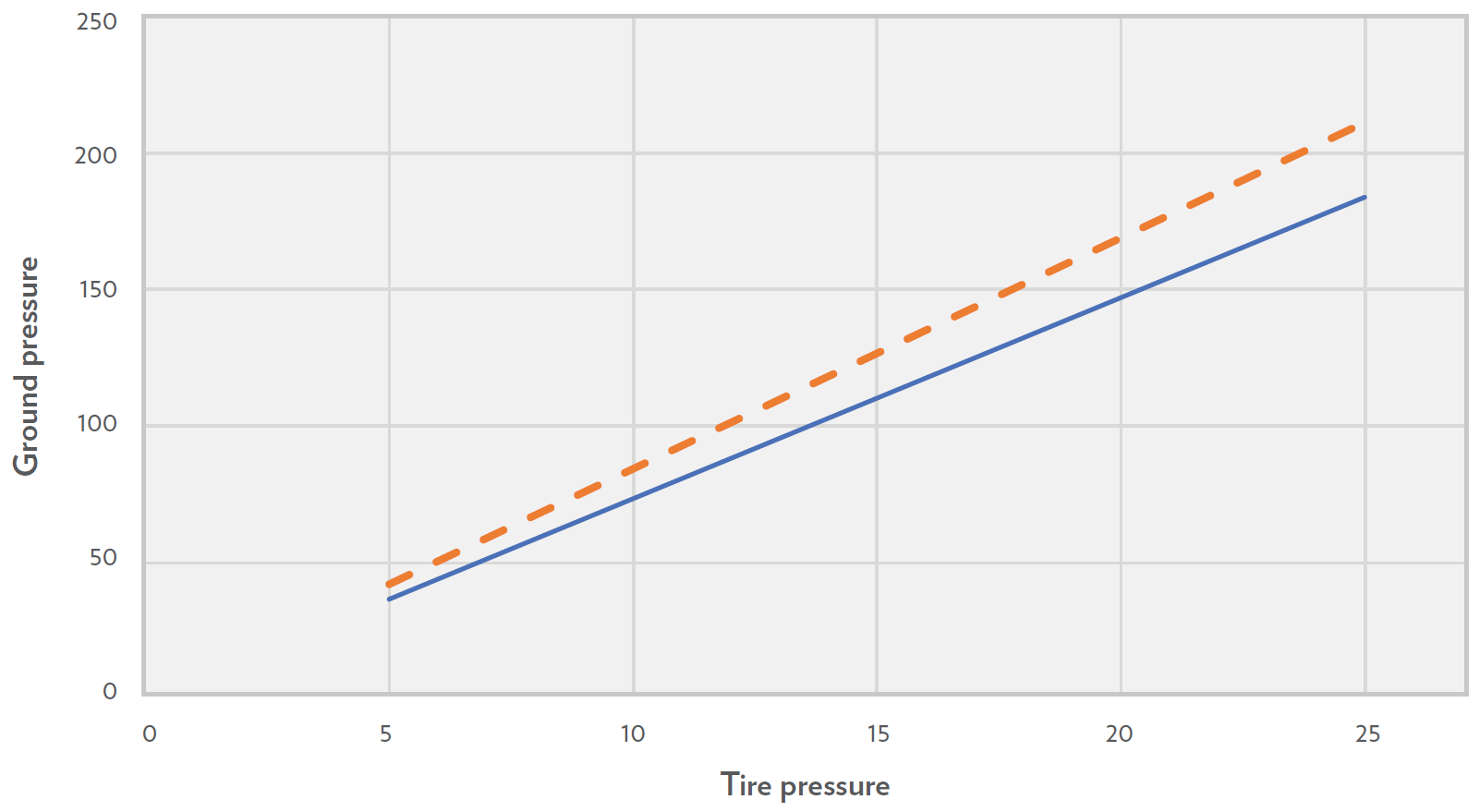
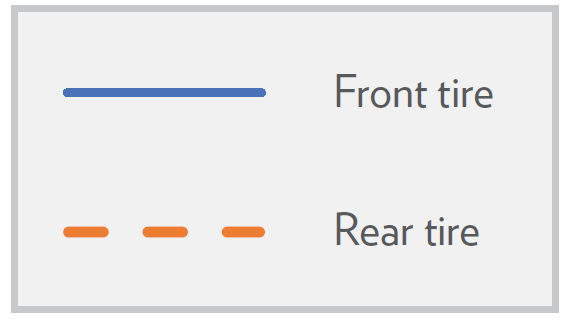
Table 2. The Slope or Rate at Which Ground Pressure Increases for Every Pound of Air Pressure Added to the Tires
| Vehicle | Tire Size | Slope (psi) |
|---|---|---|
| Tractor front | 80/85R30 | 7.35 |
| Tractor rear | 480/80R42 | 8.44 |
| Chopper duals | 520/85R42 | 8.13 |
| Chopper floats | 710/70R42 | 8.8 |
| Chopper rear | 600/65R28 | 7.22 |
| Swather drive | 580/70R26 | 7.44 |
| Swather caster | 16.5L/16.1 | 5.22 |
| Merger | 550/45R22.5 | 6.74 |
| Baler | 21.5×16.1 | 5.73 |
From these results it is easy to conclude that agricultural tires are designed for minimal ground disturbance, as compared to the road tires on semi- or box trucks. The smaller tire size of road tires, both in diameter and width, give the tire a much smaller footprint to spread the load of the machine. Because the entire load is applied on a much smaller contact patch compared to the larger footprint than those of agricultural tires, the ground pressure is much higher. This is worsened
by the high tire pressures required in semi- and box trucks. Semi-trucks are
significantly more productive than other transport vehicles, while medium box trucks and tractor-towed carts are similar in terms of productivity, which is defined as the distance the mass of crop harvested is hauled over time (Harmon et al. 2018). This means that there is little difference between using a box truck or a tractor and silage cart in terms of productivity but, the much lower ground pressure of the tractor and silage cart can significantly decrease the impact to crop and soil compaction.
These calculations also support the importance of knowing and setting your tire pressure to a level that, traction is maintained in the field while the ground pressure is minimized. It is important to follow manufacturer’s guidelines for tire pressures as well as setting pressures lower for in-field use vs. road use for all equipment. The University of Wisconsin–Madison Division of Extension publication A3367, Soil Compaction: Causes, Concerns, and Cures, has details on compaction impacts to soil and crops, including some management guidelines. Some of these guidelines pertain to field drainage, tillage practices and proper vehicle setup to help minimize and mediate compaction.
Knowing ground pressure applied by your vehicles is good, but the next step is
measuring the actual soil compaction and remediating areas that are impacted as needed. In areas of suspected compaction, such as “in-field roads” or highly trafficked areas, instruments including cone penetrometers can be used to detect
compaction. A cone penetrometer is a tool that measures the force required to
push a standardized stainless steel cone through the soil (Wolkowski et al. 2008).
This provides pressures at different depths, which allows the user to create a soil
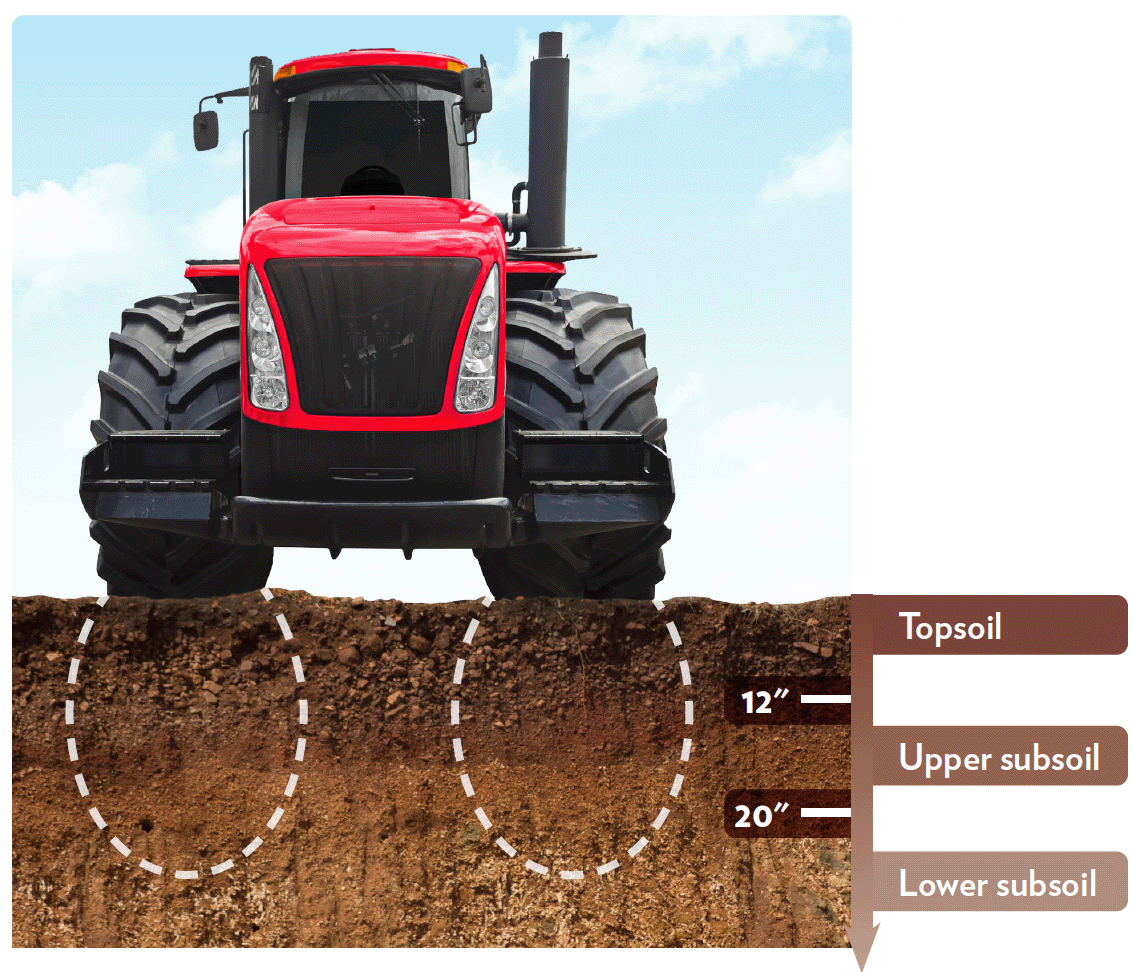
profile of compaction much like the image seen in figure 4, providing a determination of the depth at which the compaction is present. For farmers that do not have access to a penetrometer, you can measure compaction qualitatively by pushing or driving a rod or stake into an area that has not experienced any wheel traffic, like a fence line or edge of field, and then repeat this in a suspected compacted area. If the effort required is substantially greater, it means that area is likely compacted and may need to be addressed. Refer to University of Wisconsin–Madison Division of Extension publication A4144, Proper Use of Cone Penetrometers for Detecting Soil Compaction, for more information.
Figure 4. Profile of compaction effects underneath the soil
The compaction applies a ballooning effect and affects a wider area than just directly below the tire. Adapted from Duiker 2004.
Once areas of high traffic and confirmed soil compaction are found like field
entrances or infield roads, steps can be taken to lessen soil compaction. The
most common way to help reduce soil compaction is tillage. It is important to know the depth at which the compaction has occurred to select the right pieces of equipment to mediate that soil compaction. For deeply compacted soil (greater than 6 inches) some sort of deep tillage is recommended such as a ripper or other deep tillage tool (Tillage Equipment: Pocket Identification Guide 2010). Another good practice to help shallow compacted soil is to plant cover crops. Cover crops can help restore shallow compacted soils (less than 6 inches deep) by breaking up soils from the crop roots (Arriaga 2018).
Recommendations for Minimizing Wheel Traffic Impact
Harvesting forage crops has great potential to cause compaction and damage plants due to the machines used in the process and the high traffic requirements in the field. Some recommendations for minimizing the effect from wheel
traffic include:
- Avoid driving trucks or semis with road tires in production fields whenever possible.
- Utilize tractors, grain carts, and dump carts as much as possible and transfer the harvested crop to trucks at the edge of the field.
- Identify and maintain “in-field roads” during harvest and limit field travel to those locations as much as possible.
- Follow the tire manufacturer’s recommendations and specifications for tire inflation.
- Practice strategies that alleviate compaction, such as tillage over areas with soil compaction, and consider using cover crops to improve soil health and resistance to compaction.
References
Arriaga, F., B. Luck, and G. Siemering. 2018.
Managing Soil Compaction at Planting and Harvest (A4158).
Madison, WI: UW–Madison Division of Extension.
Arriaga, F. 2017. Proper Use of Cone Penetrometers
for Detecting Soil Compaction (A4144). Madison,
WI: UW–Madison Division of Extension.
Duiker, S. 2004. Avoiding Soil Compaction. Penn
State Extension. Retrieved March 26, 2020
Firestone Tire and Rubber Company. n.d. Tire Pressure Inflation Calculator. Retrieved January 15, 2020
Rechel, E., T. Novotny, and R. Ott. 2012. Lower Levels of Harvest Traffic on Alfalfa (Medicago sativa L.) Have Minimal Impact on Long-term Yields.
Wolkowski, R. and B. Lowery. 2008. Soil Compaction: Causes, Concerns, and Cures (A3367). Madison, WI: UW–Madison Division of Extension.
Šušnjar, M., D. Horvat, M. Zori, and Ž. Tomaši. 2011. Comparison of Real Axle Loads and Wheel Pressure of Truck Units for Wood Transportation with Legal Restrictions. 11.
Tillage Equipment: Pocket Identification Guide. 2010. NRCS.
Wiersma, D. W., and B. J. Holmes. 2000. Estimating the Weight of Forage in a Forage Wagon. 3(4): 2.
Madison, WI: UW–Madison Division of Extension.
Originally Published: 2020