Publication ID: A4158
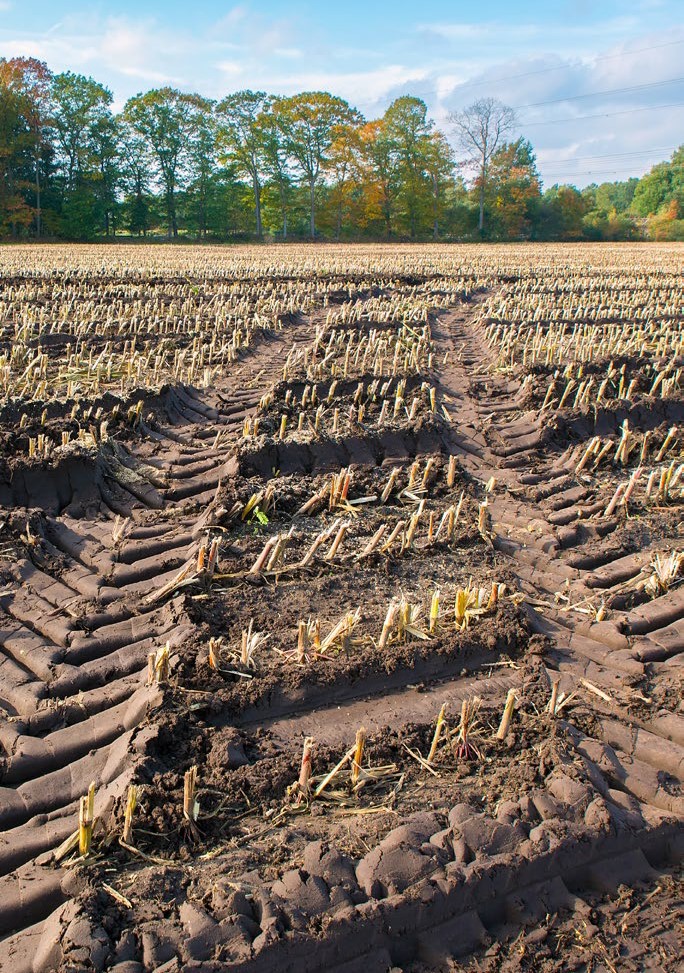
Soil compaction is the increase in soil density due to pressure being applied to moist or wet soils, typically from heavy vehicles. Compaction can happen any time of the year, but the risk during rainy planting and harvest months is often greater. There are some simple guidelines you can use to minimize soil compaction, figure out where exactly it has occurred, and determine how to fix it.
Key Facts
- When possible, wait for drier soil conditions before entering fields.
- Keep axle widths similar when purchasing equipment.
- Rutting may not indicate that deep tillage or subsoiling is needed.
- Cover crops can help remediate soil compaction.
- Reduce axles loads and lower equipment tire pressures.
- Manage equipment traffic patterns to minimize tire tracks.
- Compaction repair can take multiple growing seasons.
- Surface tillage alone may be sufficient to remove ruts and clay smearing.
Effects of Soil Compaction
Soil compaction reduces field productivity in many ways.
I had to plant/harvest while my fields were wet.
Are they compacted now?
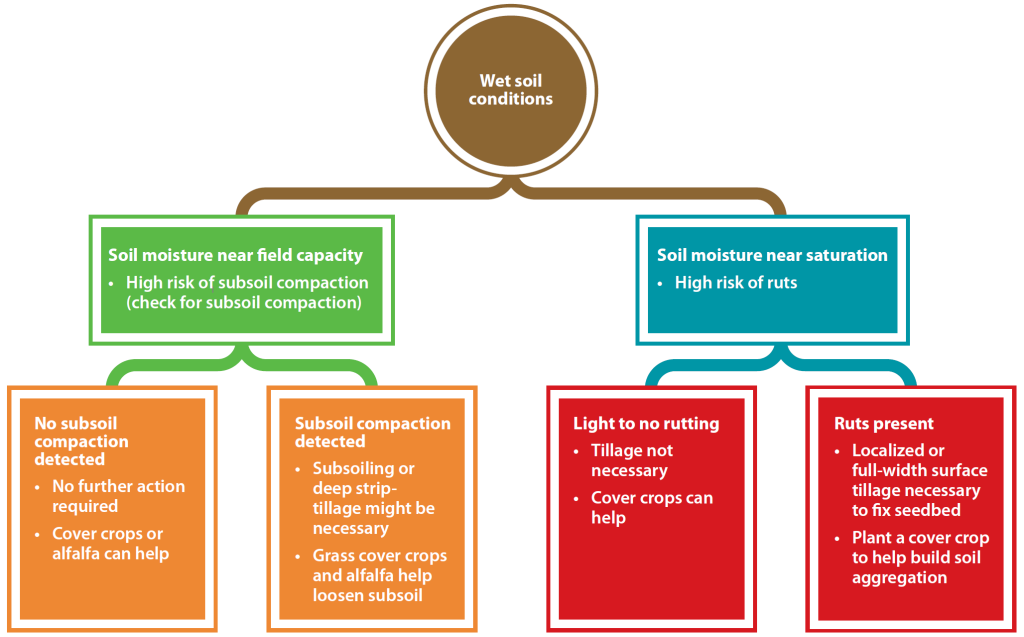
If you worked your fields while they were wet, there is a good chance your soils are compacted to some degree. However, the exact soil conditions when you worked your fields have a dramatic impact on the likelihood and type of soil compaction. Use the flowchart in figure 1 to help figure out if your soils are compacted and how they might be repaired. Most important in determining if compaction occurred is whether the field soil was saturated or at field capacity when worked.
Soil Water Content Effects on Compaction Potential
Field capacity is defined as the soil water content after the soil has been saturated and allowed to drain freely for about 24 to 48 hours. Soils are most susceptible to compaction when their water content is at or near field capacity because the proportion of soil pores filled with air and water is just right for compaction to occur. Soil well below its field capacity naturally contains tiny air pockets that work as shock absorbers and support heavy weight without the soil particles smashing together. Also, soil aggregates help dissipate loads when the soil is drier.
It seems counterintuitive, but soils that are fully saturated (i.e., their pores are completely filled with water) are less susceptible to soil compaction than those at field capacity. Since water cannot be compressed, a saturated soil can bear heavy equipment without compacting. However, soils at or near saturation are very prone to rutting and smearing near the surface.
Figure 1. Decision diagram for predicting soil compaction in fields worked while wet.
Detecting Soil Compaction
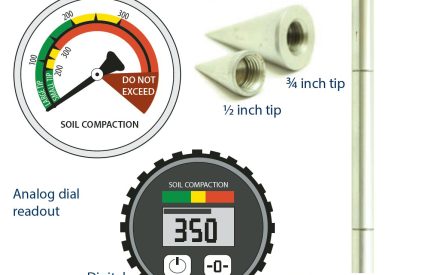
There are several ways to determine if your soils are compacted. These include looking closely at the side of a small soil pit dug in your field, using a hand probe, or using a cone penetrometer. A detailed explanation of how to measure soil compaction can be found in UW-Extension publication Soil Compaction: Causes, Concerns, and Cures (A3367). The penetrometer method will provide the most accurate results. UW-Extension has a YouTube video showing how to use a cone penetrometer (see Additional information). These instruments may be available for loan through your county Extension office.
The following are easily identified signs of soil compaction. It is probably worthwhile to conduct an in-depth investigation in the areas where these signs are seen.
On the soil surface
- Dense surface clods that don’t break down after rainfall or tillage
- Water ponding in tracks and headlands
- Wheel tracks with a smeared or glazed appearance
- Poor plant growth (e.g., reduced plant height) and stands
- Uneven plant growth or yields
- Plant leaf yellowing
Under the soil surface
- A hard zone of soil immediately below the depth of cultivation
- Hard clods that don’t break when squeezed by hand
- No structure to the soil
- Misshapen or shallow crop roots (“J-rooting” or pancake roots)
How to Prevent Compaction
Wait for Drier Conditions
The single most effective way to prevent compaction is to stay off wet fields for as long as possible. Soils are most susceptible to compaction 24 to 72 hours following a soaking rain, depending on soil type.
Manage Farm Traffic
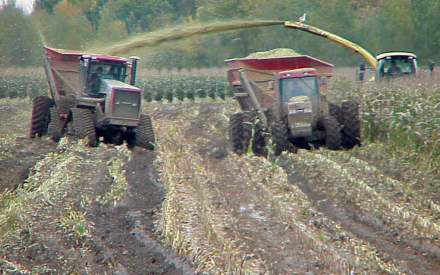
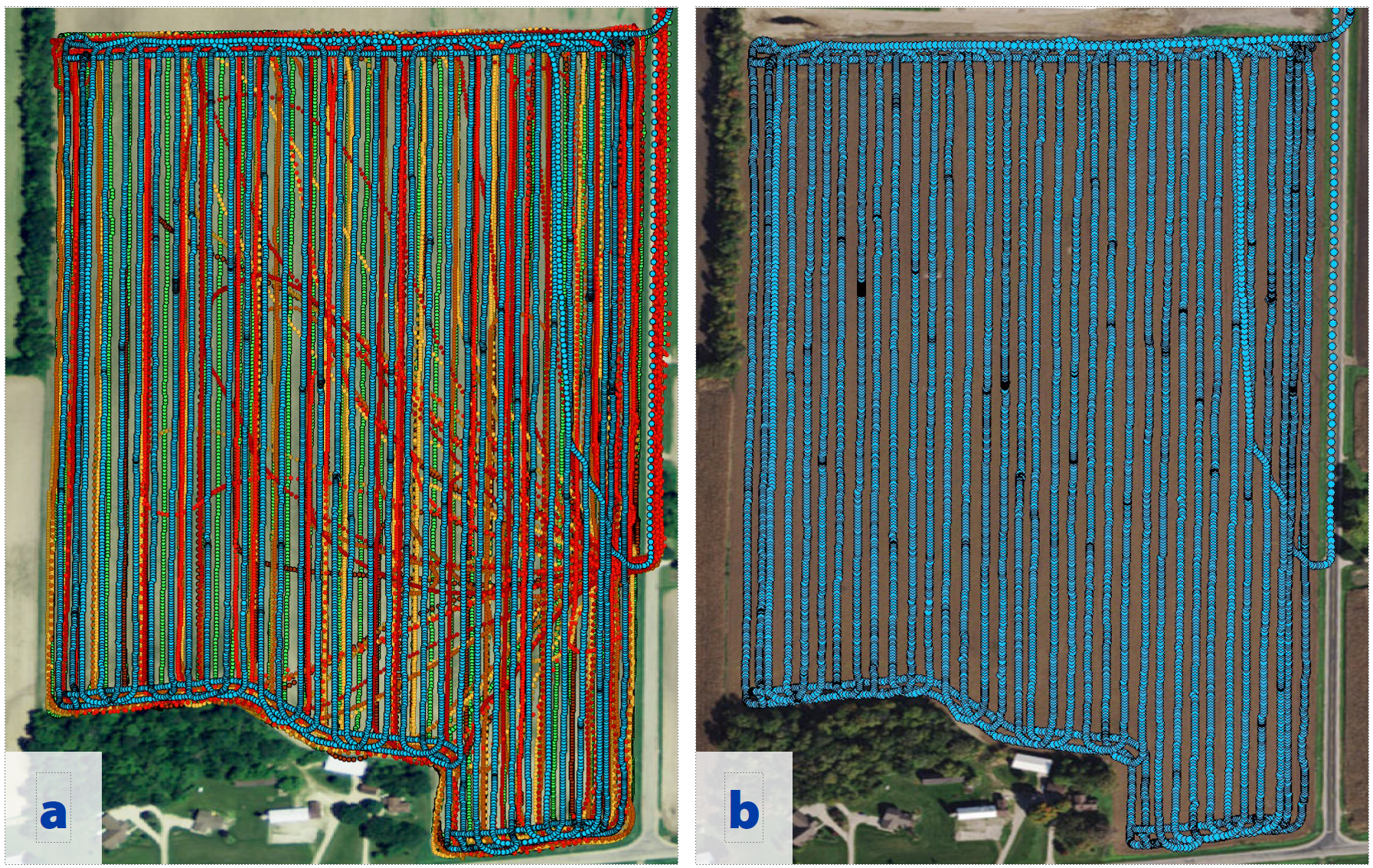
Repeating travel patterns between transport equipment and the harvester (i.e., driving in the same wheel track) can reduce the damage of operating on wet soils and will confine damage to specific and well-known locations in the field
(figure 2). Global Positioning System (GPS) guidance is helpful, but regular traffic patterns can also be achieved with some awareness and discipline on the part of the operator.
Optimize Vehicle Parameters
- Maintain tires at the tire manufacturer’s recommended pressure to spread the machine’s weight over a greater surface area.
- Attach dual wheels wherever possible.
- Use machines equipped with tracks to spread the machine’s weight over a greater surface area. Using machines with uniform wheel track spacing reduces the risk of soil compaction (figure 2).
- Consider carrying half or reduced loads out of the field.
- Use tractor-based transport equipment such as grain or dump carts within the field and load transport trucks (which have high-pressure tires) at the edge of the field.
Figure 2. Uncoordinated versus Coordinated Field Traffic
Part a shows an uncoordinated traffic pattern of two mergers, one forage harvester, and six transport trucks collected once per second during harvest. Part b shows the same field with a simulated traffic pattern where every machine follows in the path of the forage harvester.
Although the entire field is impacted by machinery in both scenarios, corrective measures would be needed only on tire ruts from managed traffic (b) rather than the entire field (a).
How to Restore Compacted Surface Soils
Light Tillage
If ruts are present, surface tillage is necessary to improve the seedbed for planting. Tillage can be localized only to rutted areas. The presence of ruts does not mean you definitively have compacted soil below the surface.
Cover Crops
If shallow compaction (less than 6” deep) is detected, planting a cover crop will help break apart the compacted soil and restore soil aggregation through natural root action. Fibrous-rooted cover crops (e.g., cereal rye) are more effective than tap-rooted cover crops (e.g., clover).
Freeze and Thaw
Winter freeze and thaw conditions may alleviate shallow compaction depending on soil type and other conditions. Compaction should be measured with
a penetrometer in the fall and spring to determine effectiveness.
How to Restore Compacted Subsurface Soils
Deep Tillage
If subsoil compaction (deeper than 6”) is detected, subsoiling or deep strip-tilling can be helpful. Deep tilling involves breaking up a hardpan using long shanks usually to a depth of 12” to 15”. This should only be done when the soil is at a moisture that allows the soil to crumble at the depth you are tilling. Till only to just below the compacted zone (2” to 3” below) as deeper tilling risks even deeper compaction and uses much more fuel. Deep tilling has shown yield benefits in sandy to clay loams but in finer textured soils the benefits may only be short-term due to recompaction.
Varying Tillage Depths
If a subsurface hardpan of soil has developed, tillage depth may be altered to break this up.
Tillage is not a permanent solution to address soil compaction. Identify practices that caused the compaction and modify as needed.
Restoration for No-till and Low-till Fields
If ruts must be repaired for seedbed planting, tillage in only the affected area is recommended. Soils in long-term no-till fields have a greater ability to recover from compaction than soils managed with conventional tillage. The higher organic matter content and aggregation normally found in no-till soils makes them more resistant to soil compaction and resilient in recovery. Research from Kentucky shows that surface compaction in a no-till field disappeared completely after two years of normal operations (Murdoch and James, 2008).
Additional Information
- View the YouTube video “Using a penetrometer to detect soil compaction”.
- UW-Extension publication Soil Compaction: Causes, Concerns, and Cures (A3367).
References
Murdoch, Lloyd W. and John James. Compaction, Tillage Method, and Subsoiling Effects on Crop Production (AGR-197). 2008. University of Kentucky Cooperative Extension Service.
Wolkowski, Richard, and Birl Lowery. Soil Compaction: Causes, Concerns, and Cures (A3367). 2008. University of Wisconsin-Extension.
Originally Published: 2018