Video Summary
Join Hannah Francis, a UW–Madison Ph.D. student in Dr. Matt Ruark’s nutrient cycling and agroecosystems lab, to follow the nitrogen journey of a cereal rye cover crop in Wisconsin corn silage systems.
This presentation shares Wisconsin-based research on how rye cover crops capture nitrogen from fall-applied manure, reduce nutrient losses, affect fertilizer needs, and contribute to long-term soil health. Learn how cover crops influence corn silage yield, nitrogen cycling, water quality, and soil nutrient storage in dairy and livestock cropping systems.
Transcript
0:05
Thanks, Chris.
0:06
Hi, everybody.
0:06
Thanks for popping on over your lunch break.
0:09
I’m Hannah, a PhD candidate with Dr. Matt Ruark, whose name came up quite a bit in Dane’s presentation.
0:16
And Dane’s presentation ended kind of where mine begins.
0:19
What happens after you terminate your rye cover crop?
0:23
And we’re going to think about this in the context of a corn silage system.
0:29
So the interest in my work in this work with a rye cover crop is Dane mentioned it has winter survivability and hardiness and it fits really well in our Wisconsin cropping systems.
0:43
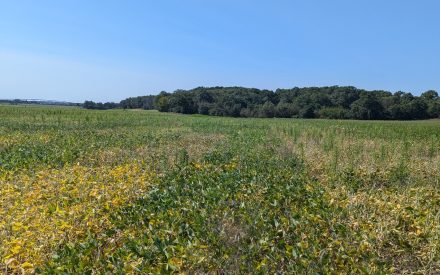
And the rye cover crop can come in at a time in in our dairy systems when our fields kind of look like this when they’re we’ve harvested our silage and our fields are bare.
0:56
And here our fields, our soil are vulnerable to erosion and potential nutrient losses.
1:04
But we can imagine when we have that cover crop in when we have a grass cover crop in like rye, this would protect our soil while retaining some nutrients and and like valuable nutrients like nitrogen.
1:19
After that crop harvest through the winter and continue growing in the spring.
1:24
And this is particularly in our fields where we applied apply manure.
1:30
So if we think about like the system where this fits in, we can think about like benefits and some costs.
1:36
We can think about this imagined future with our rye cover crop where we have our soil protected in between our growing seasons and when we apply manure.
1:45
Let me see, when we apply manure here and then we plant our rye and that’s taking up some of that extra, those extra nutrients in the system that would might otherwise be lost.
1:57
And when we plant our cover crop here and then we terminate it right before we plant our next corn crop.
2:03
And so we know as Dane mentioned, some of these water and soil quality benefits and improvement opportunities when we use this cover crop.
2:12
But maybe there are some trade-offs that we might perceive with production.
2:18
So for example, some past research to come out of the Ruark lab, this is before my time looked at production differences with and without a cover crop.
2:30
So you’ll see the no cover.
2:32
The no cover is this blue right here.
2:35
I know that’s not very like color blind friendly.
2:39
And then with the cover crop is this this black line right here and this is what we call a nutrient response curve.
2:47
This looks at different yields at different nitrogen fertilizer rates which are labeled down here and corn grain yield on the Y axis here.
2:55
So we see that that our yield with no cover crop is occurs at a lower nitrogen fertilizer rate than the maximum yield that we can achieve with the cover crop, which occurs at a higher nitrogen fertilizer rate, about 120 lbs per acre higher in this case.
3:17
And then we also don’t quite get the maximum yield that we’re able to achieve without a cover crop as we do with the cover crop in this case.
3:27
So this this perception that when we use a rye cover crop that there’s this kind of like risk to our maximum yield and that we have to balance out additional nitrogen in the system that we might, we have to add kind of substantially more nitrogen to the system to achieve our maximum yields.
3:45
This is in a corn grain system, but what happens in that silage system that we were talking about where this rye cover crop might work really well and where we have manure applied.
3:55
And I want to give everyone a little spoiler alert about where this presentation’s going to go based on my research, based on a few years of this and some exciting nitrogen tracing work that we’ll talk a little bit about at the end.
4:11
That’s kind of like the spiciest research that I have to share for you will be in the last several slides, but I need to tee up some of the context here for you.
4:21
But I want everyone to kind of walk away with from this presentation thinking about how well rye works in a corn silage system and that you should feel really good about planting rye ahead of your corn silage crop, especially if you’re using fall manure.
4:39
And so the first reason that this works really well is that in a corn silage system, often you’re applying manure to your fields anytime there.
4:47
Of the manure applied in Wisconsin, more than half of that is applied in the fall.
4:51
And manure contains a valuable nutrient, nitrogen.
4:55
And we want to keep that.
4:56
We don’t, both because there’s a pollution consequence downstream, it can pollute our waterways, but also because it’s a valuable nutrient and keeping it in our system means it can cycle through and be there for our future crops.
5:09
And so we want to keep that nitrogen from leaching.
5:13
And how do we keep it from leaving?
5:16
Well, we know based on many other studies besides just the ones that we’ve conducted in this state.
5:22
But when we look at people like this researcher Thapa and others, back in 2018, they took 28 studies all over the globe and they are all over the US.
5:32
And they compared the nitrate leaching with a cover crop versus a paired plot without a cover crop.
5:39
And they found that with grass cover crops, with using a cover crop, that nitrate leaching reduced by half.
5:48
So really they’re able to improve that water quality by reducing the nitrate leaching, which is great.
5:56
So we we can prevent losses, which is fantastic. Click. But and we talked about that as like a, a benefit to our water quality and our soil quality.
6:10
But now let’s talk about the yield implications.
6:13
What happens with our next silage crop?
6:16
What about some yield responses with silage?
6:19
And interestingly, we did not have nitrogen response trials for silage with a cover crop until, to my knowledge that have been published in the state until this work.
6:32
And so what we did this past year and the year before, but I’m going to focus on the past year’s work, is we set up some field trials at the Arlington Agricultural Research Station.
6:45
We applied manure in the fall, October 4th.
6:49
We applied at a rate of 10,000 gallons per acre.
6:54
This gave us an anticipated manure credit of 22 lbs of nitrogen.
6:57
It was a little low this year because of like some of the mixing in the pit.
7:02
And then we planted our cover crop a week after.
7:05
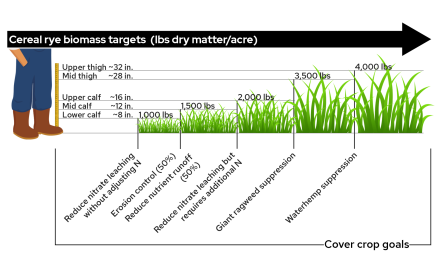
And then by the time we grew our rye and we were getting ready to harvest, we had accumulated about 2000 lbs of biomass.
7:13
That’s kind of right in the sweet spot that Dane talked about, which is like cool to see.
7:17
And based on the amount of nitrogen in that biomass, we, we can estimate that that rye took up about 75 lbs of nitrogen based on our measurements.
7:30
OK.
7:31
So we we planted our corn silage with or without our rye and then we also had plots with or without manure and this and then we fed the silage, corn silage 8 different nitrogen fertilizer rates and we ended up with nitrogen response curves for each treatment and each nitrogen response curve yielded different optimum nitrogen fertilizer rates.
7:54
So we have our optimum nitrogen fertilizer rate in pounds per acre with just manure, without manure and without a cover crop, with a cover crop and with manure and then with just a cover crop.
8:07
And so you’ll see our nitrogen response rates on the X axis.
8:10
The dashed lines correspond to where these optimum nitrogen fertilizer rates are for each treatment.
8:17
The blue lines are manured treatments with and without a cover crop.
8:21
The red lines are are treatments without manure, with and without a cover crop.
8:25
And these boxes on the top correspond to the silage yield at those optimum rates with and without manure and with and without a cover crop in tons per acre at 65% moisture.
8:40
So I want you to look at these curves and notice that some of them are curvier than others and some of them are a little flatter than others.
8:45
And we’ll come back to that story.
8:49
Let’s just break it out and talk a little bit about manure treatments.
8:54
So we have our treatment with manure and with manure and a cover crop.
9:00
And you’ll notice that despite our manure credit, so we have the same manure credit here, but with a cover crop we need a little bit more in our nitrogen.
9:10
We need about 40 lbs more nitrogen to achieve our optimum nitrogen fertilizer rate here.
9:18
And, but, but our silage yield is the same.
9:23
So even though we include our for cover crop, we’re retaining our maximum yield.
9:30
So we’re not seeing that same yield depression that we saw for corn.
9:33
And I’ve seen the same trend over a couple years of work so far.
9:36
And style of harvest is any day now for me for year 3.
9:39
So we’ll add even more food to that fodder or fire to that fodder.
9:46
So what this tells me is that when we’re adding manure, so when we have manure in our corn silage system and when we use a cover crop, manure is offering some of that risk of using a cover crop, which is great.
10:02
In this particular year, we did not see hugely curvy lines, which might indicate like big responses to applied nitrogen fertilizer or that our yields would increase dramatically with additional nitrogen fertilizer.
10:16
And this is because of some important field history, which you might want to think about for your own field if you’re deciding to incorporate a cover crop or not, and think about times when it might be riskier or not to include a cover crop.
10:29
So in this particular field, we had alfalfa 2 years ago in 2023.
10:35
Then we planted corn silage in 2024.
10:39
We had that fall manure applied in 2023.
10:44
And and so we had we’re thinking about some like potential manure and alfalfa, a leftover residual nitrogen in the system.
10:55
So when we think about like what could a second year alfalfa credit be, a lot of the research is showing that it’s about 50 lbs of nitrogen that we can expect from a second year alfalfa credit.
11:04
And this was corroborated or verified by high residual nitrogen in some of our fall soil tests.
11:13
And so without a cover crop in this field with high nitrogen, we did not see huge responses to nitrogen.
11:20
Some of those like response curves were relatively flat.
11:23
But with the cover crop, we’re seeing like a little bit of response to nitrogen.
11:27
So that’s where that we need to add additional nitrogen to reach our optimum yields comes in.
11:36
So we also know that based on the biomass we accumulated that our ride took up about 75 lbs of nitrogen.
11:45
But this difference isn’t quite reflected in the difference between our cover cropped and no cover cropped treatments.
11:54
So the differences that we’re seeing between our treatments with manure that have just manure and manure with a cover crop is about 40 lbs of nitrogen.
12:08
And then the difference is without manure and without a cover crop to just having a cover crop is again about, you know, 45 lbs of nitrogen.
12:16
And I think that we can explain a bit of what’s happening when we talk about this burning question that I’ve heard from a lot of people, a lot of farmers that I’ve talked to, a lot of extension people of like where does the nitrogen go after you terminate the rye?
12:34
So Dane sort of alluded to this thing of like, OK, adding if you accumulate 2000 lbs of rye biomass, you might have to adjust your nutrient management plan by about like 35 lbs of nitrogen.
12:46
And that doesn’t come from my research that comes from other field observations.
12:51
But I think some of this work that I’m about to show you might build on that and maybe like reinforce that for you.
12:58
So I’m going to walk through an interesting study that we did last year and we’re repeating it this year.
13:04
So we took some rye in our field and in that rye we labeled it with a specific chemical tracer, with a type of fertilizer that gave me a specific chemical signal.
13:21
And I labeled it in the weeks leading up to terminating it.
13:25
And we terminated it in the in the field.
13:29
And we had it in our plots with manure and without manure and with a cover crop and without a cover crop.
13:34
And so at the end I’m like taking soil samples throughout the growing season and I’m seeing like, can I see that chemical tracer in the soil and can I see it,
13:46
Can I see it in the next silage crop?
13:49
So we were able to recover like 77-80% of this, of this total accumulated 75 lbs of nitrogen.
13:59
So we have like 65 lbs of nitrogen that I was able to like collectively measure.
14:05
So this rye was planted as you saw in the past agronomic management slides and then killed, left to decompose in place.
14:14
It was terminated with an herbicide left to decompose in place.
14:17
And here’s what we found.
14:19
So we found that, OK, some of it, some of it stayed in this portion of the plant that we this portion of the soil organic matter pool that we think of as a particulate organic matter pool.
14:34
That’s where this like POM word comes from POM and that that’s a size of soil organic matter that’s a little larger.
14:43
It’s like not quite all the way broken down soil organic matter.
14:47
Sometimes we think of it in soil science as like a faster cycling pool that isn’t super stable, but that is really important for nutrient cycling.
14:58
So we found like, you know, 7 lbs of nitrogen per acre in this organic matter pool, which is cool Then OK, so it’s silage harvest time.
15:09
So I’m like hand harvesting silage with a machete and I bring it all out and I chop it up and then I dry it and do a lot of different steps to it to then learn that about 30% of it ended up in my silage biomass.
15:24
So we might think of that cereal rye nitrogen decomposing as not being immediately available.
15:30
And if you think of about all of the nitrogen that a corn silage plant might need to grow and to achieve its maximum yield, not a ton of nitrogen, it’s like 20 lbs of nitrogen maybe ended up 15 lbs of nitrogen ended up in the corn silage plant.
15:48
But to me, that’s still kind of cool.
15:49
Like some of that decomposing rye nitrogen from the rye is just going straight up into that next corn silage plant.
15:58
But the coolest part for me, and what I think kind of ties this story together is that when we looked at this chemical tracer in the soil and throughout the growing season, we found that you’re like, you know, this green, this green part is not all used up.
16:14
There’s still a big chunk missing.
16:16
Yeah, because the last bit of it, like 40% of this nitrogen from the cereal rye that we were able to trace ended up in this in the soil organic matter pool that we call MAM or the mineral associated organic matter pool.
16:32
We think of this pool as like a really important reservoir for nutrients in the soil.
16:38
This is a really important reservoir for retaining and cycling nitrogen.
16:43
We, there’s a lot of work about carbon in this pool too, but we think about this pool as being a hugely important nutrient resource and reservoir for future plants.
16:54
So if you think about maybe 40 percent, 40% plus like 9%, like 50% of of this maybe 75 lbs that we have to work with.
17:07
So that’s about that, you know, 35 or 40 lbs that was kind of missing for us that we needed to add to the system.
17:16
And So what I think this tells us is that while you’re not getting that nitrogen back right away from the from the rye cover crop, what it’s doing is it’s decomposing.
17:28
Some of it is going to your corn silage crop right away and but most of it is staying in the soil.
17:35
And that’s really important for building up your soil fertility, your long term soil health and for eventually cycling those nutrients out and back into your crops over time.
17:47
So let’s just go over what we talked about.
17:50
We kind of ran through some nutrient response curves for silage that showed us that when we have all manure, it is buffering some of the perceived risk that we have for yield when we use a rye cover crop.
18:05
And while rye reduces the manure nitrogen credit, as Dane mentioned, and as we’ve seen like we need to apply more nitrogen when we use rye to achieve the same yields.
18:17
We wish, we wish it would only take up like exactly the manure nitrogen that we applied or and that it wouldn’t also draw from the soil.
18:24
We wish kind of like that all of these things could be exact for us, but we’re working in this natural system.
18:29
Well, we wish this would be a case like, and we’re not getting it back right away.
18:33
We’re not getting that nitrogen back away from the cover crop.
18:37
The long the use of a cover crop does indeed.
18:40
Or what we’re seeing is that over the growing season, you’re building these long term soil nitrogen reserves that are cycled through and built up over time.
18:50
And to me that’s really exciting because it shows that the decision to use a cover crop is not only something that you can visually see with like erosion reduction or even some of the cool like phosphorus work too.
19:01
We’re also seeing like active building even within a growing season.
19:05
So I’m really excited about this work.
19:06
I’m repeating it this year and definitely have to share more with you all in the coming years.
19:13
Yeah, yeah, great job, Hannah.
19:17
I really, really enjoyed your presentation.
19:21
One question that that came in, I think you kind of hit it a little bit, but like what’s next for your research?
19:28
Is there were there additional questions that came up because of some of your findings that you’re moving forward with or is it keeping the same trial and just running it again if you want to shoot up some of that?
19:40
Thanks.
19:40
Thanks, Chris, and thanks to the question asker for that question.
19:44
Yeah.
19:44
I didn’t have enough time in this presentation to go into kind of the nitty gritty details of how we executed this in the field because we used isotopes, which are like a element that has like a slightly different weight and that’s like our chemical tracer.
20:00
But it can be a little tricky.
20:02
And so we’re only labeling or I’m only using that chemical tracer on above ground biomass in this study.
20:08
And so that left me wondering, well, what about roots?
20:11
There’s a lot of roots with cereal rye.
20:13
And So what happens with our roots?
20:14
And to understand what happens to the nitrogen in the roots, of which I think we can all we think about roots, they’re like pretty brown and they’re not.
20:24
Super juicy.
20:25
We might think like they have a higher C to N ratio, maybe a little more carbon than nitrogen.
20:30
So C to N, carbon to nitrogen.
20:33
So, but I was curious even if it’s only, you know, under 20% of the total nitrogen in the plant that that could still be quite a substantial amount of nitrogen over time.
20:43
So I was curious about, well, what happens to the nitrogen that are in the root?
20:47
So I’ve set up a greenhouse study to dive into that a little bit more.
20:52
It’s not under field conditions, but I had a little bit more control about how to label things, how to, like, do the chemical tracing there.
20:58
And I’m finishing up that study.
21:01
I’m just waiting for some results.
21:02
And as soon as I work them up, I will get back to you on that.
21:06
Yeah.
21:06
Love it.
21:07
So if this doesn’t get you excited about cover crops in Wisconsin, I don’t know what’s holding you back yet.
Badger Crop Connect
Timely Crop Updates for Wisconsin
Second and fourth Thursdays 12:30 – 1:30 p.m.
Live via Zoom