Manure is valuable but applying it accurately is tricky because it does not have a guaranteed analysis like commercial fertilizers. Sampling and testing will maximize the economic value of your manure. When is the best time to sample manure? Why is the best time to collect manure samples while you spread? Continue reading as we will explore scientific research for answers.
Why is Lab Testing Preferred Over Manure Book Values?
While book values provide an average estimate, based on thousands of manure samples, they do not accurately represent the nutrient levels in your farm’s manure. A lab test is more representative because manure nutrient levels differ based on factors unique to your farm. The animal factors include items like animal species, age, and feed. The managementfactors affecting manure include the type and amount of bedding, how the manure is managed, processed, stored, and spread.
By using manure lab testing, you can more accurately credit the nutrients you are spreading. This prevents under or over applying manure and wasting money on commercial fertilizer had you used book values. Learn more about The Economics of Manure Testing.
Why Sampling Manure During Spreading Improves Nutrient Accuracy
To help you get the most value out of your manure and avoid the risks of over or under application, research conducted across 16 Wisconsin dairy farms highlights the importance of agitation and precise sampling per farm source.1 In the study Farm #1 had nitrogen(N) values that ranged from 19 to 25 lbs/1000 gal, while Farm #9 had N values from 7 to 34 lbs/1000 gal. The study found that while agitation helps resuspend solids that settle at the bottom of storage. The nutrient content, especially phosphorus, can still vary significantly during application.
A Cornell University study across four New York dairy farms investigated exactly how nutrient levels can fluctuate during land application and what farmers can do to manage the variability.3 The study focused on dry matter (DM), nitrogen (N), phosphorus (P), and potassium (K) across different farms and storage types. Researchers discovered that manure composition changed significantly not only between different dairies but also between different storages on the same farm.
The Power of Agitation
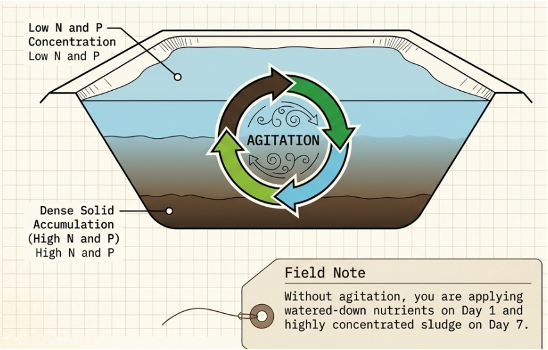
One of the most effective ways to manage manure variability is with agitation. Cornell research found that without agitation, manure solids (which have higher concentrations of N and P) settle at the bottom, leaving the upper liquid layers to have lower nutrient content. Manure agitation completed the day before and on the day of application resulted in more consistent P and K nutrient content. Potassium, being primarily found in the liquid fraction, stayed the most stable nutrient regardless of agitation. These results show the benefits of consistent agitation to ensure greater homogeneity over time as manure is spread.
What about averages? What does the research say?
Daniel Andersen of Iowa State University Extension looked at this within individual farms.2 They found there were very few statistical differences between:
- Using a single manure sample from the current year.
- Using the average of prior years from multiple manure samples per source.
- Across the five farms, phosphorus was better predicted using the site average.
Nitrogen? No difference.
Potassium? No consistent difference.
Why might phosphorus behave differently?
Phosphorus is attached to manure solids, and the manure solids are where variability shows up the most. Where and when in the pit you sample matters. Are you working with the liquid at the top or the solids at the bottom? The degree of agitation matters. Nitrogen, being largely dissolved, behaves more predictably. So yes, using prior averages can work. But here is the real question: Does that fit your management goal and how you are using the manure in your fertility program?
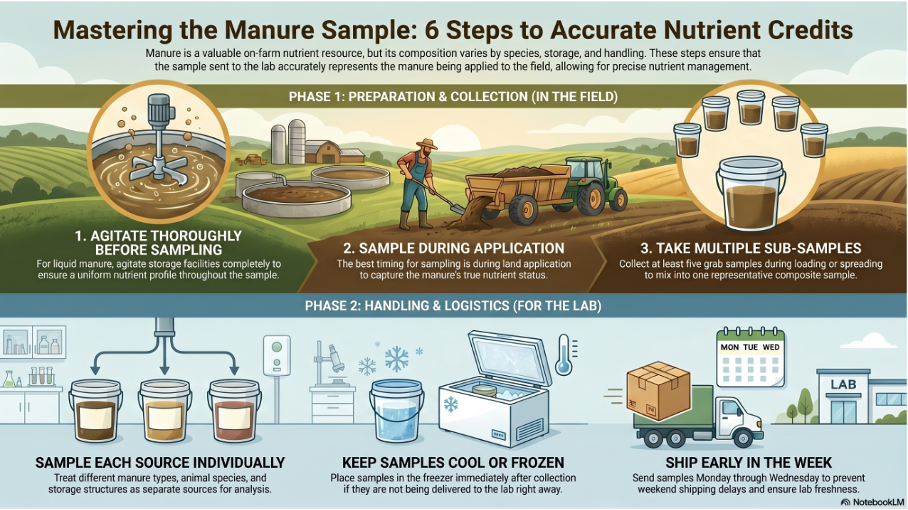
Figure 2 Description ↓
Figure 2. Titled “Mastering the Manure Sample: 6 Steps to Accurate Nutrient Credits,” this infographic is divided into two labeled phases: Phase 1: Preparation & Collection (In the Field), and Phase 2: Handling & Logistics (For the Lab).
There are three steps in phase one, preparation and collection: Agitate Thoroughly Before Sampling — For liquid manure, agitate storage facilities completely to ensure a uniform nutrient profile throughout the sample; Sample During Application — The best timing for sampling is during land application to capture the manure’s true nutrient status; and Take Multiple Sub-Samples — Collect at least five grab samples during loading or spreading to mix into one representative composite sample.
There are three steps in phase two, handling and logistics: Sample Each Source Individually — Treat different manure types, animal species, and storage structures as separate sources for analysis; Keep Samples Cool or Frozen — Place samples in the freezer immediately after collection if not delivering to the lab right away; and Ship Early in the Week — Send samples Monday through Wednesday to prevent weekend shipping delays and ensure lab freshness.
Each step is illustrated with a corresponding farm or lab scene. Created by NotebookLM.
What do these practices look like on the farm?
- Sample each manure source separately: Because nutrient levels change between lagoons or pits on the same farm. Never assume one test result applies to all the manure on your farm year after year especially if not using agitation.
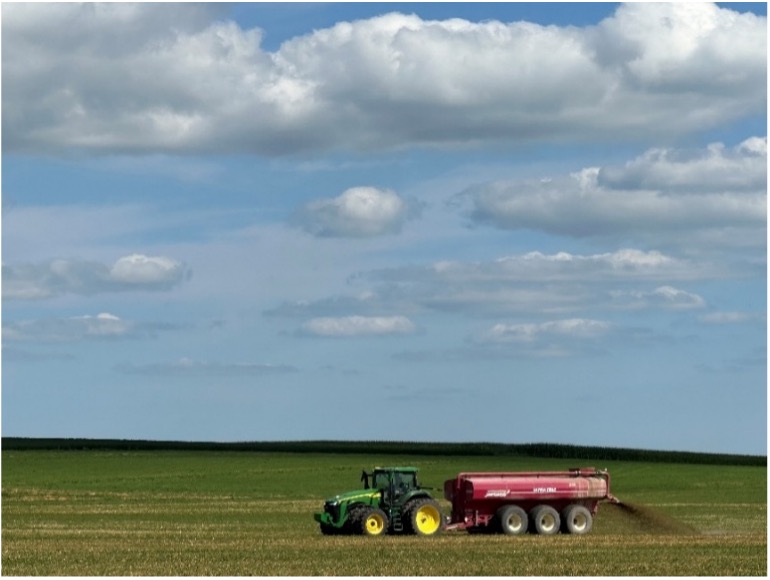
- Collect multiple samples during manure application: For the most representative results, collect samples directly from pumps or spreaders during application.
- Agitate consistently before you spread: ensure a more homogeneous mix and consistent nutrient levels agitating manure as much as possible prior to and during manure application. Recommendation is roughly 0.5 minutes per animal unit before you haul.
- Monitor dry matter: Be ready to sample again whenever you notice a notable change in the manure’s dry matter content or consistency. For open manure lagoons, have you received more or less rainfall/snow than average, check your nutrient levels.
- Keep record: Keep manure application records to track exactly where specific manure loads were spread so you can credit the nutrients and ensure you are not over or under applying based on crop need. Manure analysis results can be imported into SnapPlus V3. Once the results are uploaded, SnapPlus allows you to use a specific analysis for specific manure applications to help better account for the nutrients applied during that exact application. Additionally, if you have historical manure analysis SnapPlus V3 allows you to create an average analysis for each manure source to help with planning manure applications.
- Submit manure samples to a MAP certified laboratory.
It is not just about sampling manure. It is about reducing guesswork and using manure to meet crop need. It is about recognizing what is already on your farm, measuring it correctly. Then you can know what manure nutrients can be replaced with what you might otherwise buy.
References
- Aguirre-Villegas, Horacio & Sharara, Mahmoud & Larson, Rebecca. (2018). Nutrient Variability Following Dairy Manure Storage Agitation. Applied Engineering in Agriculture. 34. 908-917. 10.13031/aea.12796.
- Deep Dive: Manure Sampling (And What You’re Actually Trying to Do | Iowa State University Extension and Outreach Ag Engineering. Daniel Andersen, associate professor, Iowa State University, agricultural and biosystems engineering, dsa@iastate.edu
- Aidan Villanueva1, Carlos Irias1, Juan Carlos Ramos Tanchez1, Kirsten Workman1,2, Quirine Ketterings1 Manure Nutrient Variability During Land Application in Four New York Dairies.
Published: June 9, 2026
Reviewed by:
- Kevin Erb, outreach program manager, Natural Resources Institute, UW–Madison Extension
- Landon Baumgartner, soils outreach specialist, UW–Madison Extension
- Scott Reuss, regional crops educator, UW–Madison Extension
- Andrea Topper, DATCP
- Joe Sanford, assistant professor of soil and crop science, UW-Platteville