
Why should you test your soil for Nitrate?
Every field and every growing season is different, and determining if added nitrogen will pay off is hard to determine. In early to mid-June take time to collect samples for these two tests: Pre-sidedress nitrate test (PSNT) and early season tissue tests to help you determine how much nitrogen is in the soil and how much is already in the plant.
Pre-Sidedress Nitrate Testing (PSNT) can save you money by properly fertilizing for crop needs. For more PSNT advantages and disadvantages see A3630.
The concept of PSNT
The PSNT is based on the concept that early-season soil nitrate-N levels are proportional to the total amount of nitrogen that will be available over the growing season. This accounts for N that comes from soil organic matter and any recently applied or history of organic N sources (manure, forage legume residues). One of the reasons the PSNT sampling occurs in June is to quantify nitrate that has been produced from the mineralization of organic nitrogen as soil temperatures warm to 60-70°F degrees and soil biology is active.
Which fields should you test?
When deciding where to use the PSNT test, look to fields with large potential for N mineralization. Suggested fields on your farm to test include:
- Fields planted with corn
- Corn following corn
- Corn following alfalfa
- Corn following soybean
- Fields with a history of manure applications
- Fields with substantial carryover nitrogen from the previous growing season. (Ex. Had a lower yield due to drought previous year)
- Fields that included cover crops. Research has shown high biomass-producing cover crops may render some fall applied N unavailable during the following crops season.
The PSNT test does not work well in some cases:
- On sandy soils
- When average air temperature in May and June are 1°F degree or more below long-term average. (PSNT will underestimate N availability)
How and when to collect PSNT samples
Steps for collecting a PSNT sample
The proper time to collect PSNT samples includes:
- When your corn is 6-12 inches tall (V3 to V5) or
- 4-6 weeks after your planting date or
- In late May to early June, or
- 2 weeks before planned side-dress application of N
Take care not to sample too close to a leaching rainfall event. As a rule of thumb, you should wait 2 to 3 days after a significant rainfall event to collect samples.
1. Gather soil sampling supplies:
- Plastic bucket
- Soil sample bag(s),
- Lab form, soil probe.
2. Choose fields for sampling. Collect 1 composite sample per 20 acres.
3. For each composite sample, collect 15-20 soil cores to a depth of 12 inches, between rows in a representative area of field. Avoid previous fertilizer application bands, including starter and anhydrous ammonia bands.
4. Keep PSNT samples cool or frozen: to prevent the accumulation or depletion of nitrate in a soil sample before lab analysis avoid temperature fluctuations as prolonged hot temperatures can affect the accumulation of nitrate in soil samples, giving an inaccurate reading.
Additional PSNT Considerations
- The PSNT is most accurate during “typical” growing seasons.
- The accuracy of the PSNT will be reduced in years that are very wet or dry. Here’s why:
- In growing seasons with prolonged wet and cool conditions, soil mineralization slows down and thus reducing the accuracy of the PSNT values. Keep this in mind when assessing results, as slowed mineralization could lead to lower-than-actual nitrate values.
- Wisconsin PSNT research shows soil nitrate will be underestimated, thus optimum nitrogen rates for corn may be overestimated. When average temperatures in May and June are normal or higher, the PSNT seldom overestimates crop N need.
- Tips for side dressing nitrogen in a dry year Considerations for Corn Sidedress Nitrogen Applications During Hot, Dry Conditions – Integrated Pest and Crop Management – UW–Madison (wisc.edu)
- Wisconsin research has shown that with below-average snow/rainfall significant amounts of nitrate can remain in the soil to be used by crops in the following season.
- Another point to remember is that the test only finds nitrate, so it will not accurately measure any fertilizer already applied or available N from a manure application which may be in the ammonium form.
Interpreting PSNT results
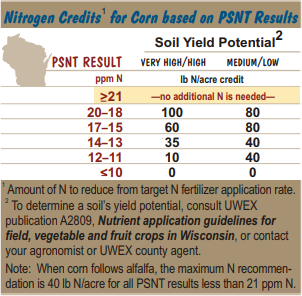
In Wisconsin, the PSNT recommendation is based on the soil yield potential of your sample.
The critical level is a PSNT result over 21 ppm nitrate-N means no additional N is needed. See the chart at right for a breakdown of PSNT nitrogen recommendations or refer to A2809 Table 6.6 (5) When interpreting PSNT use management history and knowledge of the field sampled to decide how much fertilizer to apply.
Conclusion
Results of a PSNT test provide more accurate N fertilizer recommendations for corn in Wisconsin, especially when manure is used. The PSNT can identify situations where additional yield response is or is not expected following sidedress applications of N fertilizer, allowing farmers to manage N fertilizer more profitably and reduce the risk of nitrate leaching to groundwaters from over-fertilization.
Resources
Nutrient Application Guidelines for Field, Vegetable, and Fruit Crops in Wisconsin (A2809)
Nitrogen Management of Sandy Soils (UWEX A3634)
Nitrogen and Nitrogen Management
Nitrogen Management – Rates and Economics
Post Emergence N Applications to Corn
More detailed info on the difference of PSNT and Pre Plant Nitrate Test (PPNT), can be reviewed in this IPM NMP resource https://ipcm.wisc.edu/wp-content/uploads/sites/54/2022/11/UWSoilNitrateTests_final.pdf