Publication ID: A4191
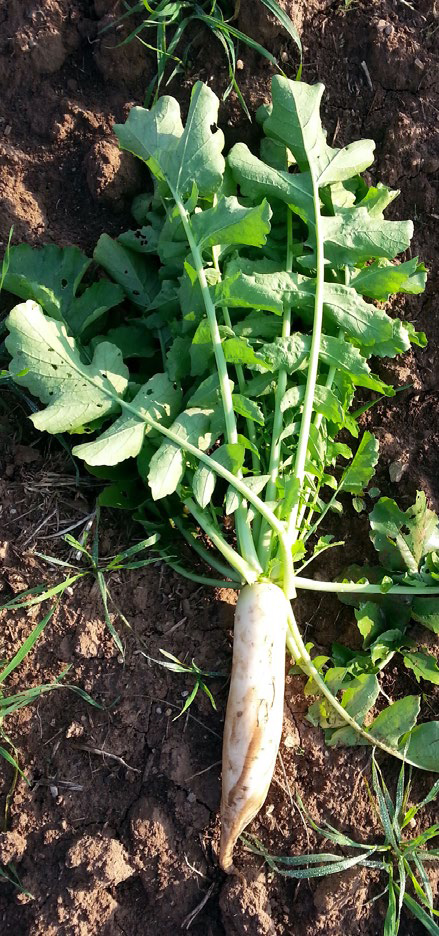
Radish (Raphanus sativus L.), which is in the Brassicaceae family (often referred to as brassicas), is a popular cover crop that can be planted in summer months (Figure 1). Radishes sold as a cover crop are usually daikon-type oilseed or forage radishes (Gruver et al. 2019). Daikon cultivars are typically larger-rooted than standard oilseed cultivars (Gruver et al. 2019). Radish is often sold under various trademarked names, or may be sold as forage radish when promoted for grazing. Here we use cover crop radish as an all-encompassing term to represent all radish used in this capacity.
Radish cover crops are promoted to have multiple benefits. It is considered to be an excellent nitrogen scavenger and can provide great coverage for erosion control, although the overall benefits to crop production have not been widely tested. The objective of this publication is to provide an overview of management recommendations for radish cover crops and to recap research that demonstrates potential benefits.
Management of Cover Crop Radish
Seeding Windows and Rates
Radish grows best when planted following harvest of short-season crops such as winter wheat, snap beans, peas, or other vegetables. Planting should occur by August 20th in southern Wisconsin and August 15th in northern Wisconsin to ensure good establishment. Planting after September 1st usually does not result in sufficient plant biomass. Radish can tolerate temperatures down to 20°F for several days, but will ultimately die off during winter in Wisconsin. Most of the radish sold as cover crops have been selected for large taproot growth, which can grow 2 or more inches in diameter and more than a foot in length with adequate growing degree-days and soil fertility.
Radish should be drilled to a depth of one-quarter to one-half inch, or broadcast and incorporated with light tillage. However, we recommend planting in a no-till system. Seeding rate for drill seeding is 10–12 lb/ac, and should be increased by 10% when broadcast seeding. Limited work with seeding density of radish has occurred, although research conducted in Michigan found that seeding rates of 10, 15, and 20 pounds per acre all produced similar amounts of biomass, but lower seeding rates resulted in larger individual plants producing larger tap roots (Ngouajio and Mutch 2004). The radish seed is relatively small, with 34,000 seeds in one pound of seed. Radish is often established with the addition of supplemental N. While growth of radish can be enhanced with additional nitrogen or manure applied at a rate of 30–50 lb/ac, we would not recommend this management practice, unless nitrogen is known to be severely deficient.
Growth and Development
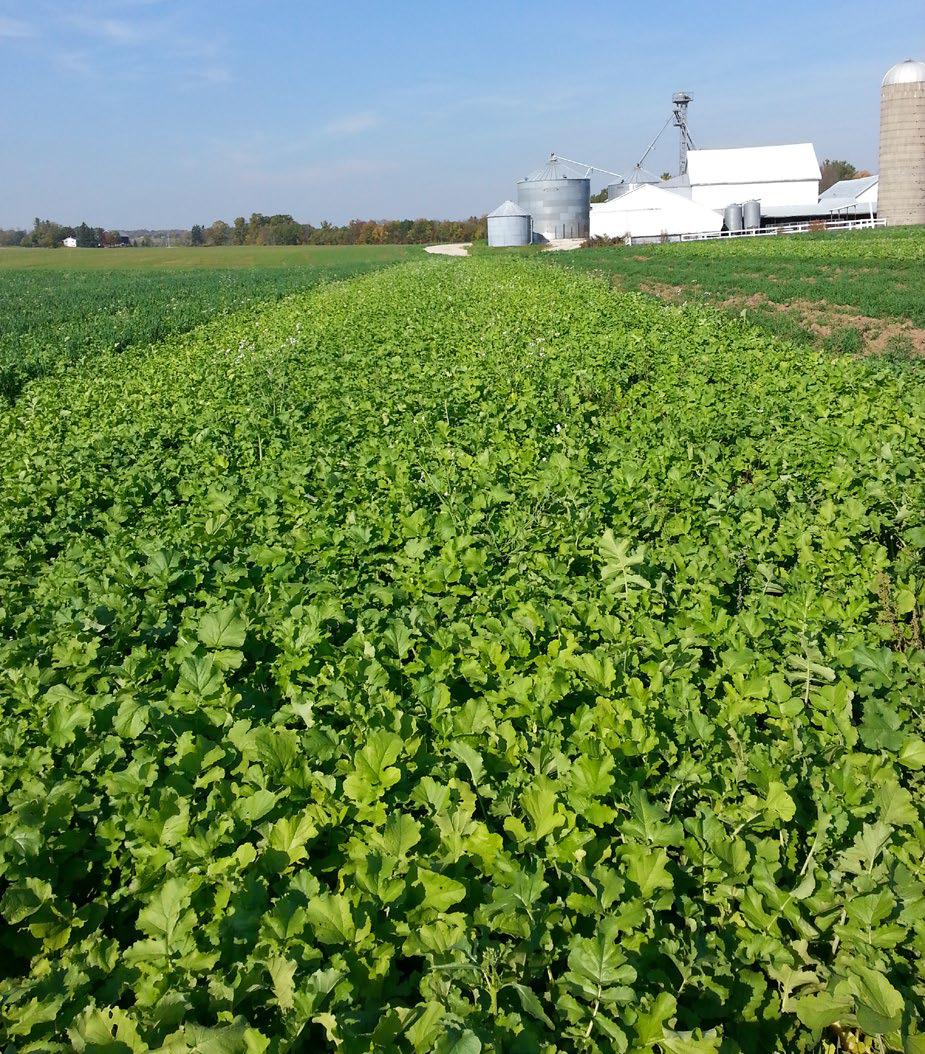
Previous research in the Midwest has shown radish growth and N uptake can be quite large (Lacey and Armstrong 2015; Gieske et al. 2016). In on-farm research trials in Wisconsin, radish growth and N uptake ranged from large amounts (180 lb-N/ac in figure 2 and 110 lb-N/ac in figure 3) to very small amounts (17 lb-N/ ac) based on the year (table 1). The low biomass effects can be attributed to poor soil moisture and low soil fertility. Radish is very sensitive to dry conditions. About 50% of the total biomass of the radish is the large tap root and about 40% of the total N in the plant is stored in the tap root. The C:N ratio of the total plant are at levels that would indicate net mineralization of N would occur (i.e., there would be release of N into the soil during decomposition), although the C:N ratio of the aboveground biomass is less than that of the tap root (Table 1).
Table 1. Radish dry matter biomass and N uptake (total and percent as tap root) and C:N ratios of total biomass, aboveground biomass, and tap root.
Radish was planted in mid to late August at all sites following winter wheat harvest and sampled in late fall prior to freezing temperatures.
| Year WI County | Total Dry Matter Biomass (lb/ac) | Biomass in tap root (%) | Total N uptake (lb-N/ac) | Percent of N in tap root (%) | C:N entire plant | C:N ABG | C:N tap root |
|---|---|---|---|---|---|---|---|
| 2011 Rock | 5,357 | nm | 180 | nm | 12 | nm | nm |
| 2012 Rock | 1,536 | 47 | 38 | 43 | 15 | 14 | 18 |
| 2013 Rock | 420 | 42 | 18 | 32 | 10 | 9 | 12 |
| 2012 Sheboygan | 6,161 | 53 | 121 | 42 | 19 | 14 | 25 |
| 2013 Sheboygan | 4,484 | 47 | 110 | 42 | 19 | 16 | 22 |
| 2012 Washington | 2,375 | 56 | 48 | 43 | 19 | 13 | 25 |
| 2013 Washington | 5,571 | 47 | 124 | 42 | 17 | 15 | 20 |
| Average | 3,753 | 49 | 76 | 41 | 17 | 14 | 20 |
| CV (%) | 60 | 10 | 76 | 11 | 23 | 18 | 25 |
Figure 2. Field Strip of Radish in Rock County on November 3, 2011 that contains 180 lb-N/ac in total biomass.
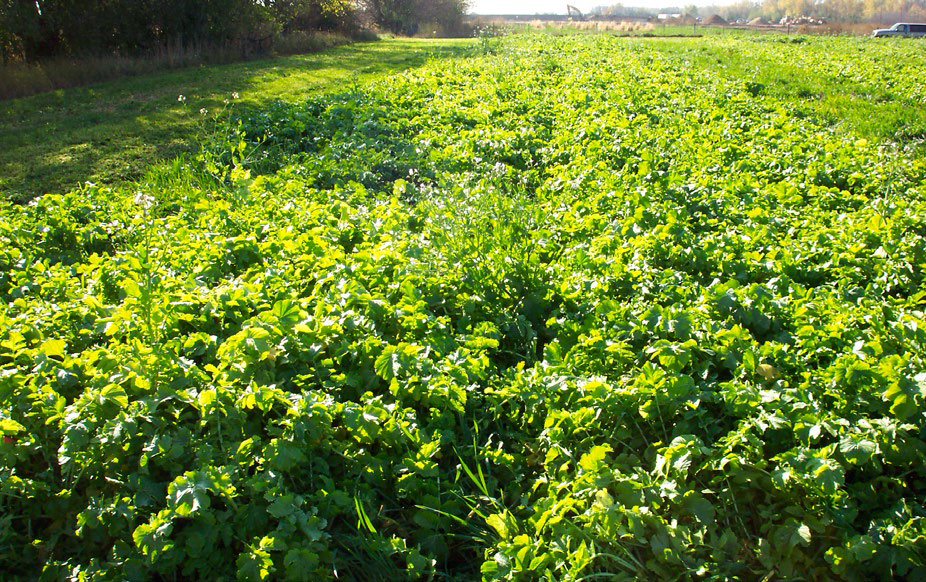
Figure 3. Field strip of radish in Sheboygan County on October 11, 2013 that contains 110 lb-N/ac in total biomass.
No Clear Yield Benefits From Radish
Radish as a cover crop has been well studied with respect to how it affects
the next crop in rotation, with positive, negative, and neutral effects being reported (summarized in Ruark et al. 2018). In this study, corn yields were measured following either radish as a cover crop or no cover crop, where the previous crop was winter wheat. Corn was no-till planted across both radish and no-radish plots at Rock and Washington County, but the no-radish plots were chisel-plowed prior to corn planting at Sheboygan County. Six to eight N rates were applied after corn was planted. There were two instances where corn yields were decreased following radish and two instances where corn yields were increased, with the remaining site-years having little to no effect. However, both instances of yield reduction occurred at Sheboygan, which could be attributed to the fact that corn following radish was no-tilled and corn following no cover crop was chisel plowed. This would suggest that radish does not effectively simulate tillage on heavier textured soils. A similar experiment in Michigan also determined neutral to negative effects of radish on corn yield (Rutan and Steinke 2019). There does not appear to be much, if any, of a corn yield benefit to using radish as a solo cover crop in the Midwest.
Radish and Nitrogen
Across all nine site-years of research in Wisconsin, the majority of the studies showed no effect at all on the optimal N requirement (Ruark et al. 2018). Since a substantial amount of N exists in the radish plant immediately before winter kill (40-120 lb/ac), this would indicate that this N is not being provided to the corn crop. In these cases, it would indicate that the N that was taken up was either immobilized (i.e., soil bacteria consumed the nitrogen) or more likely, leached out of the root zone prior to peak N uptake period of the corn. Based on the C:N ratio of the radish, net immobilization is not likely. What is more likely, is that since radish is killed with freezing temperatures in the later fall, and has a relatively low C:N ratio, it will start to decompose quickly in the spring after snowmelt. There is a fair amount of N stored in the roots and upon decomposition, the nitrogen may get transported quickly down the “hole” left by the large radish tap root. This would lead to N being moved quickly out of the root zone early in the growing season.
This theory is also supported by the lack of detection of an increase in soil nitrate following radish as a cover crop. In our Wisconsin study, only one of the nine site-years showed an increase in soil nitrate in the upper 12 inches of soil at the time of planting or the time of sidedress application. However, in nearly all cases, growing a radish cover crop resulted in less plant-available N (nitrate + ammonium) in the late fall, which would suggest it functions well as a trap crop for nitrate. Unfortunately, if the N isn’t conserved in the soil system, it may still be leached out just at a different time. For this reason, we would not suggest growing radish as a stand-alone cover crop, but instead as a mixture with a grass cover crop. This may help retain some of the N in the radish biomass in the spring with a grass that survives the winter (e.g., winter rye), although some legumes that survive the winter may also be helpful (e.g., field pea). In addition, use of radish is also not recommended on sandy soils, as it has been noted that there is even less ability to retain the N early in the spring.
In studies outside the Midwest where corn yields increased following cover crops, the nature of the benefit has been attributed to changes in the physical condition of the soil and the potential for N supply. However, there appears to be little, if any evidence in our study that the N stored in radish biomass gets contributed to the next corn crop. In our Wisconsin study, when corn yield increases were observed following radish cover crop, more N fertilizer was required to achieve these higher yields. This would suggest that the benefit of radish came from something other than supplying nitrogen.
Soil Health and Pests
A perceived benefit from the tap root of radish is compaction alleviation. Certainly, radish can be more deeply rooted than other cover crops, with roots being easily grown down to 3 feet in typical growing seasons, and have been detected down below 5 ft in extreme cases (Kristensen and Thorup-Kristensen 2004). Research from Maryland did demonstrate that radish’s tap root can penetrate through compacted soil layers (Williams and Weil 2004). The radish rooting structure may provide more benefits in the vertical direction rather than the horizonal direction, creating channels in the soil, but not influencing the bulk soil as a fibrous root system would. Cover crops with a dense and fibrous rooting structure, such as annual ryegrass and winter rye, will help hold soil better than deep tap-rooted covers. This, in-turn, may help reduce erosion losses. We would not recommend radish as a stand-alone cover crop on highly erodible land, as there have been observations of enhanced erosion risk down the radish rows in the spring (Johnson and Stute 2011).
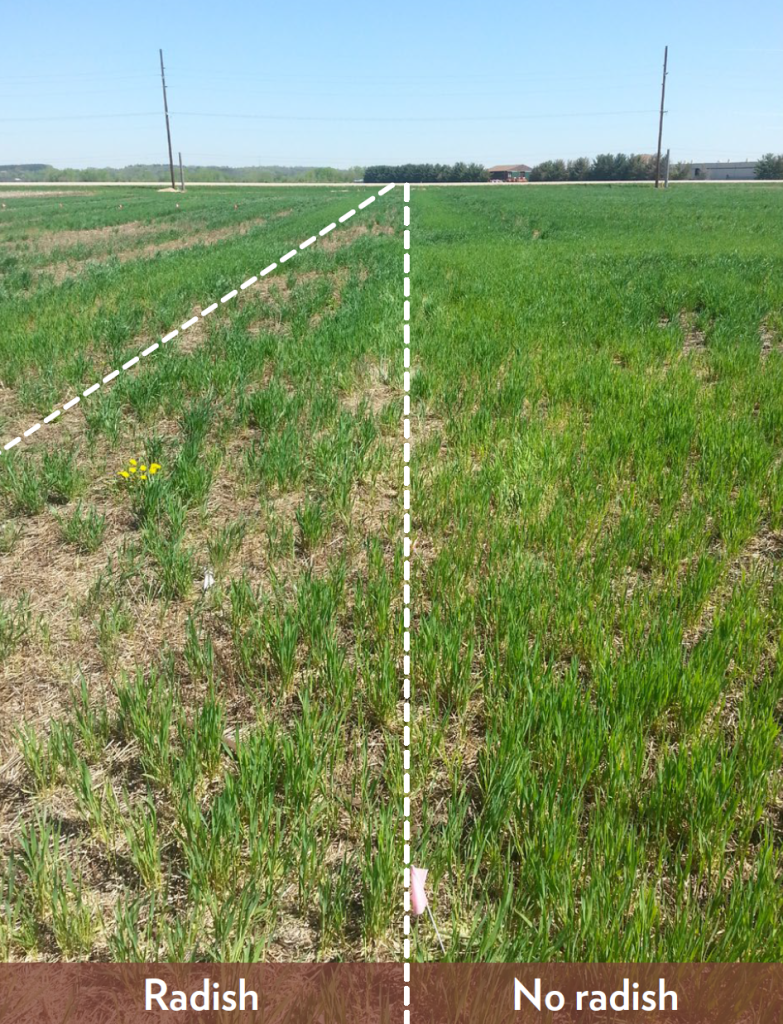
Weed suppression by a radish cover crop has been observed in field experiments as well as in farm fields (Smith et al. 2020). Research from Maryland has concluded that this effect is from rapid germination by the radish, which outcompetes and smothers the weeds, and not allelopathy (chemical inhibition) (Lawley et al. 2012). The canopy of a drill-seeded radish field can clearly smother out weeds when they are small. However, in our Wisconsin experiments, conducted under no-till conditions, we did note that there was plenty of regrowth of winter wheat, albeit less than in the no-cover-crop areas (Figure 4). Thus, radish alone does not necessarily alleviate the need for spraying fields for weed control.
Figure 4. Winter wheat regrowth in Rock County on May 13, 2013.
The field strip on the right is following no radish cover crop, and the field strip outlined on the left is following radish cover crop (which winter-killed).
Soil health has not been widely tested with radish directly, but long-term use of
cover crops can lead to increases in soil organic matter (Poeplau and Don 2015)
and soil health (Kim et al. 2020). Radish is a non-arbuscular mycorrhizal fungus (AMF, a beneficial soil fungus) associating plant. Radish will not help enhance colonization of AMF in the subsequent crop, nor will they suppress AMF growth. Radish produces glycosinolate compounds which break down into chemicals found in commercial fumigants. While there is potential for radish to function as a
biofumigant (Ngouajio and Mutch 2004), field trials are lacking to evaluate its
overall effectiveness. In addition, some radish cultivars can be a host for root-knot nematode, while others may help control these nematodes (Edwards and Ploeg 2014). Perhaps the biggest drawback to radish as a cover crop is the rotten egg odor that can occur during decomposition.
Conclusions and Recommendations
The results of this research show that a radish cover crop is a good scavenger of fall soil nitrogen. From an environmental perspective, the uptake of nitrogen in the fall by radish reduces the potential for nitrate nitrogen to make its way to the groundwater. However, the release of nitrogen from decomposing radish biomass was not available to a subsequent corn crop, as indicated by the corn yield. This study found that radish did not supply N to the next season’s crop as determined through N response curves (data not shown). Thus, the ultimate fate of the N that was taken up by the radish remains unknown. For this reason, we recommend using radish in a dual crop or mixture. We do not recommend fertilizing the radish cover crop since the N in the biomass likely does not get retained in the soil system and thus the application will not be economical. Instead, consider planting radish with grass cover crops that survive the winter (such as winter rye) to help trap the N released from the radish biomass. Adding radish to cover crop mixtures helps diversify cover crop systems beyond grass and legumes as well as diversifying the overall cropping system. If planted
in a mixture and during the summer, we recommend planting radish at a low rate (<3 lb/ac) to avoid smothering other cover crops. It is important to remember that soil improvement from cover crops will often take many years. Use cover crops consistently to see benefits to your soil; we recommend developing a long-term game plan to use cover crops at least every other year to obtain soil health benefits. Lastly, radish can serve as a high-quality forage crop for grazing animals, providing an additional value to certain farm operations.
Additional Resources
- Managing Cover Crops Profitably, 3rd Edition. Sustainable Agriculture and Research Education.
- Radish (Tillage, Groundhog, Nitro, Oilseed, or Forage Radish), UW-Madison Extension Crops and Soil Publication
References
Edwards, S., and A. Ploeg. 2014. “Evaluation of 31 potential biofumigant brassicaceous plants as hosts for three Meloidogyne species.“ J. Nematology 46:287–295.
Gieske, M.F., V.J. Ackroyd, D.G. Bass, D.R. Mutch, D.L. Wyse, and B.R. Durgan. 2016. “Brassica cover crop effects on nitrogen availability and oat and corn yield.” Agron. J. 108:151–161.
Gruver, J., R.R. Weil, C. White, and Y. Lawley. “Radishes—A new cover crop for
organic farming systems.” https://eorganic.org/node/4182.
Johnson, H., and J. Stute. 2011. “Use caution if planting oilseed radish on highly erodible soil types.” Wisconsin Crop Manager.
https://ipcm.wisc.edu/blog/2011/07/use-caution-if-planting-oilseed-radish-onhighly-erodible-soil-types.
Kim, N., M. Zabaloy, K. Guan, and M.B. Villamil. 2020. “Do cover crops benefit soil microbiome? A meta-analysis of current research.” Soil Biol. Biochem. 142:107–701.
Kristensen, H.L., and K. Thorup-Kristension. 2004.“Root growth and nitrate uptake of three different catch crops in deep soil layers.” Soil Sci. Soc. Am. J. 68:529–537.
Lacey, C., and S. Armstrong. 2015. “The efficacy of winter cover crops to stabilize soil inorganic nitrogen after fall-applied anhydrous ammonia.” J. Environ. Qual. 44:442–448.
Lawley, Y.E., J.R. Teasdale, and R.R. Weil. 2012. “The mechanism for weed
suppression by a forage radish cover crop.” Agron. J. 104:1–10.
Ngouajio, M., and D.R. Mutch. 2004. “Oilseed Radish: A New Cover Crop for
Michigan.” Bulletin E 2907. Michigan State University, East Lansing.
Poeplau, C., and A. Don. 2015. “Carbon sequestration in agricultural soils
via cultivation of cover crops—A meta-analysis.” Agric. Ecosyst. Environ. 200:33–41.
Ruark, M.D., M.M. Chawner, M.J. Ballweg, R.T. Proost, F.J. Arriaga, and J.K. Stute. 2018. “Does cover crop radish supply nitrogen to corn?” Agron. J. 110:1–10.
Rutan, J., and K. Steinke. 2019. “Corn nitrogen management following daikon
radish and forage oat cover crops.” Soil Sci. Soc. Am. J. 83:181–189.
Smith, R.G., N.D. Warren, and S. Cordeau. 2020. “Are cover crop mixtures better
at suppressing weeds than cover crop monocultures?” Weed Sci. 68:186–194.
Williams, S., and R. Weil. 2004. “Crop cover root channels may alleviate soil
compaction effects on soybean crop.” Soil Sci. Soc. Am. J. 68: 1403–1409.
Originally Published: 2021