Introduction
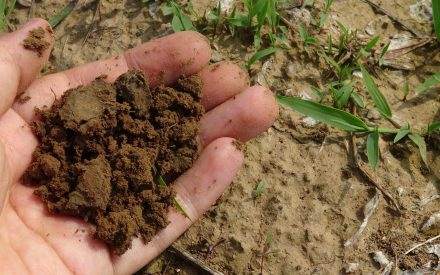
Stratification, or the unequal distribution of nutrients within the soil profile, has been well documented across Wisconsin, with the most concentrated nutrients existing within the upper 2” of soil in all fields. Having reduced or eliminated tillage on more acreage across Wisconsin in recent decades, it is worth considering what has happened to soil stratification over that time, especially when it comes to Phosphorus (P) and Potassium (K). First, let’s review a couple of factors that may contribute to stratification in reduced tillage settings.
P and K inputs are often surface applied, or at least within the first 2” of soil. When there is no mechanical mixing of inputs at deeper levels of the soil, the nutrients stratify, creating a very nutrient rich area near the surface which interacts with precipitation or meltwater. This can lead to increased risk of phosphorus loss in both the dissolved and particulate forms into nearby surface water, especially if soil is left uncovered.
What are the Agronomic Implications of Stratification?
The main topic I get regularly questioned on, and hope to share insight on as a nutrient management specialist with a soils background, is what we currently know about the agronomic implications of nutrient stratification. One of the recurring questions I receive most from farmers is whether nutrient stratification hurts crop production. Second, what actions should be taken to alleviate any potential negative impacts from stratification. If you are a crop advisor, you may have been presented with an identical question recently, or if a farmer, wondered about this yourself.
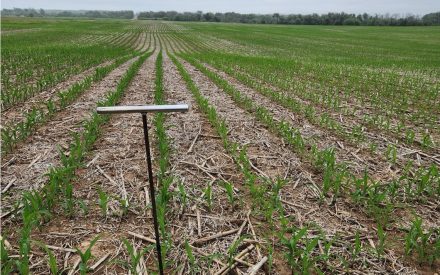
The conversation is usually aimed at getting to the bottom of one actionable question, “Should I till, at least occasionally, my no-till fields so I even out where my nutrients are located, providing my plants better access to them.” This is a valid question.
I prefer to first take this question and frame it through the lens of additional questions.
- No-till causes many changes to our soils, including but not limited to soil temperature, moisture, and structure, which cannot be isolated from stratification as a soil feature no-tillers have to consider. So how do we decide which factor to attribute crop performance to and affect change?
- If we have adequate soil tests for P and K, does nutrient stratification really mean we are struggling with those nutrients being available and taken up by the plant?
- Can we assume that tillage, whether it be deep or shallow, is going to solve the issue if nutrient stress is occurring?
- Is adding tillage to the system going to pay for itself AND have the pros outweigh the cons in my context?
What Does Research Reveal About Stratification?
Agronomically, the research that has been done to answer these questions is relatively consistent and encouraging. From Kansas to Ontario, from Kentucky to Iowa, spanning the 1980s, 1990s, and 2000s, university-based researchers have studied corn, soybean, wheat, and even sorghum responses to P and K applications across tillage history, fertilizer placement depth, and soil types. Even across all these variables in space and time, a few consistent themes have stood out when datasets were viewed broadly.
- Crop uptake of P and K often does not improve with tillage. In fact, no-till plots often had higher crop uptake of these macronutrients, or at least a higher return on investment of nutrient inputs.
- Deep banding phosphorus in the crop root-zone, typically 4-8” below the soil surface, to make nutrients more available in the crop root zone, consistently yielded lower or not well enough to offset the added costs of deep banding when compared with surface or shallow-placed fertilizers. Deep banding of potassium has shown more promise in providing yield benefits, albeit alongside higher application costs.
- No-till is likely to result in higher organic matter levels and microbial activity alongside the higher P levels at the soil surface, allowing organic-bound P to become more plant available.
Key Takeaways
Several factors could contribute to the consistency of these results across studies. First, plant roots are capable of proliferating in a soil profile wherever resources are plentiful, allowing plants to adapt and utilize nutrient dense layers where they exist, instead of the other way around. Another is that in our no-till systems, sufficient moisture is often maintained more consistently than tilled systems, allowing for better nutrient mobility, availability, and conditions for root systems to grow as actively as possible. Lastly, with less soil disturbance, mycorrhizal fungi increase, further enhancing a plant’s ability to scavenge nutrients throughout a soil profile wherever they may be located.
Nevertheless, increased phosphorus in shallower soil layers is worth paying attention to when it comes to guiding our water quality improvement decisions. That starts with consistent and adequate soil testing to avoid unnecessary P build-up, and to allow for sustainable P draw-down in soils with excessively high P. Based on the research that has been done, it appears the soil environment that long-term no-till creates, including moisture retention, increased soil biological activity, temperature moderation, and organic matter accumulation, provide many crop production benefits, even alongside potential exacerbation of the nutrient stratification process. This is not to say that in some years and in some soils altering fertilizer placement strategies or employing strip-till won’t pay off. Introducing full-width tillage to eliminate P and K stratification appears economically and agronomically unnecessary for Wisconsin no-till farms.
References
- Blevins, R. L., Grove, J. H., & Kitur, B. K. (1986). Nutrient uptake of corn grown using moldboard plow or no‐tillage soil management. Communications in Soil Science and Plant Analysis, 17(4), 401–417. https://doi.org/10.1080/00103628609367722
- Bordoli, J. M., & Mallarino, A. P. (1998). Deep and shallow banding of phosphorus and potassium as alternatives to broadcast fertilization for no-till corn. Agronomy Journal, 90(1), 27–33. https://doi.org/10.2134/agronj1998.00021962009000010006x
- Borges, R., & Mallarino, A. P. (2000). Grain yield, early growth, and nutrient uptake of no-till soybean as affected by phosphorus and potassium placement. Agronomy Journal, 92(2), 380–388. https://doi.org/10.2134/agronj2000.922380x
- Borges, R. and Mallarino, A.P. (2001). Deep Banding Phosphorus and Potassium Fertilizers for Corn Managed with Ridge Tillage. Soil Science Society of America Journal, 65(2): 376-384. https://doi.org/10.2136/sssaj2001.652376x
- Fernández, F. G., & White, C. (2012). No-till and strip-till corn production with broadcast and subsurface-band phosphorus and potassium. Agronomy Journal, 104(4), 996–1005. https://doi.org/10.2134/agronj2012.0064
- Hudak, C. M. (1987). An evaluation of K rate, placement, and tillage systems for soybean (Glycine max (L.) Merr.) (Master’s thesis, The Ohio State University).
- Vyn, T. J., Galic, D. M., & Janovicek, K. J. (2002). Corn response to potassium placement in conservation tillage. Soil & Tillage Research, 67(2), 159–169. https://doi.org/10.1016/S0167-1987(02)00061-2
- Kline, A. M. (2005). Corn responses to deep placement of phosphorus and potassium in high yield production systems (Master’s thesis, Purdue University)
- Pittelkow, C. M., Linquist, B. A., Lundy, M. E., Liang, X., van Groenigen, K. J., Lee, J., van Gestel, N., Six, J., Venterea, R. T., & van Kessel, C. (2015). When does no‑till yield more? A global meta‑analysis. Field Crops Research, 183, 156–168.
- Randall, G.W. and Hoeft, R.G. (1988). Placement Methods for Improved Efficiency of P and K Fertilizers: A Review.Journal of Production Agriculture, 1: 70-79.
https://doi.org/10.2134/jpa1988.0070 - Schwab, G. J., Whitney, D. A., Kilgore, G. L., & Sweeney, D. W. (2006). Tillage and phosphorus management effects on crop production in soils with phosphorus stratification. Agronomy Journal, 98, 430–435. https://doi.org/10.2134/agronj2005.0050
- University of Wisconsin Extension. (2025, July 2). The Zone of Interaction: Exploring phosphorus stratification with Kelsey Hyland and Laura Paletta [Video]. YouTube. https://www.youtube.com/watch?v=olk8O0t3WsQ
- Yin, X. and Vyn, T.J. (2002). Soybean Responses to Potassium Placement and Tillage Alternatives following No-Till. Agronomy Journal., 94: 1367-1374. https://doi.org/10.2134/agronj2002.1367
- Yin, X., & Vyn, T. J. (2004). Residual effects of potassium placement for conservation‑till corn on subsequent no‑till soybean. Soil & Tillage Research, 75(1), 151–159.
Published: April 8, 2026
Reviewed by:
• Chris Clark, soils outreach specialist, UW–Madison Extension
• Laura Paletta, agriculture water quality outreach specialist, UW–Madison Extension
• Stephen Hall, professor and agriculture water quality outreach specialist, UW–Madison Extension