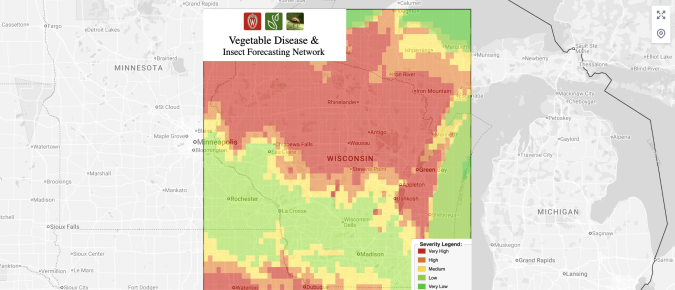
Managing vegetable pests and diseases can be a challenge, especially when patterns and outbreaks vary from year to year. The Vegetable Disease and Insect Forecasting Network (VDIFN) helps take the guesswork out of management by providing data-driven risk forecasts for your farm. This guide walks you through key concepts behind pest and disease models, VDIFN basics and navigation, step‑by‑step examples for insect pest and disease forecasting, and resources for integrated pest and disease management.
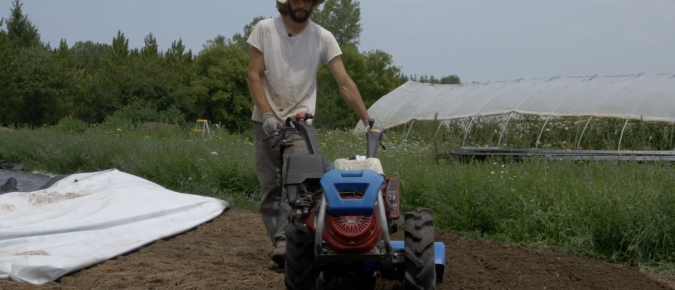
This video covers simple in‑field observations to assess soil structure, compaction, water movement, and soil life, along with practical management practices such as reduced tillage, cover crops, mulches, and soil cover to improve soil function over time.
Minimizing the risk of contamination through your irrigation systems is part of delivering a quality product. In this webinar, Kristin Krokowski shares about the importance of water quality, inspecting your irrigation system and the choices you can make on your farm to minimize risk whether or not you are subject to the FSMA produce safety rule.
Understand how to use soil and plant water use data to set up simple irrigation schedules for a system. In this webinar, Dr. Mallika Nocco (Assistant Professor and Extension Specialist in Agrohydrology) discusses how to use plant available water content and crop evapotranspiration to build schedules for irrigation management.
Understanding how water moves, stores, and is available for plant uptake in the soil is one of the first steps in crop water management. In this webinar, Dr. Izze Mcnamee (Extension Water Quality Specialist) discusses how to determine plant available water, monitor soil moisture, and apply these approaches in everyday irrigation management.
From drip tape and wobblers to hardening-off misters and seedling flood tables, irrigation design is always a custom job. So how do you (re)design your own? Join Tom Bryan for stories of success, regrets, and automation for 1-5 acre vegetable irrigation systems. Tom discusses his most recent farm project’s irrigation design, decisions he regrets, and […]
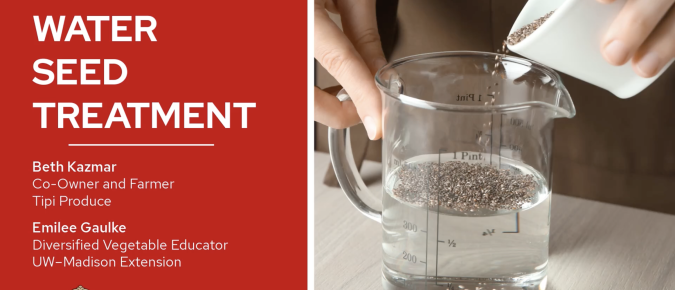
Disease prevention starts before we plant our first seeds of the season. In this webinar, learn more about hot water seed treatment and how this method can be used in combination with other integrated pest management (IPM) practices to reduce and prevent outbreaks of seed-borne diseases.
This article walks through the different parts of and considerations around calibrating and using a backpack sprayer in diversified vegetable systems.
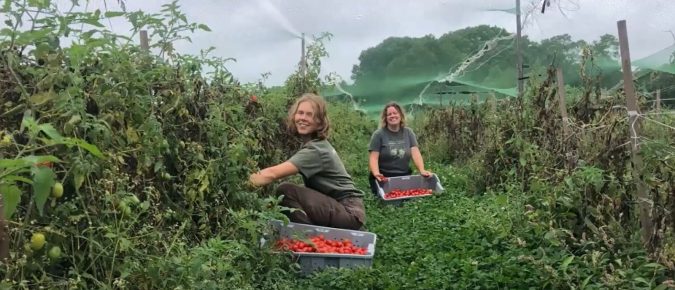
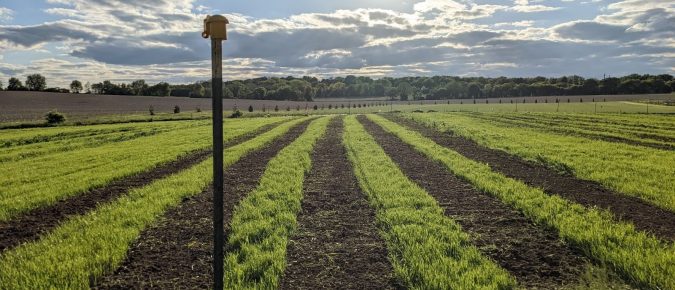
Most farmers are familiar with the benefits of cover crops: they reduce erosion, improve soil health, and help suppress weeds. Cover crops are often incorporated into fields as part of crop rotations, but they can also be planted in the aisles between cash crop beds, providing cover during a time of year when the soil is typically bare. These “living aisles” add additional advantages, such as reducing mud during rainy periods, allowing farmers to access beds when the ground is wet, and keeping harvest bins cleaner. Depending on the species used, living aisles may also be allowed to grow into beds after harvest to provide winter cover.
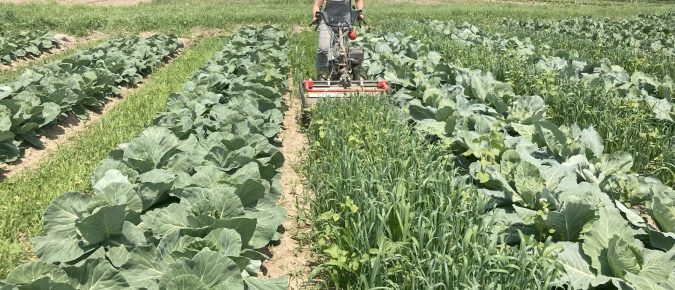
Most farmers are familiar with the benefits of cover crops: they reduce erosion, improve soil health, and help suppress weeds. Cover crops are often incorporated into fields as part of crop rotations, but they can also be planted in the aisles between cash crop beds, providing cover during a time of year when the soil is typically bare. These “living aisles” add additional advantages, such as reducing mud during rainy periods, allowing farmers to access beds when the ground is wet, and keeping harvest bins cleaner. Depending on the species used, living aisles may also be allowed to grow into beds after harvest to provide winter cover.
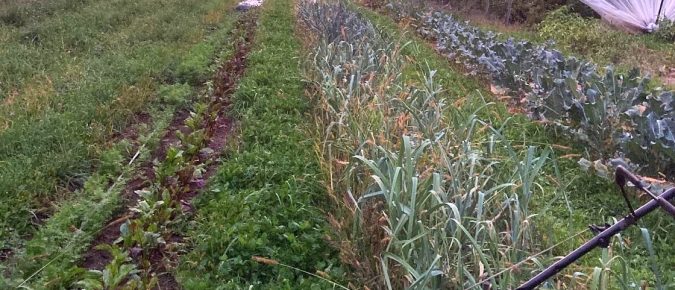
Most farmers are familiar with the benefits of cover crops: they reduce erosion, improve soil health, and help suppress weeds. Cover crops are often incorporated into fields as part of crop rotations, but they can also be planted in the aisles between cash crop beds, providing cover during a time of year when the soil is typically bare. These “living aisles” add additional advantages, such as reducing mud during rainy periods, allowing farmers to access beds when the ground is wet, and keeping harvest bins cleaner. Depending on the species used, living aisles may also be allowed to grow into beds after harvest to provide winter cover.
Most farmers are familiar with the benefits of cover crops: they reduce erosion, improve soil health, and help suppress weeds. Cover crops are often incorporated into fields as part of crop rotations, but they can also be planted in the aisles between cash crop beds, providing cover during a time of year when the soil is typically bare. These “living aisles” add additional advantages, such as reducing mud during rainy periods, allowing farmers to access beds when the ground is wet, and keeping harvest bins cleaner. Depending on the species used, living aisles may also be allowed to grow into beds after harvest to provide winter cover.