

Agenda
Wisconsin Water and Soil Health Conference
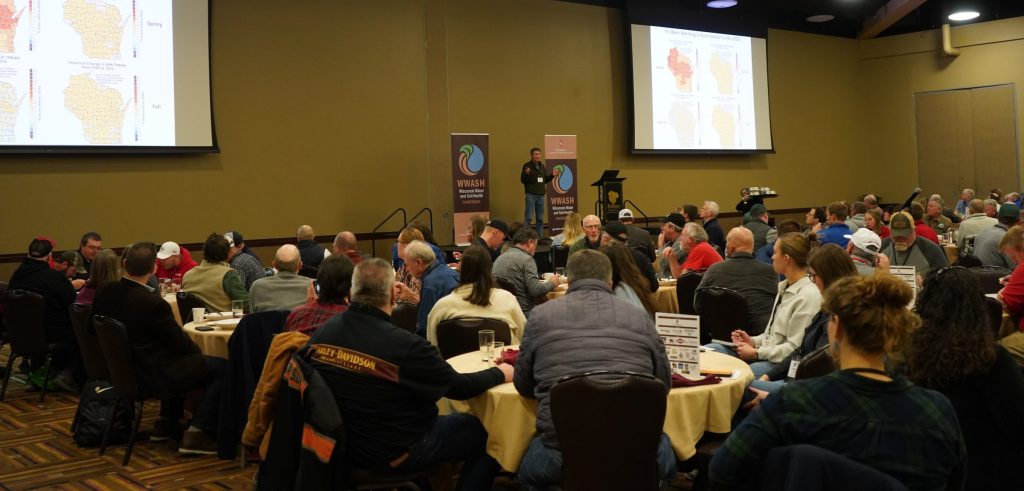
Explore the intersection of on-farm research, soil health, and water quality with other farmers and agriculture professionals through dynamic keynote speakers, interactive breakout sessions, and thought-provoking roundtable discussions.
2026 Conference Agenda
All sessions will be held in the Kilimanjaro Ballroom, unless otherwise noted.
Day 1: December 15
9:00 a.m.
Registration and welcome
Coffee and snacks provided.
9:45 – 10:45 a.m.
Innovation Panel
Moderator: Matt Oehmichen, Agronomist, Farm Manager, and Water Action Volunteer
View Full Details →
Resiliency through adaptation. This panel will highlight various strategies such as equipment modifications, adjusting fertility for water quality or soil management, precision conservation, and rain 360 to help your farm become more resilient to change.
11:00 a.m.
Breakout Sessions
Conservation Cropping and Crop Protection: Balancing Risk, Resilience, and Reality →
Do conservation practices increase pest and disease problems? The answer isn’t always straightforward. This session examines the realities of pest and pathogen management in conservation cropping systems. Speakers will share insights from long-term insect field scouting, crop disease research, and observations from Wisconsin farms and conservation networks. Attendees will gain practical Integrated Pest Management (IPM) strategies and a clearer understanding of pest and disease risks in conservation systems.
Speakers:
- Dr. Damon Smith, Vaughan-Bascom Professor, Plant Pathology, Extension Specialist, Field Crops Pathology, UW-Madison
- Dr. John Tooker, Professor of Entomology, State IPM Coordinator and Director of the PA IPM Program, Pennsylvania State University
- Matt Brugger, CCA/Agronomist, Tilth Agronomy and Project Manage, Green Bay West Shore Demonstration Farms Network
Room: 3
Is There a Place for Tillage in Soil Health Systems? →
Soil health systems are based on principles of minimizing soil disturbance and maximizing soil cover and living roots. These principles can be achieved through adopting practices such as cover crops and no-till. Despite the advantages of a soil health system, some farmers still use tillage to address problems such as slower spring soil warming, soil compaction, nutrient stratification, and controlling herbicide resistant weeds. The speakers will discuss physical changes of the soil when tillage is introduced, and when tillage is and isn’t beneficial in soil health systems.
Speakers:
- Brady Goettl, Extension Soil Fertility Specialist, North Dakota State University
- Steve Hoffman, President, InDepth Agronomy
Room: 4
Find Your Sweetheart: Cover Crop Speed Dating →
Whether you are just beginning to use cover crops in your rotation or a seasoned pro, choosing the right cover crop shouldn’t feel like a guessing game. Join us for an interactive session focused on how to select the best cover crop species and build effective mixes for your farm’s goals.
Speakers:
- Jamie Patton, Wisconsin State Agronomist, USDA NRCS
- Jim Stute, Stute Farms, East Troy, WI
Room: 6
Noon
Lunch
12:30 – 12:50 p.m.
Keynote (during lunch): 2026 – A Smorgasbord of Extreme Weather
Steve Vavrus, Director and State Climatologist, Wisconsin State Climatology Office
View Full Details →
It’s been a crazy year of weather in Wisconsin. Our state has experienced a laundry list of extreme events: exceptional cold and heat, a paralyzing blizzard, record wet and dry months in succession, and a round of unforgettable wildfire smoke. To top it off, the year is ending with a potentially record-breaking El Niño. Steve will recap the weather highlights of 2026 and reflect on how they do or don’t fit into long-term climate trends.
1:00 – 1:45 p.m.
Poster session – Innovation from producer led groups, county conservation, and demo farms
2:00 – 3:00 p.m.
Breakout Sessions
Innovation in Manure Management: Creativity Happening Between Barn and Field →
This session will focus on 3 different approaches Wisconsin farmers are taking to maximize efficiency in manure management systems. From composting bedded pack manure in the barn and/or in the windrow, to new technologies used to deliver liquid manure from pit to field, this session is for Wisconsin manure managers of all types. Hear about real world experiences from farmers who can speak to the pros and cons of their practice and challenges they’ve faced. Bring questions specific to your farm!
Speakers:
- Matthew Canter, Evensong Farm, Cashton, WI
- Jeff Endres, Endres Berryridge Farms, Waunakee, WI
Room: 3
Beyond the Forecast: What Tools Should I Have in my Climate Toolbox? →
We can assume farmers are familiar with near-term weather forecasts from the National Weather Service, local media, or smartphone apps. But, is that all there is in the “weather toolbox” when it comes to making on-farm decisions? In this session, we will present several ag-climate decision tools to help farmers make decisions that go “beyond the forecast.”
Speakers:
- Josh Bendorf, Climate Outreach Specialist, State Climatology Office, UW–Madison
- Kevin Koepsel, Wisconet Station Host and Dairy Farmer
Room: 4
Earning Your Wings With Drone Seeding Cover Crops →
Aerial seeding technology is evolving rapidly, offering a flexible way to establish cover crops early in standing crops. This session explores the practicalities and real world results of adopting cover crop as a conservation practice on a watershed scale. Learn when, where, and how drone seeding makes financial and agronomic sense on your farm.
Speakers:
- Jeramy Williams, Owner, American Drone
- Craig Ficenec, Senior Director – Agricultural Conservation, Sand County Foundation
Room: 6
3:15 – 4:15 p.m.
Keynote: Leveraging Natural Enemies in Conservation-Based Agricultural Systems to Control Insect and Slug Pests
John F. Tooker, Professor and Extension Specialist, Department of Entomology, Pennsylvania State University
View Full Details →
Insects and slugs pests can occasionally challenge crops in no-till systems, but these conservation-based systems have great potential to harbor populations of natural enemies that can help with pest control. Unfortunately, standard preventative pest management programs in corn and soybeans limit the potential for natural enemies to contribute to pest control. We will discuss how no-till, cover crops, and integrated pest management (IPM) can combine to build natural enemies populations that can help protect crops from insect and slug pests.
4:30 – 5:30 p.m.
Roundtables
View Full Details →
- Farm Succession Planning
Joy Kirkpatrick, Farm Succession Outreach Specialist, UW–Madison Extension - Camelina Production in Wisconsin
Anastasia Kurth and Sam Bibby, Regional Crops Educators, UW–Madison Extension - SnapPlus Version 3 in 2026 and Beyond
Hava Blair, Researcher, Soil and Environmental Sciences, UW–Madison - Maximizing Conservation Practices to Minimize Phosphorus Loss: Tailored Findings for Your Region and Cropping System
Steven Hall, Associate Professor, Department of Plant and Agroecosystem Sciences, UW-Madison - Updates on SlugNet and Predator/Prey Populations in Conservation Systems
Dane Elmquist, Conservation Cropping Outreach Specialist, UW–Madison Extension - Infiltration
Malika Nocco, Assistant Professor, Department of Biological Systems Engineering, UW–Madison - Nitrogen in Irrigation Water (Bring your own sample to test on the spot!)
Guolong Liang, Ag Water Outreach Specialist, UW–Madison Extension - Using Zero N Strips as a Tool on Your Farm
Megan Blauwet, Nitrogen Management Outreach Specialist, UW–Madison Extension - Soil Nutrient Availability: How Wisconsin Soil Testing Methods Inform our Management Decisions
Andrew Stammer, Director, UW Soil and Forage Lab - Weed Management in Cover Cropped Rotations
Dan Smith, Weed Science Outreach Specialist, UW–Madison Extension - Biologicals
Kevin Koepsel and Scott Reuss, Regional Crops Educator, UW–Madison Extension
- Manure Composting
Kevin Erb, Director, Conservation Professional Training Program, UW–Madison Extension - Diversified Dairy Forage Rations: Impacts on Feed Quality, Production, and Soil Health
Alison Duff, Research Ecologist, and Lizzy French, Research Animal Scientist, Dairy Forage Research, USDA - How to Bring Farmers Into the Conservation Community
Jenny Seifert, Watershed Outreach Specialist, UW–Madison Extension - Let’s Talk About the Weather
Josh Bendorf, Climate Outreach Specialist, UW–Madison Extension, and Bridgette Mason, Assistant State Climatologist, Center for Climatic Research, UW–Madison - How to Get Involved in Producer-Led On-Farm Research
Abby Augarten, On-Farm Research Program Manager, UW–Madison Extension - Virtual Fence and Forage Inventory Tools for Livestock Integration
Michael Geissinger, Grazing and Nutrient Management Outreach Specialist, UW–Madison Extension - Bale Grazing: What’s the Total Impact of the Practice
Jason Cavidini, Grazing Outreach Specialist, UW–Madison Extension - Crop Diseases From 2026 and What we Learned
Matt Brugger, CCA/Agronomist, Tilth Agronomy Group - Water Quality Monitoring: Options and Opportunities
Lindsey Hartfiel, Discovery Farms Program Manager, UW–Madison Extension - Alternative and Emerging Crops
Will Fulwider, Regional Crops Educator, Sam Bibby, Regional Crops Educator, and Steffen Mirsky, Emerging Crops Outreach Specialist, UW–Madison Extension - Soil Health Testing Updates in Wisconsin
Matt Ruark, Associate Professor, Department of Soil Science, UW–Madison
6:30 p.m.
Dinner (for those that selected the dinner add-on)
8:00 p.m.
Adjourn
Day 2: December 16
7:30 a.m.
Breakfast and Registration for One-day Attendees
7:45 – 8:30 a.m.
Nitrogen Panel – information coming soon!
8:45 – 9:45 a.m.
Breakout Sessions
Farm the Best, Conserve the Rest: Edge of Field Practices From Start to Finish →
Explore how farm-collected data can pinpoint underperforming acres and guide the strategic placement of perennial practices in working fields. Two Wisconsin farmers will share their real-world experiences with edge-of- field conservation practices — what they planted, costs associated, how they made decisions, and how they navigated implementation on owned and rented land. Attendees will leave with practical insights for boosting whole field profitability while improving soil health, water quality, and operational ease.
Speakers:
- Johnny Behrendt, Precision Ag and Conservation Specialist, Pheasants Forever
- Jim Luedtke, farmer, Muddy Bottom Farmers
- Karl Geske, Trempealeau County farmer, Buffalo Trempealeau Farmer Network
Room: 3
Navigating Nitrogen: Using Research and Soil Health Indicators to Guide Nitrogen Decisions →
Learn how farmers and researchers are refining nitrogen management through on-farm research, site-specific factors, and soil health measurements including the Haney Test. This session will highlight findings from the Nitrogen Optimization Pilot Program (NOPP) and explore how practical tools and data-driven approaches can support nitrogen decision making while balancing productivity, profitability, and water quality goals.
Speakers:
- Megan Blauwet, Nitrogen Management Outreach Specialist, UW–Madison Extension
- Chris Bandura, Soils Program Manager, UW–Madison Extension
Room: 4
ABCs of Grazing Cover Crops →
Looking to get double duty out of your cover crops? Join two livestock farmers and an Extension grazing specialist for a practical discussion on successfully integrating grazing into crop production systems. This panel-driven session moves past theory to show how cover crops can extend your grazing season, reduce winter feed costs, and build soil health at the same time.
Speakers:
- Jason Cavadini, Grazing Outreach Specialist, UW-Madison Extension
- Drew Votis, Votis Family Farm, Coleman, WI
- Ron Schoepp, Schoepp Farms LLC, Lodi
Room: 6
10:00 – 11:00 a.m.
Keynote: Short- and Long-Term Steps to Decrease Nutrient Losses from Wisconsin’s Agricultural Lands
Steven Hall, Associate Professor and Extension Specialist, Department of Plant and Agroecosystem Sciences, UW-Madison
View Full Details →
Dr. Hall will sketch out a road map to prioritize immediate and longer-term actions for improving water quality by decreasing phosphorus and nitrogen losses, drawing on an ongoing collaborative science assessment and case studies from Wisconsin.
11:15 a.m. – 12:15 p.m.
Breakout Sessions
Three's Company: Why Your Rotation Needs a Third Wheel →
Session description coming soon.
Room: 3
Nitrogen and Tile Drainage →
Session description coming soon.
Room: 4
Decision Making Using On-Farm Data →
There are more ways than ever to collect on-farm data, but it can be a challenge to know which tools are worthwhile and how to apply the results. This session highlights practical examples of using on-farm data to inform decisions and advance profitability, soil health, and water quality goals. We will hear expert perspectives on soil health testing and explore nitrogen management tools that can help evaluate efficiency and manage risk.
Speakers:
- Abby Augarten, On-Farm Research Program Manager, UW–Madison Extension
- Dr. Jamie Patton, CPSS, Wisconsin State Agronomist, USDA-NRCS
- Guolong Liang, Agriculture Water Quality Outreach Specialist, UW-Madison Extension
Room: 6