

Welcome back to another season of Notes from the Field! This year’s Notes from the Field will follow Erin Warner with Warm Belly Farm (Cottage Grove, Fort Atkinson). The goal of this newsletter is to hear from the grower’s perspective and foster connection and knowledge sharing between fruit growers. I’ll be focusing our discussions on farm history, phenology and fruit development, and integrated pest management. As we move through petal fall into early fruit set, hear how Erin is tackling early-season management challenges.
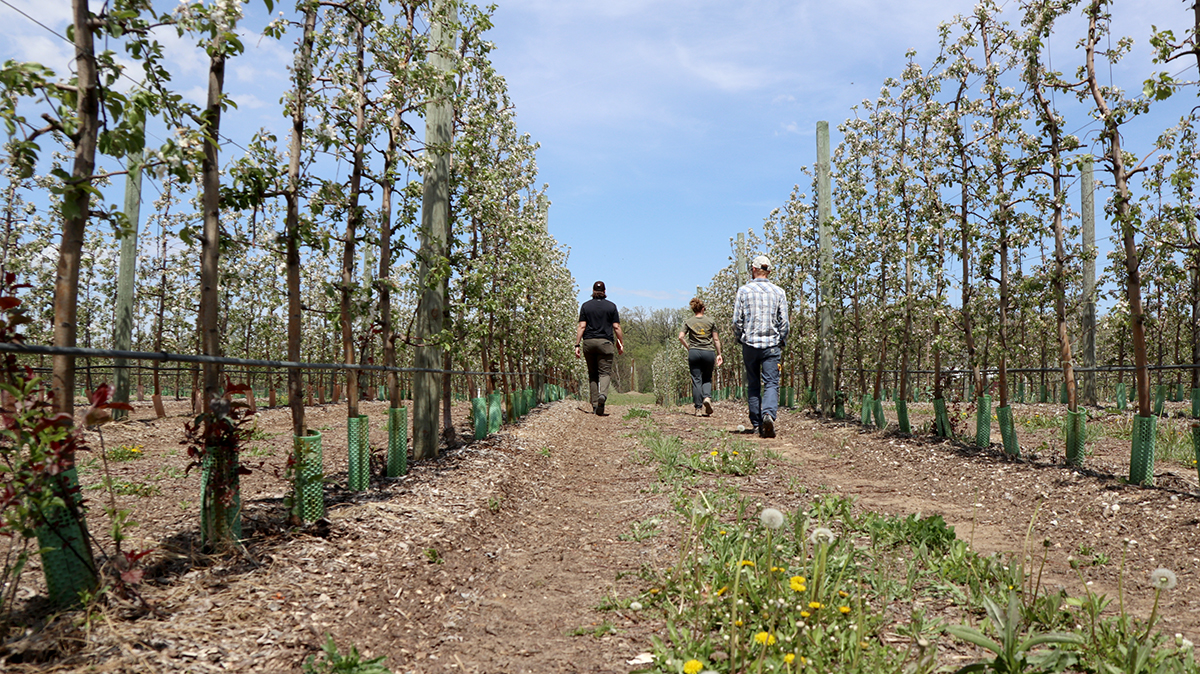
Apple trees at Warm Belly Farm’s Fort Atkinson location
Warm Belly Farm focuses its growing efforts on a few specialty crops such as high-density apples, hydroponic strawberries, honeyberries, and cut flowers. They sell their produce through their pick-your-own operations, garden center, on site-farm stand, local farmer’s markets, and some wholesale grocery. Warm Belly Farm is split across two locations in Cottage Grove and Fort Atkinson. The Cottage Grove location hosts Warm Belly Farm’s garden center, pick-your-own hydroponic strawberries, cut flower operation, and is the main location for events and Agritourism activities. The Fort Atkinson location houses about nine acres of high-density apples, half an acre of honeyberries, and offers pick-your-own apples from mid-August through October, along with a small farm stand and shaded picnic area.
I visited with Erin at Warm Belly on Monday, May 18. We took a walk through the orchard and chatted about current management challenges.
The Fort Atkinson location has about 24 different apple varieties, all planted in a dwarfing, high-density trellised system, mostly on G.11 and some B.9 rootstock. Most apple varieties were at petal fall, with fruitlet size between 5 and 10mm.
Erin has noticed Western Flower Thrips are causing some terminal leaf curling and deformation. Thrips typically target the supple leaf terminals for feeding.
Codling moth pheromone traps were hung on May 4, and as of May 18, a total of 5 moths were captured. Trap captures on Mon., May 18 were likely from moths that flew on Sat., May 16. Codling moths prefer to fly in the evening when it is warm, and relatively calm. It’s a good reminder to check traps daily, especially following evenings with ideal conditions for a flight.
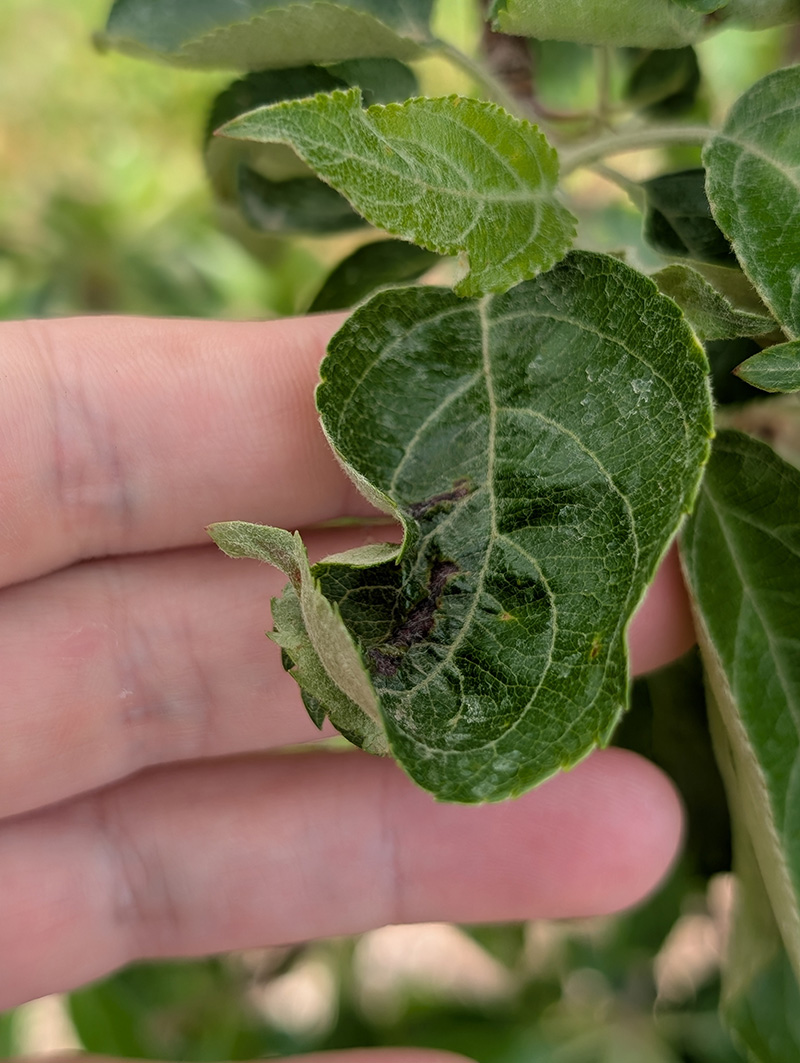
Apple leaf with dark scarring and distorted tissue consistent with thrips feeding injury.
Erin works with Peter Werts, the Specialty Crops Department Director at a local non-profit organization called the IPM Institute of North America. Peter helps Erin by monitoring insect traps, scouting for pests and diseases and provides management and spray recommendations based on these observations, using integrated pest management principles.
Fire blight has certainly been a concern at Warm Belly, and Erin has put quite a bit of work into pruning out strikes and removing trees where infection has hit the trunk in previous years. Erin most recently used a combination of Roper Rainshield (mancozeb), Kasumin (Kasugamycin) and Apogee (Prohexadione calcium), as an end-of-bloom disease protectant in accordance with the NEWA scab and fire blight model. Prior to applying Kasumin, she used two streptomycin applications during bloom. Kasumin was used during the extended bloom period due to delayed favorable fire blight conditions. She also applied Liquid Lime Sulfur and Mineral Oil to non-bearing trees. Conditions were favorable in the last week or so for fire blight, with warm day-time temperatures and a handful of rain events. Erin follows the NEWA Fire Blight Model and NEWA Apple Scab Model to track infection risk, and has a NEWA weatherstation located directly on-site.
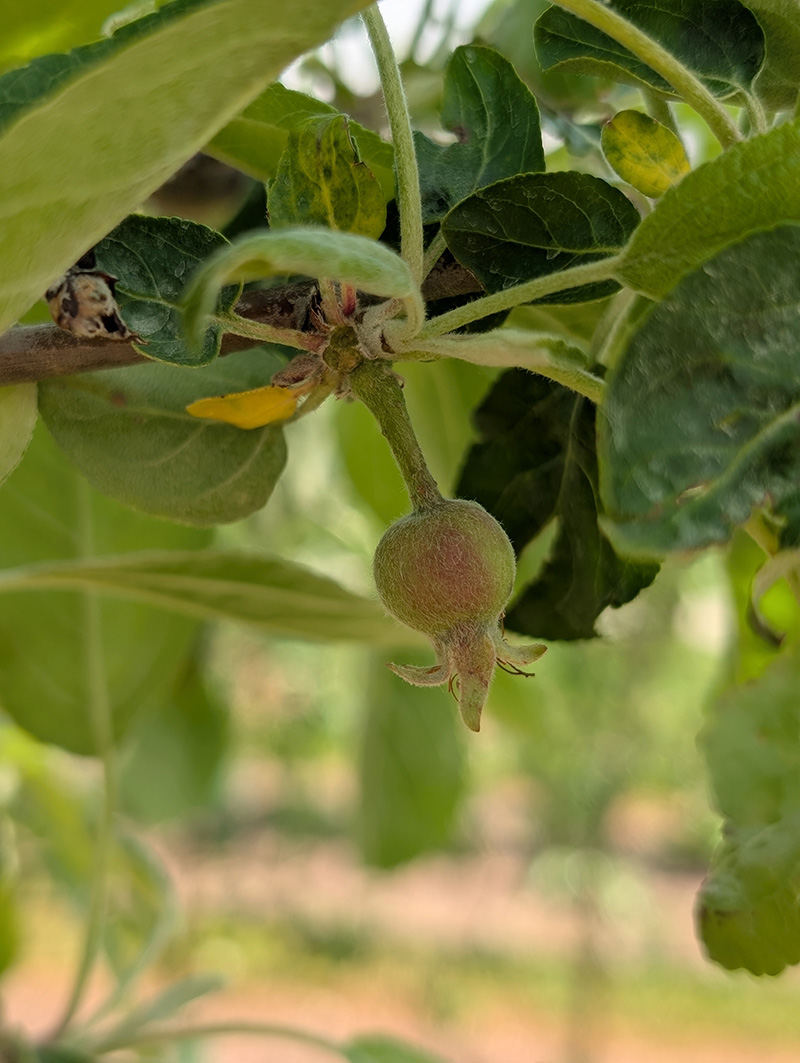
Young apple fruitlet (‘Zestar!’) with fuzzy surface hanging below leaves, showing normal early development after bloom.
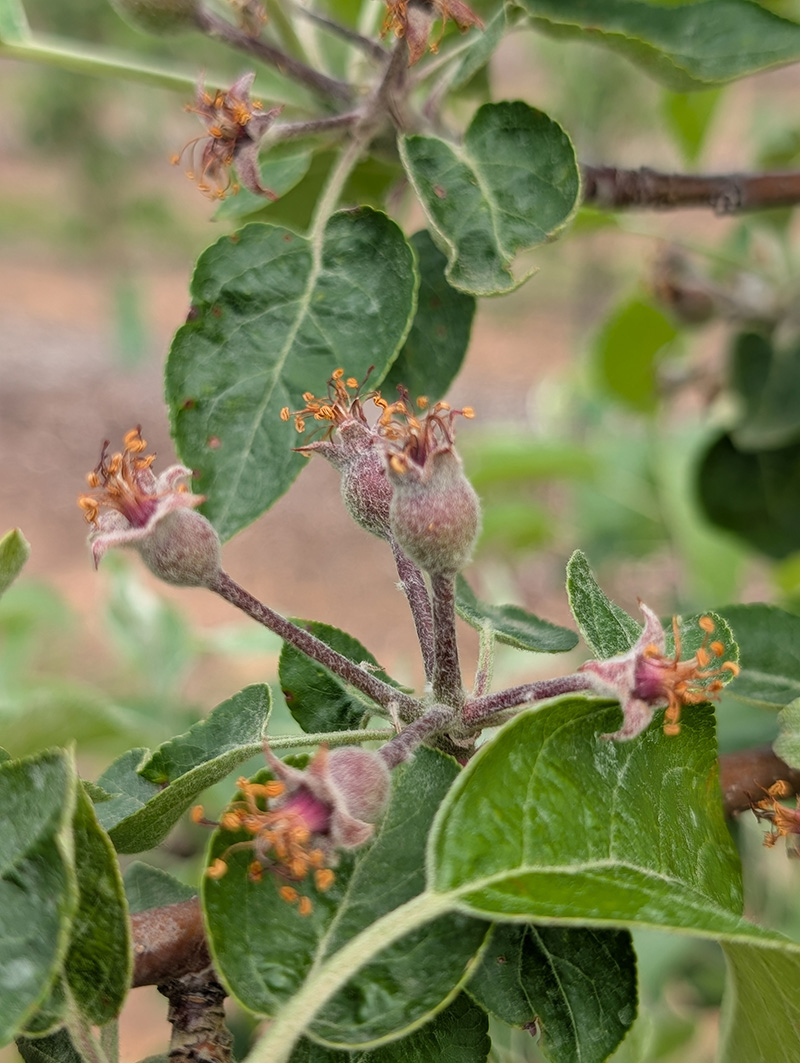
Cluster of young Honeycrisp apple fruitlets with dried blossoms and stamens still attached after petal fall.
Several hard freezes occurred between April 20 and May 20, where temperatures got down to 31 °F or colder during peak bloom across much of the orchard. These additional freezing temperatures likely knocked off another 25-50% of blooms, with some varieties seeing more than 90% loss.
Erin is keeping a close eye on fruit development as we move into petal fall and beyond. It may be a good idea for growers to take a walk through the orchard and tap some clusters to assess whether they are sticking or falling off. Petal fall is typically a crucial time for crop load management (thinning).
Many growers are delaying thinning until a better survival estimate can be determined. Check out Dr. Amaya Atucha’s most recent articles on Thinning After a Frost Event and Predicting Apple Fruit Set After Thinning Sprays.
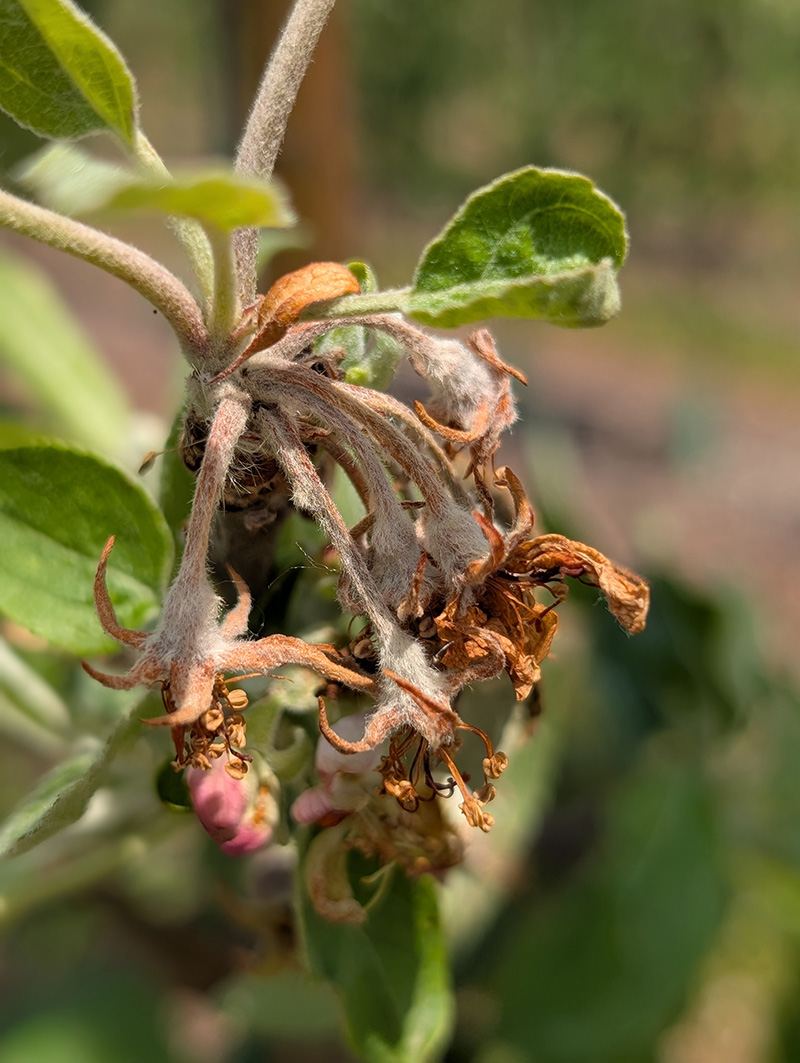
Apple flower cluster with browned, dried blossoms and shriveled tissues, consistent with freeze damage after bloom.
That’s all for now – I’ll check back in with Erin in our next Wisconsin Fruit Newsletter on June 5!
This article series is NOT intended to be prescriptive for other orchards. It is simply an opportunity for our readership to hear from other growers about their experiences growing fruit crops in Wisconsin.
Growing the same crop does not always justify the same practices. Management decisions at your farm should be tailored to your operation and consider location, regional climate, disease and pest history of your vineyard, and your varieties.
The mention of a product is NOT an endorsement. Always follow the instructions on product labels and consult weather stations (ex. NEWA) in your area for current weather forecast and disease and pest prediction models.
Featured In
Wisconsin Fruit News
To receive more content like this directly to your email inbox, sign up for the Wisconsin Fruit News e-newsletter.
Our bi-weekly in-season newsletter is designed for Wisconsin apple, grape, and berry growers.