

Most cultivars in southern Wisconsin were at full bloom by April 30 when we experienced the first of two nights of frost. As shown in Figure 1, we tracked temperatures at the West Madison Agricultural Research Station at several heights within the orchard. The morning of May 1 was the coldest, with temperatures reaching 27°F close to the base of the trees.
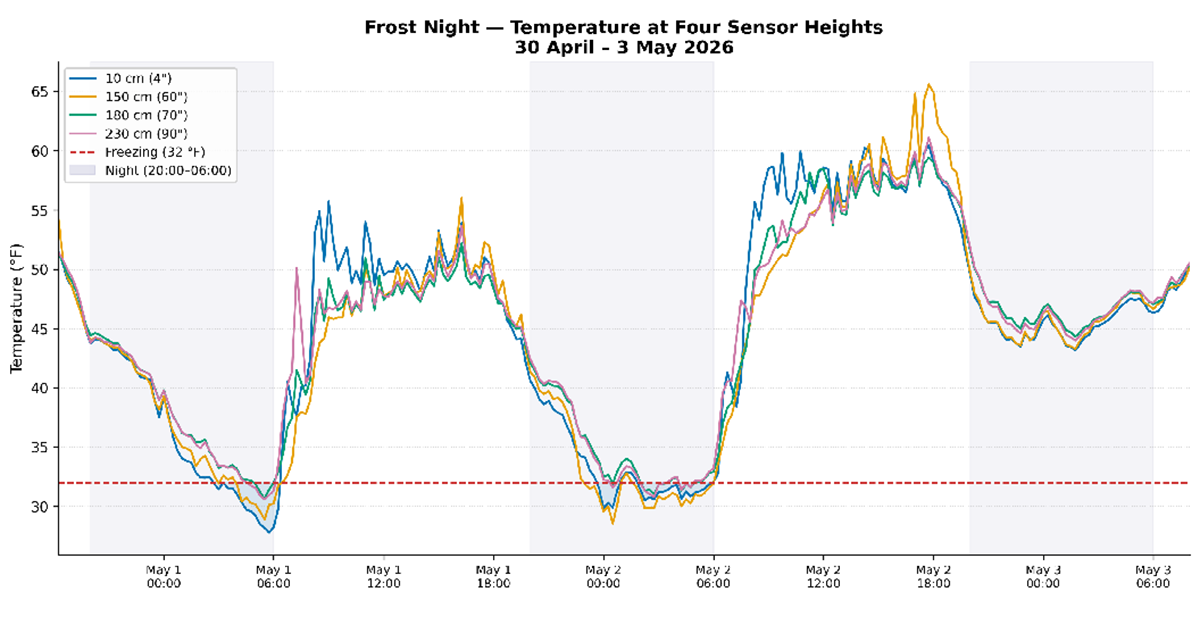
Image Description ↓
Figure 1. Air temperatures recorded at four heights (4, 60, 70, and 90 inches) during a frost event at the West Madison Agricultural Research Station (Verona, WI), 30 April – 3 May 2026. The dashed line indicates the freezing threshold (32 °F). Apple cultivars at the site were at full bloom during the event.
Managing Apple Thinning Risks After Orchard Frost Events
The single most important thing you can do right now is wait. Applying thinners before you understand what the frost left you risks overthinning a crop that may already be reduced. Give the orchard time to show you which fruitlets are growing and which are not before you commit to any spray program.
How to Use the Fruit Growth Rate Model to Assess Frost Damage
Dr. Terence Robinson from Cornell University shared some useful thoughts on how to use the Fruit Growth Rate model to assess frost damage. The key insight is that frost-damaged fruitlets behave much like fruitlets after a chemical thinner application — if they are damaged, they will stop growing. This means the FGR model, which is designed to detect which fruitlets are actively growing and which are not, can be used as a diagnostic tool this season, not just a thinning decision aid.
Using the MaluSim App for Accurate Fruitlet Growth Measurements
Based on Dr. Robinson’s recommendations, if you have dissected flowers and confirmed frost damage, skip the petal fall thinning spray and wait until fruitlets reach 7 mm. At that point, use the Fruit Growth Rate (FGR) model through the MaluSim app to get a reliable estimate of what you actually have. Tag 15 spurs on each of 5 representative trees (75 spurs total) and measure each fruitlet’s diameter.
Translating Growth Data into Reliable Fruit Set Estimates
Five days later, return and measure the same spurs again. The model will use those two measurements to calculate the percentage of fruitlets that are actively growing and likely to persist. When entering data into the app, record 5 fruits per spur regardless of how many are actually present, and use a value of 0.1 for any missing fruit positions. This keeps the model functioning correctly on frost-damaged spurs that may have fewer fruitlets than normal.
Pair this with whole-tree cluster counts on your 5 representative trees to translate the percent fruit set estimate into an actual fruit number per tree. That combination will tell you whether you need to thin at all, and if so, by how much.
Thinning Timing for One-Year-Wood and Damaged Spur Flowers
Based on Dr. Robinson’s recommendations, timing becomes especially critical in blocks if frost killed most of the spur flowers and you are depending on one-year-wood bloom for your crop. Wait to apply any thinners until the king fruit on one-year-wood clusters reaches at least 12 mm. At that size, king fruits are well set and will resist thinning, but the lateral fruitlets on those same clusters remain responsive. Keep in mind that spur fruitlets will be considerably larger by this point, around 16 mm, so plan your application timing with both populations in mind.
Preparing for Hand Thinning: Addressing Frost Rings and Russeting
Finally, any fruitlets showing frost ring, russeting, or misshaping will not respond to chemical thinners and can only come off by hand. Build that into your labor plan now so it does not catch you short later in the season.
Featured In
Wisconsin Fruit News
To receive more content like this directly to your email inbox, sign up for the Wisconsin Fruit News e-newsletter.
Our bi-weekly in-season newsletter is designed for Wisconsin apple, grape, and berry growers.