

Welcome back to another season of Notes from the Field! This year’s Notes from the Field will follow Erin Warner with Warm Belly Farm (Cottage Grove, Fort Atkinson). The goal of this newsletter is to hear from the grower’s perspective and foster connection and knowledge sharing between fruit growers. I’ll be focusing our discussions on farm history, phenology/fruit development and integrated pest management. As we kick off the growing season, hear how Erin is tackling early-season management challenges.
Erin Warner was inspired to pursue an education and career in plant sciences from her WWOOF’ing experience in Hawaii. When she returned to Wisconsin, she also returned to school as an adult student. Through hard work and determination, she obtained her degree in Horticulture from UW-Madison. She has been the Head Grower at Warm Belly Farm since 2020. This is her sixth growing season! Warm Belly Farm focuses its growing efforts on a few specialty crops such as high-density apples, hydroponic strawberries, honeyberries, and cut flowers. They sell their produce through their pick-your-own operations, garden center, on site-farm stand, local farmer’s markets, and some wholesale grocery. Warm Belly Farm is split across two locations in Cottage Grove and Fort Atkinson. The Cottage Grove location hosts Warm Belly Farm’s garden center, pick-your-own hydroponic strawberries, cut flower operation, and is the main location for events and Agritourism activities. The Fort Atkinson location houses about 9 acres of high density apples, 1/2 acre of honeyberries, and offers pick-your-own apples from mid-August through October, along with a small farm stand and shaded picnic area.
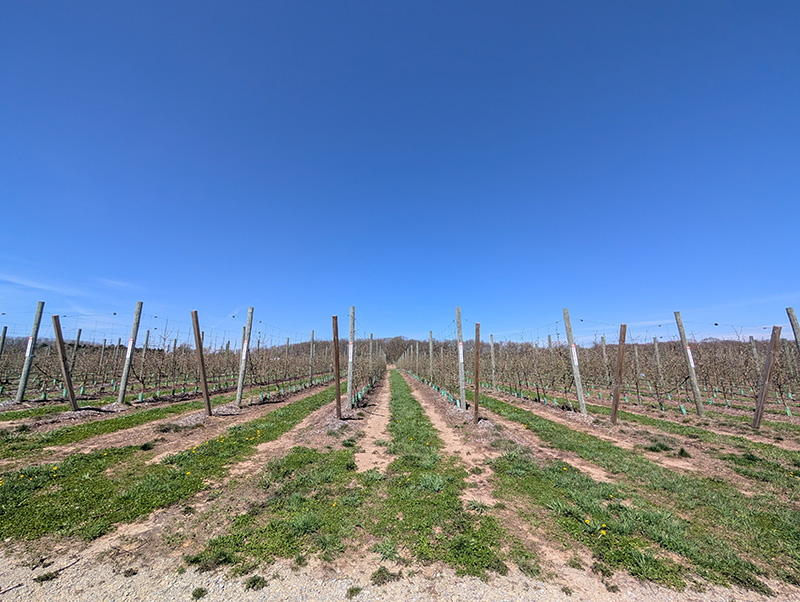
Apple trees at Warm Belly Farm’s Fort Atkinson location
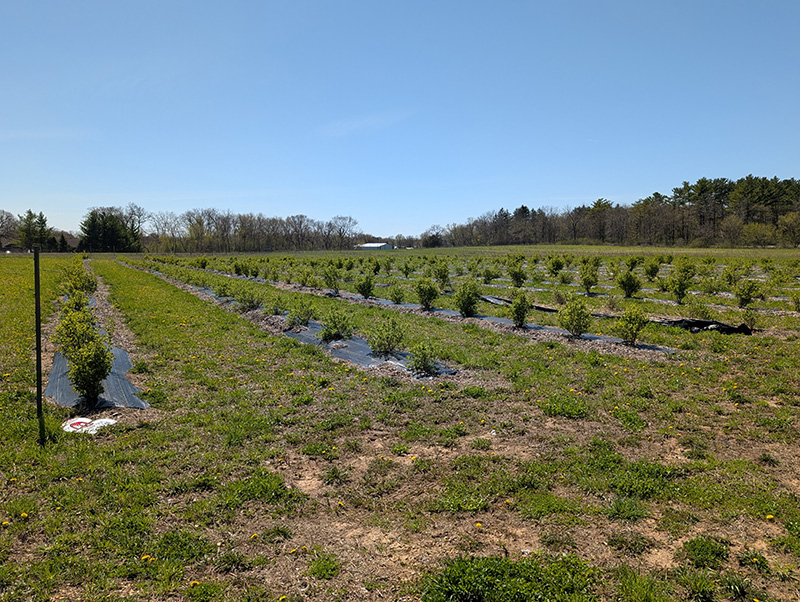
Honeyberry bushes at Warm Belly Farm’s Fort Atkinson location
I visited with Erin at Warm Belly on Monday, April 20. She took me on a farm tour, and we chatted about plans for this growing season as well as current management challenges. This year, Erin is looking forward to their first full crop of honeyberries and is focusing on bringing apple trees planted between 2021 and 2024 to full production. The Fort Atkinson location has about 24 different apple varieties, all planted in a dwarfing, high-density trellised system, mostly on G.11 and some B.9 rootstock. Tree phenology during my visit ranged anywhere from ½” green tip, to king bloom in Zestar.
Erin has had concerns with early-season insect pests in the past, like mites, scale and aphids; therefore, she applies two dormant or early-season oil applications (1-2%) targeting these pests. The past few years, the orchard has also been hit hard with woolly apple aphid; therefore, Erin is considering a pre-bloom application of Esteem (pyriproxyfen) to limit the population. For further information on early-season insect management, including scouting and management recommendations, check out this 2024 Wisconsin Fruit News article: Dormant and Early Season Insect/Mite Control.
Recent rain and storm events have posed a bit of a challenge for early-season disease management, like apple scab, as most protectants will wash off after ~1 inch of rain. Hail injury also opens the tree up to potential disease colonization, most worrisome being fire blight, especially for varieties at or near bloom. Fire blight has certainly been a concern at Warm Belly, and Erin has put quite a bit of work into pruning out strikes and removing trees where infection hit the trunk. Erin most recently used a combination of Mancozeb and Inspire Super (Difenoconazole, Cyprodinil) as an early-season disease protectant, and is on a 5-10 day rotation depending on rainfall and general conditions. She will add Kasumin (*Kasugamycin Hydrochloride Hydrate) and Regalia (Extract of Reynoutria sachalinensi) in future disease applications for fire blight control.
To top it all off, there was a hard freeze on Sunday (April 19) evening into Monday (April 20) morning where temperatures got down to 26℉. To assess potential freeze damage, I collected 50 apple clusters from both Zestar! and Honeycrisp to identify the percentage of frost-killed buds. Zestar! had a 52% frost kill and Honeycrisp had a 22% frost kill. Overall, this may simply serve as an early fruit thinning aid for Warm Belly Farm.
For further information on early-season apple scab management, check out Dr. Leslie Holland’s 2025 publication on Apple Scab Risk with Warming Weather – Stay Covered from Green Tip through Tight Cluster to learn more about product recommendations and application timing. Also, review Dr. Holland’s most recent article on Fire Blight Management here.
That’s all for now – I’ll check back in with Erin in our next Wisconsin Fruit Newsletter on May 8!
This article series is NOT intended to be prescriptive for other orchards. It is simply an opportunity for our readership to hear from other growers about their experiences growing fruit crops in Wisconsin.
Growing the same crop does not always justify the same practices. Management decisions at your farm should be tailored to your operation and consider location, regional climate, disease and pest history of your vineyard, and your varieties.
The mention of a product is NOT an endorsement. Always follow the instructions on product labels and consult weather stations (ex. NEWA) in your area for current weather forecast and disease and pest prediction models.
Featured In
Wisconsin Fruit News
To receive more content like this directly to your email inbox, sign up for the Wisconsin Fruit News e-newsletter.
Our bi-weekly in-season newsletter is designed for Wisconsin apple, grape, and berry growers.