

Weather and climate conditions this week in Wisconsin
Here are this week’s take-home points about the weather. As a reminder, AgWOW reports will be published weekly throughout the growing season. Scroll down for the full report.
Additionally, we’re collecting user feedback. Regardless of whether it’s your first time here or if you are a regular user, we’d love to hear from you!

Key Points
Recent Conditions
- Temperatures were unseasonably warm once again last week, with many locations at 5-7°F above normal for early June. Along with warmer temperatures, humidity levels were also elevated.
- Most of Wisconsin received at least 0.5” of rainfall last week, with folks in the southwest counties receiving the most (2-4” or more). Totals were a bit less in east-central and northwest counties.
Impact
- Soil moisture changes at 4” depth across Wisconet research farm stations were a mixed bag with variable precipitation totals (0” to over 1”).
- Satellite-based soil moisture estimates indicate that most of Wisconsin has drier than normal moisture in the top 1-meter depth for early June, with closer-to-normal moisture the southwest counties normal following a relatively wet week.
- Drought coverage was unchanged in the state from last week, with minimal decreases in D0 coverage in the southwest.
- Corn and soybean planting is just about wrapped up in Wisconsin fields, and crop condition reports indicate that most of the young crops are in good to excellent condition.
Outlook
- The next 7 days look to be active for precipitation across the state, with the best chances for rain along the Illinois border.
- The outlook for mid-to-late June indicates near normal temperatures with a lean toward above-normal precipitation, especially on the eastern side of the state (40-50% odds).
- Across most of Wisconsin, the June outlook indicates a lean towards above-normal temperatures (40-50% odds) and below-normal precipitation (33-40% odds for most).
Agronomic, Fruit and Vegetable Considerations
Field Conditions
- June is the time for pre-sidedress nitrate soil sampling. See guidelines for PSNT sampling.
Forage Management
- First crop alfalfa is being harvested throughout WI. Consider using a PEAQ (Predictive Equations for Alfalfa Quality) stick to estimate relative feed value as you decide when to make each cut.
- As scissor clips have concluded throughout the state; find UW and UMN quality data using the Alfalfa Harvest Alert dashboard.
Pest Management
- Scout fields to note what weed species are emerging or have escaped herbicide application.
- Be observant of black cutworm and true armyworm moths migrating through the state. Check the DATCP Pest Trap Network Maps. Look for true armyworm larvae in corn (especially around V5), grass pasture, and small grains.
- Scout emerging corn until V5 for signs of cutworm feeding.
- Continue scouting for alfalfa weevil larva, mostly in the northern half of WI. Weevil larvae have the greatest impact (quality and yield) on first and second alfalfa cuts. Fields that have been harvested are seeing feeding on second crop regrowth.
- SlugNet is trapping again in 2026! Review weekly trap catches across the state. Observe fields (especially fields with reduced tillage and cover crops) for any signs of slug damage.
- Continue to scout corn and soybean fields for disease. While disease in these crops has been of low concern so far, recent precipitation could change conditions to be more favorable.
Manure Applications
- Reminder of Wisconsin’s NR 151 Runoff Rules with the timing of manure spreading and current runoff levels. Check DATCP Runoff Risk Advisory Forecast.
Small Grains
- Scout small grains for signs of disease. This includes powdery mildew and stripe rust, especially in susceptible varieties. Use the Crop Risk Tool and Fusarium Risk Tool for risk assessment for Fusarium Head Blight. FHB risk has remained low.
- Staging small grain growth is important for fungicide timing as diseases are emerging. Winter wheat in the southern half of the stat is past the window to spray fungicide. Those in the central and northern parts of the state may still have an opportunity, if warranted. Review growth stages here.
Fruit Considerations- General
- Wisconsin fruit growers can reference the Midwest Fruit Pest Management Guide for a list of registered products and recommended best practices. View the MFPMG Online.
- Strawberry growers who recently received heavy rain in the last week should keep an eye out for cracking and molding. Any sitting water may also increase the risk of root diseases. Growers may reference this University of Minnesota Extension article on Harvesting Strawberries after severe weather or heavy rain.
Fruit Considerations- Disease
- Apple and grape growers can reference the NEWA weather station network to monitor for disease infection periods in their area. Check out your nearest weather station: NEWA Weather Station Network (Cornell).
- Secondary Apple scab fruit lesions have been observed in Southern WI, likely pushed along by recent rains. Continue scouting scab susceptible varieties. A reminder that protectants will typically wash off after ~1inch of rain.
- Recent rain events have driven infection periods for grape diseases. Grape growers may consider reviewing grape black rot (Cornell) monitoring and management and grape phomopsis monitoring and management.
- Grape growers can reference the NEWA weather station network to monitor disease infection events for phomopsis, powdery mildew and black rot. Check out your nearest weather station: NEWA Grape Diseases Model.
Fruit Considerations- Insects
- Apple growers should continue monitoring degree-day (base 50℉) accumulation for Codling moth. First generation larvae will emerge after ~250 degree-days (base 50℉) have accumulated from the biofix date. Second generation larvae will typically emerge at ~1250 degree-days (base 50℉) from the biofix date.
- Apple growers should keep track of degree-day (base 50℉) accumulation from petal fall to determine the end of plum curculio movement into the orchard. Plum curculio will typically cease movement into the orchard after ~308 degree-days (base 50℉) have accumulated from the petal fall date.
- Strawberry growers have reported signs of spittlebugs, which typically cause little damage unless large populations are present (~1/plant).
Vegetable Considerations- General
- Remove garlic scapes to maximize bulb size. Research has shown that failure to remove garlic scapes can reduce bulb size by as much as 48%. Scapes can be removed as soon as they emerge or if you have a market for scapes, once they are fully coiled. Removing scapes at full coil has a minor impact on yield, research has shown a 9% reduction, but make up for this loss with the demand from consumers. If hand removal is not practical, research has shown that letting the scapes grow longer (30-40cm) and then cutting with a sickle bar mower reduces damage to leaves and minimizes impacts on yield.
- Whether you use drip or a center pivot to irrigate, it is important to monitor water pressure to maintain effective irrigation of crops especially during recent dry conditions. Check out this article from Michigan State to learn more.
- It is a great time to consider summer cover crops before planting fall crops. Summer cover crop options include buckwheat, cowpea, and sorghum sudangrass. Check out these videos from UW Madison Extension and Iowa State Extension to learn more about what might work on your farm. Purdue also has a great article on this topic.
Vegetable Considerations- Disease
- Cucumber downy mildew spores have been detected in 3 eastern and southeastern counties in Michigan. However, no reports of disease outbreaks have been reported in Michigan or Wisconsin.
Vegetable Considerations- Insects
- Thrips and mites are common high tunnel pests due to their preference for hot and dry conditions. In addition, to direct damage to the plant, they can also transmit diseases. Biological control is one option to help control these pest populations. Check out this article from University of Maryland Extension about commercially available biological control agents, the pests they can control, and the best conditions in which to implement this control strategy.
- Squash vine borer risk is starting to increase in southern WI as adults start to emerge from their overwintering sites in the soil. Be on the lookout for adults which are day flying moths. Their abdomens are red to orange in color with black spots. Newly emerged females begin looking for hosts to lay eggs shortly after emerging. Floating row cover during peak adult activity can reduce crop risk although it must be removed during flowering. Chemical control options are limited once larvae move into the plant stem. Effective chemical control requires insecticides to be in place before and during egg laying.
- Stalk borer risk is high in southern WI and increasing in central WI. Starting in late May the larvae migrate from grassy weeds along field edges into susceptible crops which include tomatoes, potatoes, sweet corn, and beans. Larvae feed on leaves or stalk tunnels, causing irregular holes in the newly unfolding leaves. Control options are limited this time of year. If eggs have already hatched, removing alternative weed hosts can increase the amount that migrate into your crop. For chemical treatment to be effective, treatment must occur before larvae have moved into the crop stem. Therefore, it is very difficult to use chemical controls as their presence is not often noticed until they are already inside the stem and have caused damage.
- The risk from the first generation of western flower thrips is now high or very high in northern WI. The risk from the second generation will be increasing in southern WI over the next week. Early detection is key as control can be very difficult. Iowa State has a few useful videos on scouting: tip on finding thrips and tips on spotting thrips damage on cucumber transplants. Control options include row cover, reflective mulch and weed management as weeds such as chickweed and lambsquarters serve as alternative hosts.
- Recent rains should have helped knock back populations of onion thrips. However, as the first alfalfa harvest continues across the state, the risk of migration into your vegetables increases. Scout weekly and pay particular attention to field edges are this pest is more common there early in the season. Scouting tips and management information can be found here and here.
- Alfalfa harvest also means that aster leafhoppers will be on the move. MSU traps and checks infectivity levels in Michigan. Sign up for text alerts here to get an idea of how infectivity levels are changing throughout the season. Aster leafhoppers spread aster yellows which can cause significant damage to a range of crops including garlic, lettuce, carrots, and parsley. Control of aster yellows depends on control of the aster leafhopper. Management options include floating row covers, planting resistant cultivars, and insecticides.
- Potato leafhopper is another pest that is common to find on your vegetable crop post alfalfa harvest. Pay attention to beans and potatoes for signs of damage which include veins turning yellow and leaf curling during early stages and later appears as the characteristic “hopper burn” that leads to the yellowing or browning of leaf tips. Damage occurs most rapidly under hot and dry conditions. Management information and action thresholds can be found here.
- Continue scouting for Colorado potato beetle. Reports from the Vegetable Crop indicate that “in much of southern Wisconsin, larval populations are well into mid- and later stages of larval development, whereas only early larval stages are present in most fields within central Wisconsin.” Larvicide recommendations can be found here.
- Continue to scout for striped cucumber beetles. Eggs are laid at the base of cucurbit plants. Once larvae hatch, they feed on roots and stems and can cause stunted growth or even kill seedlings. Adults feed on foliage and fruit and can spread bacterial wilt which can cause severe losses in cucumber and muskmelon. It is important to scout and, when necessary, control beetles early in the season to reduce risk of spreading this bacterial wilt. Control measures include dipping seedlings in kaolin clay prior to transplanting, floating row cover or high tunnel insect exclusion screens, and perimeter trap cropping.
- Scout for cabbage looper, imported cabbageworm and diamondback moth eggs and larvae. Eggs are laid on the underside of leaves or occasionally on the stem. One way to help identify the larvae is by their behavior when disturbed. Cabbageworm larvae will typically remain motionless while diamondback larvae will wiggle around and often fall off the plant. Cabbage loopers move with a distinctive arch or loop and may whip its head around when disturbed. Plants are most susceptible to damage as young transplants and from early heading to harvest so the management threshold is when 10% of plants are affected. More information on treatment thresholds and management options can be found here. It is best to rely on larvae counts rather than damage or frass (droppings) to determine the level of infestation. Resistance to insecticides is a risk with these pests. Rotate modes of action, choose a selective insecticide when possible, and spot treat or band applications rather than broadcasting.
- The second generation of adult seed corn maggots is now active around Spooner, Wausau, Shawano, and Green Bay. Northern WI can expect the risk to increase over the next week especially with the predicted warm temps. The third generation will start becoming active in southern WI over the next week. Injury is caused exclusively by larvae which feeds on the cotyledons and below ground tissue of seedlings. Management is only effective if done in a preventative manner. Once larval damage is detected, their are no control options. Preventative management options can be found here.
- Cabbage maggot peak egg laying is now occurring in northern WI. Treatment is primarily preventative. When possible, till in cover crops 2 to 3 weeks before planting to reduce attractiveness. If possible, delay planting to avoid peak activity. Plantings after mid-June generally suffer less damage than early plantings. Floating row covers and diatomaceous earth are also good options during peak activity. To monitor activity in your area, use the Vegetable Disease and Insect Forecasting Network.
- DATCP continues to report black cutworm moth trap catches. Black cutworm larvae feed on newly emerged crops and prefer direct seeded crops over transplants. Many crops are susceptible to damage including beets, carrots, cucumber, leafy greens, sweet corn and squash. Management options include weed management as females prefer to lay eggs in weedy areas and avoiding the use of green manure in areas where cutworms tend to be a problem. For chemical control to be effective, early detection is key. If chemical treatment is necessary, begin treating at the first signs of cutting and repeat every 7 days until 1000 degree days are reached.
Dive deeper into each report section by clicking a topic below.
Precipitation Trends
7 Day Precipitation
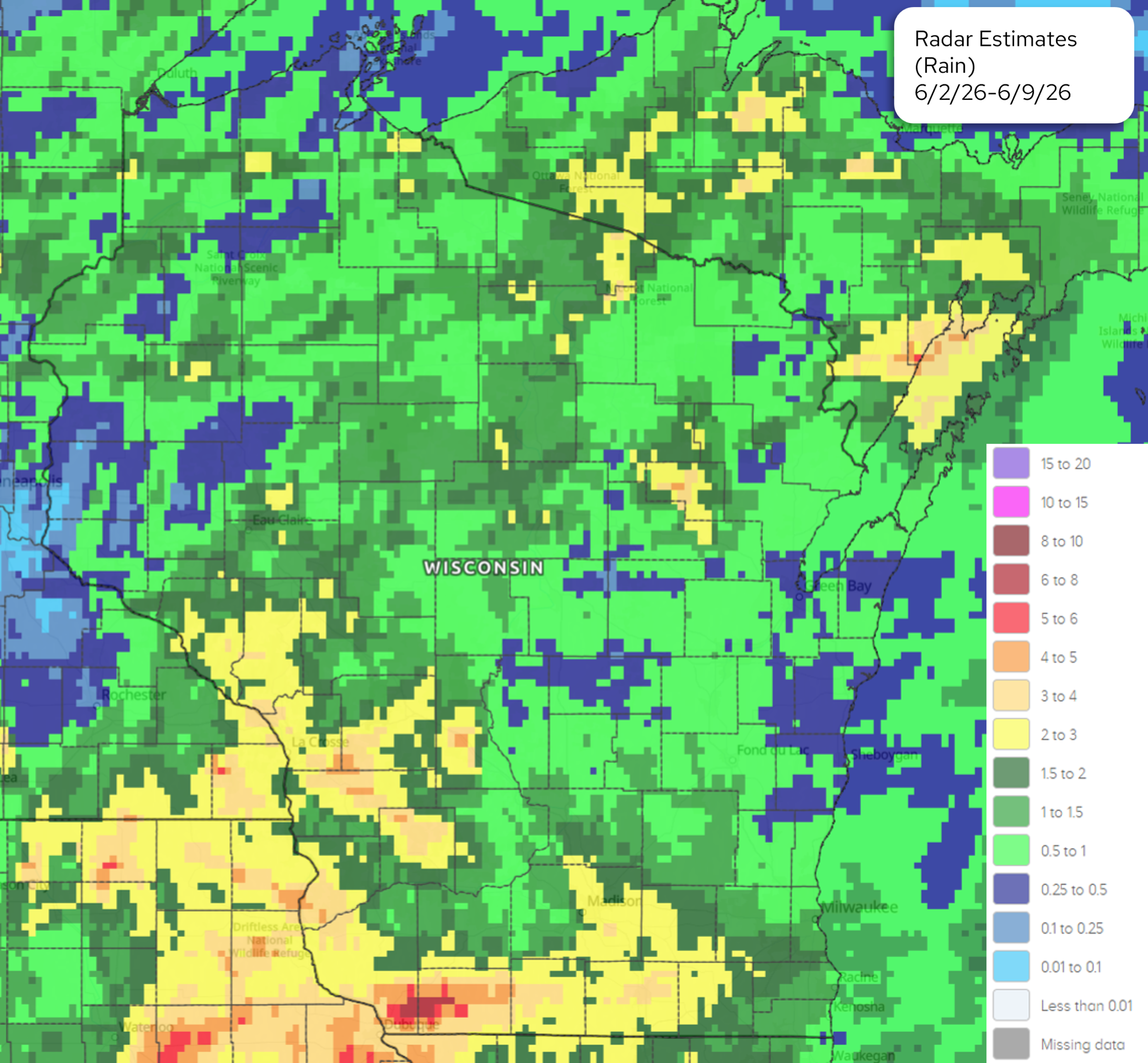
Image Description ↓
Color-coded precipitation map showing total rainfall estimates from June 2-9, 2026, across Wisconsin, Minnesota, Iowa, Illinois, and Michigan’s Upper Peninsula. Most of central and northern Wisconsin received 1-2 inches (green shades). Heaviest rainfall, 4-8+ inches, occurred in southwestern Wisconsin near the Iowa/Illinois border (Dubuque area), shown in orange and red. A smaller area of 3-5 inches appears near Green Bay along Lake Michigan’s shore. Western Minnesota near the Twin Cities and parts of northern Wisconsin show minimal rainfall (under 0.25 inches, blue shades). Legend ranges from “Less than 0.01” to “15 to 20” inches.
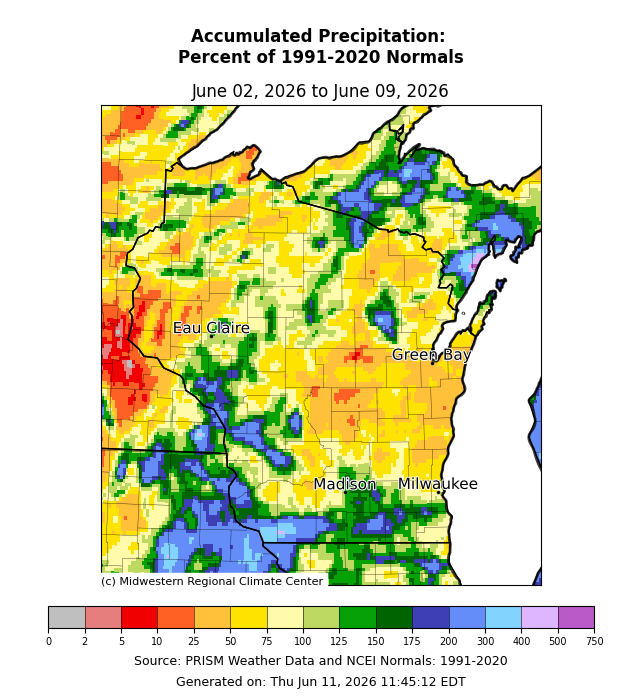
Image Description ↓
Map titled “Accumulated Precipitation: Percent of 1991-2020 Normals, June 02, 2026 to June 09, 2026,” covering Wisconsin and parts of neighboring states. A color scale ranges from gray (0%) through red, orange, yellow (low percentages), to green, blue, and purple (high percentages, up to 750%). Western Wisconsin near Eau Claire shows red and orange shading, indicating roughly 5-25% of normal precipitation. Central and southern Wisconsin, including Madison and Milwaukee, show yellow tones, around 75-100% of normal. Northern and northeastern Wisconsin, including areas near Green Bay, show scattered blue and green patches indicating 150-300% of normal. Source credited to PRISM Weather Data and NCEI Normals 1991-2020, generated by the Midwestern Regional Climate Center on Thu Jun 11, 2026, 11:45:12 EDT.
- Most of Wisconsin received over 0.5” of rain last week. In southwestern counties, totals of 2-4” were common.
- Totals along the Grant-Lafayette County border were particularly high (Darlington Wisconet 7-day total = 6.47”).
- The northwest and east-central counties were on the drier end of the spectrum last week, with totals of less than 0.5” for some.
30 Day Precipitation Total and Departure from Normals
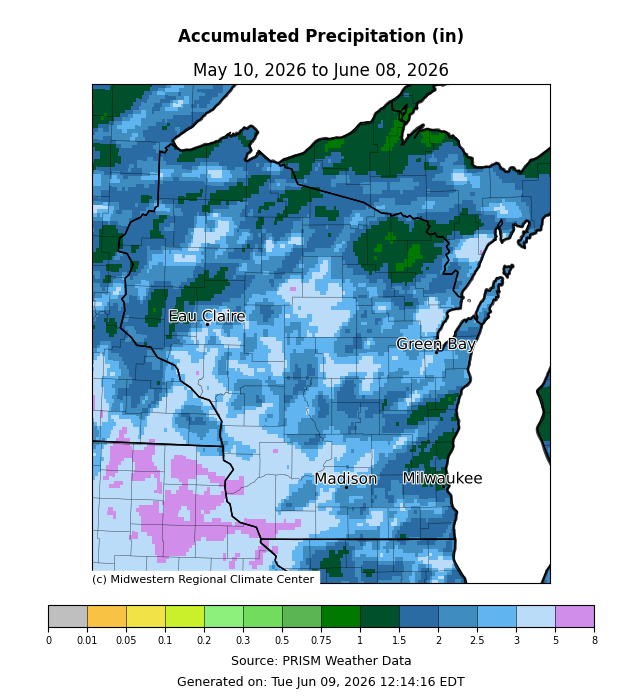
Image Description ↓
Title “Accumulated Precipitation (in), May 10, 2026 to June 08, 2026,” sourced from PRISM Weather Data (Midwestern Regional Climate Center, generated June 9, 2026). Map shows Wisconsin and surrounding areas with color-coded rainfall totals on a scale from 0 to 8+ inches. Most of the state is shaded blue, indicating 1.5–3 inches of rain. Darker green areas in the north and along Lake Michigan’s shoreline indicate higher totals (1–1.5 inches and above). A pink region in the south-central/southwest part of the state indicates the highest totals, exceeding 5 inches. Cities labeled include Eau Claire, Green Bay, Madison, and Milwaukee.
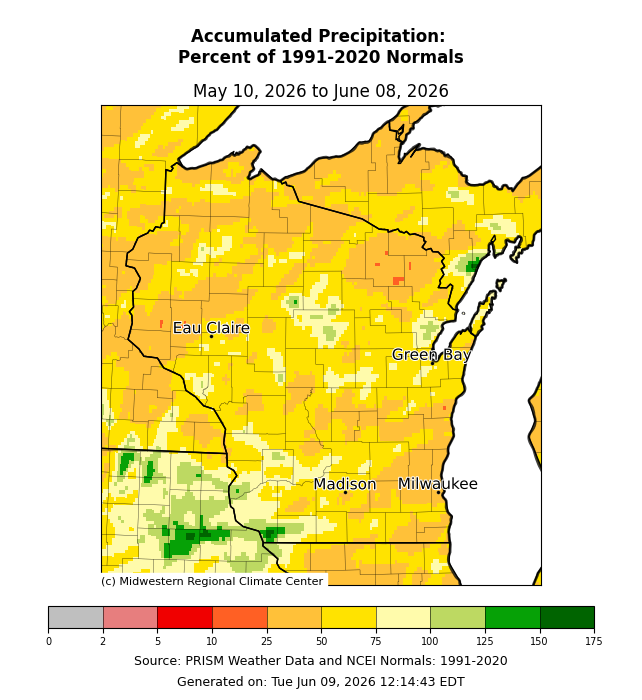
Image Description ↓
Map titled “Accumulated Precipitation: Percent of 1991-2020 Normals, May 10, 2026 to June 08, 2026.” Most of Wisconsin shows 50–100% of normal precipitation (orange to yellow shading). Southwestern Wisconsin shows higher totals, 100–175% (light to dark green), with the darkest green concentrated near the Wisconsin-Illinois border. Scattered small patches of below-normal precipitation (red/orange, 5–25%) appear in central and north-central Wisconsin. Cities labeled: Eau Claire, Green Bay, Madison, Milwaukee. Color scale ranges from 0 to 175 percent. Source: PRISM Weather Data and NCEI Normals 1991-2020, generated by the Midwestern Regional Climate Center on Tue Jun 09 2026.
- The last 30 days have been drier-than-normal across most the state, with most locations receiving totals that were 25-75% of normal (3” or less).
- Totals were closer to normal in portions of southwestern and north-central Wisconsin (3-5”), following last week’s rain.
90 Day Precipitation Total and Percent of Normals
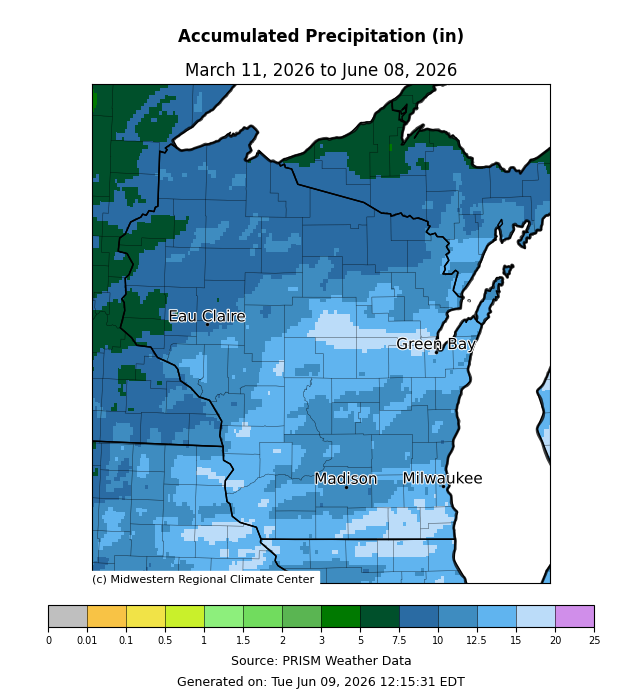
Image Description ↓
Title “Accumulated Precipitation (in), March 11, 2026 to June 08, 2026.” Map of Wisconsin and surrounding areas with color-coded precipitation totals. Most of the state shows 7.5–12.5 inches (medium to light blue), with central Wisconsin near Madison showing lighter blue (12.5–15 in). Dark green areas (5–7.5 in) appear scattered in northwestern and far northern Wisconsin, with a small darker green patch (7.5–10 in range) near the Door Peninsula. Cities labeled: Eau Claire, Green Bay, Madison, Milwaukee. Color scale legend ranges from 0 to 25 inches. Source: PRISM Weather Data. Generated Tue Jun 09, 2026, 12:15:31 EDT. Credit: (c) Midwestern Regional Climate Center.
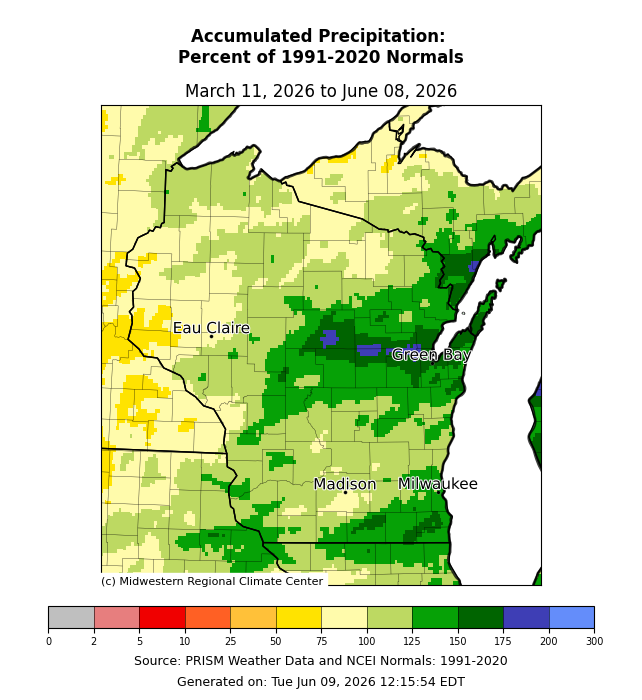
Image Description ↓
Map titled “Accumulated Precipitation: Percent of 1991-2020 Normals, March 11, 2026 to June 08, 2026,” credited to the Midwestern Regional Climate Center. Western Wisconsin (near Eau Claire) shows below-normal precipitation, mostly 50-75% (yellow), with some areas at 25% or below. Central Wisconsin is near normal (90-110%, pale yellow/green). East-central and southeastern Wisconsin, including areas around Green Bay, Madison, and Milwaukee, show above-normal precipitation, ranging 125-175% (green tones), with isolated pockets reaching 200-300% (dark blue) near Green Bay. A color scale at the bottom ranges from 0 to 300 percent. Source: PRISM Weather Data and NCEI Normals 1991-2020. Generated Tue Jun 09, 2026 12:15:54 EDT.
- Totals of 15” or more were observed in portions of southwest, southeast, and northeast counties. These totals were 150% of normal or greater.
- Most of the state received precipitation totals that were at or above normal, with most receiving at least 10” of precipitation (rain plus melted snow).
- Precipitation totals were lowest in the northwest, along the St. Croix River (5-7.5”). In the northwest, 90-day totals were 50-75% of normal.
2026 Precipitation
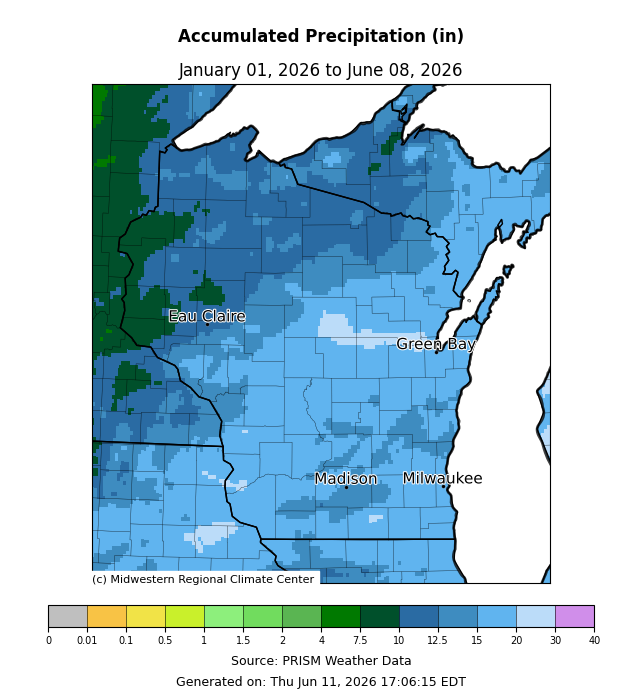
Image Description ↓
Title “Accumulated Precipitation (in), January 01, 2026 to June 08, 2026,” credited to Midwestern Regional Climate Center. The map covers Wisconsin and surrounding areas, with cities Eau Claire, Green Bay, Madison, and Milwaukee labeled. Most of the state shows precipitation totals between 10 and 20 inches (shades of blue), with a band of lighter blue (15–20 in) across the central-east region near Green Bay. Western Wisconsin, especially near Eau Claire, shows darker green areas indicating higher totals (7.5–12.5 in range on the green scale, locally exceeding surrounding areas). A color-coded legend at the bottom ranges from 0 to 40 inches. Source: PRISM Weather Data. Generated Thu Jun 11, 2026, 17:06:15 EDT..
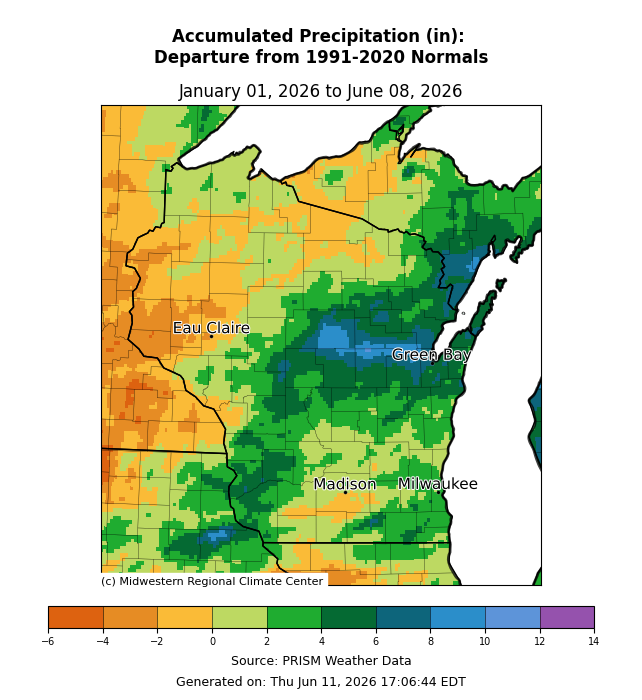
Image Description ↓
Map titled “Accumulated Precipitation (in): Departure from 1991-2020 Normals, January 01, 2026 to June 08, 2026,” sourced from PRISM Weather Data via the Midwestern Regional Climate Center. A color scale ranges from -6 to 14 inches, with orange/yellow indicating below-normal precipitation and green/blue/purple indicating above-normal. Western and southwestern Wisconsin show orange and yellow shading (roughly -6 to 0 inches departure), indicating drier-than-normal conditions, with the deepest deficits near the southwest corner. Central and eastern Wisconsin, including areas around Green Bay, show green and dark blue shading (2 to 10+ inches above normal), indicating wetter-than-normal conditions, with the highest surpluses in the Green Bay area. The Madison and Milwaukee areas show light green to pale yellow, near-normal to slightly above-normal precipitation. Eau Claire is located in the orange/yellow drier region.
Soil Moisture and Temperature Trends
Soil Moisture Models
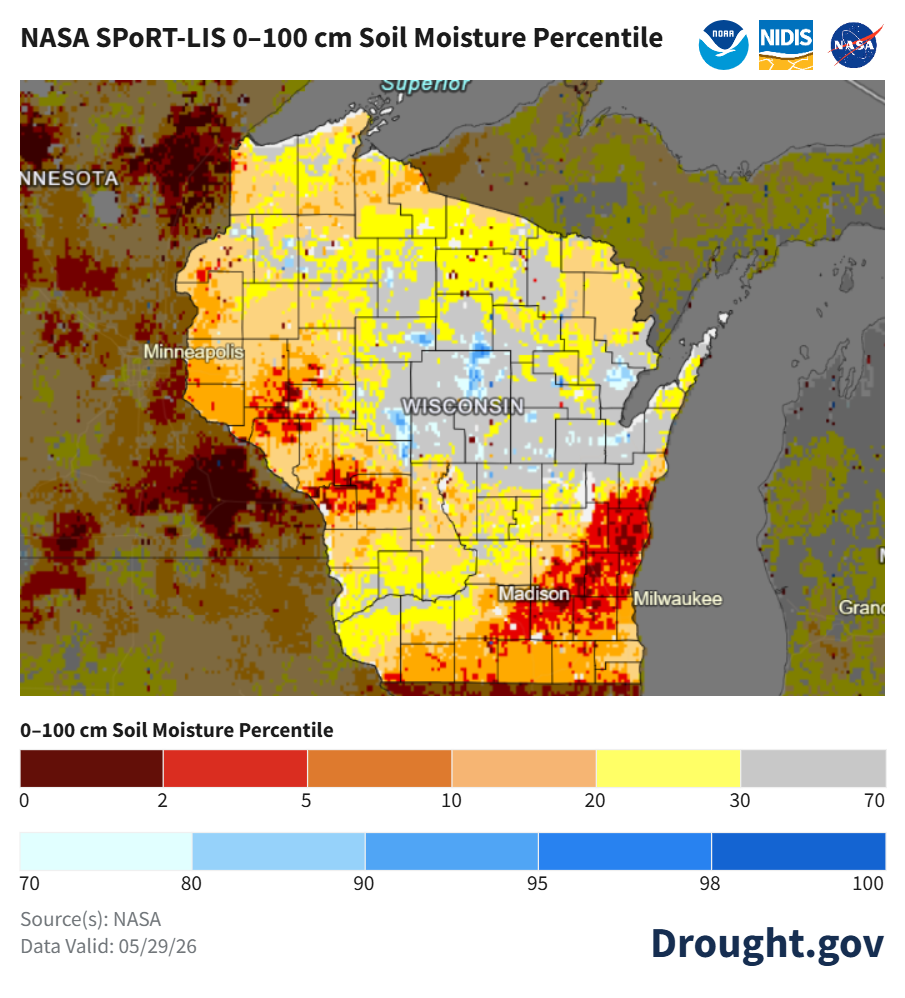
Image Description ↓
Map titled “NASA SPoRT-LIS 0–100 cm Soil Moisture Percentile” showing Wisconsin and surrounding states color-coded by soil moisture percentile. Dry conditions (dark red, percentile 0–5) appear in southeastern Wisconsin near Madison and Milwaukee, southwestern Wisconsin, and parts of Minnesota. Moderately dry areas (orange, 5–20) cover much of southern and western Wisconsin. Central and northern Wisconsin show near-normal to slightly dry conditions (yellow to gray, 20–70). Small pockets of wetter conditions (light to medium blue, 70–98) appear near central Wisconsin. Legend shows two scales: dry conditions from 0 to 70 in red/orange/yellow/gray tones, and wet conditions from 70 to 100 in blue tones. Source: NASA. Data valid 05/29/26. Logos for NOAA, NIDIS, and NASA appear in the top right; Drought.gov logo appears in the bottom right.
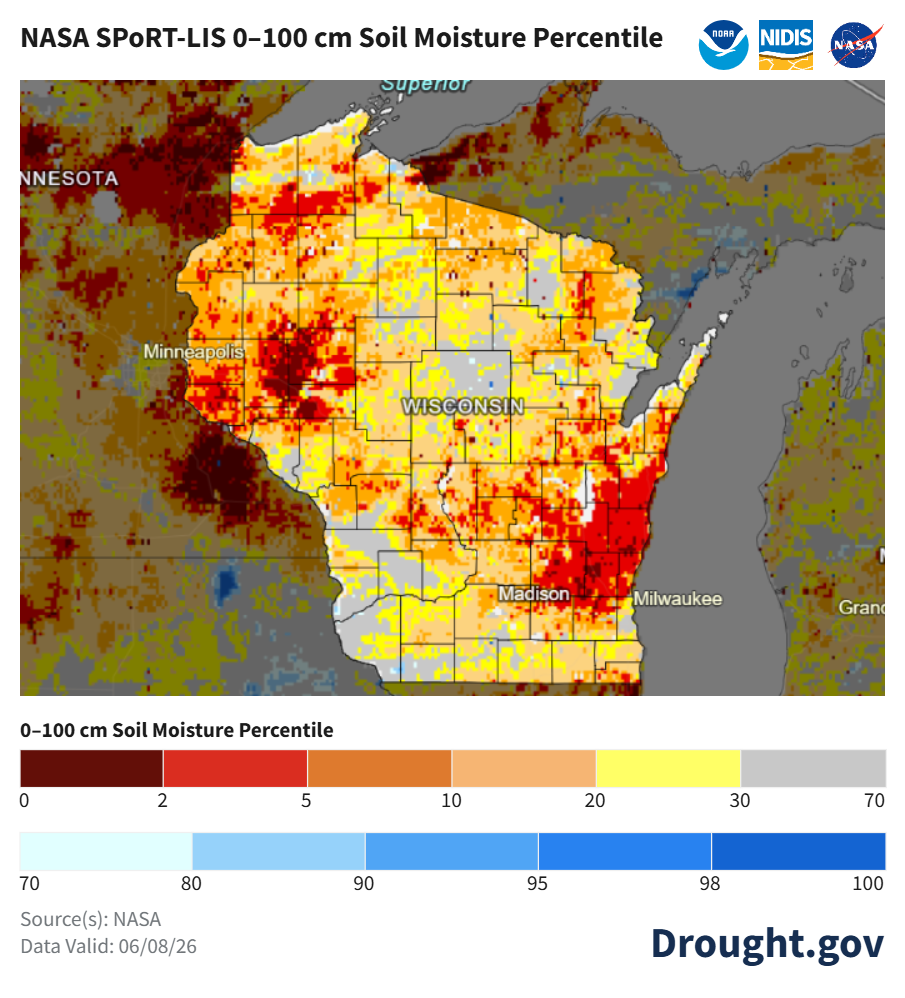
Image Description ↓
Map titled “NASA SPoRT-LIS 0–100 cm Soil Moisture Percentile,” data valid 06/08/26, source NASA. Wisconsin and surrounding region shown in colors representing soil moisture percentiles. Most of Wisconsin displays low percentiles (orange, tan, and yellow, roughly 5–30), with extensive dark red areas (below 2nd percentile) across western and southeastern Wisconsin and southern Minnesota, indicating widespread dry soil conditions. Small gray patches (30–70 percentile) appear in central Wisconsin. A legend shows two color scales: dry conditions from 0 to 70 (dark red to gray) and wet conditions from 70 to 100 (light blue to dark blue), with minimal blue shading visible on the map. Logos for NOAA, NIDIS, and NASA appear in the top right; “Drought.gov” appears in the bottom right.
- Wisconet research farm stations experienced a wide range in total precipitation last week (0” to over 1”) and thus change in 4-inch soil moisture was a mixed bag across stations.
- Satellite-based soil moisture estimates indicate that most of Wisconsin has drier than normal moisture in the top 1-meter depth, especially in east-central and northwest counties.
- Soils in the southwest counties have soil moisture that is closer to normal following a relatively wet week.
- Notes on how to interpret the maps:
- Red areas = top 5 driest in 100 years.
- Dark red areas = top 2 driest in 100 years.
- Dark blue areas = top 2 wettest in 100 years.
Wisconet Soil Moisture
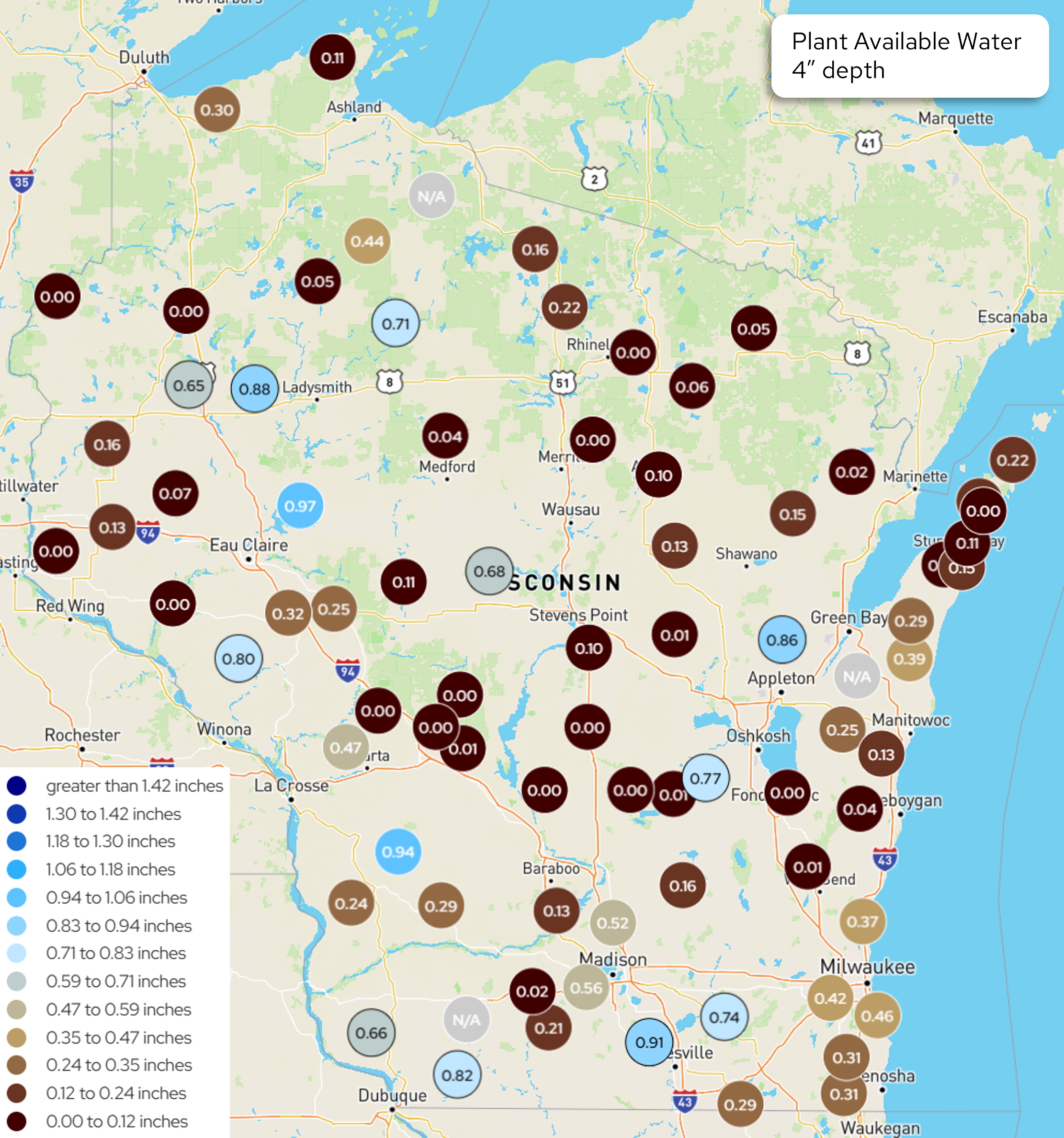
Image Description ↓
A map of Wisconsin and surrounding region displays numbered, color-coded circles at dozens of locations indicating Plant Available Water at a 4-inch soil depth. Values range from 0.00 to 0.97 inches. Most sites in central, western, and eastern Wisconsin show low values (0.00–0.16, dark red), indicating dry conditions. Higher values (0.65–0.97, light blue and gray-blue) appear near Ladysmith, Eau Claire, Wisconsin Dells, Appleton, Janesville, and the Dubuque area. Moderate values (0.24–0.56, tan and gray-tan) cluster in the southwest, southeast, and Lake Michigan shoreline counties near Manitowoc, Sheboygan, and Milwaukee. Two sites are marked “N/A” (gray), located near the Michigan border and southwest of Madison. A legend in the lower left maps eleven color categories to inch ranges from “0.00 to 0.12 inches” (dark red) through “greater than 1.42 inches” (dark blue).
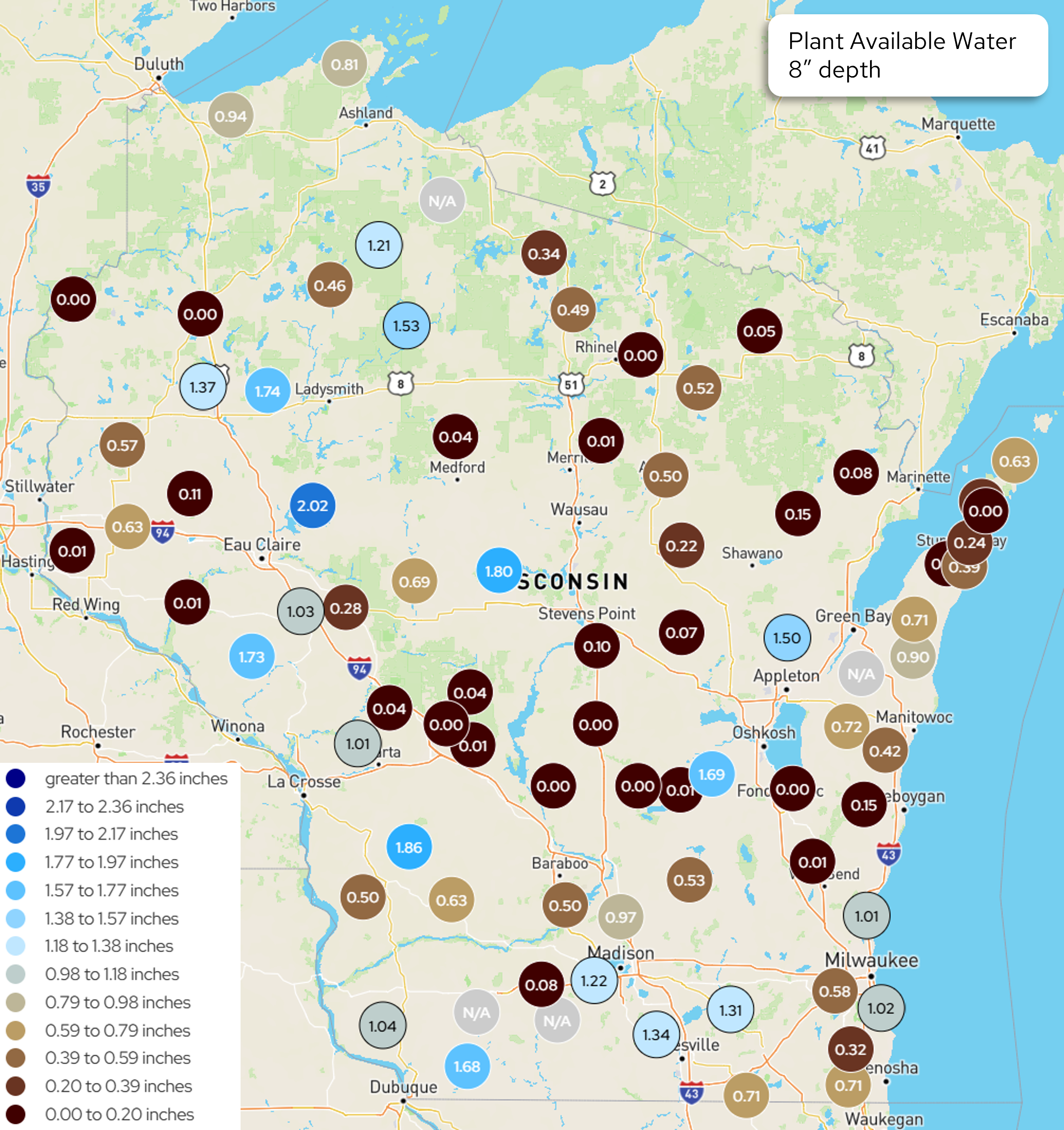
Image Description ↓
Map of Wisconsin and surrounding region showing plant available water (8″ depth) as color-coded circles at numerous locations, scaled from dark red (0.00–0.20 inches) to dark blue (greater than 2.36 inches). Most central, southern, and eastern Wisconsin sites show very low values (0.00–0.15 inches), shown in dark red. Northwestern Wisconsin and areas near Eau Claire, Ladysmith, and the Wisconsin Dells region show higher values (1.21–2.02 inches), shown in light to medium blue. Some southern and eastern sites near Madison, Janesville, and the Lake Michigan shoreline range from 0.50 to 1.34 inches. A few locations are marked “N/A” in gray.
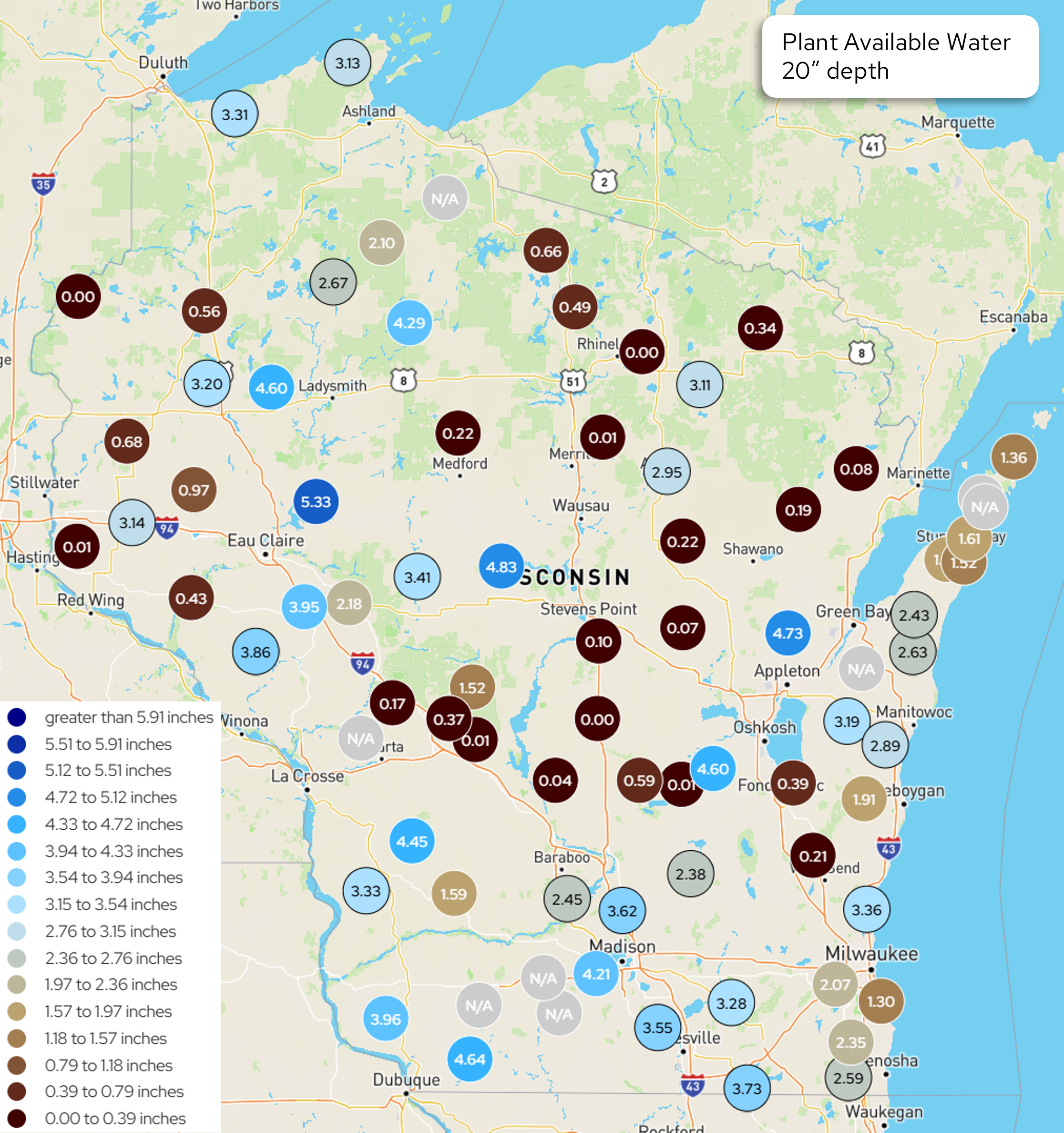
Image Description ↓
Map of Wisconsin and surrounding region showing dozens of circular markers at weather/monitoring station locations, each labeled with a numeric plant available water value (inches) and color-coded per legend: dark blue (>5.91″) through dark red (0.00–0.39″), plus gray “N/A” markers. Northern and central Wisconsin show predominantly dark red values (0.00–0.49), indicating very low plant available water. Southern and western Wisconsin show lighter blue values (3.13–4.83), indicating higher plant available water. Eastern shoreline counties show mixed tan/gray values (1.18–2.67). Several stations along Lake Michigan and northeast Wisconsin are marked “N/A”. A legend in the lower left lists 14 color categories ranging from “greater than 5.91 inches” (dark blue) to “0.00 to 0.39 inches” (dark red), plus gray for “N/A”.
- The maps show the daily average Wisconet plant available water (inches) on June 8th.
- The table shows total precipitation and changes in plant available water from June 1st (Start) to June 8th (End).
- What is plant available water? To learn more, read this article from UW Extension Ag Water Quality on plant available water. There is also a webinar from UW Extension on soil water management that you can watch.
- Example: Imagine that you have 4 inches of soil in the bottom of a bucket. In that soil, there are 1.5 inches of plant available water. Therefore, if you removed the soil and left only the water available for plant roots to take up, you would have 1.5 inches of water in the bottom of the bucket.
- The wilting point is when plant available water is at 0 inches, and the plant can no longer access water at that depth in the soil.
| Research Farm | County | Total Precipitation (in.) | 4″ Start | 4″ End | 8″ Start | 8″ End | 20″ Start | 20″ End |
|---|---|---|---|---|---|---|---|---|
| Arlington | Columbia | 0.85 | 0.34 | 0.52 | 0.90 | 0.97 | 3.85 | 3.62 |
| Black River Falls | Jackson | 0.57 | 0.00 | 0.00 | 0.07 | 0.04 | 0.28 | 0.17 |
| Dairy Forage ARS | Sauk | 0.56 | 0.26 | 0.13 | 0.70 | 0.50 | 2.73 | 2.45 |
| Hancock | Waushara | 0.17 | 0.00 | 0.00 | 0.00 | 0.00 | 0.00 | 0.00 |
| Kemp | Oneida | 0.00 | 0.04 | 0.22 | 0.20 | 0.49 | 0.20 | 0.49 |
| Lancaster | Grant | 1.10 | 0.28 | 0.66 | 0.72 | 1.04 | 3.82 | 3.96 |
| Marshfield | Marathon | 1.31 | 0.50 | 0.68 | 1.62 | 1.80 | 4.65 | 4.83 |
| O.J. Noer (Turfgrass) | Dane | 0.90 | 0.16 | 0.56 | 0.61 | 1.22 | 3.66 | 4.21 |
| Peninsular | Door | 0.51 | 0.11 | 0.11 | 0.36 | 0.24 | 1.85 | 1.61 |
| Rhinelander | Oneida | 0.38 | 0.00 | 0.00 | 0.00 | 0.00 | 0.00 | 0.00 |
| Spooner | Washburn | 0.06 | 0.00 | 0.00 | 0.00 | 0.00 | 0.73 | 0.56 |
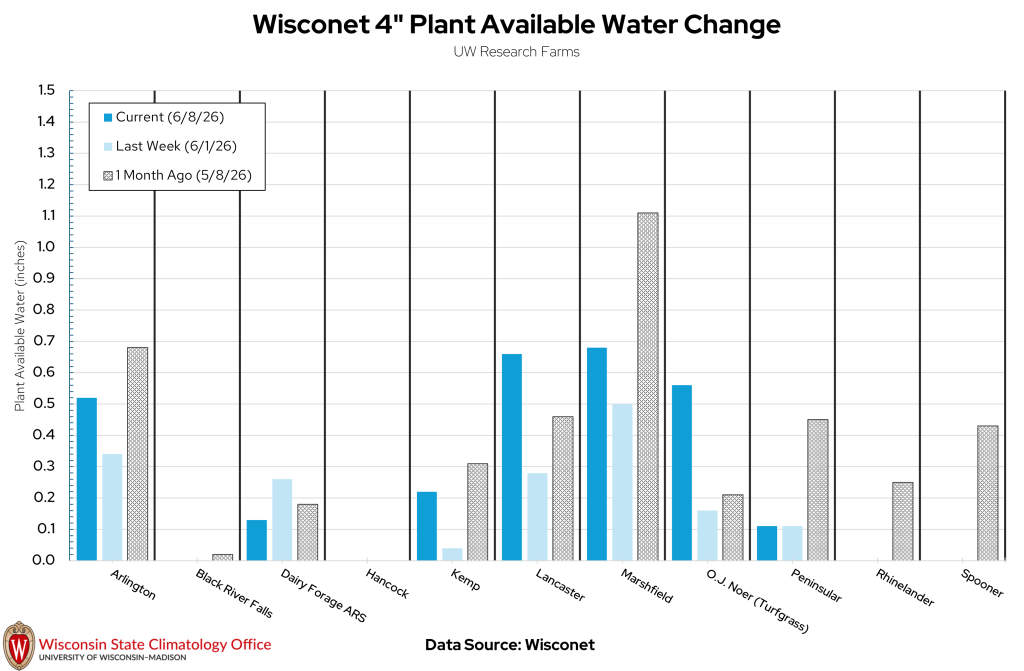
| Research Farm | Current 4″ Soil Moisture | Last Week’s 4″ Soil Moisture | 1 Month Ago 4″ Soil Moisture |
|---|---|---|---|
| Arlington | 0.52 | 0.34 | 0.68 |
| Black River Falls | 0.00 | 0.00 | 0.02 |
| Dairy Forage ARS | 0.13 | 0.26 | 0.18 |
| Hancock | 0.00 | 0.00 | 0.00 |
| Kemp | 0.22 | 0.04 | 0.31 |
| Lancaster | 0.66 | 0.28 | 0.46 |
| Marshfield | 0.68 | 0.50 | 1.11 |
| O.J. Noer (Turfgrass) | 0.56 | 0.16 | 0.21 |
| Peninsular | 0.11 | 0.11 | 0.45 |
| Rhinelander | 0.00 | 0.00 | 0.25 |
| Spooner | 0.00 | 0.00 | 0.43 |
USDA Soil Moisture Reports
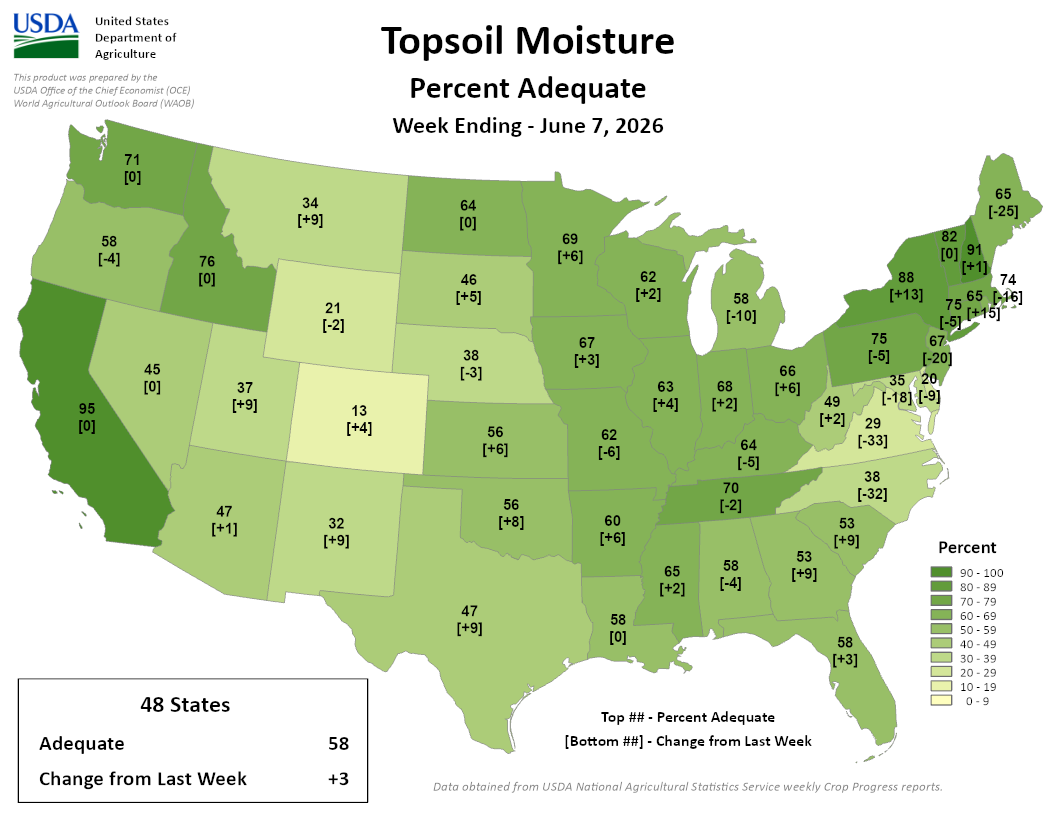
Image Description ↓
Choropleth map of the contiguous US showing topsoil moisture percent adequate by state, with green shading from light (0-9%) to dark (90-100%). State values [change from prior week]: Washington 71 [0], Oregon 58 [-4], Idaho 76 [0], California 95 [0], Nevada 45 [0], Utah 37 [+9], Arizona 47 [+1], Montana 34 [+9], Wyoming 21 [-2], Colorado 13 [+4], New Mexico 32 [+9], North Dakota 64 [0], South Dakota 46 [+5], Nebraska 38 [-3], Kansas 56 [+6], Oklahoma 56 [+8], Texas 47 [+9], Minnesota 69 [+6], Iowa 67 [+3], Missouri 62 [-6], Arkansas 60 [+6], Louisiana 58 [0], Wisconsin 62 [+2], Illinois 63 [+4], Mississippi 65 [+2], Alabama 58 [-4], Georgia 53 [+9], Michigan 58 [-10], Indiana 68 [+2], Kentucky 64 [-5], Tennessee 70 [-2], South Carolina 53 [+9], Florida 58 [+3], Ohio 66 [+6], West Virginia 49 [+2], North Carolina 35 [-18], Virginia 29 [-33], Maryland/Delaware 38 [-32], Pennsylvania 75 [-5], New York 88 [+13], Vermont 82 [0], New Hampshire 91 [+1], Maine 65 [-25], Massachusetts/Connecticut/Rhode Island 67 [-20], New Jersey 20 [-9], 74 [-16] (coastal Northeast region). Source: USDA National Agricultural Statistics Service weekly Crop Progress reports.
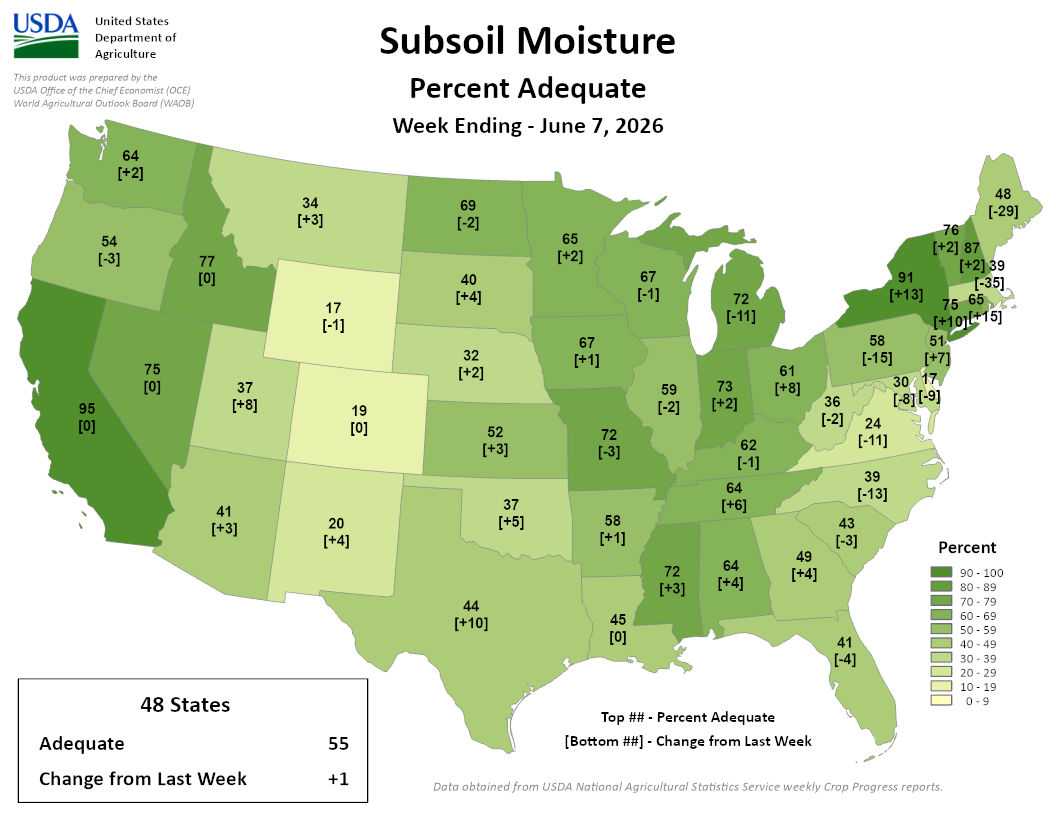
Image Description ↓
Choropleth map of the 48 contiguous states, shaded green by percent adequate subsoil moisture (scale: 0-9 to 90-100, darker = higher). Each state shows its percent value with change from last week in brackets. State values: WA 64 [+2], OR 54 [-3], CA 95 [0], ID 77 [0], NV 75 [0], UT 37 [+8], AZ 41 [+3], MT 34 [+3], WY 17 [-1], CO 19 [0], NM 20 [+4], ND 69 [-2], SD 40 [+4], NE 32 [+2], KS 52 [+3], OK 37 [+5], TX 44 [+10], MN 65 [+2], IA 67 [+1], MO 72 [-3], AR 58 [+1], LA 45 [0], WI 67 [-1], IL 59 [-2], MS 72 [+3], AL 64 [+4], GA 49 [+4], MI 72 [-11], IN 73 [+2], OH 61 [+8], KY 62 [-1], TN 64 [+6], FL 41 [-4], NY 75 [+10], PA 58 [-15], WV 36 [-2], VA 24 [-11], NC 39 [-13], SC 43 [-3], ME 48 [-29], VT 76 [+2], NH 87 [+2], MA 39 [-35], CT 91 [+13], RI 65 [+15], NJ 30 [-8], DE 17 [-9]. Source: USDA NASS weekly Crop Progress reports.
- 62% and 67% of agricultural soils in the state are reported as having adequate topsoil and subsoil moisture, respectively.
- 35% and 26% of agricultural soils in the state are reported as having short to very short topsoil and subsoil moisture, respectively.
Wisconet Soil Temperature
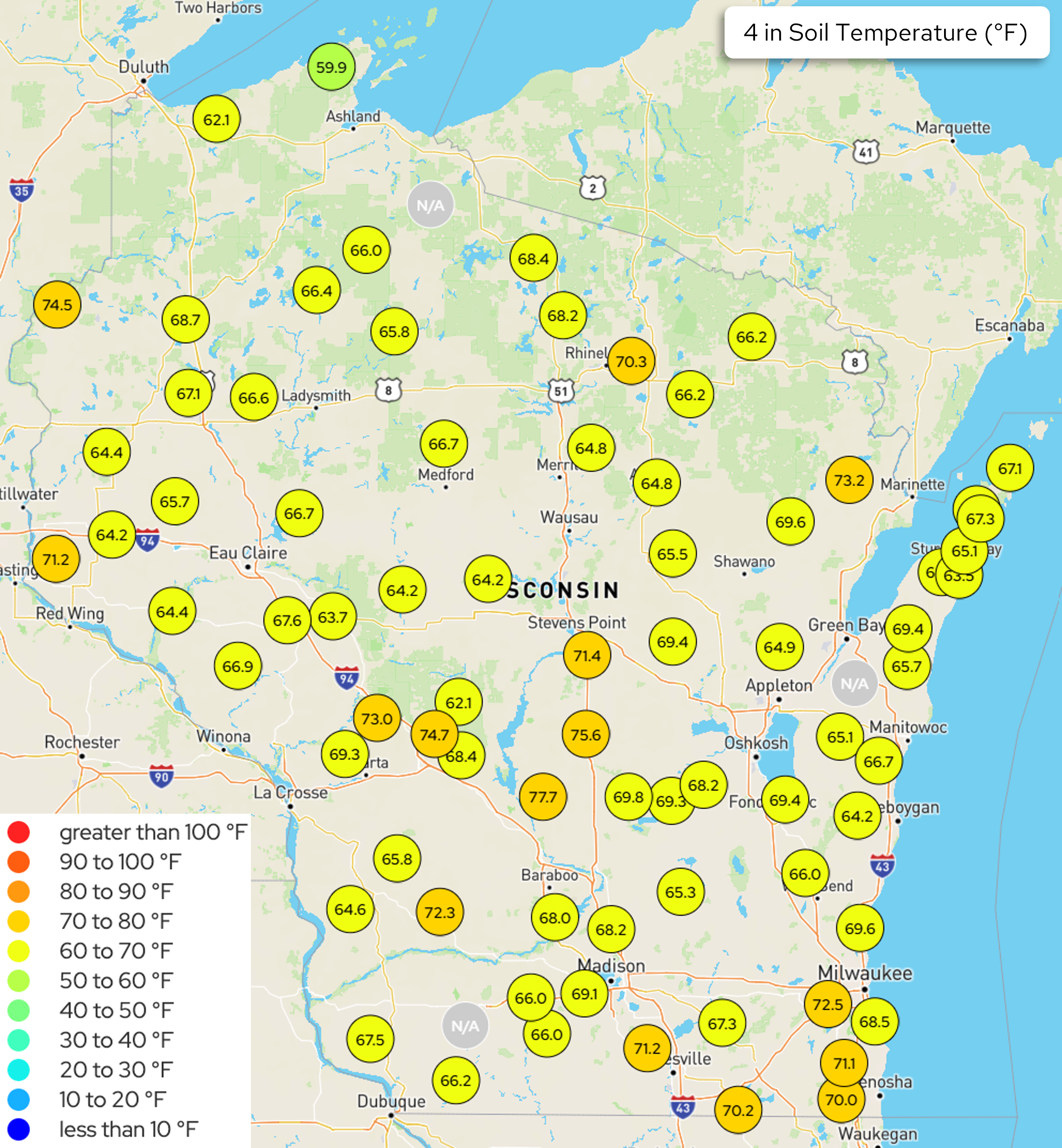
Image Description ↓
A color-coded map of Wisconsin and surrounding areas titled “4 in Soil Temperature (°F).” Circular markers at weather station locations display temperature readings, color-coded by range per the legend (yellow = 60-70°F, orange-yellow = 70-80°F, dark orange = 80-90°F, light green = 50-60°F, gray “N/A” = no data). Most of the state shows readings in the 60s, with values ranging from 59.9°F in the far north near Lake Superior to 77.7°F in central Wisconsin near Wautoma. Higher readings (70-77°F) appear scattered across central, southern, and southeastern Wisconsin, including near Eau Claire (74.5°F, 71.2°F), Tomah area (73.0°F, 74.7°F, 75.6°F), Rhinelander (70.3°F), Marinette (73.2°F), and the Milwaukee/Kenosha area (70-72.5°F). Two locations show “N/A” with no temperature data: one near Lake Superior and one near Lake Winnebago.
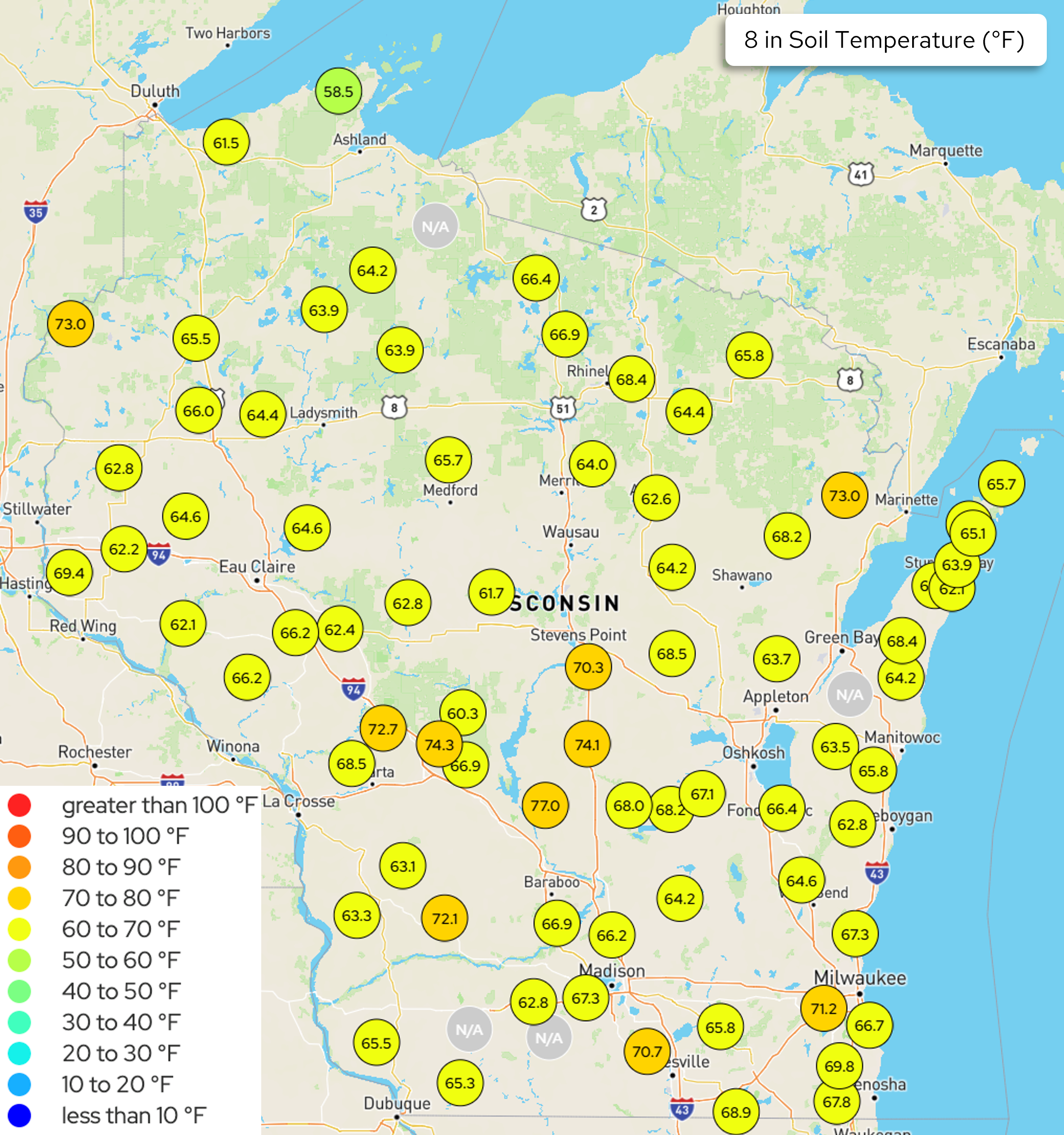
Image Description ↓
Map of Wisconsin and surrounding areas with circular markers showing 8-inch soil temperature readings in °F at various locations. Color-coded legend ranges from “less than 10°F” (blue) to “greater than 100°F” (red). Most values fall between 60-70°F (yellow), shown widely across the state. Several stations in the 70-80°F range (orange) appear in west-central and central Wisconsin, including readings of 73.0, 72.7, 74.3, 70.3, 74.1, 77.0, 72.1, 70.7, and 71.2. One station near the Lake Superior shore shows 58.5°F (light green), in the 50-60°F range. A few stations are marked “N/A” in gray. Individual readings range roughly from 58.5°F to 77.0°F.
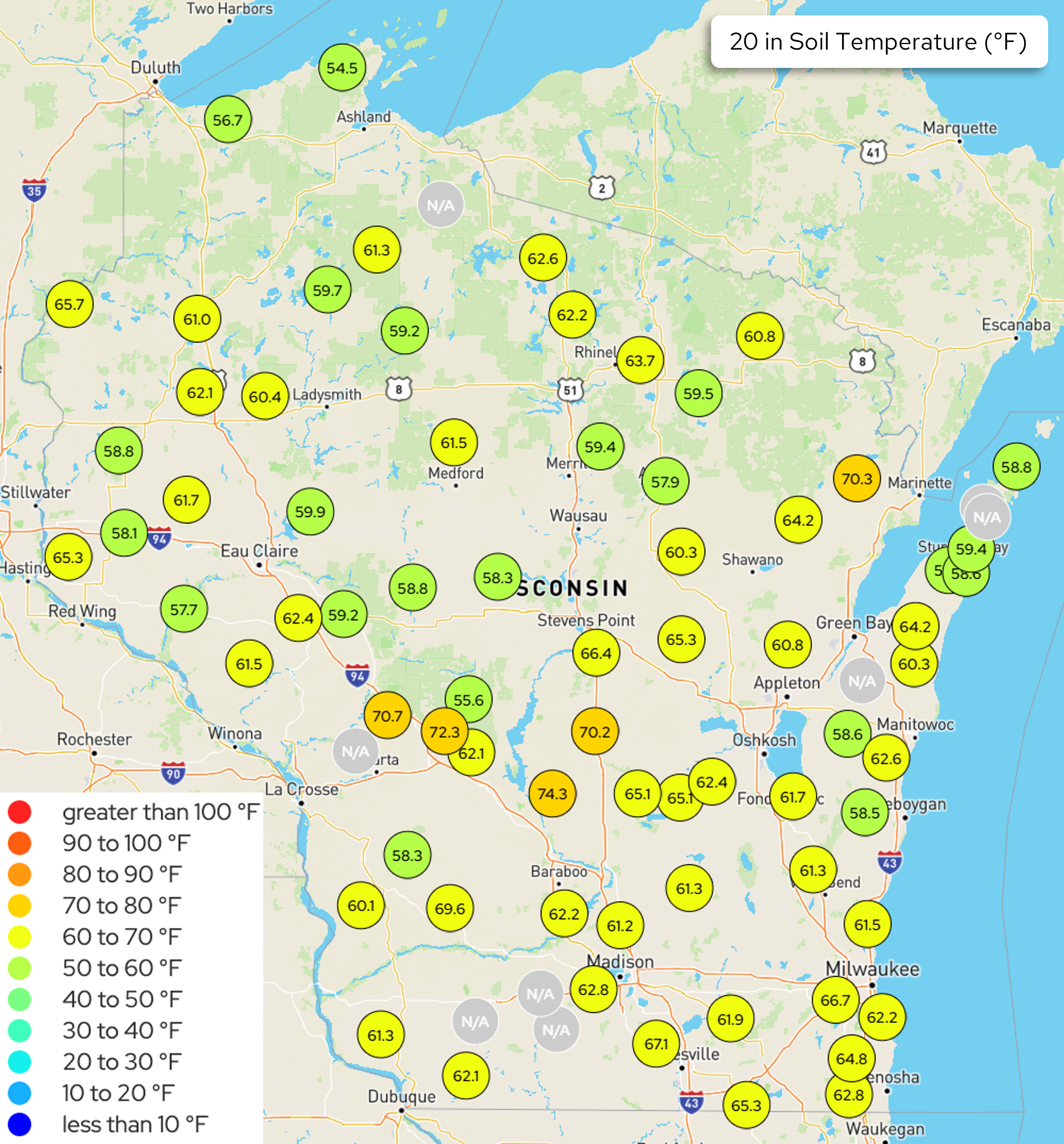
Image Description ↓
Map of Wisconsin and surrounding areas (Minnesota, Michigan, Iowa, Illinois borders) displaying 20-inch soil temperature readings (°F) at numerous monitoring stations as color-coded circles. Most values fall in the 55–66°F range (yellow and light green), with a cluster of higher readings (70–74°F, orange) in the central-south region near Wisconsin Rapids/Hatfield. Several stations show “N/A” (gray). A legend in the bottom left maps colors to temperature ranges from “less than 10°F” to “greater than 100°F.” Title reads “20 in Soil Temperature (°F).”
- The maps show daily average Wisconet soil temperature conditions on June 8th.
U.S. Drought Monitor
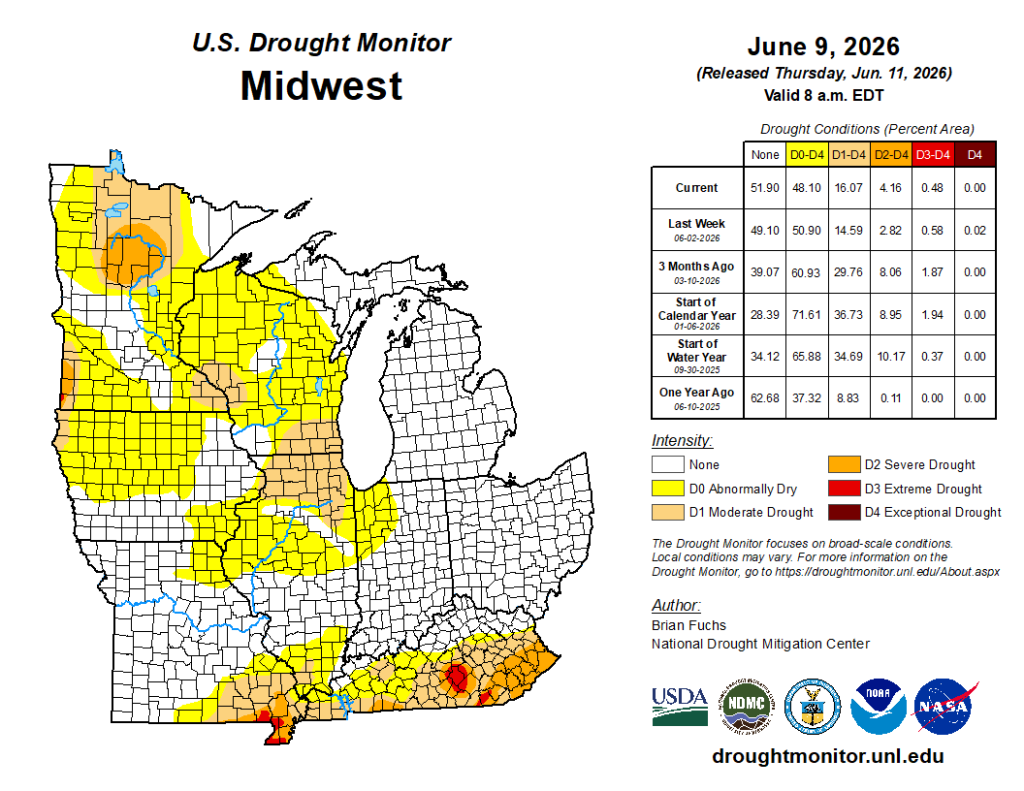
Image Description ↓
Map showing drought conditions across Midwest states (MN, WI, IA, IL, MO, IN, OH, MI). Areas of D0 (Abnormally Dry) and D1 (Moderate Drought) span much of Iowa, southern Minnesota, Wisconsin, and Illinois, with patches of D2 (Severe Drought) in northern Minnesota and a band across southern Indiana/Kentucky border into Missouri’s bootheel, including small areas of D3 (Extreme Drought). Accompanying table shows percent area by category: Current – None 51.90%, D0-D4 48.10%, D1-D4 16.07%, D2-D4 4.16%, D3-D4 0.48%, D4 0.00%. Comparisons given for last week, 3 months ago, start of calendar year, start of water year, and one year ago, showing drought conditions have increased significantly compared to one year ago (37.32% D0-D4 then vs. 48.10% now). Source: National Drought Mitigation Center, USDA, NOAA, NASA. droughtmonitor.unl.edu.
Compared to last week:
- Midwest: D1 and D2 drought coverage increased by 1-2%, primarily across northern MN. Elsewhere, there were localized areas of 1 class drought improvement.
- 83.9% of the Midwest region is drought free (~16.1% in D1-D4).
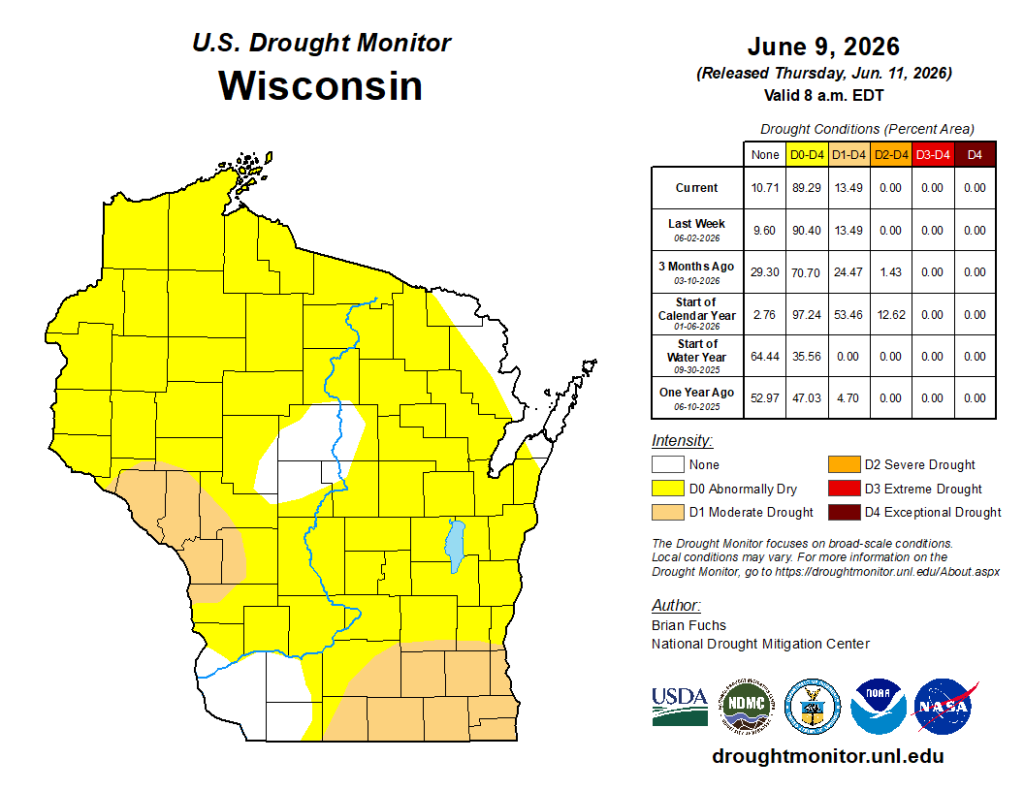
Image Description ↓
Wisconsin map with most of the state shaded yellow (D0 – Abnormally Dry) and patches of tan (D1 – Moderate Drought) in southwestern and south-central counties along the Illinois border. Small white (no drought) areas appear near Door County and the southern border. A data table shows drought conditions over time: Current (None 10.71%, D0-D4 89.29%, D1-D4 13.49%, D2-D4 0%, D3-D4 0%, D4 0%); Last Week 06-02-2026 (9.60%, 90.40%, 13.49%, 0%, 0%, 0%); 3 Months Ago 03-10-2026 (29.30%, 70.70%, 24.47%, 1.43%, 0%, 0%); Start of Calendar Year 01-06-2026 (2.76%, 97.24%, 53.46%, 12.62%, 0%, 0%); Start of Water Year 09-30-2025 (64.44%, 35.56%, 0%, 0%, 0%, 0%); One Year Ago 06-10-2025 (52.97%, 47.03%, 4.70%, 0%, 0%, 0%). Author: Brian Fuchs, National Drought Mitigation Center. Source: droughtmonitor.unl.edu.
- Wisconsin: D0 coverage decreased slightly (1.1%), primarily in southwest counties. D1 coverage was unchanged.
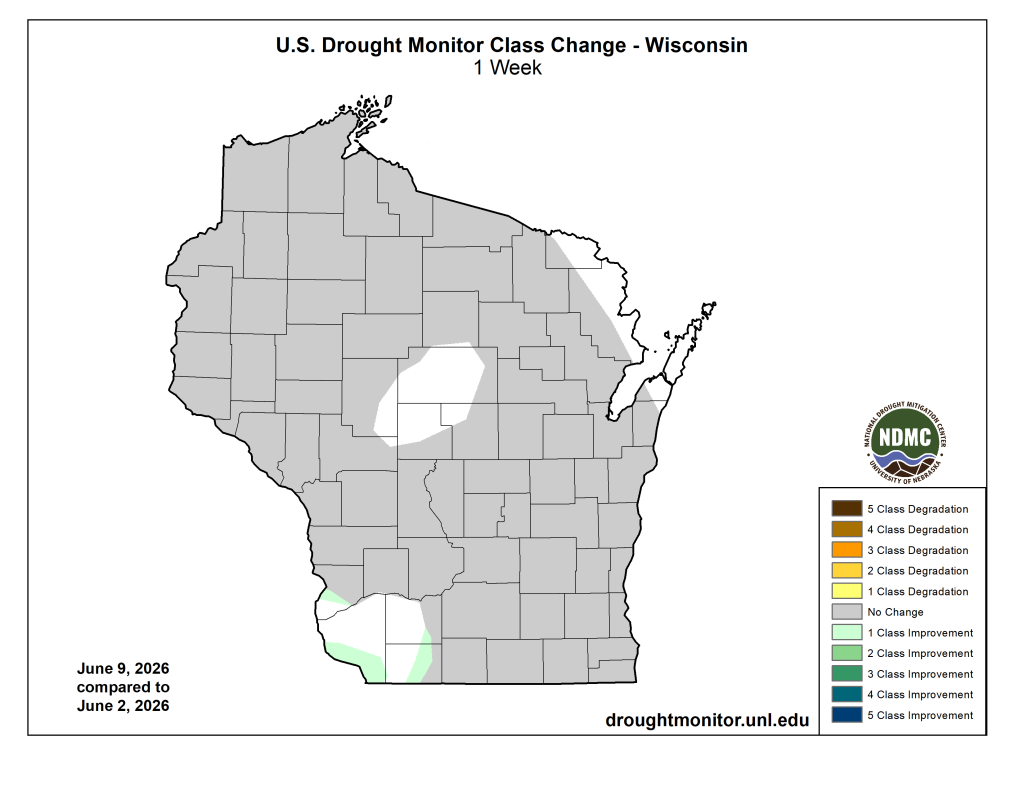
Image Description ↓
Map titled “U.S. Drought Monitor Class Change – Wisconsin, 1 Week,” dated June 9, 2026 compared to June 2, 2026. Most of Wisconsin shows no change (gray). A small area in southwestern Wisconsin (along the Mississippi River and southern border counties) shows 1 class improvement (light green). Source: droughtmonitor.unl.edu, NDMC/University of Nebraska logo included.
- Most areas in WI had no drought class change compared to last week
U.S. Drought Monitor Time Series
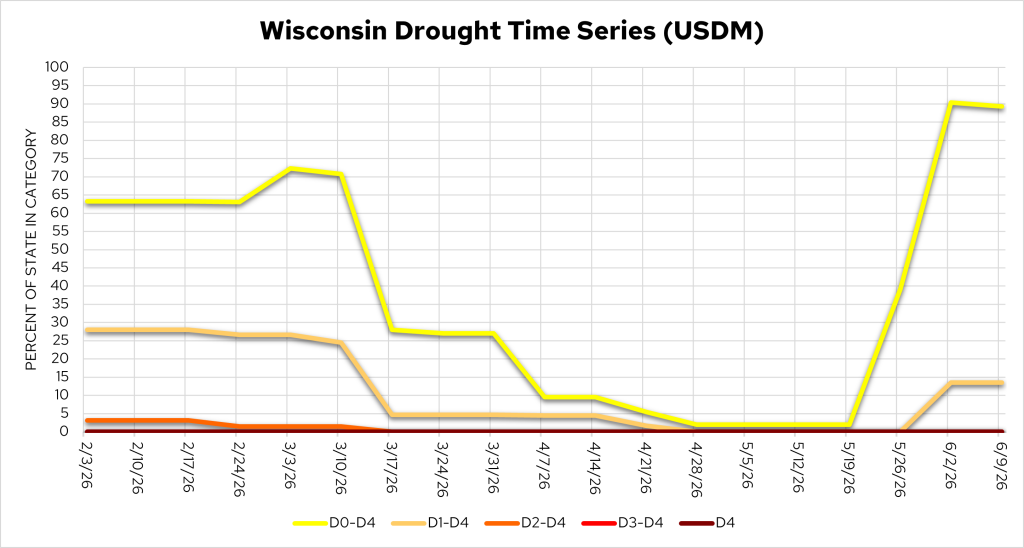
Image Description ↓
Line chart titled “Wisconsin Drought Time Series (USDM)” showing percent of state area in drought categories D0-D4, D1-D4, D2-D4, D3-D4, and D4 from 2/3/26 to 6/9/26. D0-D4 (any drought/abnormally dry) starts near 63%, rises to about 72% by 3/3/26, holds near 70% through 3/10/26, then drops sharply to about 28% by 3/17/26, stays near 27% through 3/31/26, declines to about 9% by 4/7/26, remains near 9% through 4/14/26, falls to about 2-3% by late April, and stays near 0-3% through mid-May. It then rises sharply from about 3% on 5/19/26 to roughly 90% by 6/2/26, holding near 89% through 6/9/26. D1-D4 (moderate drought or worse) starts near 28%, declines gradually to about 24% by 3/10/26, drops to roughly 4% by 3/17/26, holds near 4% through mid-April, declines to near 0% by late April through late May, then rises to about 13-14% by early June. D2-D4 (severe drought or worse) starts near 3%, declines gradually to near 0% by mid-March and remains at 0% for the rest of the period. D3-D4 and D4 (extreme and exceptional drought) remain at 0% throughout the entire period.
- Minimal change compared to last week.
Temperature Trends
7 Day Temperatures
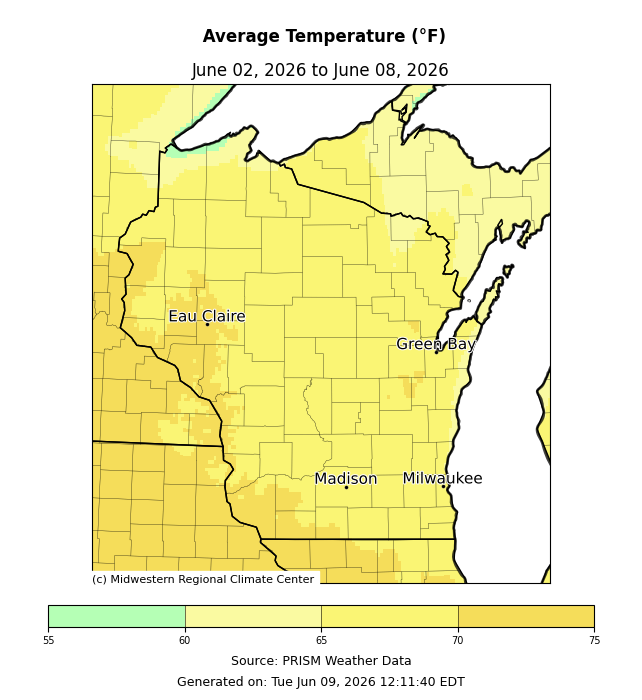
Image Description ↓
Color-coded map titled “Average Temperature (°F), June 02, 2026 to June 08, 2026,” sourced from PRISM Weather Data via Midwestern Regional Climate Center, generated June 9, 2026. A legend ranges from 55°F (teal) to 75°F (dark orange). Most of Wisconsin shows yellow shading (60–70°F). Northern areas near Lake Superior show teal/light green (55–60°F). Southern and southwestern Wisconsin show darker orange (70–75°F). Cities labeled: Eau Claire, Green Bay, Madison, and Milwaukee.
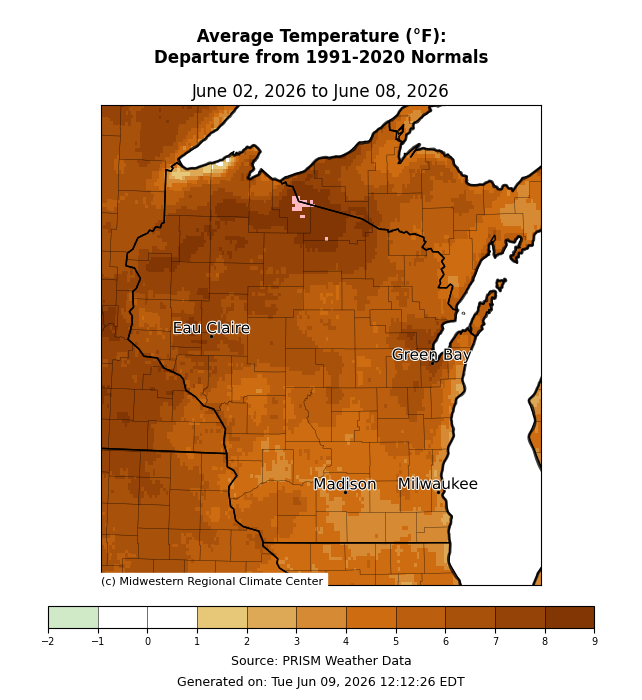
Image Description ↓
Title “Average Temperature (°F): Departure from 1991-2020 Normals, June 02, 2026 to June 08, 2026.” A map of Wisconsin with surrounding states and Lake Michigan, shaded in shades of orange and brown indicating temperatures 3-9°F above the 1991-2020 normal across nearly the entire state. A small pink area near the Wisconsin-Michigan border (north-central Wisconsin) shows temperatures 1-2°F below normal. Cities labeled: Eau Claire, Green Bay, Madison, and Milwaukee. A color scale legend at the bottom ranges from -2 to 9°F. Source: PRISM Weather Data, Midwestern Regional Climate Center. Generated Tue Jun 09, 2026 12:12:26 EDT.
- Average temperatures ranged from 70-75°F along the Mississippi River to 55-65°F along Lake Superior and Lake Michigan.
- Temperatures were 5-7°F above normal across most of the state, with the northern counties being the most above normal.
30 Day Temperatures
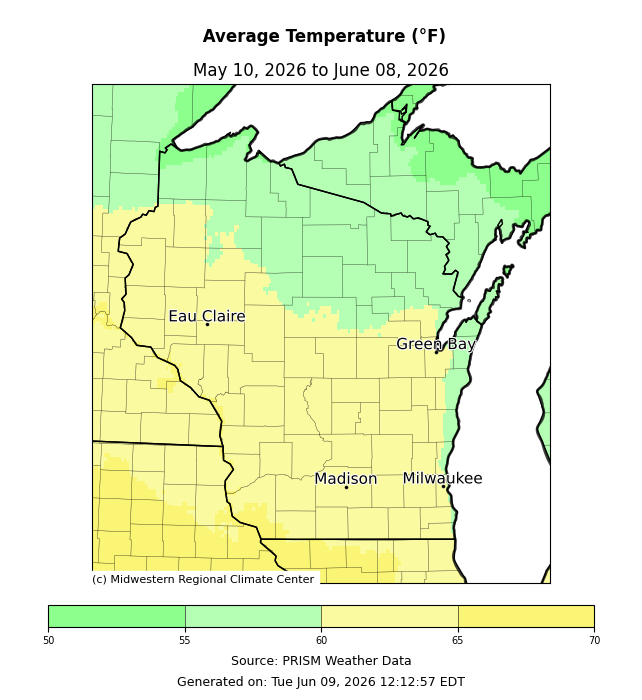
Image Description ↓
Title “Average Temperature (°F), May 10, 2026 to June 08, 2026.” Map of Wisconsin and surrounding areas color-coded by temperature, with green shades (50–60°F) across northern Wisconsin and yellow shades (60–70°F) across southern and central Wisconsin, indicating warmer temperatures in the south. Cities labeled: Eau Claire, Green Bay, Madison, and Milwaukee. A color scale legend at the bottom spans 50 to 70°F. Source: PRISM Weather Data, Midwestern Regional Climate Center. Generated Tue Jun 09, 2026, 12:12:57 EDT.
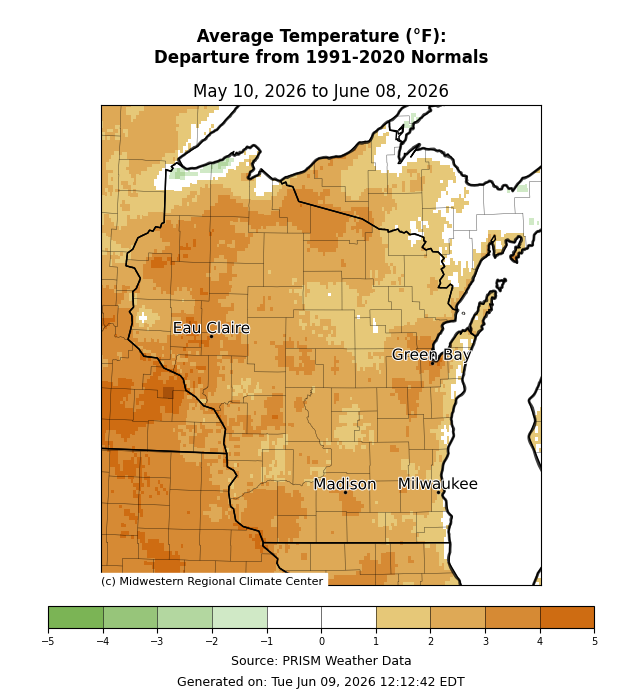
Image Description ↓
Map titled “Average Temperature (°F): Departure from 1991-2020 Normals, May 10, 2026 to June 08, 2026.” Most of Wisconsin shows shades of orange indicating temperatures 1–3°F above normal, with darker orange (3–5°F above normal) in southwestern and far southern counties. A small green patch (1–2°F below normal) appears near the Lake Superior shoreline in the north. White/near-white areas (near normal) appear in parts of northeastern Wisconsin and along the Lake Michigan shoreline near Green Bay and the Door Peninsula. Cities labeled: Eau Claire, Green Bay, Madison, and Milwaukee. A color scale legend ranges from -5 to 5°F. Source: PRISM Weather Data, Midwestern Regional Climate Center. Generated Tue Jun 09, 2026 12:12:42 EDT.
Growing Degree Days (Base 50°F)
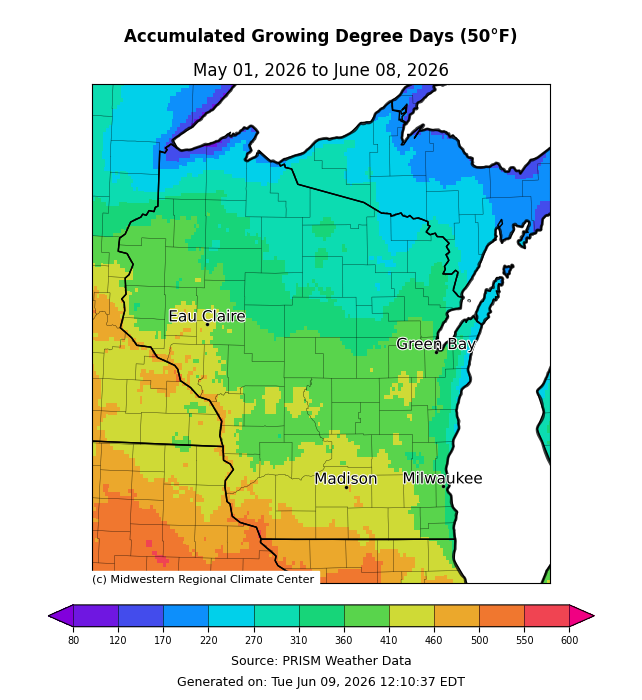
Image Description ↓
Color-coded map titled “Accumulated Growing Degree Days (50°F), May 01, 2026 to June 08, 2026,” sourced from PRISM Weather Data via the Midwestern Regional Climate Center, generated June 9, 2026. A legend ranges from 80 (purple) to 600 (red/pink) GDD. Northern Wisconsin shows lowest accumulations (170–270, blue/teal), central Wisconsin shows moderate values (310–410, green), and southern Wisconsin shows highest accumulations (410–510, yellow/orange/red). Eau Claire and Green Bay are in the moderate (green) zone; Madison and Milwaukee are in the higher (orange-yellow) zone.
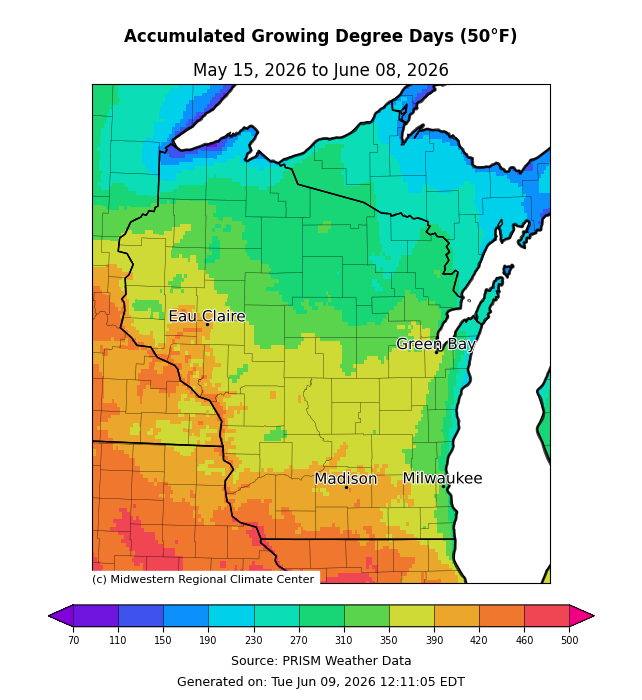
Image Description ↓
Color-coded Wisconsin map titled “Accumulated Growing Degree Days (50°F), May 15, 2026 to June 08, 2026.” A gradient scale from purple (70) through blue, teal, green, yellow, orange, to red (500) shows GDD values. Northern Wisconsin and areas near Lake Superior show lowest values (blue/teal, ~150–230). Central Wisconsin shows mid-range values (green/yellow, ~270–350). Southern Wisconsin shows highest values (orange/red, ~390–500), with the southwest corner reaching the highest range. Cities labeled: Eau Claire, Green Bay, Madison, and Milwaukee. Source: PRISM Weather Data, courtesy Midwestern Regional Climate Center. Generated Tue Jun 09, 2026 12:11:05 EDT.
- Starting May 1 – Growing degree day accumulation ranges from 550 GDD in the far south and west to 270 GDD in the far north. These values are 110-120% of normal.
- Starting May 15 – Growing degree day accumulation ranges from 420 GDD in the far south and west to 230 GDD in the far north. These values are 130-140% of normal.
Crop Progress and Condition
Crop Progress Report for Wisconsin for the Week Ending on June 7, 2026
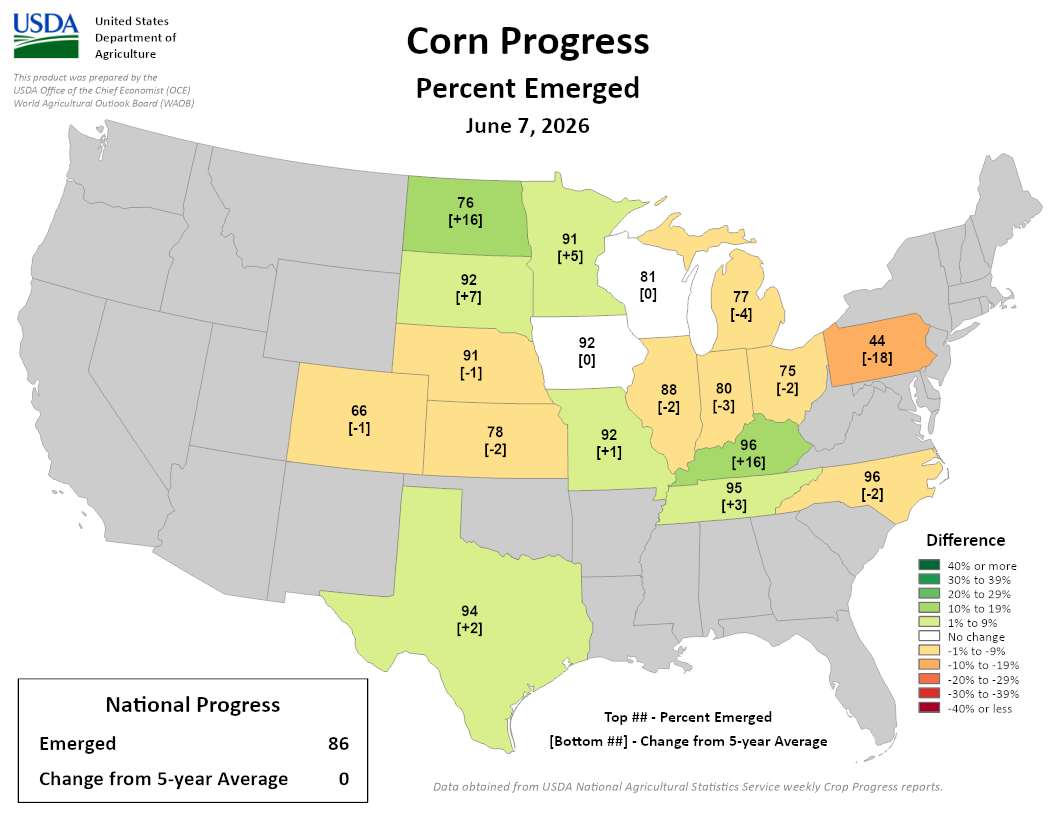
Image Description ↓
Choropleth map of US states showing corn percent emerged with change from 5-year average in brackets. North Dakota 76 [+16], Minnesota 91 [+5], South Dakota 92 [+7], Wisconsin 81 [0], Iowa 92 [0], Nebraska 91 [-1], Colorado 66 [-1], Kansas 78 [-2], Missouri 92 [+1], Illinois 88 [-2], Indiana 80 [-3], Ohio 75 [-2], Pennsylvania 44 [-18], Michigan 77 [-4], Kentucky 96 [+16], Tennessee 95 [+3], North Carolina 96 [-2], Texas 94 [+2]. Color scale ranges from dark green (40%+ above average) through light green, white (no change), to orange/red (below average).
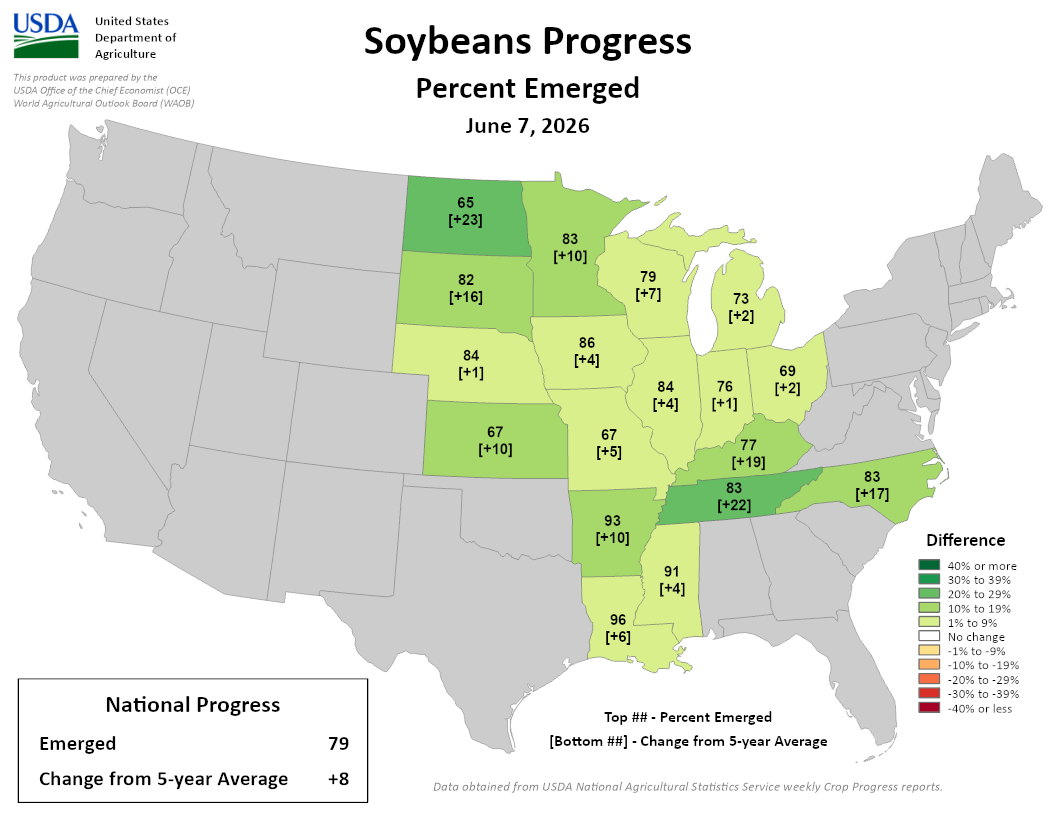
Image Description ↓
Choropleth map of central/eastern US states, shaded by deviation from 5-year average percent emerged (scale: 40%+ to -40% or less, dark green to dark red, white = no change). Each state shows percent emerged followed by change in brackets. North Dakota 65 [+23], Minnesota 83 [+10], South Dakota 82 [+16], Wisconsin 79 [+7], Michigan 73 [+2], Nebraska 84 [+1], Iowa 86 [+4], Illinois 84 [+4], Indiana 76 [+1], Ohio 69 [+2], Kansas 67 [+10], Missouri 67 [+5], Kentucky 77 [+19], North Carolina 83 [+17], Tennessee 83 [+22], Arkansas 93 [+10], Mississippi 91 [+4], Louisiana 96 [+6]. Most states are shaded light green (1-9% above average) except North Dakota (dark green, 20-29% range) and Iowa/Nebraska (very pale, near no change).
- Wisconsin had 5.7 days suitable for fieldwork statewide, thanks to warm and dry conditions up until later in the week.
- Corn is 97% planted and 81% emerged.
- Soybeans are 95% planted and 79% emerged.
- Corn and soybean conditions are 79% good to excellent for both crops.
- Oats are 88% emerged and 17% headed. Oat condition is 79% good to excellent.
- Pasture and range were rated 61% good to excellent, up 3 percentage points from last week. Winter wheat is 53% headed and is rated 68% good to excellent (up 2% from last week).
- The first cutting of alfalfa is 70% complete.
- Read the full USDA report.
Forecasts and Outlooks
7 Day Precipitation Forecast
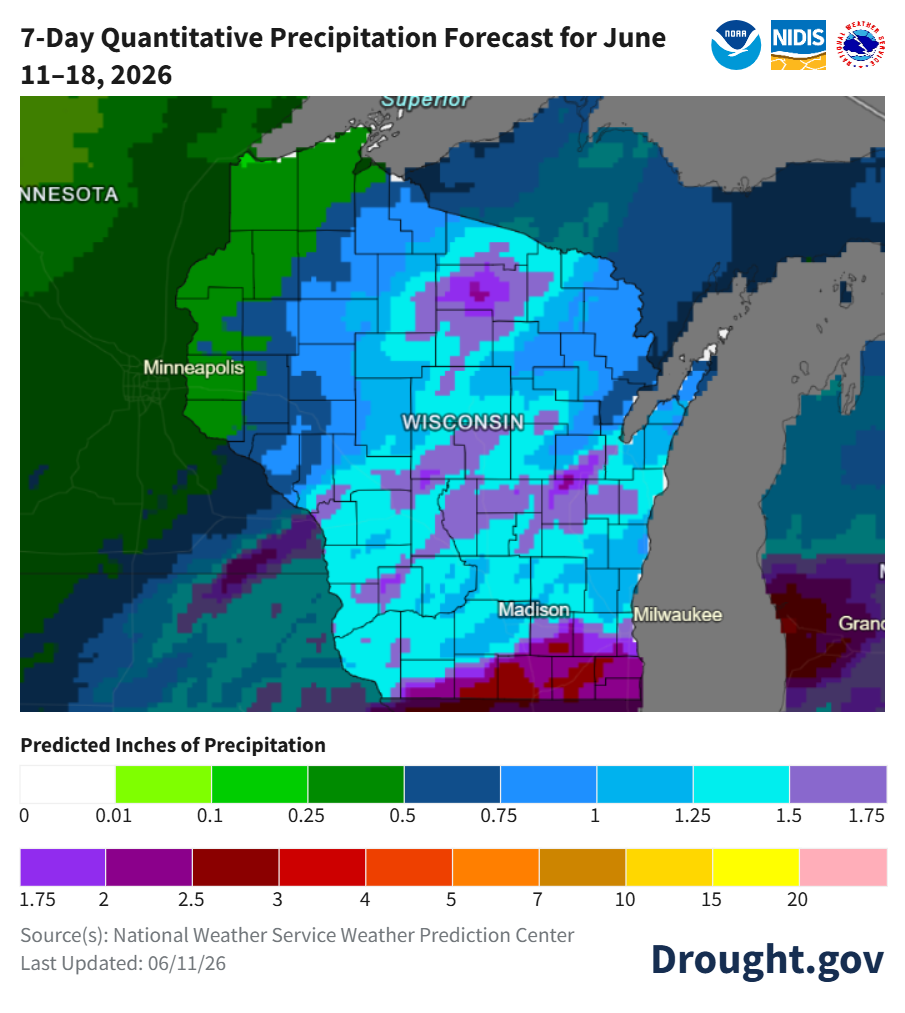
Image Description ↓
NOAA/NWS map titled “7-Day Quantitative Precipitation Forecast for June 11–18, 2026,” covering Wisconsin, Minnesota, and Lake Superior/Michigan region. A color-coded legend ranges from 0 to 20+ inches. Most of Wisconsin is shaded light blue and cyan, indicating 1–1.5 inches of predicted precipitation, with patches of purple (1.75–2 inches) near central Wisconsin and along the southern border into Illinois. Northwestern Wisconsin and Minnesota show green shading (0.1–0.5 inches), indicating lower precipitation totals. Areas east of Lake Michigan show dark blue (0.5–0.75 inches). Source: National Weather Service Weather Prediction Center. Last updated 06/11/26.
- When? –There are multiple days with rain chances next week, with the best chances on Thursday (6/11), Friday (6/12), and Wednesday (6/17).
- Where? – Rain chances are higher along the Illinois border and lower in the northwest.
- Be aware of the potential for flooding from heavy rainfall on Thursday (6/11).
- Check your local forecast for details on totals and timing.
- Average precip (1991-2020) for this week: 0.98”.
8-14 Day Temperature and Precipitation Outlook
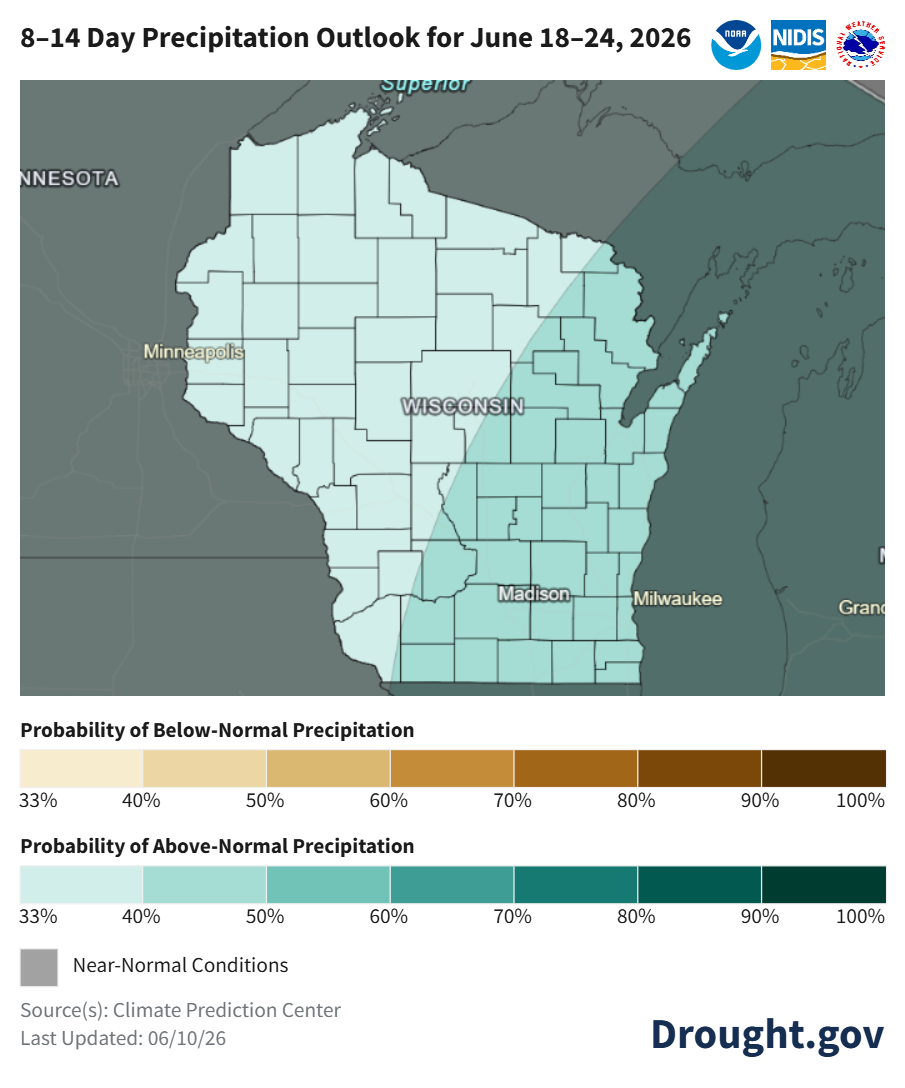
Image Description ↓
Map titled “8–14 Day Precipitation Outlook for June 18–24, 2026” with NOAA, NIDIS, and National Weather Service logos. Wisconsin is divided diagonally: the northwestern two-thirds shows “Near-Normal Conditions” (gray), while the southeastern third, including Madison and Milwaukee, shows a 33–40% probability of above-normal precipitation (light teal). Two color-scale legends show probability of below-normal precipitation (tan to brown, 33–100%) and above-normal precipitation (light teal to dark green, 33–100%). Source: Climate Prediction Center. Last updated 06/10/26. Drought.gov logo in bottom right.
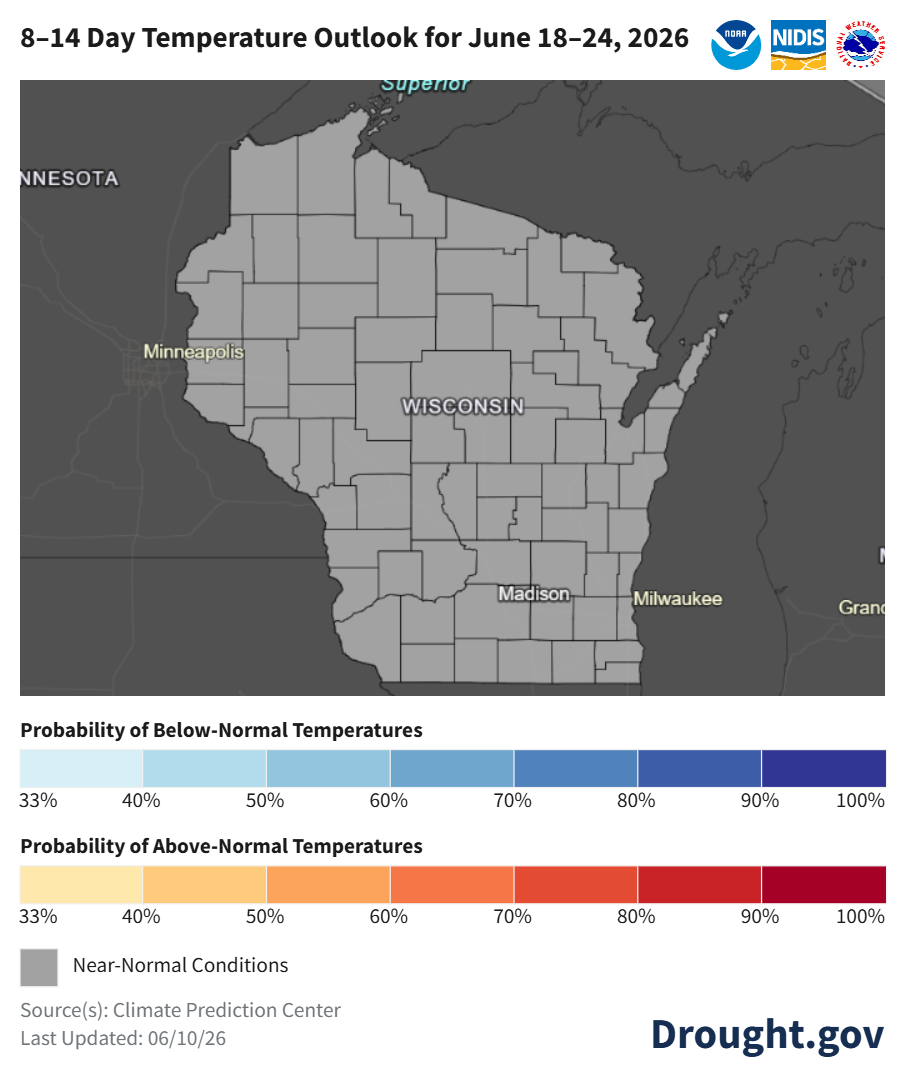
Image Description ↓
Map titled “8-14 Day Temperature Outlook for June 18-24, 2026” from NOAA/NIDIS/Climate Prediction Center, dated 06/10/26. Wisconsin and surrounding region shown in gray, indicating “Near-Normal Conditions” (equal chances category) with no above- or below-normal temperature probability assigned. Two color-scale legends are shown but unused: “Probability of Below-Normal Temperatures” (blue gradient, 33%-100%) and “Probability of Above-Normal Temperatures” (orange-red gradient, 33%-100%). Source: Climate Prediction Center, via Drought.gov.
- Mid-to-Late June: Temperature probabilities are leaning towards near normal statewide, with precipitation leaning towards above normal. The chances for above normal precipitation are higher on the eastern side of the state (40-50%).
- Statewide normals (1991-2020) for June 18-24 are 66.6°F and 1.28”.
30 Day Temperature and Precipitation Outlook
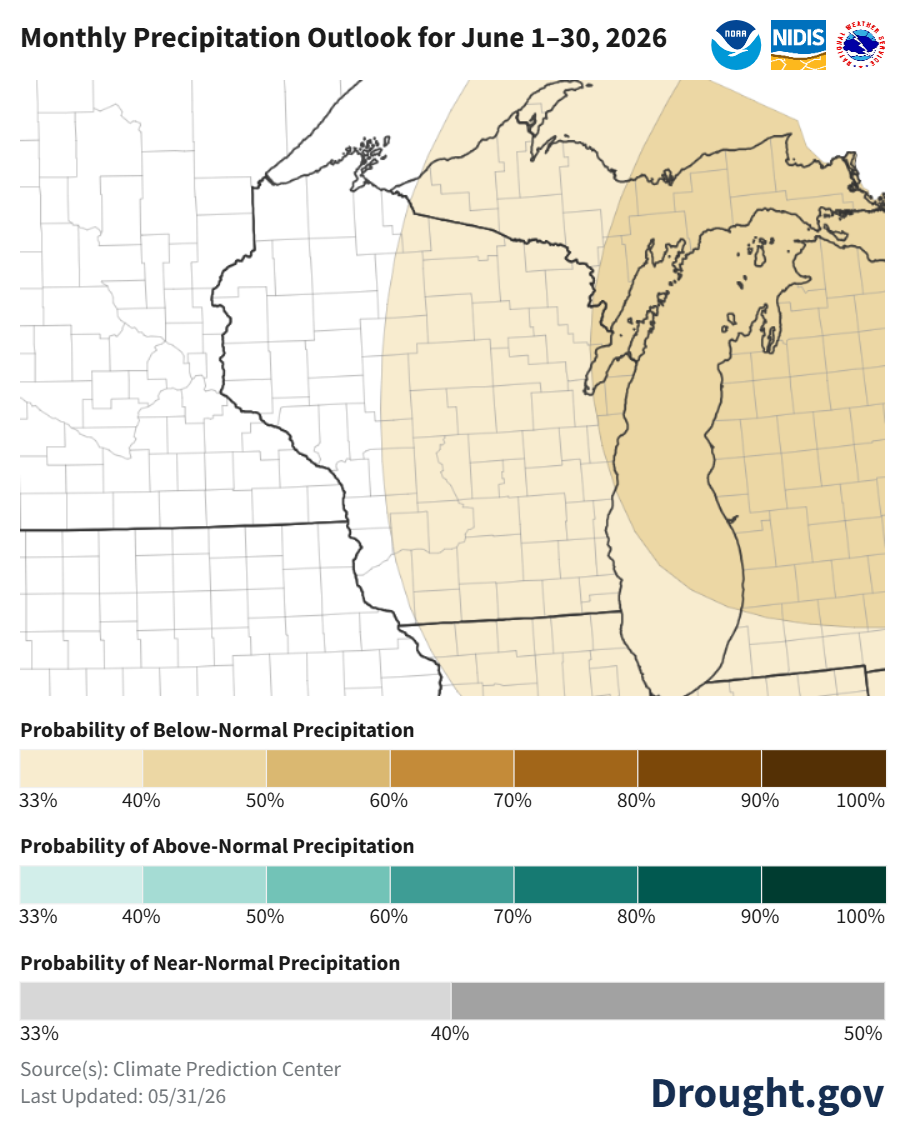
Image Description ↓
Title: “Monthly Precipitation Outlook for June 1–30, 2026,” from NOAA/NIDIS Climate Prediction Center, last updated 05/31/26. Map of Wisconsin, Michigan, and surrounding states shows a shaded region covering eastern Wisconsin and all of Michigan, indicating 33–40% probability of below-normal precipitation (lightest tan), with a slightly darker tan band over central/eastern Michigan indicating 40–50% probability. Western Wisconsin and other states show no shading (no defined outlook). Three legend bars show color scales for probability of below-normal precipitation (tan to dark brown, 33–100%), above-normal precipitation (light to dark teal, 33–100%), and near-normal precipitation (light to dark gray, 33–50%). Source: Drought.gov.
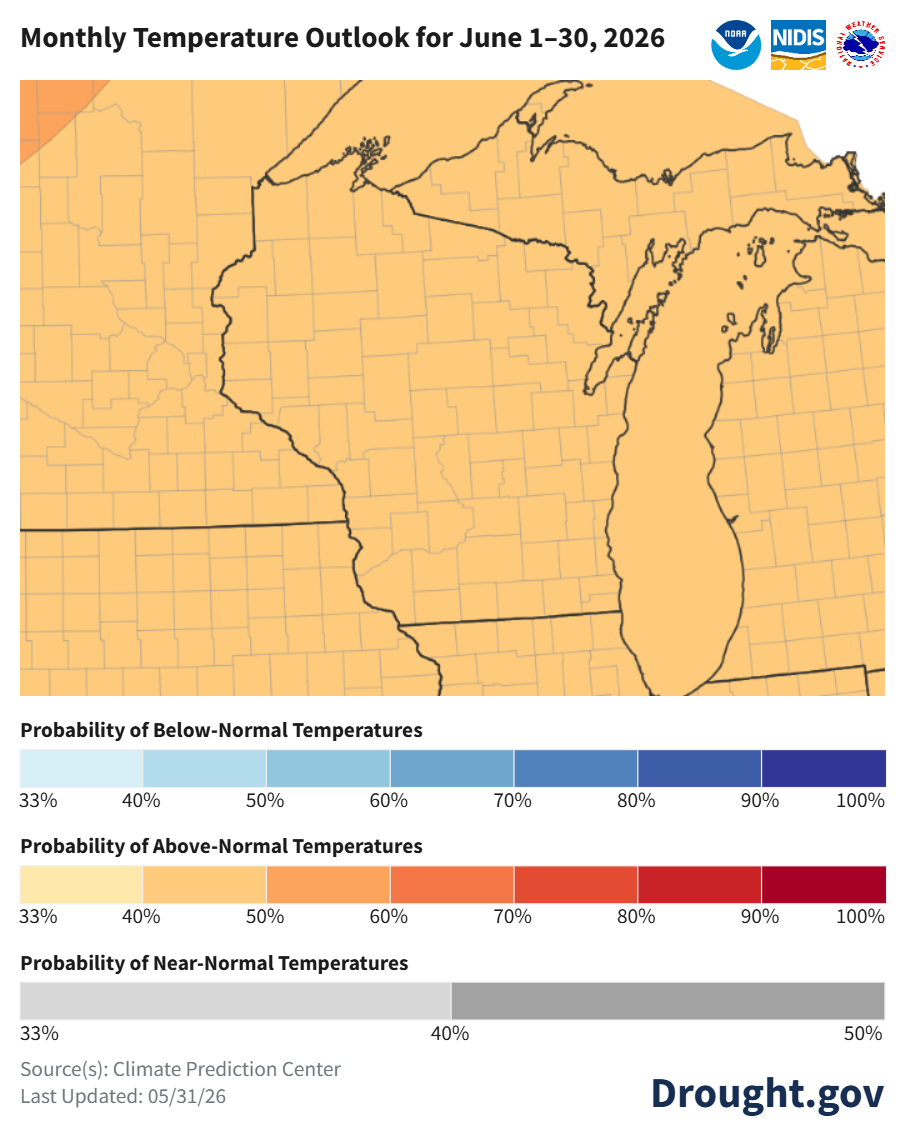
Image Description ↓
NOAA Climate Prediction Center map for June 1–30, 2026, covering Wisconsin, Michigan, and surrounding areas. Most of the region is shaded light orange, indicating a 33–40% probability of above-normal temperatures. A small area in the northwest corner is shaded darker orange, indicating 40–50% probability of above-normal temperatures. The map includes legends for probability of below-normal (blue scale), above-normal (orange-red scale), and near-normal (gray scale) temperatures, each ranging from 33% to 100% (near-normal capped at 50%). Source: Climate Prediction Center. Last updated 05/31/26.
- June: Temperatures are leaning towards being warmer-than-normal (40-50% odds). Precipitation is leaning drier-than-normal across most of Wisconsin (33-40% odds). Further west, precipitation is more uncertain.
- Statewide normals (1991-2020) for June 1-30 are 65.1°F and 4.69”.
90 Day Temperature and Precipitation Outlook
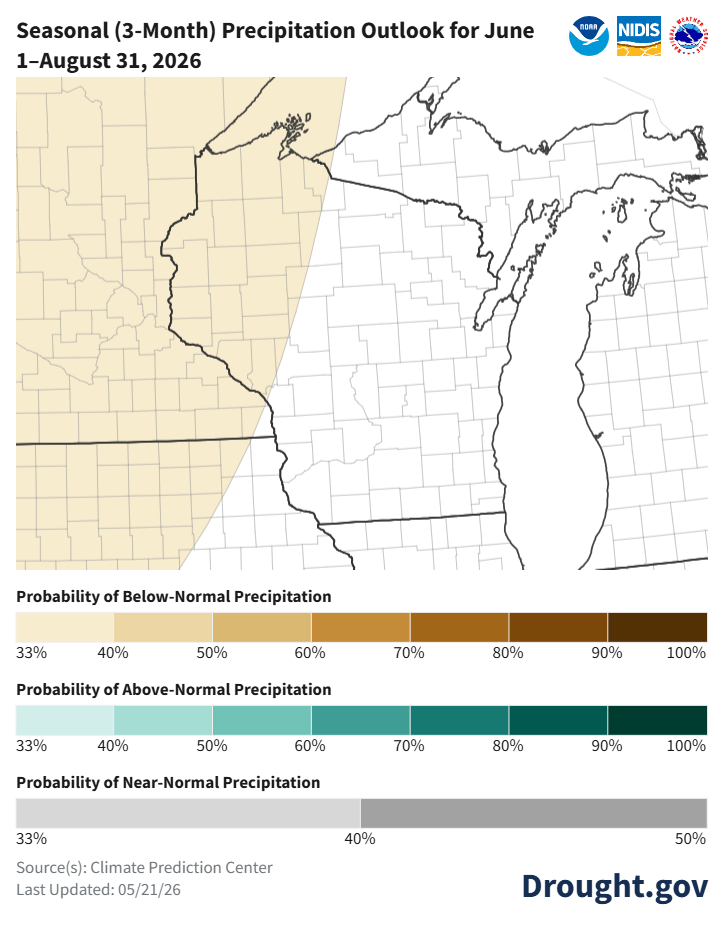
Image Description ↓
NOAA Climate Prediction Center seasonal precipitation outlook map for June 1–August 31, 2026. A tan-shaded region covering Wisconsin, eastern Minnesota, and parts of Iowa and Illinois indicates 33-50% probability of below-normal precipitation, using the lightest two shades on the below-normal scale (33% and 40%). Michigan and the surrounding white area indicate “equal chances” (no leaning forecast). Three legend bars show probability scales for below-normal (33-100%, tan to dark brown), above-normal (33-100%, light to dark teal), and near-normal (33-50%, light to dark gray) precipitation. Source: Climate Prediction Center, last updated 05/21/26.
Image Description ↓
Map from NOAA/NIDIS/Climate Prediction Center (Drought.gov), titled “Seasonal (3-Month) Temperature Outlook for June 1–August 31, 2026,” depicting Wisconsin, Lake Michigan, and surrounding states/counties with no color-coded data displayed (blank/outline only). Three legend scales are shown below the map: “Probability of Below-Normal Temperatures” (light blue to dark blue, 33%–100%), “Probability of Above-Normal Temperatures” (light yellow to dark red, 33%–100%), and “Probability of Near-Normal Temperatures” (light to dark gray, 33%–50%). Source: Climate Prediction Center. Last updated 05/21/26.
- June-August: Temperatures and precipitation are uncertain currently with equal chances for above-, near-, or below-normal conditions. The exception is northwest Wisconsin, which shows a slight lean (33-40% chance) towards below normal precipitation.
- Statewide normals (1991-2020) for June-August are 67.2°F and 12.63”.
User Survey
Are you a regular user of the Ag Weather Outlook for Wisconsin (AgWOW)? Or maybe you are viewing this page for the first time this week? Either way, we want to hear your feedback on this resource! Please take a few minutes and fill out this survey. Your feedback will help us better serve your ag-weather data needs through AgWOW.
If you have any trouble accessing or filling out the survey, please email Josh Bendorf at jbendorf@wisc.edu. Thank you!