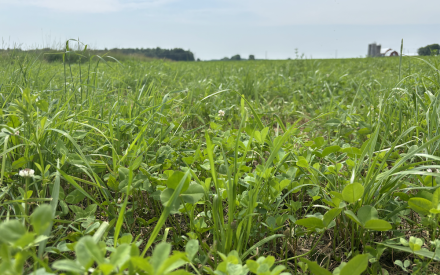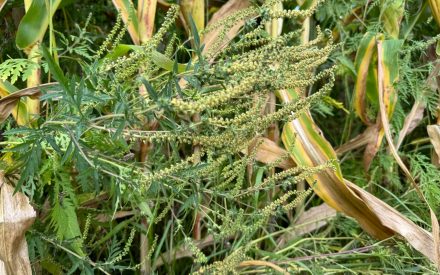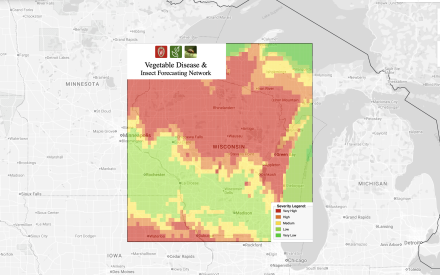
The true armyworm is a common spring insect pest found each year in Wisconsin crop fields and pasture locations. Adult moths migrate north in the spring in search of food and habitat to begin mating and egg laying. Eggs are laid primarily in lush green grass which serves as protection and a nutritious source of food for newly hatched larvae. Farmers and crop consultants rely on moth trapping reports and degree-day models to pinpoint a timely crop scouting timeline. The WI DATCP Black Light Trap network is a tool to assist with predicting the population of true armyworms by monitoring moth flight numbers each spring. Higher than normal moth flights suggest an elevated risk of crop and pasture damage due to plant foliage feeding.
Biological description
Moth
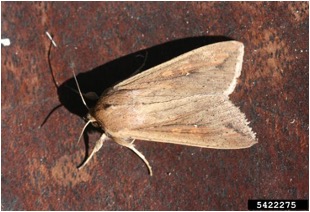
True armyworm moths are sand-colored and have a wingspan of 1.5” with a definitive white dot in the center of each forewing and dark markings on the hind wings.
Egg
True armyworm eggs are greenish-white and are laid in rows or clusters on leaves.
Larvae
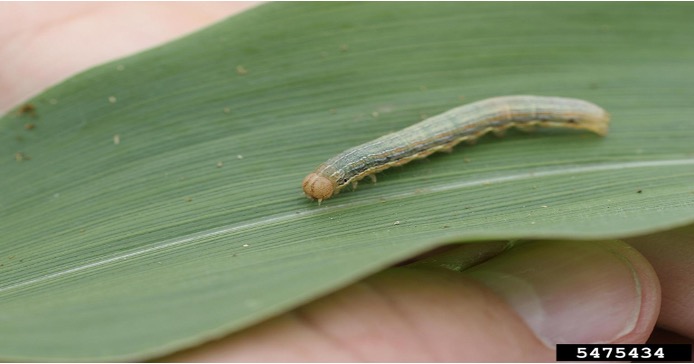
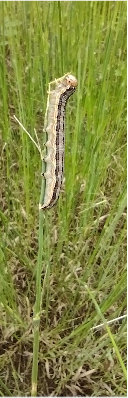
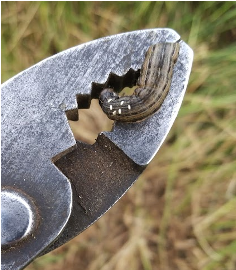
True armyworm larvae are brownish-green, hairless, and have alternate dark and light stripes down their backs. Their heads are pale brown with dark markings. Fully grown larvae are about 2″ long.
Pupae
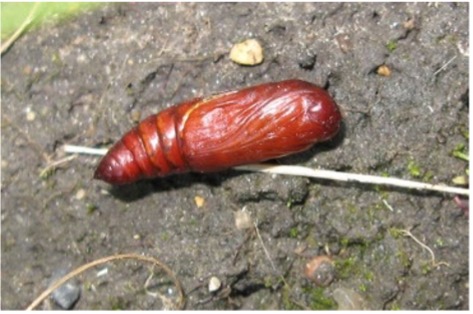
True armyworm pupae are dark brown and approximately ¾ of an inch long. They are sharply tapered at the tail end with a much more rounded head end.
Armyworms often are confused with the variegated cutworm and other related species. The true armyworm can be a serious pest in corn production. In general, outbreaks are more severe following cold, wet, spring weather.
Life cycle
True armyworms reproduce by complete metamorphosis which includes four stages, egg, larval, pupal, and adult moth. Females lay eggs in the evening and at night in rows or combinations of rows on the leaf blades of preferred host plants. Moths often choose to lay eggs in grasses and small grains since the plants help to protect egg viability and are the desired source of food for the larval stage of the insect. Seven to ten days following egg lay, larvae emerge and begin to feed on lush green foliage. The first generation is usually small but can cause economic damage to wheat, corn planted after grass cover crops, and fields with uncontrolled grassy weeds. After feeding for 3-4 weeks, the full-grown larvae pupate and emerge two weeks later as adult moths. In WI, true armyworms normally have 2-3 generations per season, with each generation lasting 5-6 weeks. The second larval generation, which appears in July, is the largest and most damaging generation to Wisconsin crops. The success of this generation produces later, more injurious, generations of armyworms. The fall generation is typically not injurious and is often heavily parasitized by beneficial insects, fungi, and viruses. True armyworm does not overwinter in Wisconsin as moths migrate to Wisconsin each spring.
Damage and symptoms
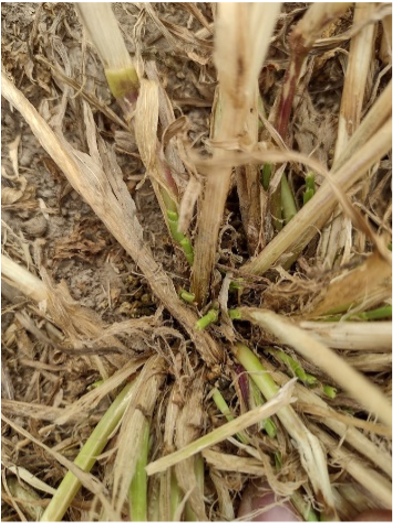
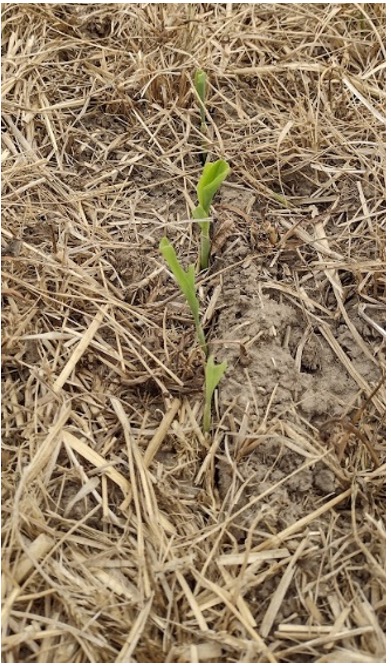
The larvae tend to feed at night or on cloudy days and hide in the soil or under foliage during the day. First generation damage can be very difficult to locate and will catch many crop scouts by surprise. Pay close attention to corn planted after grass cover crops and corn fields which have high grassy weed populations. In wheat and other small grains detection is also difficult. Pay special attention to areas where crop density is high and/or where lodging has occurred. Second generation infestations may occur throughout a corn field during July if grassy weeds such as foxtail, quack grass, goosegrass, and nutsedge are present for oviposition in the field. In this case, plants in scattered areas of the field will have ragged leaves from larval feeding. The other type of infestation results when armyworms migrate from pastures, spring seeded small grains, or grassy hay fields, and invade the outside rows of corn. Damage is usually highest along the field edge or near grassy spots.
Non-chemical natural control
Several braconid wasps and tachinid flies help keep armyworm numbers down, as do birds, toads, skunks, and some domestic fowl.
Cultural control
Since female moths prefer to lay eggs in grassy areas, keeping grassy weeds controlled will lessen the possibility of problems. Avoid planting susceptible crops in low wet areas or in rotations following sod. If this is unavoidable, be sure to plow in the fall of the previous season to decrease early spring egg-laying sites. Killing grass with an herbicide or tillage may drive armyworms to the susceptible crops.
Biological control
Several natural enemies exist which may keep armyworm populations low. The red-tailed tachinid fly (Winthemia quadripustulata) is one such biocontrol agent. It lays its eggs on the armyworm’s back and the tachinid larvae bore into larval armyworms to feed. In addition, several ground beetles and parasitic hymenoptera prey upon the armyworm. There is also an egg parasite (Telenomus minimus) that is effective in preventing egg hatch and subsequent larval feeding damage.
Chemical control
Corn: field scouting and economic threshold
Timely detection is critical for post emergent insecticidal treatment to be effective. If you find signs of armyworm feeding, check 5 sets of 20 plants at random. Record the number of damaged plants and the number of worms per plant. Repeat in several locations within the field since infestations may be restricted to certain areas. Treatment is suggested if worms are ¾ inch long or less, and two or more worms per plant can be found on 25% of the stand; or if one worm per plant can be found on 75% of the stand. Spot treat when possible. When armyworms migrate from adjoining areas, treat border rows.
Small grains and pasture: field scouting and economic threshold
Armyworms can severely damage small grain fields or pasture. In mid-June and early July, larvae strip leaves and frequently clip off heads as the crop approaches maturity. Detecting young larvae requires careful searching. To guard against severe losses, check several areas of each field carefully. Check thick lodged areas first because armyworms will often be most numerous there. If you do not find larvae in these areas, the odds are good that there are no problems in the rest of the field. However, check the field again in several days. If you find armyworms in the lodged areas, check several areas in the rest of the field. Treatment is suggested if populations average 3 or more per square foot. Before spraying, check the preharvest interval to make sure the selected insecticide fits with the timing of harvest.
Chemical Suggestions
Guidance within this publication is not a substitute for following the label directions. Always read the pesticide label prior to use as the label is the law and label guidelines can change. These recommendations are sourced from A3646.
Active Ingredients (AI’s) Labeled for Treatment of True Armyworm in WI Crops
| Corn | Pasture grass | Small grains | All three crops listed |
| Alpha-cypermethrin | Carbaryl | Alpha-cypermethrin | Chlorantraniliprole |
| Bacillus thuringiensis (Bt) | — | Cyfluthrin | Lambda-cyhalothrin |
| Beta-cyfluthrin | — | Gamma-cyhalothrin | Spinosad |
| Bifenthrin | — | — | Zeta-cypermethrin |
| Carbaryl | — | — | — |
| Deltamethrin | — | — | — |
| Esfenvalerate | — | — | — |
| Gamma-cyhalothrin | — | — | — |
| Methoxyfenozide | — | — | — |
References
R. H. Davidson and W. F. Lyon (1987) Insect Pests 8th Ed. of Farm, Garden, and Home. John Wiley & Sons, New York 640 pp.
C. L. Metcalf and R L. Metcalf (1993) Destructive and Useful Insects, Their Habits and Control 5th Ed. McGraw Hill Book Co., New York.