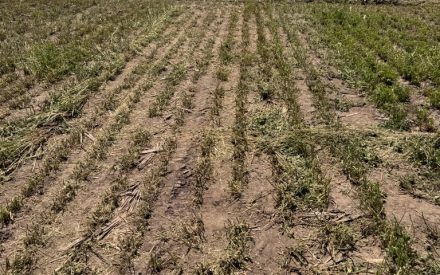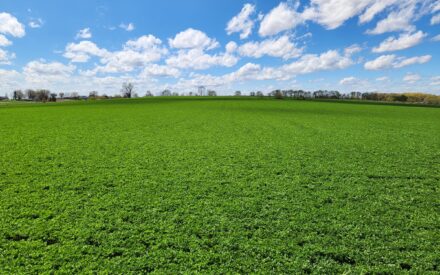
Soil seems to be the hot-button topic of nearly every farmer-focused event and agricultural publication these days. While it’s ironic that this resource, which predates modern agriculture itself, has become the rising star of modern agriculture, it’s appropriate because soil is the foundation of everything we do. Few would argue that the health and long-term productivity of our soil is the most critical factor for the future of agriculture and society. It is that logic that has driven the regenerative agriculture movement, along with the emphasis on soil health principles.
Soil health principles
- Minimize soil disturbance
- Keep the soil covered
- Maintain living roots in the soil
- Maximize plant diversity
- Integrate livestock
Soil health is increasingly being researched, demonstrated, promoted, and embraced across the land. Great gains are being made because of this work, but care should be taken to not overlook other critical components of an agricultural system.
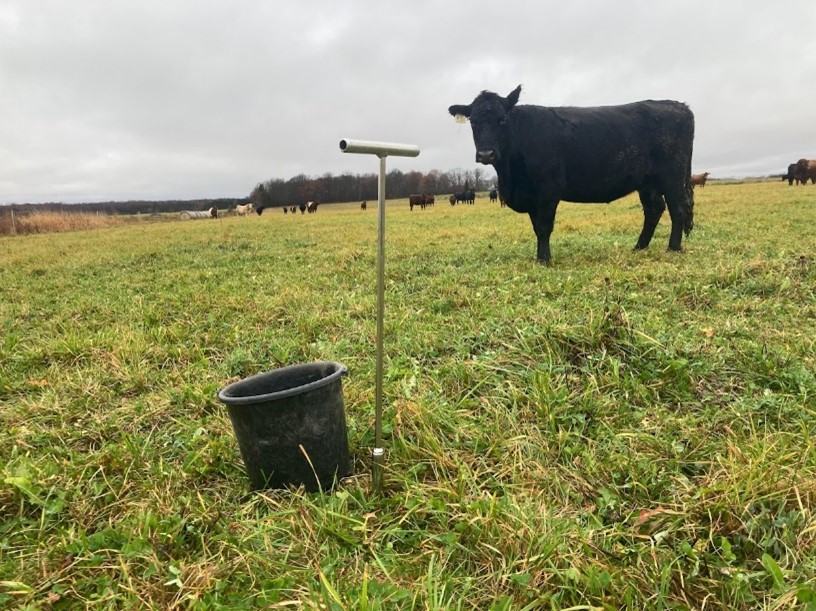
One of the critical aspects sometimes taken for granted in grazing systems is soil fertility. It could be easy to master all five soil health principles and the many benefits they offer and make the mistake of thinking that the system will automatically have optimal soil fertility. However, soil fertility must be actively managed, even when soil health best management practices are in place. Pastures provide the perfect opportunity to see the importance of managing soil fertility and soil health together.
Soil fertility is not straightforward in grazing systems
Not all pastures are the same, largely because not all grazing is created equal. A well-managed grazing system meets all five soil health principles. Such a system is likely built on a diverse, perennial forage base and can be further characterized by proper residual left behind after grazing (4-6” recommended), long rest periods before re-grazing (30 days or more), and frequent moving of livestock from paddock to paddock. This is not only a highly functional soil health system, but also a high-recycling nutrient environment resulting in a significant amount of fertility being returned to the soil. Approximately 80% of nutrients are returned to the soil in a managed-grazing system. The high rate of nutrient return has huge implications when managing soil fertility for economic optimization. It also means that soil fertility in pastures is not as straightforward as in other cropping systems.
All livestock agriculture removes nutrients from the soil. This often occurs through harvesting feed. In grazing scenarios, this may include feed for winter months. Nutrient removal also occurs every time a cow is milked, a steer is slaughtered, or an animal is sold at market – meat, milk, and livestock all carry nutrients derived from the soil. A system that includes both grazing and harvesting forages is adding and removing nutrients from the soil at different rates. Balancing nutrients in this system must begin by taking inventory of the total nutrient input and corresponding outputs.
Start with soil sampling
A routine soil sample (taken every 3-4 years) will indicate levels of phosphorus (P), potassium (K), acidity (pH), and organic matter (OM) that currently exist in the soil. Managing pH is the first order of business because it influences the availability of all other nutrients. A grass/legume pasture should have a pH of somewhere around 6.3. While P and K are the only nutrients indicated by the routine analysis because they are often the most limiting nutrients, there are 15 other nutrients essential to plant growth. Nitrogen (N) receives the most attention because of its influence on grass yield, but it is not indicated by routine soil tests because it is dynamic and difficult to measure. Like other cropping systems, pasture soil fertility usually comes down to managing N, P, and K (assuming that pH and micronutrients are in balance). Of those, P often ranks third in importance as many grazing systems occur where there’s been a history of livestock resulting in high levels of P already in the system. Soil fertility in pastures often comes down to managing for N and K.
Managing Nitrogen
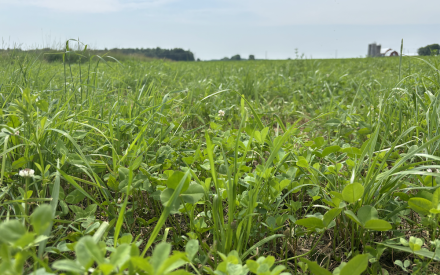
Nitrogen is very mobile and short-lived in the soil. Thus, applications of N fertilizer must be viewed as only benefitting the next harvest or grazing event. The University of Wisconsin guidelines (Extension Publications A2809 and A4034) suggest a seasonal requirement of approximately 130 lbs N/acre for grass pastures, split into two or three applications. However, the average pasture consists of grass mixed with legumes – which have the ability to fix nitrogen. N applications are generally not recommended for grass/legume mixes because it causes grass to outcompete legumes, to the detriment of legume persistence. While a low application (40 lbs N/acre) of fertilizer at spring green-up or before late-summer stockpiling can be economical, the best management strategy for N in pastures is to maintain legumes. This is achieved through the combination of good grazing management and other nitrogen-building measures, such as interseeding or frost-seeding legumes.
Managing Potassium
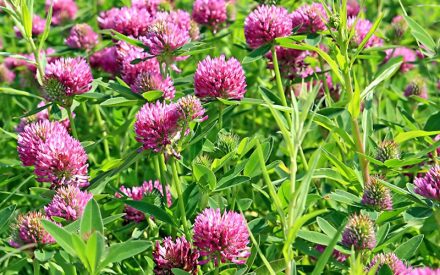
Potassium, in contrast to N, is not very mobile. It is attached to soil particles, and, if the soil is protected, K is stable. However, K is removed from the soil in large quantities through forage – grazed or harvested. It cannot be emphasized enough that K is critical to legume persistence. The seasonal requirement for a grass/legume pasture is approximately 180 lbs K/acre. A pasture that is only grazed and not harvested, with 80% of nutrients being returned to the soil in the form of manure, plant residue, and biological activity, will still be 40-60 lbs K/acre short of the seasonal requirement. That deficit may vary from season to season but left unaddressed can compound and ultimately lead to K deficiency. While it may be a slow decline when only grazing is occurring, harvesting hastens the mining process. A modest forage yield of 3 tons/acre (dry matter) will remove approximately 150 lbs K/acre. This is why one season of harvesting can have a drastic effect on the forage composition of a pasture. The first sign of K deficiency in a pasture is often the departure of legumes. Conversely, the first response from applications of K is often the reappearance of legumes.
Manage Potassium to Manage Nitrogen
As stated, soil fertility in many pastures often comes down to managing nitrogen and potassium. It is important to understand how these two are linked. Even a well-managed grazing system is not likely to maintain sufficient levels of N and K long-term. A helpful rule of thumb is potassium feeds legumes, legumes provide nitrogen, nitrogen feeds grass.
Cost-effective steps for managing soil fertility in grazing systems
- Soil test – every 3-4 years.
- Nitrogen – manage for legumes.
- Phosphorus – only fertilize if the soil test indicates below optimum.
- Potassium – fertilize at removal rate: frequently if making hay, occasionally if grazing only.
- Legumes – allow to flower once per season, frost seed occasionally, maintains potassium.
- Consider cost-effective nutrient sources such as applied manure or outwintering on pasture.
- Forage test – occasionally, a hay analysis can be used to estimate nutrient removal rate.
References
Laboksi, C.A.M., and J.B. Peters. Nutrient Application Guidelines for Field, Vegetable, and Fruit Crops in
Wisconsin (A2809).
Laboski, C.A.M., and K.B. Shelley. Soil Fertility Guidelines for Pastures in Wisconsin (A4034).