Well-managed grazing on perennial pastures is a way for dairy farmers to reduce the costs of raising replacement heifers while enhancing the soil health and ecosystem services of their land. But the success of heifer grazing depends on how well pastures support forage production, animal growth, and nutrient cycling. This study compared pasture productivity and dairy heifer performance on grass pastures that were fertilized with nitrogen, interseeded with clover, or left unfertilized.
Confinement-based dairy heifer raising offers precise feed inputs and consistent animal outputs but comes at the cost of being one of the greatest expenses for most dairy farms. Pasture-based heifer raising systems reduce reliance on harvested feeds and lower input costs, but achieving consistent heifer growth requires strong forage management skills and the use of high-efficiency grazing strategies like managed rotational grazing.
Adequate forage digestibility and nitrogen (N) use efficiency are critical factors to support reliable weight gain and overall grazing system productivity. Incorporating legumes such as red and white clover into grass pastures can boost forage productivity and nutritive value through biological N fixation and diversified pasture composition, while reducing reliance on synthetic N fertilizers. But establishing and maintaining a robust component of legumes at a quantity able to sustain pasture and heifer productivity can be challenging for multiple reasons.
This study evaluated the potential for even a small proportion of legumes to replace fertilizer as a source of N in grass pastures. Forage growth, forage quality, stocking rate, gain per area, and nutrient cycling were observed for pastures interseeded with legumes versus those fertilized for N.
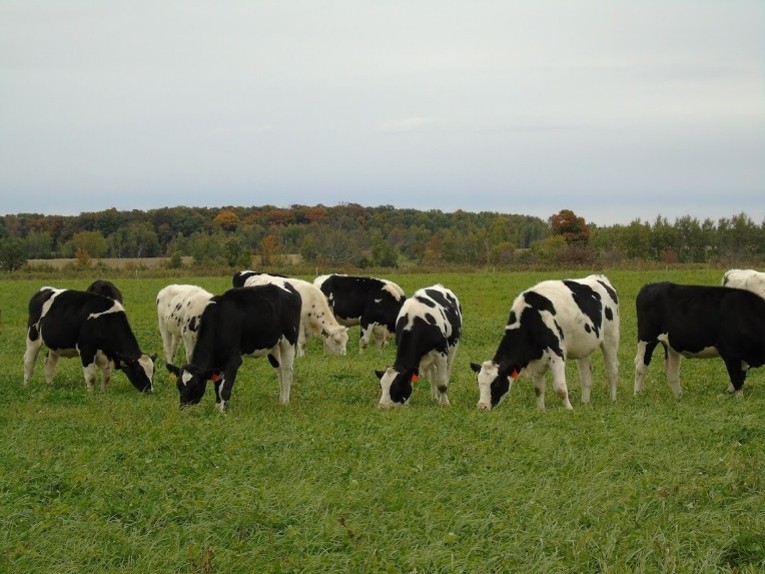
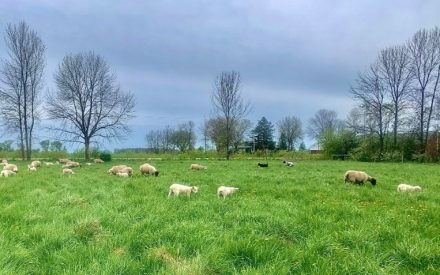
Photo: Dairy heifers grazing a mixture of meadow fescue and red/white clover.
Top Takeaways
Study Design
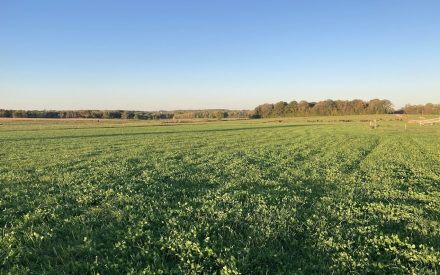
This study was conducted across nine 2-acre pastures arranged in a randomized complete block design, with each pasture sub-divided into 10 paddocks. Heifers were managed using rotational grazing with stocking rates held constant throughout the season based on forage availability. Treatments in this study were: N fertilized grass (meadow fescue), unfertilized grass-clover (red/white clover), and unfertilized grass (control). All treatments began as established pure grass pastures. The grass-clover treatment was established at a later date by interseeding red/white clover into established grass. A very dense stand of grass and dry soil conditions resulted in legume establishment well below the targeted 30% of total pasture composition. Not an uncommon occurrence, the grass-clover treatment is representative of a mature pasture with thinning legumes, or a marginally successful pasture interseeding effort.
The quantity and quality of forage were measured every 14 days using a combination of rising plate meter readings, hand-plucked samples, and laboratory analyses. These quantities represented the forage mass, which is a snapshot in time, of the forage on pasture. Pasture composition was assessed monthly to track proportions of grass, clover, and weeds in each system. Average daily gain, stocking rate, and gain per acre were measured throughout each grazing season. An external marker technique was used to estimate animal fecal output, and mineral analyses were used to measure nutrient concentrations and quantify N cycling from animals in each treatment.
Results
Forage Mass & Botanical Composition
Despite poor clover establishment, the legume-grass treatment performed significantly better than the unfertilized grass treatment. Nitrogen fertilization consistently produced the most grazable forage, averaging 1,588 lb DM/ac/rotation. But unfertilized grass-clover pastures averaged 1,410 lb DM/ac/rotation while unfertilized grass pastures averaged 1,276 lb DM/ac/rotation. Forage growth peaked in late May to early June, with N fertilized grass having the greatest pre and post‑grazing quantities throughout the grazing season. Although legumes represented only ~4% of total biomass in the unfertilized grass-clover pastures, its presence still increased grazable forage enough to reach 89% of the N fertilized system’s productivity. The unfertilized pasture, however, only produced 80% of the grazable forage when compared to that of the fertilized pasture. So, the small presence of legumes still boosted grazable forage by 9% compared to unfertilized pastures. Additionally, weed presence was lowest in fertilized grass and highest in unfertilized grass pastures.
Forage Quality
Nitrogen fertilized grass pastures maintained the highest crude protein (CP, 19%) and in-vitro organic matter digestibility (IVOMD, 65%) across the grazing season, outperforming both grass-clover and unfertilized grass pastures. While the small presence of legumes limited major forage quality improvements over N fertilized grass, marginal increases in CP and IVOMD still reflected small contributions from legumes.
All treatments followed typical seasonal patterns, with forage quality declining mid-summer and improving later in the grazing season. Fiber concentrations increased during warmer months, but N fertilized grass accumulated less neutral detergent fiber (NDF) and acid detergent fiber (ADF) in late-season evaluations. Legumes provided only modest improvements in CP and IVOMD due to their low presence in the pastures.
Heifer Growth & Carrying Capacity
Heifers grazing N fertilized grass had the highest growth rates with gains of 1.5 lb/day compared to 1.2 lb/day on unfertilized grass-clover and 1.2 lb/day on unfertilized grass. While the whole-season average growth rates in this trial were below typical goals for dairy heifers (1.8 to 1.9 lb/day), it must be noted that daily growth rates exceeded those goals after heifers received parasite treatments. N fertilized grass also supported the highest stocking rates between treatments (1.9 AU/ac) and directly contributed to higher gain per acre (325 lb/ac) compared to the unfertilized treatments (222-239 lb/ac). Animal performance was similar for unfertilized grass and grass-clover pastures, confirming that legume proportions were likely too low to substantially affect growth. However, it is worth noting that the grass-clover pastures had higher growth rates and gain per acre than unfertilized grass, suggesting a slight benefit from even a small proportion of legumes.
Nitrogen Utilization & Nutrient Return
Nitrogen intake was substantially higher in heifers grazing N fertilized grass due to higher forage CP. As a result, the amount of N lost through urine (104 g/day) on fertilized grass was nearly double that of the unfertilized treatments (59 g/day), and N use efficiency was lowest for that treatment. Cycling of other nutrients, including Ca, Mg, S, was also greatest under fertilized grass, but was mostly a function of higher stocking rates and nutrient intake. Grass-clover pastures provided intermediate nutrient return, reflecting some biological N fixation despite low legume presence, which is supported by the improved performance of unfertilized grass-clover compared to unfertilized grass pastures.
Conclusions
Nitrogen fertilization consistently improved the quantity and quality of grazable forage and heifer performance in grass pastures. However, these productivity gains came with increased N losses and fertilizer costs, signaling environmental and economic tradeoffs that must be considered when increasing stocking rates. Legumes offered modest but important benefits even though their presence was well below the typically recommended amount (>30%). The modest impact observed from just a small proportion of legumes underscores the importance of prioritizing the maintenance of legumes as a sound long-term pasture and grazing management strategy. Legumes remain a critical tool for managing N in grass pastures to reduce or eliminate N fertilizer inputs and improve N cycling when integrated successfully. Future efforts to refine legume establishment methods and management strategies could enhance the reliability of grass–legume pasture systems for dairy heifer grazing in the future.
Practical Applications
Acknowledgments
This project was conducted by the USDA-Agricultural Research Service Institute for Environmentally Integrated Dairy Management, Dr. David Jaramillo, Lisa Bauman and Lais Lima.
Updated: Feb. 11, 2025