

This year’s Notes from the Field follows Erin Warner with Warm Belly Farm (Cottage Grove, Fort Atkinson). The goal of this newsletter is to hear from the grower’s perspective and foster connection and knowledge sharing between fruit growers. I’ll be focusing our discussions around farm history, phenology/fruit development and integrated pest management. As fruit begin to ripen, hear how Erin is tackling late-summer and early-harvest challenges.
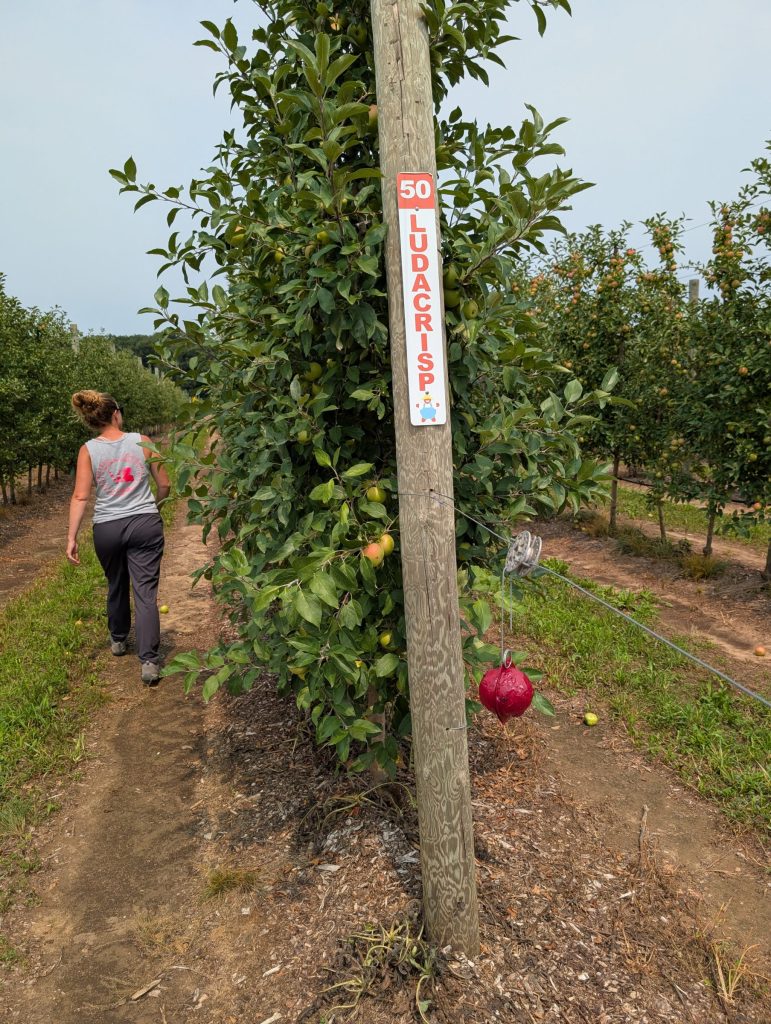
Walking down the Ludacrisp row at Warm Belly Farm’s Fort Atkinson location
Warm Belly Farm focuses its growing efforts on a few specialty crops such as high-density apples, hydroponic strawberries, honeyberries, and cut flowers. They sell their produce through their pick-your-own operations, garden center, on site-farm stand, local farmer’s markets, and some wholesale grocery. Warm Belly Farm is split across two locations in Cottage Grove and Fort Atkinson. The Cottage Grove location hosts Warm Belly Farm’s garden center, pick-your-own hydroponic strawberries, cut flower operation, and is the main location for events and agritourism activities. The Fort Atkinson location houses about 9 acres of high density apples, 1/2 acre of honeyberries, and offers pick-your-own apples from mid-August through October, along with a small farm stand and shaded picnic area.
I visited with Erin at the farm on Monday, August 10. A reminder the Fort Atkinson location has about 24 different apple varieties, all planted in a dwarfing, high-density trellised system, mostly on G.11 and some B.9 rootstock.
Erin is continuing to monitor codling moth pheromone traps and had one trap capture this week. She applied Assail (acetamiprid) on July 30, targeting second generation codling moth and lesser appleworm (LAW, Washington State University). A good reminder to check traps daily following evenings with ideal flight conditions, above 65F with low winds and high humidity. Erin has had zero apple maggot captures in the last two weeks. She will continue to monitor traps through harvest.
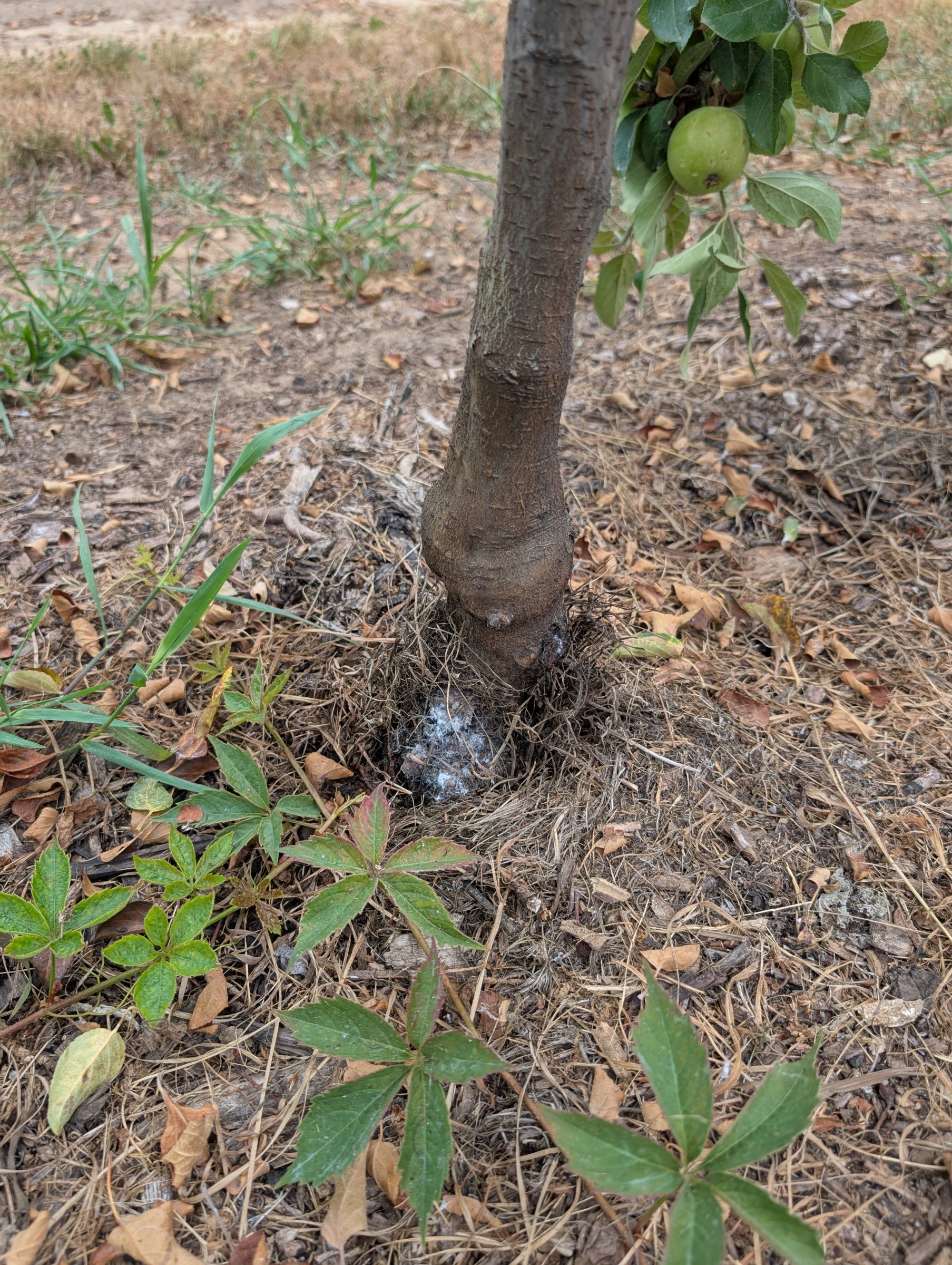
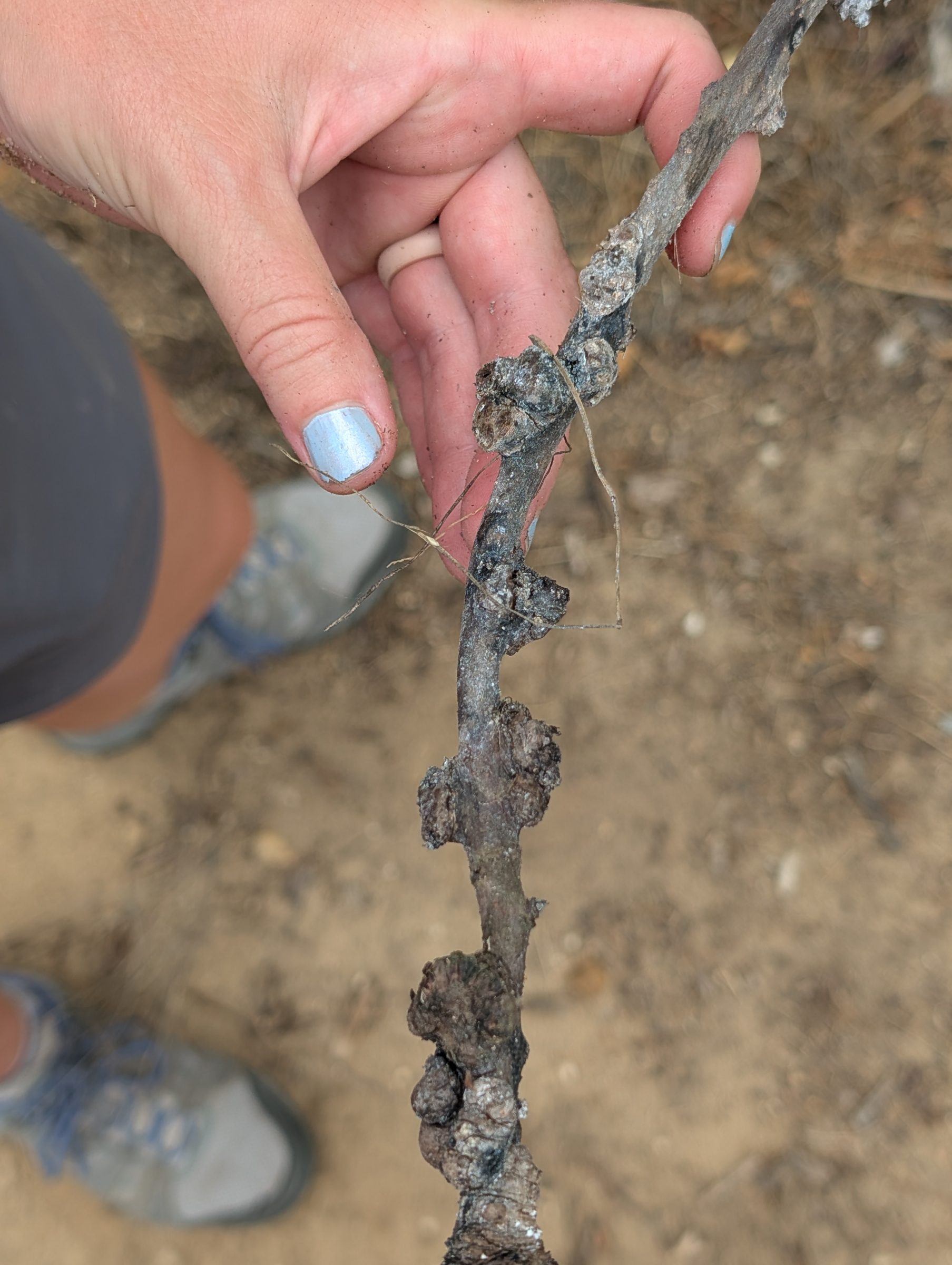
Erin is continuing to monitor woolly apple aphids (WAA, Pennsylvania State University Extension) for any building populations. Rain in the last week or so has helped wash off remaining white, waxy residue. Her Diazinon (diazinon) application three weeks ago has successfully knocked the population back. After the application, Erin removed trunk guards to assess the root zone and observed WAA colonies building under the guards. She also observed burr knots – burr knots are bumpy, cyst-like masses of root tissue and their crevices provide ideal, protected nesting sites for woolly apple aphids to feed and reproduce. Erin plans to shift her management strategy next season to prevent another large outbreak.
Two spotted spider mites (TSSM) continue to be observed, though have dropped in population since my last visit at the end of July. This is likely due to the Portal (fenpyroximate) and Nealta (cyflumetofen) applications about two weeks ago, along with steady rain over the last week. Mites prefer hot, dry conditions and often slow down reproduction during periods of rain.
Along with the insecticide application on July 30, Erin applied Flint (trifloxystrobin) as a protectant for summer diseases like bitter rot, and to protect apples from storage rots. She will plan to do one final fungicide application in the next week, likely Topsin (thiophanate-methyl).
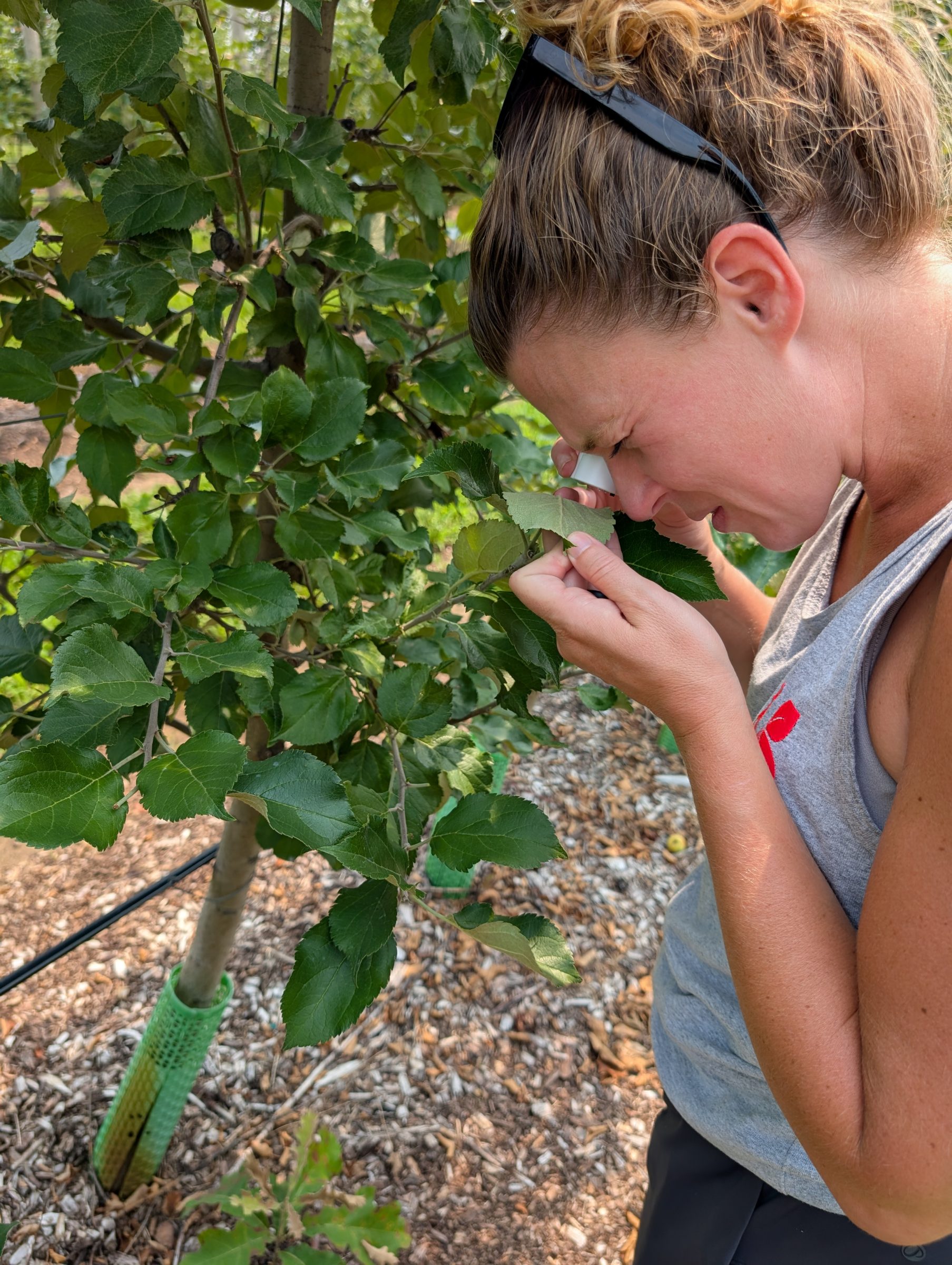
Erin scouting for two-spotted spider mites.
Erin is combating the hot, humid and dry conditions with irrigation across the entire orchard. She uses a zone system, and waters each zone twice per week via drip irrigation. One of the many hats that Erin wears includes maintenance work and has been working on fixing some irrigation system issues.
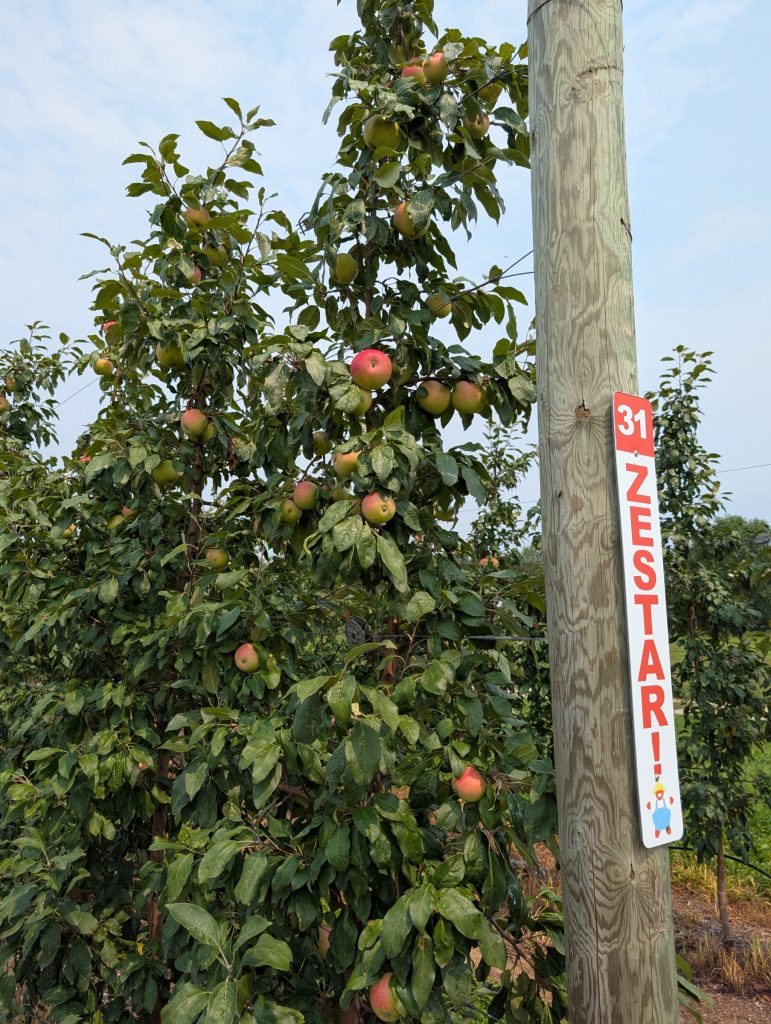
Erin plans to have pick-your-own events the first two weekends in September from 9:00am-3:00pm at the Fort Atkinson location. Fall fest will begin on September 12 at the Cottage Grove location where pre-picked apples will be available, along with the retail store, biergarten and various activities. Zestar and Summer McIntosh varieties will likely be ready for a first round of color picking in the next couple of weeks. She will begin starch and brix testing in the next week to assess fruit maturity and ripeness as well.
Thanks for tuning in – that’s all for this week! I’ll check back in with Erin in the next newsletter coming out on Friday, August 28.
This article series is NOT intended to be prescriptive for other orchards. It is simply an opportunity for our readership to hear from other growers about their experiences growing fruit crops in Wisconsin.
Growing the same crop does not always justify the same practices. Management decisions at your farm should be tailored to your operation and consider location, regional climate, disease and pest history of your vineyard, and your varieties.
The mention of a product is NOT an endorsement. Always follow the instructions on product labels and consult weather stations (ex. NEWA) in your area for current weather forecast and disease and pest prediction models.
Featured In
Wisconsin Fruit News
To receive more content like this directly to your email inbox, sign up for the Wisconsin Fruit News e-newsletter.
Our bi-weekly in-season newsletter is designed for Wisconsin apple, grape, and berry growers.