

This year’s Notes from the Field follows Erin Warner with Warm Belly Farm (Cottage Grove, Fort Atkinson). The goal of this newsletter is to hear from the grower’s perspective and foster connection and knowledge sharing between fruit growers.
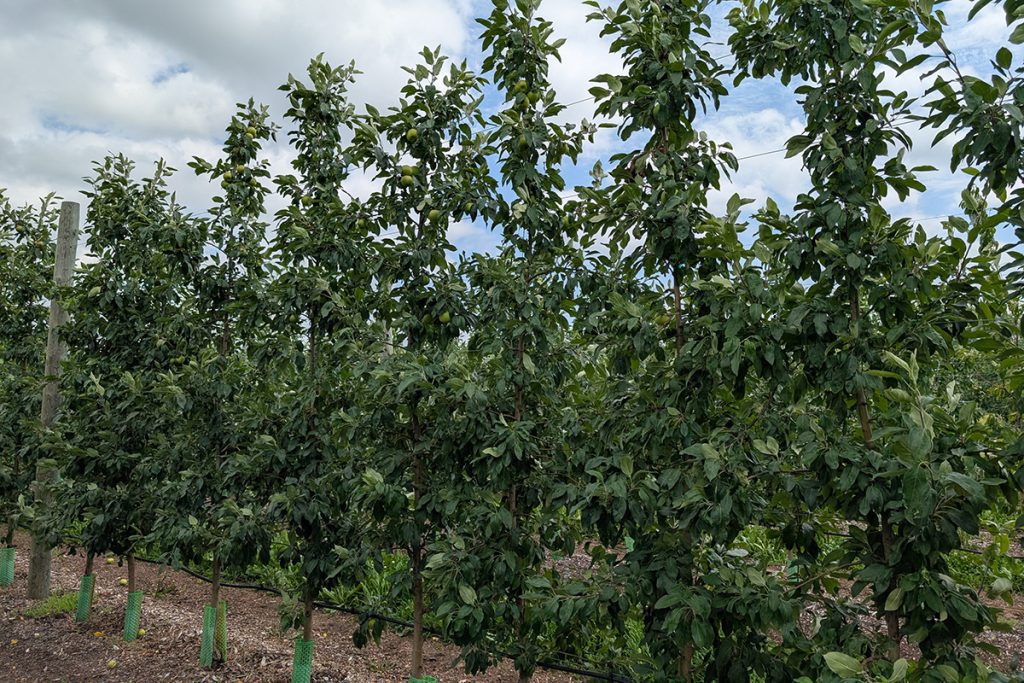
Trellised apple tree row at Warm Belly Farm’s Fort Atkinson location
I’ll be focusing our discussions around farm history, phenology/fruit development and integrated pest management. As we move through fruit set, hear how Erin is tackling early summer management challenges.
Warm Belly Farm focuses its growing efforts on a few specialty crops such as high-density apples, hydroponic strawberries, honeyberries, and cut flowers. They sell their produce through their pick-your-own operations, garden center, on site-farm stand, local farmer’s markets, and some wholesale grocery. Warm Belly Farm is split across two locations in Cottage Grove and Fort Atkinson.
The Cottage Grove location hosts Warm Belly Farm’s garden center, pick-your-own hydroponic strawberries, cut flower operation, and is the main location for events and agritourism activities. The Fort Atkinson location houses about 9 acres of high density apples, 1/2 acre of honeyberries, and offers pick-your-own apples from mid-August through October, along with a small farm stand and shaded picnic area.
I visited with Erin at the farm on Monday, June 29. A reminder the Fort Atkinson location has about 24 different apple varieties, all planted in a dwarfing, high-density trellised system, mostly on G.11 and some B.9 rootstock.
Codling moth pheromone traps were hung on May 4th, and reached biofix on May 21st. Erin’s last trap check on June 23 had a total of one codling moth capture across five traps.
The previous count on June 19 had a total of 10 captures across five traps. Codling moths prefer to fly in the evening when it is warm, and relatively calm. There will likely be flights this week as evening conditions will be favorable, especially in southern Wisconsin.
A good reminder to check traps daily following evenings with ideal flight conditions, above 65°F with low winds and high humidity.
Erin will be keeping an eye out for any large bumps in trap captures over the next several weeks that will indicate second generation flight.
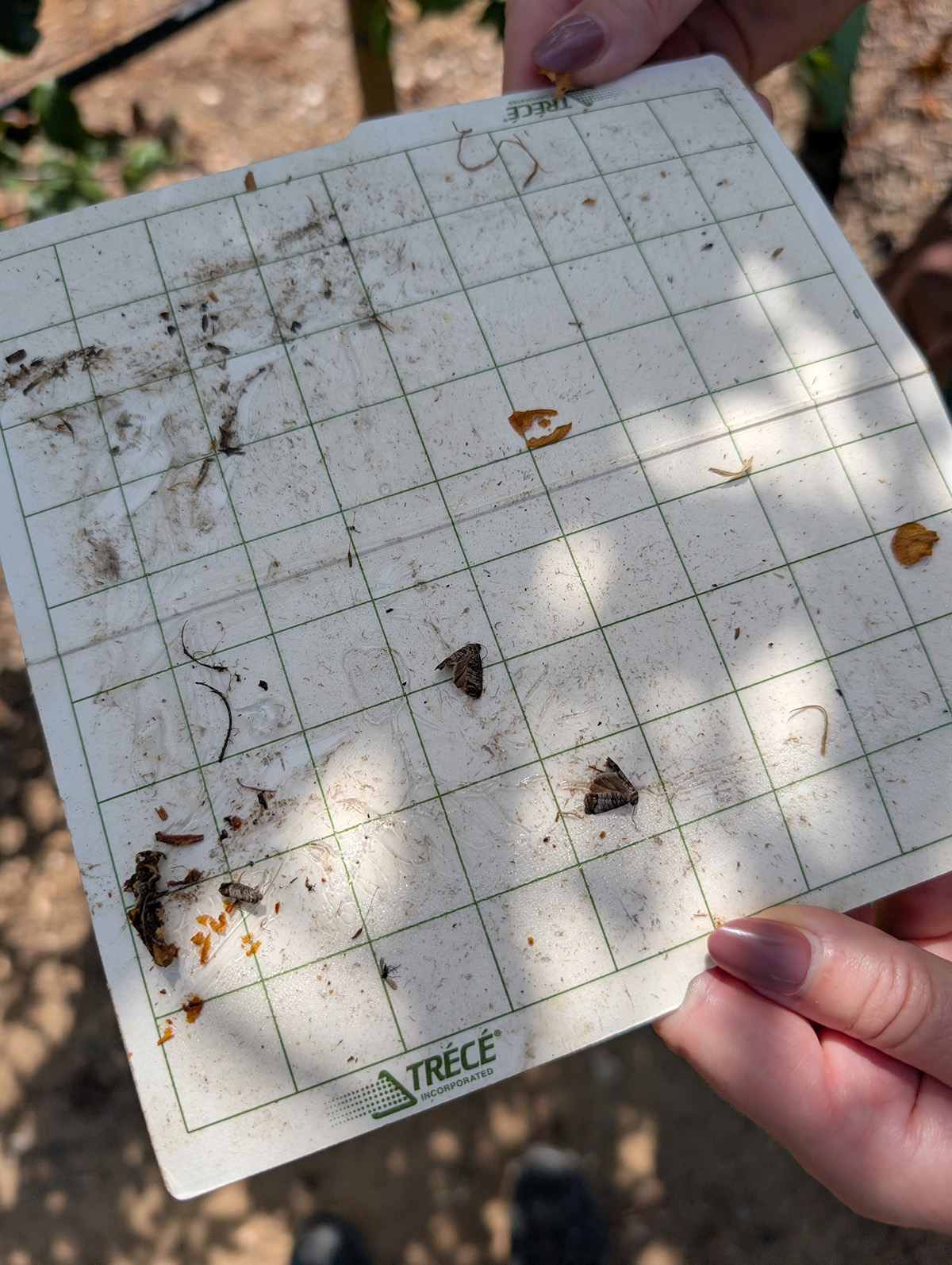
Codling moth trap at Warm Belly Farm
Erin applied her third and final round of insecticide, Avaunt (indoxacarb) targeting codling moth on June 25. A reminder to rotate mode of action between applications and if targeting multiple generations to limit risk of resistance. Dry time is dependent on the mode of action and whether the product is systemic or not.
Erin has also observed an increase in woolly apple aphids that have moved up into the canopy.
She applied Wrangler (imidacloprid) and Beleaf (flonicamid), targeting both woolly apple aphid and green apple aphids.
Wrangler also has efficacy on codling moth.
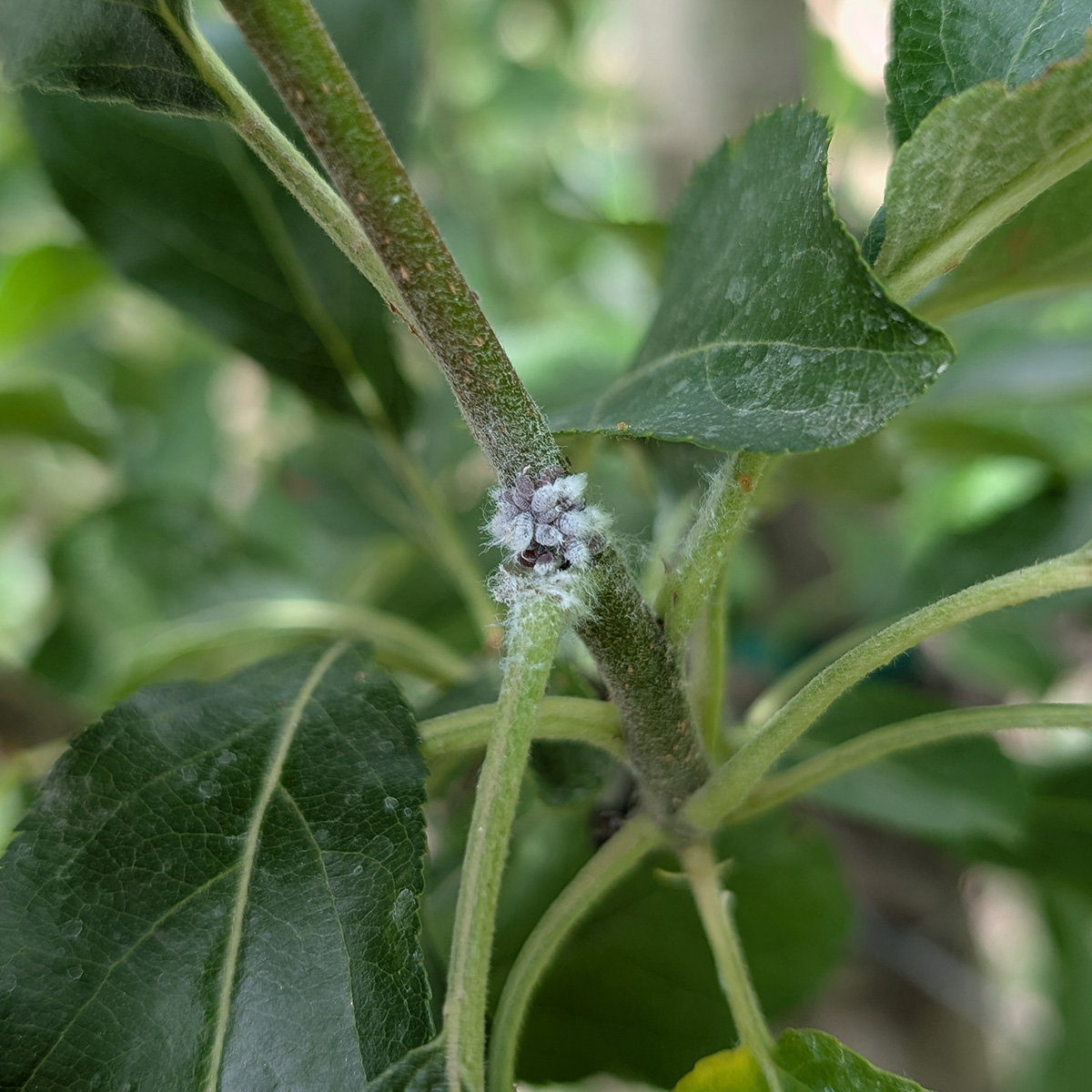
Woolly apple moths on an apple tree canopy.
We also observed some rust mites in low numbers on leaf terminals. These past two weeks have been quite warm, which has pushed along insect development. Those who are tracking degree days and using insect models should note the temperature listed as the maximum development rate, often between 85-90°F.
Along with the insecticide application on June 25, Erin applied Captan (captan) as a protectant for summer diseases. She is seeing minimal fire blight strikes, and gives some credit to her Apogee applications.
A reminder that Apogee is a plant growth regulator that helps slow new shoot growth, therefore lowering the risk of disease spread by limiting growth of new shoot material that is highly susceptible to infection.
Fruit set is becoming more clear after a handful of hard freezes that occurred between April 20 and May 20. Erin is estimating the orchard has about 20-25% cropload compared to the last several seasons, with some mid to late-season varieties faring better, around 50% cropload.
Peter Werts from the IPM Institute of North America was also present during my visit. I was able to tag along as Erin and Peter grabbed soil and petiole samples in the honeycrisp block for a nutrient analysis.
It is ideal to collect petiole samples prior to honeycrisp chlorosis (leaf yellowing), a common natural occurrence observed in honeycrisp leaves. Petiole samples in other varieties are typically taken in the first two weeks of July.
Soil samples help inform which nutrients are available for uptake trees, while petiole samples reflect the nutrients the tree(s) are uptaking. Both are important to better understand tree health and nutrient availability.
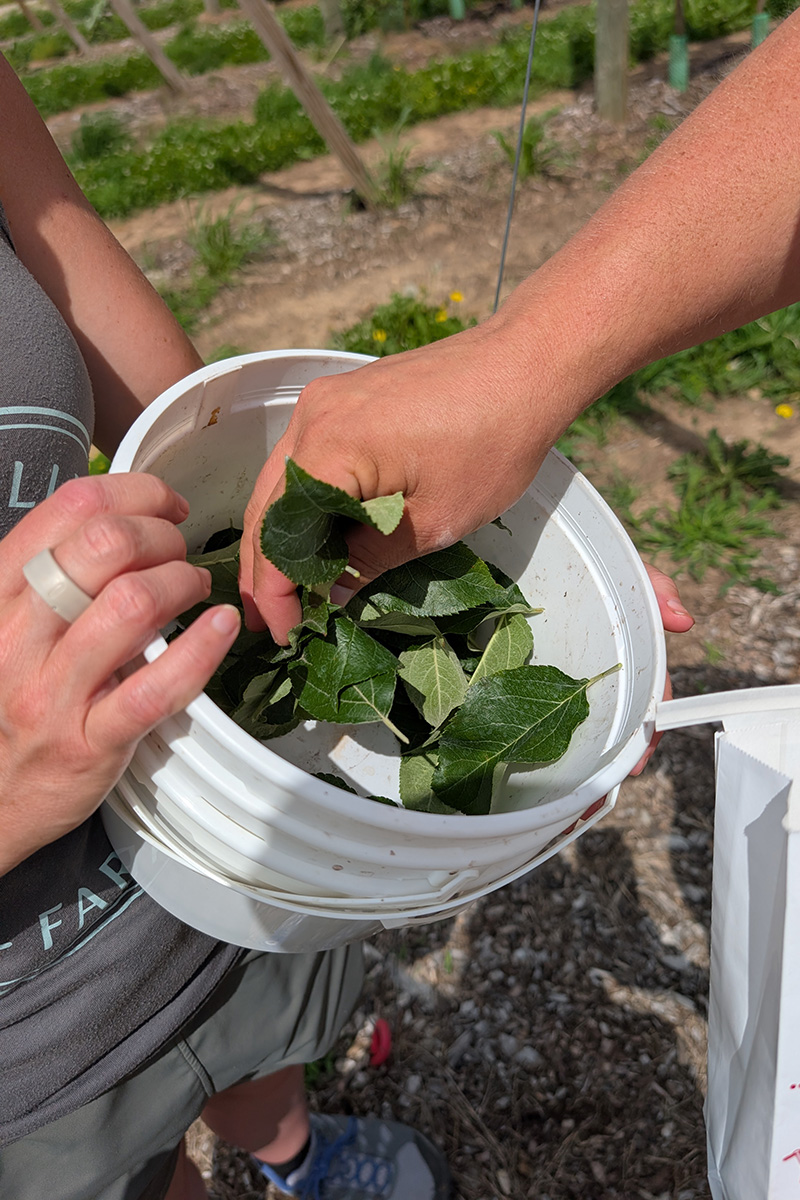
Petiole collection and sampling at Warm Belly Farm
Many fruitlets that are hanging on have frost rings that make the fruit less marketable. Erin plans to turn many of these impacted fruit into cider that will be available on-farm.
The majority of remaining fruit is located in the upper canopy where temperatures may have been a degree or two warmer during the freeze events. The good news is the honeycrisp blocks have fared better than initially estimated, and Warm Belly should have a decent cropload this year.
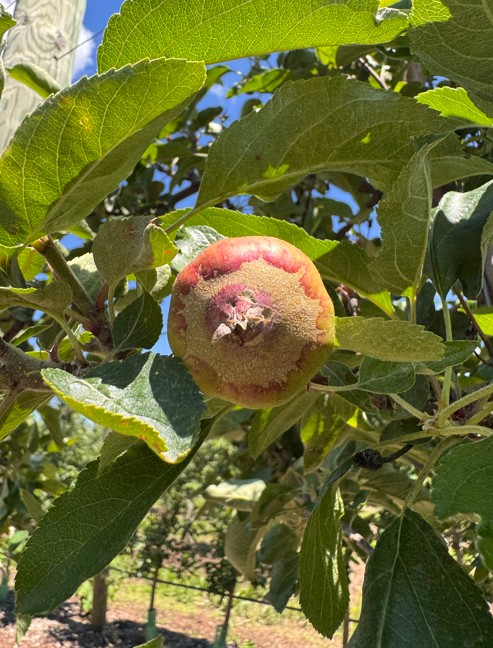
Frost ring on apple fruitlet
As the apples grow in size over the next several weeks, cropload and you-pick availability will become much more apparent.
With such a loss, orchard management will need to be adjusted, especially since Warm Belly is primarily pick-your-own. Erin and her team are working through shifts in business planning and will be determining a course of action in the coming weeks when fruit are fully set and cropload estimates are more accurate.
That’s all for now – I’ll check back in with Erin in our next Wisconsin Fruit Newsletter on July 17th!
This article series is NOT intended to be prescriptive for other orchards. It is simply an opportunity for our readership to hear from other growers about their experiences growing fruit crops in Wisconsin.
Growing the same crop does not always justify the same practices. Management decisions at your farm should be tailored to your operation and consider location, regional climate, disease and pest history of your vineyard, and your varieties.
The mention of a product is NOT an endorsement. Always follow the instructions on product labels and consult weather stations (ex. NEWA) in your area for current weather forecast and disease and pest prediction models.
Featured In
Wisconsin Fruit News
To receive more content like this directly to your email inbox, sign up for the Wisconsin Fruit News e-newsletter.
Our bi-weekly in-season newsletter is designed for Wisconsin apple, grape, and berry growers.