

This year’s Notes from the Field follows Erin Warner with Warm Belly Farm (Cottage Grove, Fort Atkinson). The goal of this newsletter is to hear from the grower’s perspective and foster connection and knowledge sharing between fruit growers. I’ll be focusing our discussions around farm history, phenology/fruit development and integrated pest management. As we move through fruit set, hear how Erin is tackling early summer management challenges.
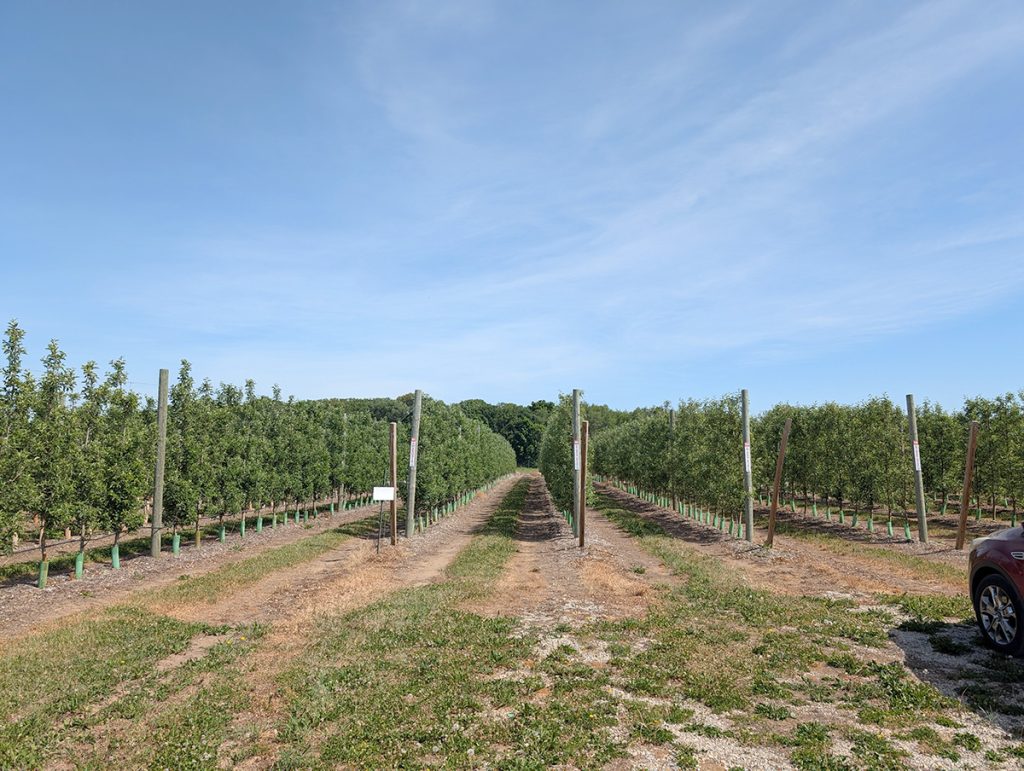
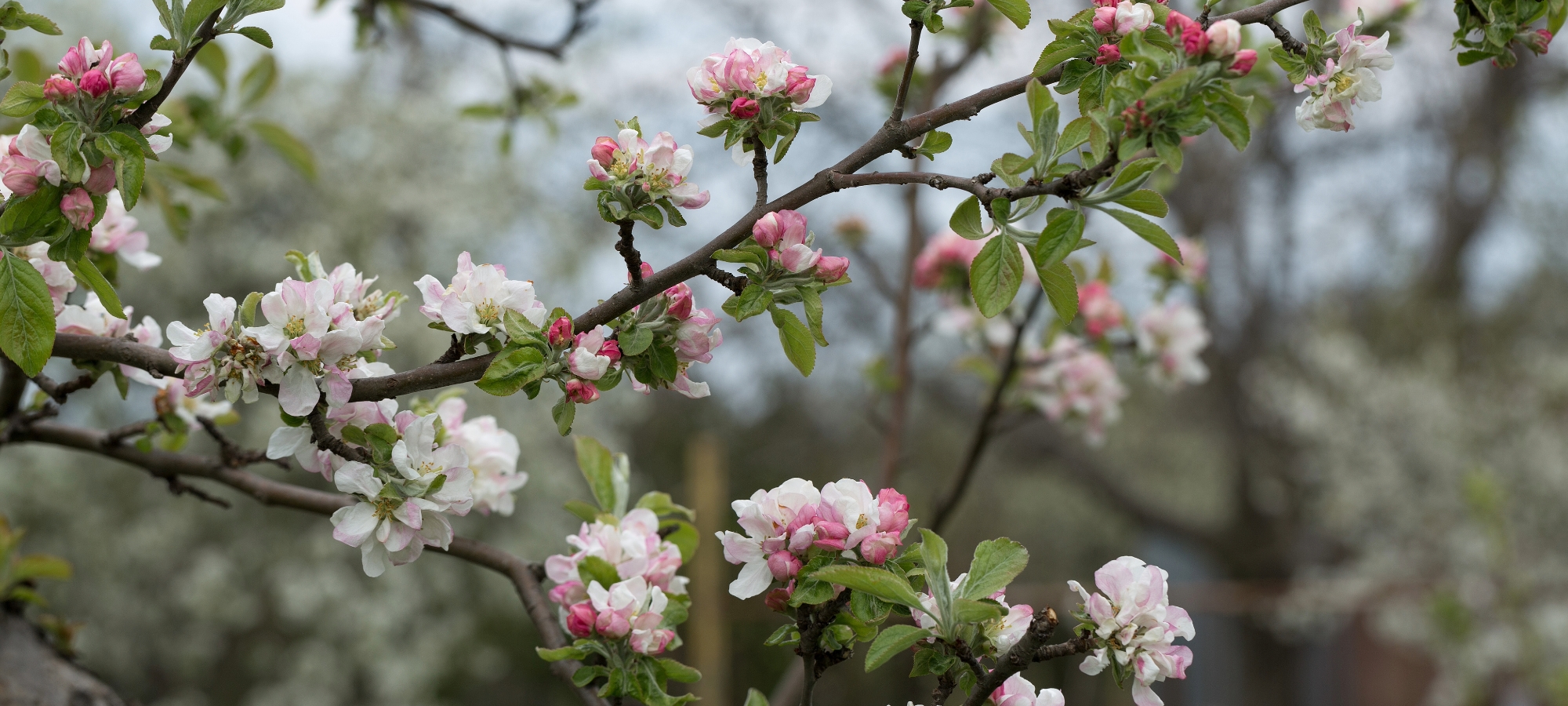
Apple orchard at Warm Belly Farm’s Fort Atkinson location
Warm Belly Farm focuses its growing efforts on a few specialty crops such as high-density apples, hydroponic strawberries, honeyberries, and cut flowers. They sell their produce through their pick-your-own operations, garden center, on site-farm stand, local farmer’s markets, and some wholesale grocery.
Warm Belly Farm is split across two locations in Cottage Grove and Fort Atkinson. The Cottage Grove location hosts Warm Belly Farm’s garden center, pick-your-own hydroponic strawberries, cut flower operation, and is the main location for events and agritourism activities. The Fort Atkinson location houses about nine acres of high-density apples and half an acre of honeyberries and offers pick-your-own apples from mid-August through October, along with a small farm stand and shaded picnic area.
I chatted with Erin on Tuesday, June 17. Due to weather, we were not able to do a farm visit this week. A reminder the Fort Atkinson location has about 24 different apple varieties, all planted in a dwarfing, high-density trellised system, mostly on G.11 and some B.9 rootstock.
Codling moth pheromone traps were hung on May 4th, and reached biofix on May 21st. Erin’s last trap check on June 11 had a total of four codling moth captures across five traps.
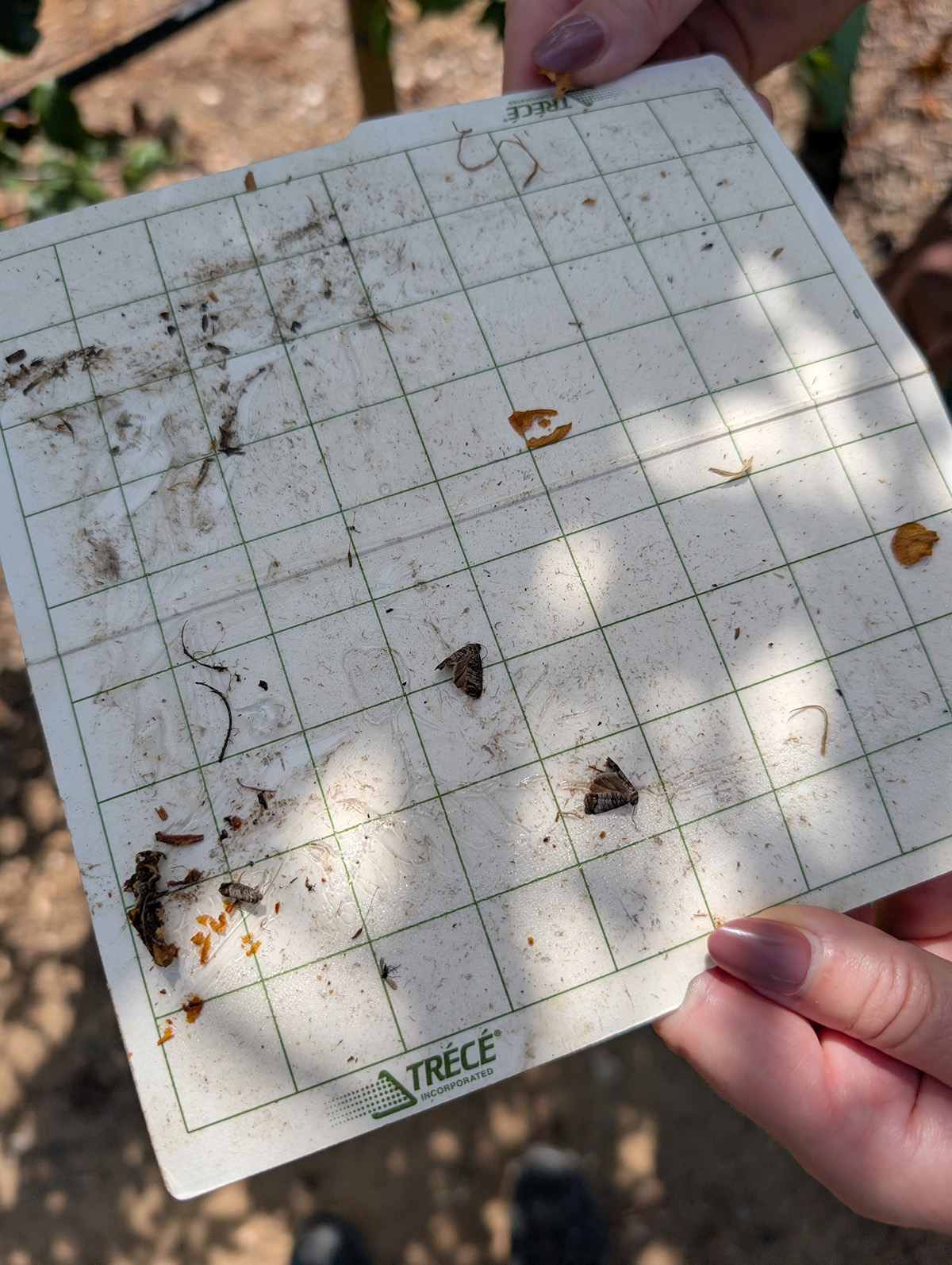
Codling moth trap at Warm Belly Farm
Codling moths prefer to fly in the evening when it is warm, and relatively calm. A good reminder to check traps daily, especially following evenings with ideal conditions as we approach second generation codling moth flights. Erin will be keeping an eye out for any large bumps in trap captures over the next several weeks.
Erin applied her second round of insecticide, Altacor (chlorantraniliprol), targeting codling moth on June 12. Her first application of Avaunt (indoxacarb) on June 5th was followed by an inch+ of rain. A reminder that most pesticides will wash off after 1-2 inches of rain. Dry time is dependent on the mode of action and whether the product is systemic or not. Erin has also observed small colonies of woolly apple aphid on suckers and under tree guards, and has been squishing and removing them as she’s able. These past two weeks have been warm and rainy, which has pushed along insect and disease development.
Fire blight continues to be a concern at Warm Belly, and Erin has put quite a bit of work into pruning out strikes and removing trees where infection has hit the trunk in previous years. She has been keeping an eye on areas with a history of fire blight to catch any potential strikes before they spread. In the past week, she has pruned out a few suckers with fire blight symptoms, and has not observed spread into the canopy.
Along with the insecticide application on June 12, Erin used a combination of Captan (captan) and Topsin (thiophanate-methyl) as a second cover disease protectant for summer fruit rots. Erin has had good results with Apogee applications and believes that has played a large role in limiting fire blight strikes. A reminder that Apogee is a plant growth regulator that helps slow new shoot growth, therefore lowering the risk of disease spread by limiting growth of new shoot material that is highly susceptible to infection.
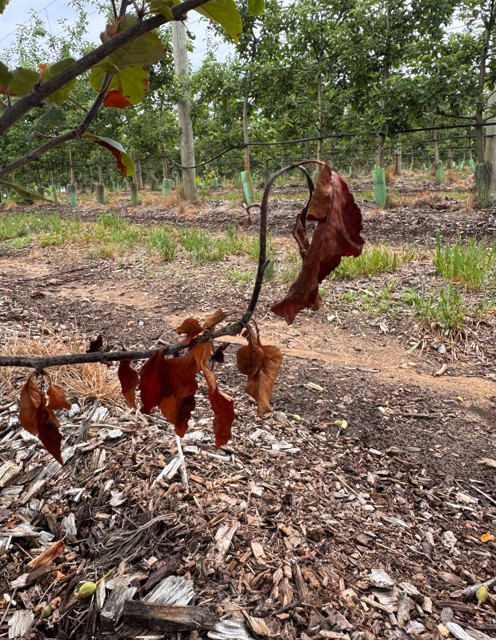
Fire blight observed on a root sucker.
Fruit set is becoming more clear after a handful of hard freezes that occurred between April 20 and May 20. Erin is estimating the orchard has about 20-25% cropload compared to the last several seasons. Many fruitlets that are hanging on have frost rings (see photo below), that make the fruit less marketable. The majority of remaining fruit is located in the upper canopy where temperatures may have been a degree or two warmer during the freeze events. Check out Dr. Amaya Atucha’s most recent article on Predicting Apple Fruit Set After Thinning Sprays.
With such a loss, orchard management will need to be adjusted, especially since Warm Belly is primarily pick your own. Erin and her team are working through shifts in business planning and will be determining a course of action in the coming weeks when fruit are fully set and cropload estimates are more accurate.
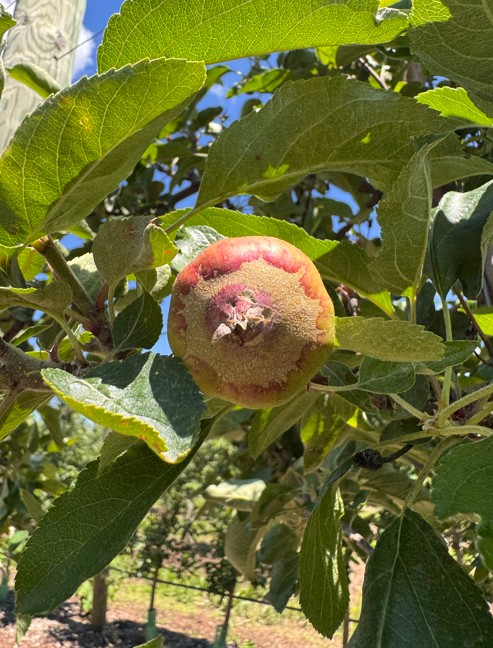
Frost ring on apple fruitlet
Honeyberries were harvested in the last week and are available for purchase at the Cottage Grove location. Erin has 600 honeyberry bushes with a total yield 350lbs for the 2026 season. She has three honeyberry varieties: Aurora, Indigo Gem and Indigo Treat. Erin has determined that Aurora was much easier to harvest as the shrubs were less dense and allowed for berries to fall through the canopy into the harvest pools.
To harvest the honeyberries, Erin used kiddie swimming pools cut in half that were placed underneath the bushes. Bushes were hand shaken to dislodge the berries, which drop conveniently into the kiddie pools below. From there, berries were placed into bins to dry, then were taken back to be shaken over a “debris slide” (see photo below). Berries were slowly rolled down the slide while simultaneously being blown with a leaf blower to remove any remaining leaf litter and stems.
That’s all for now – I’ll check back in with Erin in our next Wisconsin Fruit Newsletter on July 3!
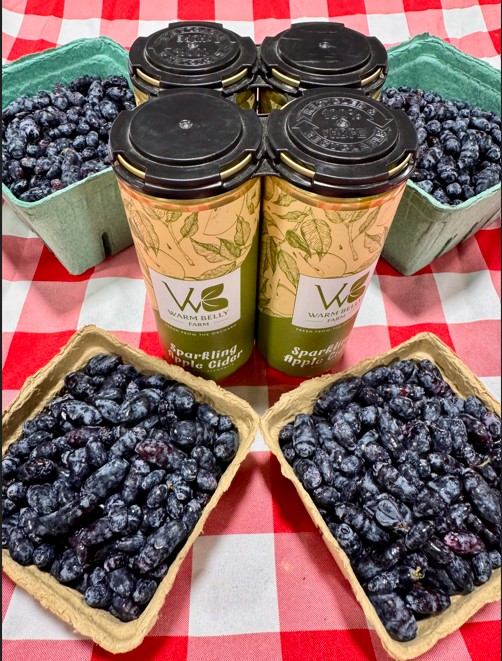
Honeyberries, an emerging berry crop in Wisconsin
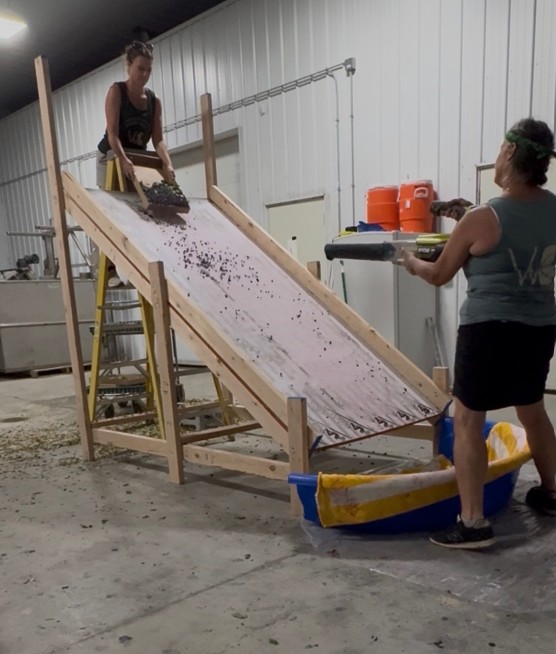
Honeyberries are rolled down the slide and blown with a leaf blower to remove remaining leaves and stems.
This article series is NOT intended to be prescriptive for other orchards. It is simply an opportunity for our readership to hear from other growers about their experiences growing fruit crops in Wisconsin.
Growing the same crop does not always justify the same practices. Management decisions at your farm should be tailored to your operation and consider location, regional climate, disease and pest history of your vineyard, and your varieties.
The mention of a product is NOT an endorsement. Always follow the instructions on product labels and consult weather stations (ex. NEWA) in your area for current weather forecast and disease and pest prediction models.
Featured In
Wisconsin Fruit News
To receive more content like this directly to your email inbox, sign up for the Wisconsin Fruit News e-newsletter.
Our bi-weekly in-season newsletter is designed for Wisconsin apple, grape, and berry growers.