

Weekly Slug Trapping Data for Wisconsin Farmers
Week of May 4–10
More monitoring sites across Wisconsin continue to come online! We are grateful for the efforts of all SlugNet volunteers who are monitoring over 200 shingle traps in conservation cropping fields across 11 counties.
Slugs were captured in all counties except Crawford and Kewaunee Counties. Activity remains relatively stable compared to week 1. Slight increases in Dane, Iowa, and Fond du Lac suggest more activity in these counties.
Each county reported less than one slug per trap, except for Dane County. While there are no established economic thresholds for slugs in corn or soybean, researchers from Penn State University suggest that if you are finding 1-2 slugs per shingle trap AND there is slug feeding damage, dying seedlings, and gaps in stand, an intervention may be warranted. See our Managing Slugs in Wisconsin Field Crops publication for management options or reach out to the SlugNet team. Farmers in Dane County should consider scouting for slug feeding damage and slime trails on plants in emerging crops.
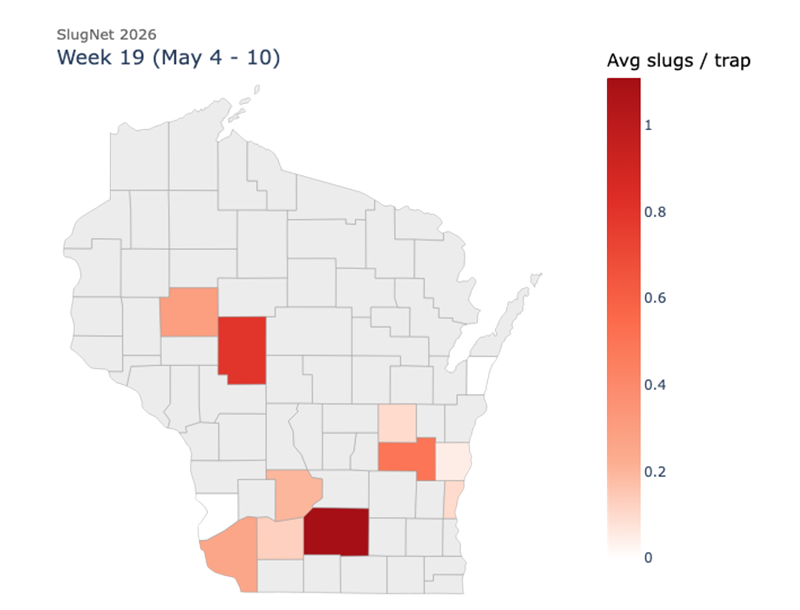
| County Name | Average Slug Count Per Trap | Total Traps Per County | Total Slugs |
|---|---|---|---|
| Chippewa | 0.30 | 20 | 6 |
| Clark | 0.80 | 5 | 4 |
| Crawford | 0.00 | 5 | 0 |
| Dane | 1.11 | 27 | 30 |
| Fond du Lac | 0.50 | 40 | 20 |
| Grant | 0.26 | 50 | 13 |
| Iowa | 0.13 | 15 | 2 |
| Kewaunee | 0.00 | 20 | 0 |
| Ozaukee | 0.10 | 20 | 2 |
| Sauk | 0.20 | 5 | 1 |
| Sheboygan | 0.05 | 20 | 1 |
| Winnebago | 0.10 | 20 | 2 |
NR indicates “no recording” from that county.
Welcome to the second year of the SlugNet project in Wisconsin, a new initiative aimed at monitoring slug populations across the state. This effort uses a citizen science approach, relying on the valuable contributions of participants across our state to collect slug population datain field crops, with a focus on conservation cropping systems (e.g., reduced tillage, cover crops).
UW-Madison Extension and external partners are tracking slug activity to identify patterns in their emergence and damage. The project’s goal is to understand the key factors that lead to severe slug outbreaks so we can help farmers take preventive steps—especially since current chemical control methods are limited. As planting gets underway, be prepared for slugs since we are working in wet and cool weather conditions.
The team will be regularly sharing updates on slug counts from participating counties and observations of feeding damage in this weekly article. In the first year of the project, the team is excited to gather as much data as possible.
For those interested in helping us understand slug activity in Wisconsin crop fields, there’s still time to get involved! Visit the SlugNet project website for more information about the project’s goals, protocols, and how to participate in slug monitoring. Thanks to all volunteers who are already monitoring traps for slugs!
Slug Management Resources

Visit our partner, the Bick Lab, for more field crop insect pest information
See our Managing Slugs in Wisconsin Field Crops article for more information on slug pests in Wisconsin.