

Weather and climate conditions this week in Wisconsin
Here are this week’s take-home points about the weather. As a reminder, AgWOW reports will be published weekly throughout the growing season. Scroll down for the full report.
Additionally, we’re collecting user feedback. Regardless of whether it’s your first time here or if you are a regular user, we’d love to hear from you!
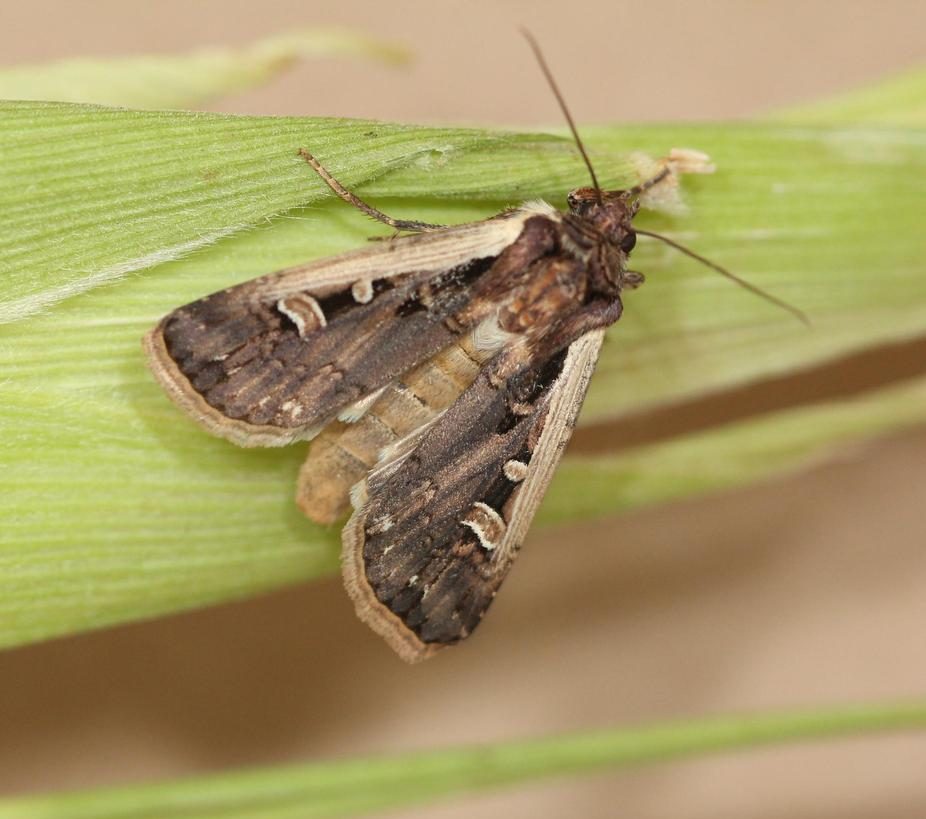
Key Points
Recent Conditions
- Temperatures were below normal across most of the state last week, with the southeast and far northwest corners of the state being the most below normal.
- Southern Wisconsin received at least 0.5” last week, with pockets of 2-4”. Totals across the northern half of the state were commonly 1” or less.
Impact
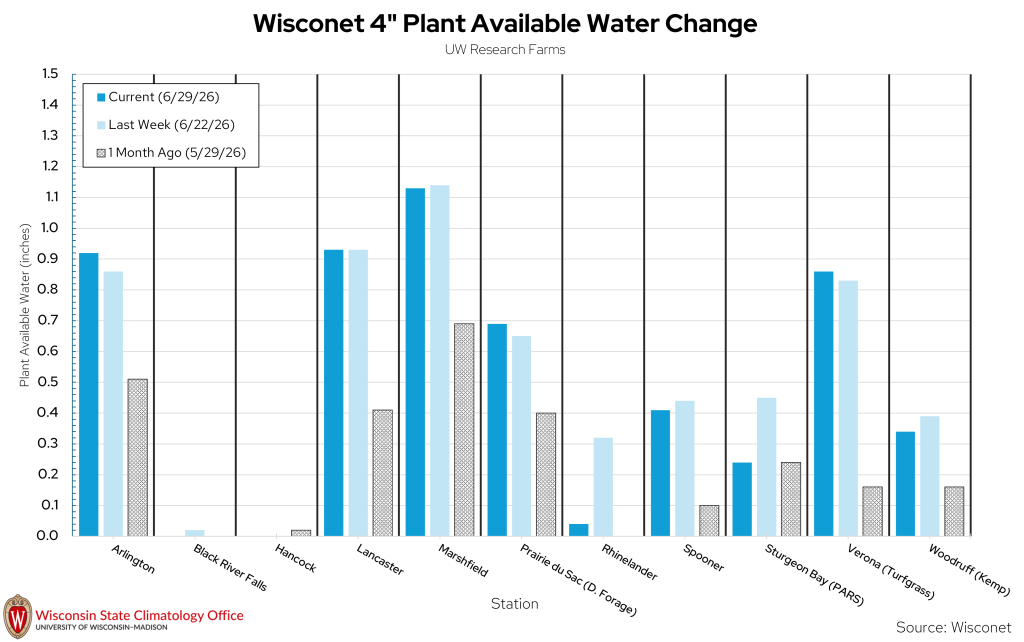
- Most Wisconet research farm stations showed minimal change in 4-inch moisture from last week’s report. Some locations saw a more substantial decrease following a dry week.
- Satellite-based soil moisture estimates indicate drier soils in the northwest compared to last week’s report, with counties in northwest, central, and east-central Wisconsin indicated as abnormally dry.
- D0 coverage decreased by nearly 10%, and D1 coverage decreased by 1%. Most of the drought/dryness improvements were in southern counties.
- Soybeans in Wisconsin have begun to bloom, with winter wheat heading and the first cutting of alfalfa nearly complete. The crops are primarily in good to excellent condition across Wisconsin fields.
Outlook
- The next few days look very active for precipitation, with the highest chances in southern and western counties. Be aware of potentially excessive rainfall.
- Mid-July temperatures are leaning above normal statewide, with precipitation leaning towards near normal for most of the state.
- The outlook for July indicates no strong leans in the temperature or precipitation probabilities.
- Late summer through early fall (July-Sept) may be cooler-than-normal in southern and central counties (33-40% odds), with precipitation leaning towards below normal for most of the state.
Agronomic, Fruit and Vegetable Considerations
Field Conditions
- Thunderstorms have brought hail to areas of the state. Read more about hail damage and crop impacts here.
- Recent humidity has decreased crop evapotranspiration in the wake of warm temperatures.
Forage Management
- Second crop is well underway in Southern WI. Consider using a PEAQ (Predictive Equations for Alfalfa Quality) stick to estimate relative feed value as you decide when to make each cut.
- Scout for potato leafhopper in alfalfa fields.
Pest Management
- Scout fields to note what weed species are emerging or have escaped herbicide application.
- Early planted soybeans are reaching reproductive stages. Revisit POST herbicide labels for timing considerations. Glufosinate must be applied before the R1 stage and Enlist One can be applied through the R1 stage. See recommendations for POST herbicide application in soybean during this warm weather stretch.
- Western bean cutworm trapping has begun for the season. Check DATCP trap catches.
- Japanese beetles are starting to emerge.
- Corn rootworm larvae are feeding on corn roots now. Conduct a root dig to assess damage.
- Continue to scout corn and soybean fields for disease. Particularly, tar spot in corn and white mold in soybean to stay ahead of any disease pressure.
- Red crown rot was confirmed in WI last year. Know what to scout for in your soybean fields this year.
Manure Applications
- Reminder of Wisconsin’s NR 151 Runoff Rules with the timing of manure spreading and current runoff levels. Check DATCP Runoff Risk Advisory Forecast.
Small Grains
- Scout small grains for signs of disease. This includes powdery mildew and stripe rust, especially in susceptible varieties. Use the Crop Risk Tool and Fusarium Risk Tool for risk assessment for Fusarium Head Blight. FHB risk has increased with weather. Winter wheat is not of concern at this point; however, spring wheat should be scouted frequently.
- Staging small grain growth is important for fungicide timing as diseases are emerging. Winter wheat in the southern half of the stat is past the window to spray fungicide. Those in the central and northern parts of the state may still have an opportunity, if warranted. Review growth stages here.
Fruit Considerations- General
- Make sure newly planted fruit crops are getting enough water in this heat. Without irrigation, growth can stall during establishment. Irrigation frequency depends on soil type—sandy soils need water daily or every two days, while heavier soils like silt or clay can be watered less often by applying several days’ worth of water at once.
- Wisconsin fruit growers can reference the bi-weekly Wisconsin Fruit News for the most recent, in-depth updates on fruit production, including disease and insect management.
- Apple and grape growers can reference the NEWA weather station network to monitor for disease infection periods in their area. Check out your nearest weather station: NEWA Weather Station Network (Cornell). Check out your nearest weather station: NEWA Weather Station Network (Cornell).
- Grape growers may reference Dr. Amaya Atucha’s most recent article on petiole sampling in cold hardy grapes.
- Wisconsin fruit growers can reference the Midwest Fruit Pest Management Guide for a list of registered products and recommended best practices. View the MFPMG Online.
Fruit Considerations- Disease
- Apple and grape growers can reference the NEWA weather station network to monitor for disease infection periods in their area. Check out your nearest weather station: NEWA Weather Station Network (Cornell).
- Strawberry growers may reference the most recent Wisconsin Fruit News article on Strawberry Disease Concerns Following Heavy Rains During Harvest by Dr. Leslie Holland.
Fruit Considerations- Insects
- Check out the WI DATCP Orchard Insect Pest Bulletin for more information on current insect trap captures across the state.
- Overview of grape insect/mite monitoring and management: Grape Insects and Mite Pests, 2024 Field Season (Cornell, 2024).
- Apple growers should continue monitoring degree-day (base 50℉) accumulation for Codling moth. First generation larvae will emerge after ~250 degree-days (base 50℉) have accumulated from the biofix date. Second generation larvae will typically emerge at ~1250 degree-days (base 50℉) from the biofix date.
- Apple growers should keep track of degree-day (base 50℉) accumulation from petal fall to determine the end of plum curculio movement into the orchard. Plum curculio will typically cease movement into the orchard after ~308 degree-days (base 50℉) have accumulated from the petal fall date.
Vegetable Considerations- Disease
- High humidity and temperatures lead to the production of brassica alternaria spores. Spores can spread by wind and water. Controlling flea beetles and alternative weed hosts as well as staying out of fields when wet can help prevent the spread. If necessary, fungicide options are also available to control this disease.
- Monitor brassicas for symptoms of black rot which include yellow blotches that start on leaf margins and spread in a v-shaped pattern into the leaf. Veins will also appear brown or black when held up to a light. One of the best management strategies during the season is avoiding working in fields when foliage is wet.
- Early detection of alternaria leaf blight of cucurbits will help you control this disease before major damage occurs. Symptoms start as small, water-soaked lesions that can develop concentric rings. The fungus can survive on plant debris for up to two years so be sure to remove and destroy any infected plant tissue at the end of the season.
- Alternaria leaf blight can sometimes be confused with anthracnose and angular leaf spot which thrive in similar conditions. Angular leaf spot can be distinguished by angular lesions often confined by veins and the whitish liquid that forms on the underside of leaves when wet and forms a crust when dry. The most distinguishing symptom of Anthracnose is the dark, sunken lesions on fruit that have salmon-colored spores under damp conditions.
- As onions continue to put on a lot of vegetative growth, be sure to scout regularly to ensure early detection of foliar disease. Conditions of prolonged leaf wetness are conducive for disease development.
- Botrytis leaf blight starts as small white lesions with light green halos. As the disease progresses, the leaf tip will wither and die back. Avoid working in fields when wet, when possible time irrigation such that leaves will have the chance to dry quickly, and if using protective fungicides, use the Vegetable Disease and Insect Forecasting Network to help time applications.
- Onion downy mildew causes irregular lesions that start as a pale green and progress into yellow or brown necrotic tissue. Fuzzy grey to purple fungal growth forms on leaves during periods of prolonged leaf wetness. Prevention methods include minimizing stress from irrigation deficits, avoiding excess nitrogen applications, and controlling thrips that can stress plant and cause damage that allows entry of pathogens.
- Stemphylium leaf blight infects alliums including onions, garlic and shallots as well as asparagus, parsley and radish. On alliums, symptoms are water soaked, tan lesions that can form large necrotic areas as the disease progresses. It can reduce yield as well as storage life. Some management options are controlling weeds that serve as alternative hosts including pigweed, purslane, and nutsedge, tilling in crop residue at the end of season, and avoiding excessive nitrogen applications.
- Preventative applications for early blight in potato are now recommended for fields from Plover southward. Preventative measures allow for the most successful management.
- Preventative fungicide applications for late blight of tomato and potato are still not necessary as we have not yet accumulated enough favorable weather.
- There are no confirmed cases of sweet corn tar spot in WI; however, it has been confirmed at low levels in states south of WI including Indiana and Iowa. Recent weather conditions are conducive for disease development so scout crops regularly to look for symptoms. Early symptoms are small raised black spots on both the upper and lower leaf surfaces that typically start in the lower canopy before spreading to newer growth. Management options include managing residue to reduce overwintering, growing cultivars that are less susceptible, and fungicides. Use the crop risk assessment tool to determine when to time protective sprays.
Vegetable Considerations- Insects
- Japanese beetles are beginning to emerge. Pheromone traps show mixed control as often the traps attract more beetles to your area. If you do choose to use a trap, make sure it is far away from your crops. Biological controls options are available for grubs although success is inconsistent. Information on chemical control can be found here.
- Diamondback moths are completing their first generation in southern WI. There are typically 3 to 5 generations a year. Continue scouting for eggs and larvae through the season. Management options can be found here.
- Continue to scout for striped cucumber beetles. Adults feed on foliage and fruit and can spread bacterial wilt which can cause severe losses in cucumber and muskmelon. It is important to scout and, when necessary, control beetles early in the season to reduce risk of spreading this disease. Management options include spraying plants with kaolin clay although this will wash off with rain, floating row cover or high tunnel insect exclusion screens, and soil drenches for larvae.
- Start scouting for squash bugs as eggs laying starts around late June or early July. Orange to brown colored eggs are laid in clusters on the underside of leaves. Chemical control is most effective when applied at egg hatch, so early detection is key for the best management. In small plantings, crush eggs and trap adults by placing newspaper or cardboard on the soil surface. At night, they will congregate underneath and can be killed in the morning.
- Squash vine borer risk is high in central WI and northern WI. Be on the lookout for adults which are day flying moths. Their abdomens are red to orange in color with black spots. Floating row cover during peak adult activity can reduce crop risk although it must be removed during flowering. Chemical control options are limited once larvae move into the plant stem. Effective chemical control requires insecticides to be in place before and during egg laying.
- Keep monitoring for Colorado potato beetle. Overwintered adults are disappearing from southern and central fields. They are still prevalent in northern WI however, and egg hatch and early larvae are increasing. Check out the Vegetable Production Newsletter for management recommendations.
- Western bean cutworms are being detected across southern and central WI. View trap catches for your area on the DATCP trap network map. Scout for egg masses on the upper surfaces of new leaves and unfurled leaves above and below the ear zone. Management options can be found here.
Dive deeper into each report section by clicking a topic below.
Precipitation Trends
7 Day Precipitation
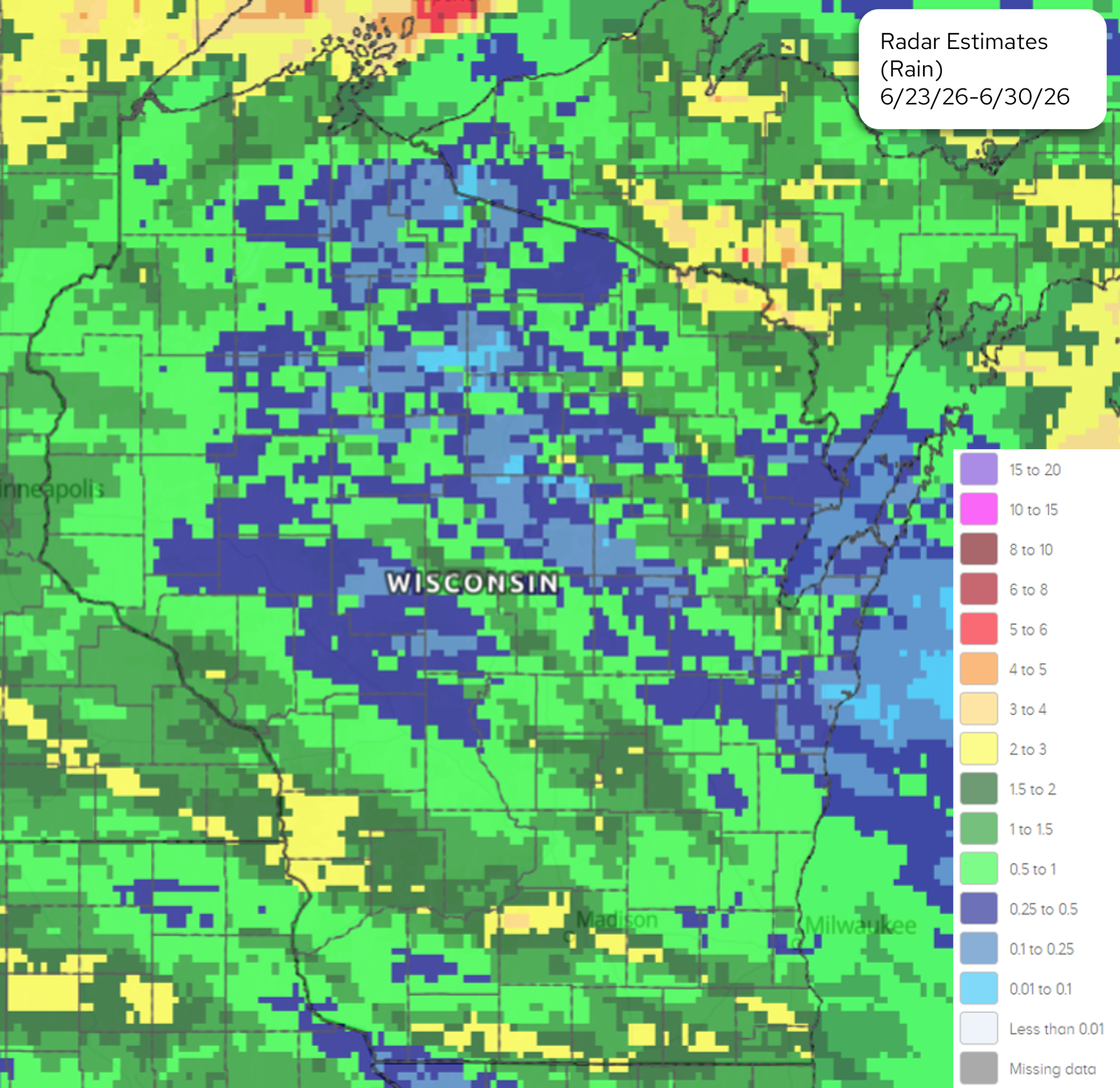
Image Description ↓
Color-coded radar precipitation estimate map covering Minnesota, Wisconsin, and parts of surrounding states for the period 6/23/26–6/30/26. Most of central and southern Wisconsin shows 0.25–1 inch of rain (dark blue and green shading), with a band of lower totals (0.1–0.25 inch, light blue) running through central Wisconsin. Far northern Wisconsin and the Upper Peninsula area show higher totals of 2–6 inches (yellow, orange, and red shading), including a small red pocket (5–6 inches) near the top of the map. Southern Minnesota and areas near Milwaukee show scattered pockets of 2–4 inches (yellow/tan). The legend lists 15 rainfall categories ranging from “Less than 0.01” inch to “15 to 20” inches, plus a “Missing data” category shown in gray. City labels visible on the map include Minneapolis, Madison, and Milwaukee.
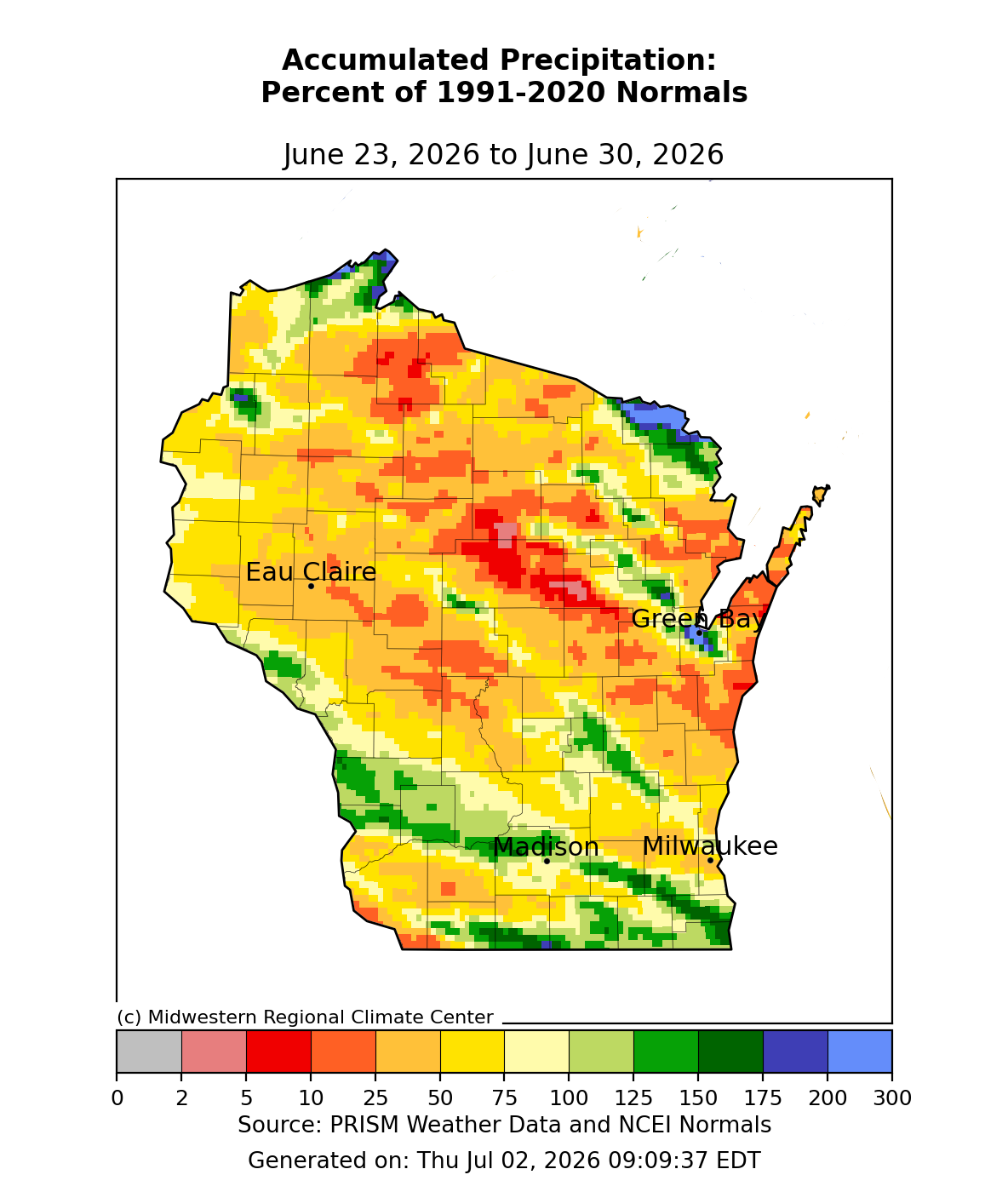
Image Description ↓
Map titled “Accumulated Precipitation: Percent of 1991-2020 Normals, June 23, 2026 to June 30, 2026,” from the Midwestern Regional Climate Center, sourced from PRISM Weather Data and NCEI Normals, generated Thu Jul 02, 2026 09:09:37 EDT.
The map shows Wisconsin shaded by county-level precipitation percentages, with cities Eau Claire, Green Bay, Madison, and Milwaukee labeled. A color scale at the bottom runs from gray (0%) through red (2–10%, driest), orange and yellow (25–75%), pale yellow (100%, near normal), green (125–175%), to dark blue and light blue (200–300%, wettest).
Most of the state falls in the yellow-to-orange range (50–150% of normal). A prominent red band of low precipitation (5–25% of normal) runs through central Wisconsin near Eau Claire and extending northeast. Small patches of dark blue/green (150–300%, well above normal) appear near the Door County peninsula and far northern border. Southern Wisconsin, including areas near Madison and Milwaukee, shows a mix of yellow and light green (75–150%).
- Southern Wisconsin received at least 0.5” last week, with pockets of 2-4”.
- Totals across the northern half of the state were commonly 1” or less. Localized higher amounts (0.5-2”) were observed.
- Highest Wisconet station total from last week: 2.76” (Darlington, Lafayette County). Totals in Lafayette County were as high as 175% of normal.
30 Day Precipitation Total and Departure from Normals
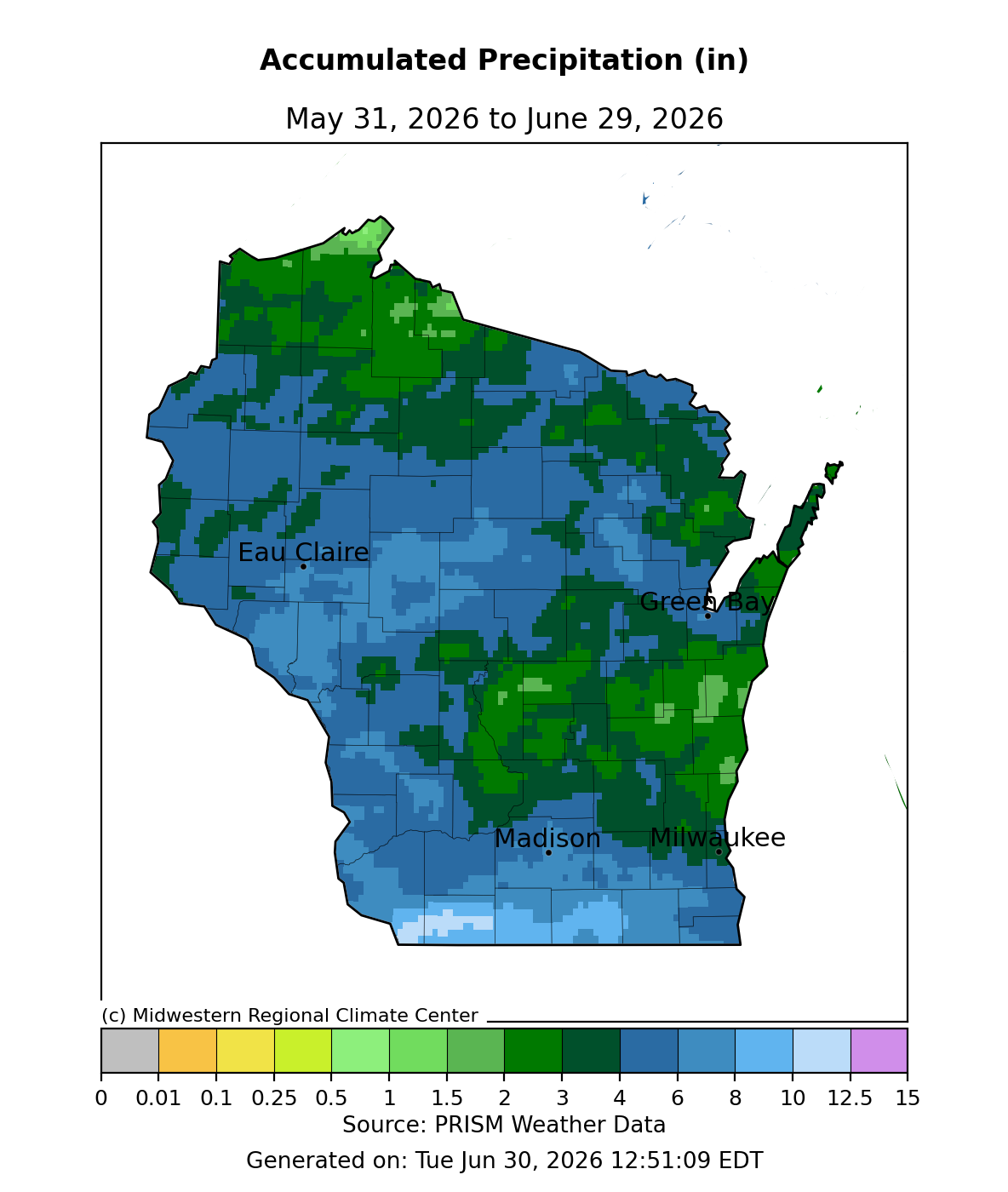
Image Description ↓
Choropleth map titled “Accumulated Precipitation (in), May 31, 2026 to June 29, 2026,” sourced from PRISM Weather Data via the Midwestern Regional Climate Center, generated Jun 30, 2026. Color scale ranges from 0 to 15 inches (gray, orange, yellow, green shades, blue shades, light blue, and magenta for highest values). Most of Wisconsin shows 3–6 inches (blue tones). Higher totals of 4–8+ inches (dark green) appear in the far north, along Lake Michigan’s eastern shore near Green Bay and Door County, and in south-central/southeastern counties. Lower totals of 2–3 inches (light blue) appear in the far south near the Illinois border. Cities labeled: Eau Claire, Green Bay, Madison, and Milwaukee.
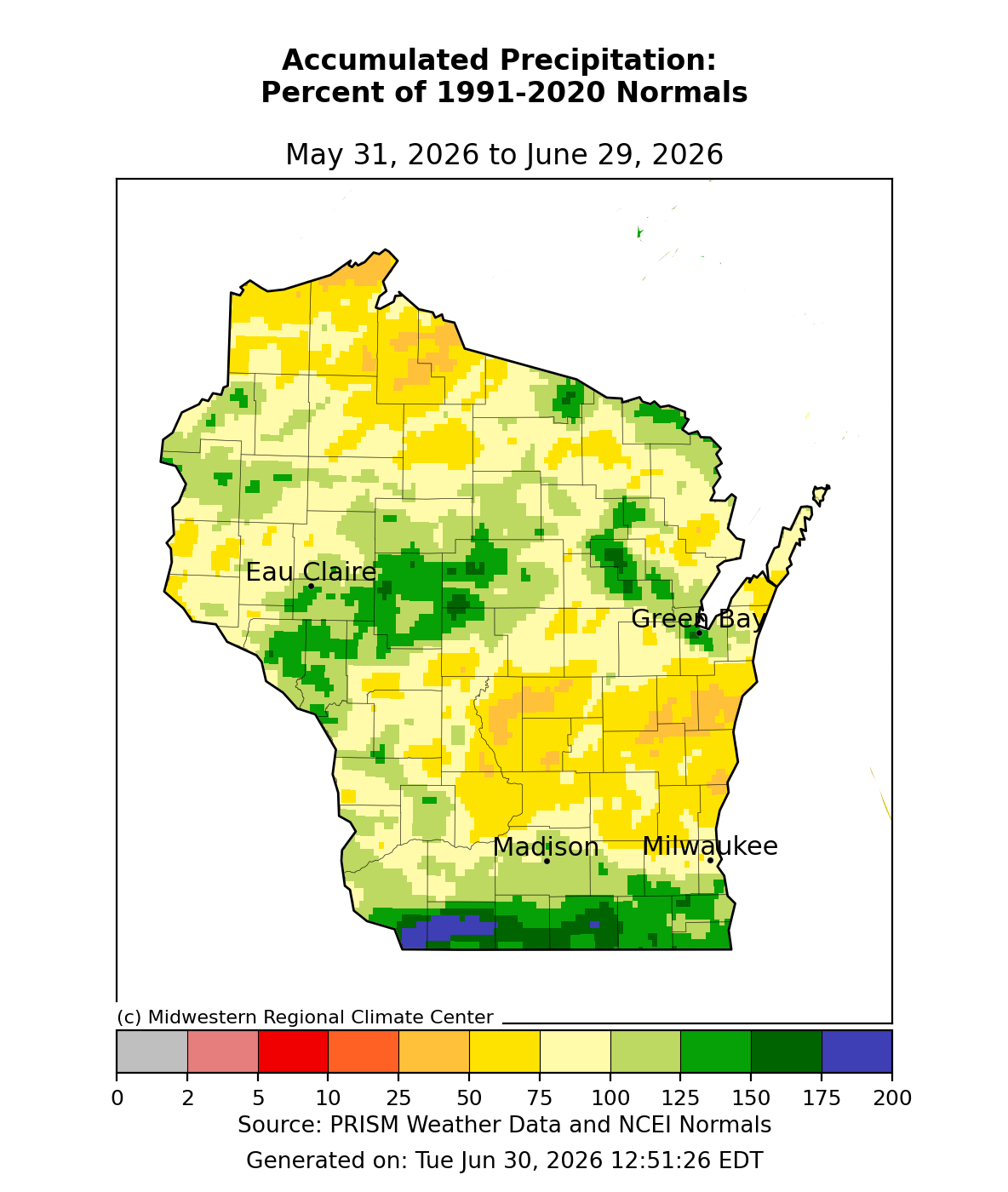
Image Description ↓
Choropleth map titled “Accumulated Precipitation: Percent of 1991-2020 Normals,” dated May 31, 2026 to June 29, 2026, produced by the Midwestern Regional Climate Center using PRISM Weather Data and NCEI Normals, generated June 30, 2026. Color scale ranges from gray (0%) and red (2–10%, driest) through orange and yellow (25–75%), pale yellow (100%, near normal), green shades (125–175%), to dark blue (200%, wettest). Most of Wisconsin shows near-normal to above-normal precipitation (yellow to green), with a wide yellow band of below-normal precipitation (75–100%) across the south-central and eastern part of the state near Madison and Milwaukee. Pockets of well-above-normal precipitation (dark green, 150–175%) appear in west-central Wisconsin near Eau Claire and in the far south along the Illinois border, where a small dark blue area indicates over 200% of normal. Cities labeled: Eau Claire, Green Bay, Madison, and Milwaukee.
- Totals in southern, western, and north-central Wisconsin commonly ranged from 4-8”. These totals were at or above normal, with a bullseye of ≥175% of normal in southern Grant and Lafayette Counties.
- Elsewhere in the state, precipitation totals were commonly 2-4” (25-75% of normal).
90 Day Precipitation Total and Percent of Normals
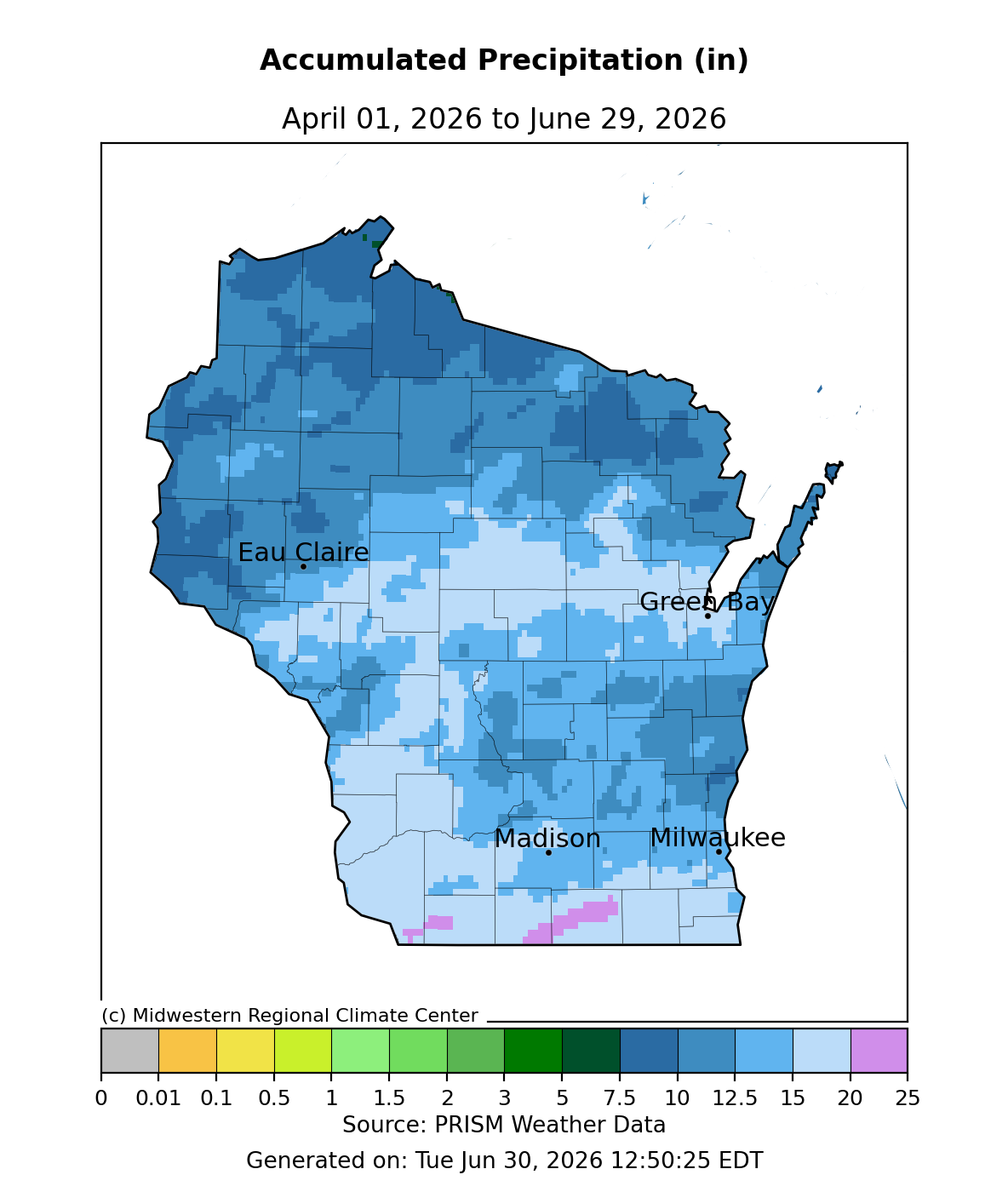
Image Description ↓
Choropleth map titled “Accumulated Precipitation (in), April 01, 2026 to June 29, 2026,” sourced from PRISM Weather Data via the Midwestern Regional Climate Center, generated June 30, 2026. Northern Wisconsin shows the highest totals, mostly 12.5–15 inches with some areas exceeding 15 inches. Central Wisconsin, including Eau Claire, Green Bay, Madison, and Milwaukee, shows moderate totals in the 7.5–12.5 inch range. A band across south-central Wisconsin near the Illinois border shows lower totals of 15–20 inches shaded in pink/magenta, indicating the driest areas relative to the color scale. The legend ranges from 0 to 25 inches using a gradient from gray (0) through orange, yellow, green, dark green, blue tones, and pink (20–25).
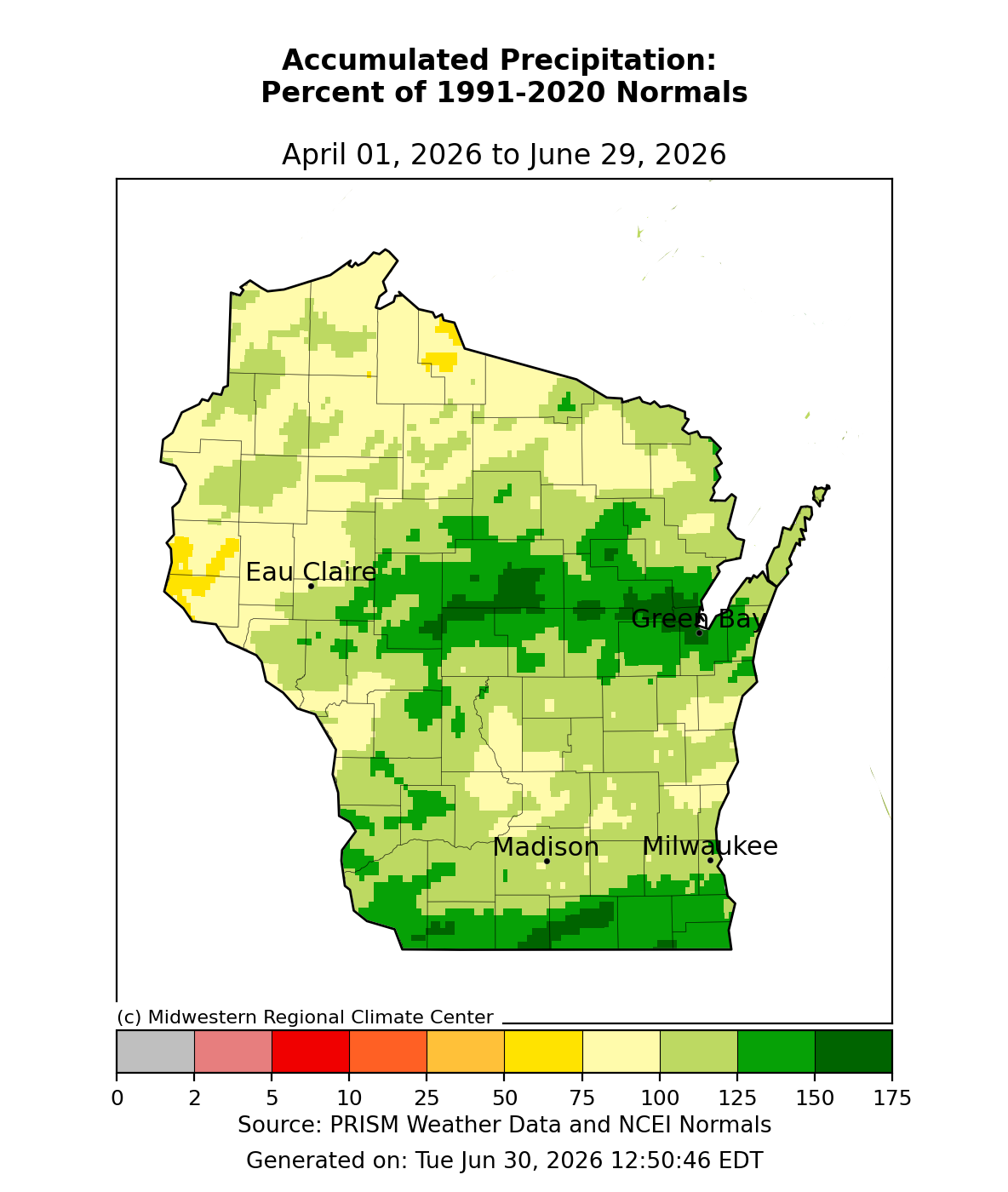
Image Description ↓
Choropleth map titled “Accumulated Precipitation: Percent of 1991-2020 Normals,” dated April 01, 2026 to June 29, 2026, sourced from PRISM Weather Data and NCEI Normals via the Midwestern Regional Climate Center, generated June 30, 2026. Wisconsin is shaded by percent-of-normal precipitation on a 10-category scale from 0 to 175%. Most of the state falls in the 100–150% range (pale yellow to green), indicating near-normal to above-normal precipitation. Central Wisconsin, southern counties, and areas near Green Bay show pockets of 150–175% (dark green), reflecting well-above-normal rainfall. A small area in northwestern Wisconsin (near the western border) and a spot in the north-central region show 25–50% (yellow/orange), indicating notably below-normal precipitation. Cities labeled: Eau Claire, Green Bay, Madison, and Milwaukee.
- Totals of 15-20” or more were common across southern, west central, and north central counties. These totals were 100-175% of normal.
- Most of the state received precipitation totals that were at or above normal, with most receiving at least 10” of precipitation (rain plus melted snow).
- Precipitation totals were lowest in the north (7.5-12.5”). In the north and northwest, 90-day totals were 50-100% of normal.
2026 Precipitation
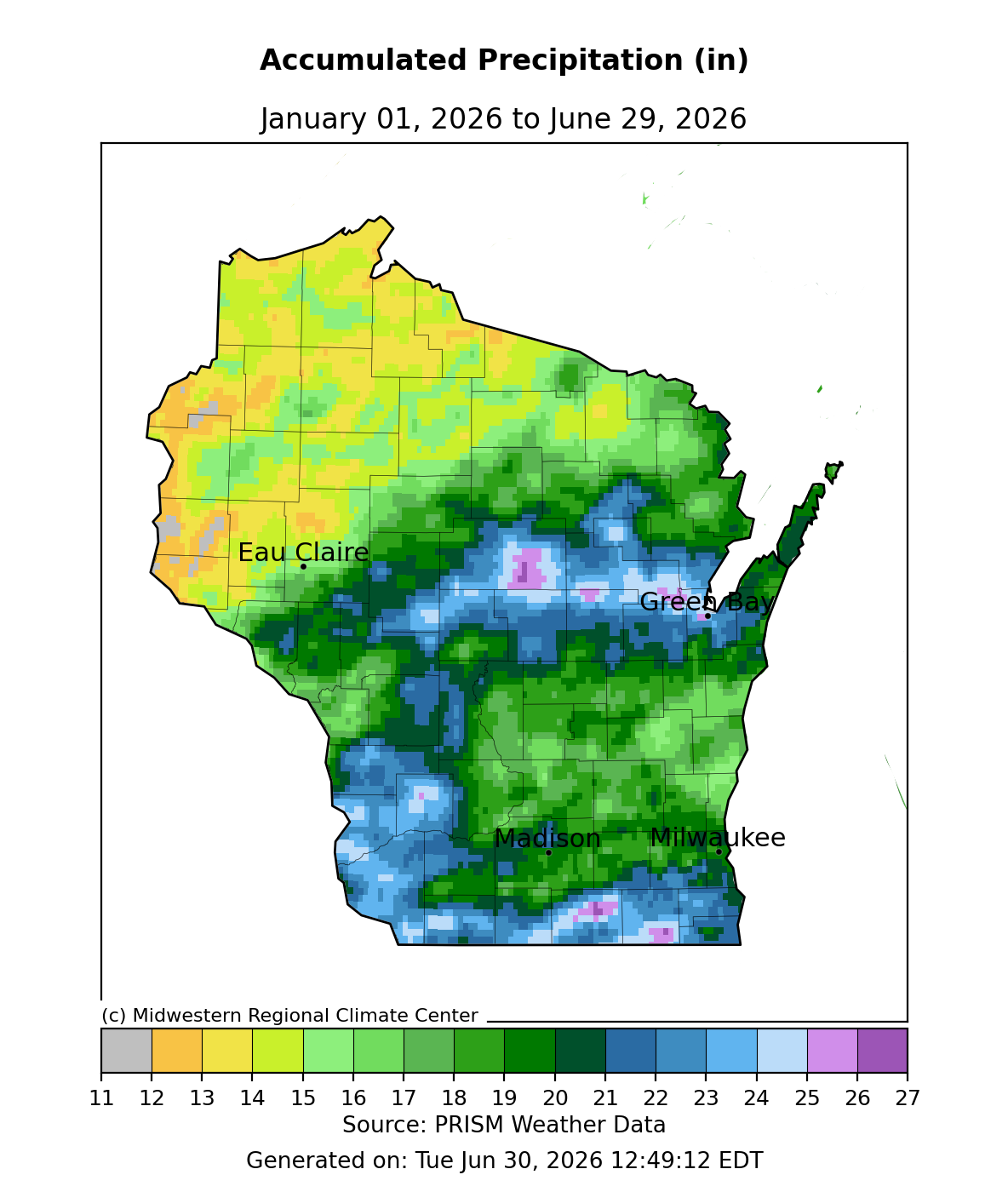
Image Description ↓
Map titled “Accumulated Precipitation (in), January 01, 2026 to June 29, 2026,” from the Midwestern Regional Climate Center, sourced from PRISM Weather Data, generated June 30, 2026. Color scale ranges from 11 to 27 inches. Northern Wisconsin shows the lowest totals (12–15 in, orange/yellow), transitioning to moderate totals (16–19 in, green) across the central band. A wide swath through south-central Wisconsin, including areas near Madison, Eau Claire, and Green Bay, shows higher totals (20–24 in, dark green to blue), with isolated pockets exceeding 25–27 inches (pink/purple) near central Wisconsin and along the southern border. Milwaukee and the eastern shoreline show totals in the 18–22 inch range.
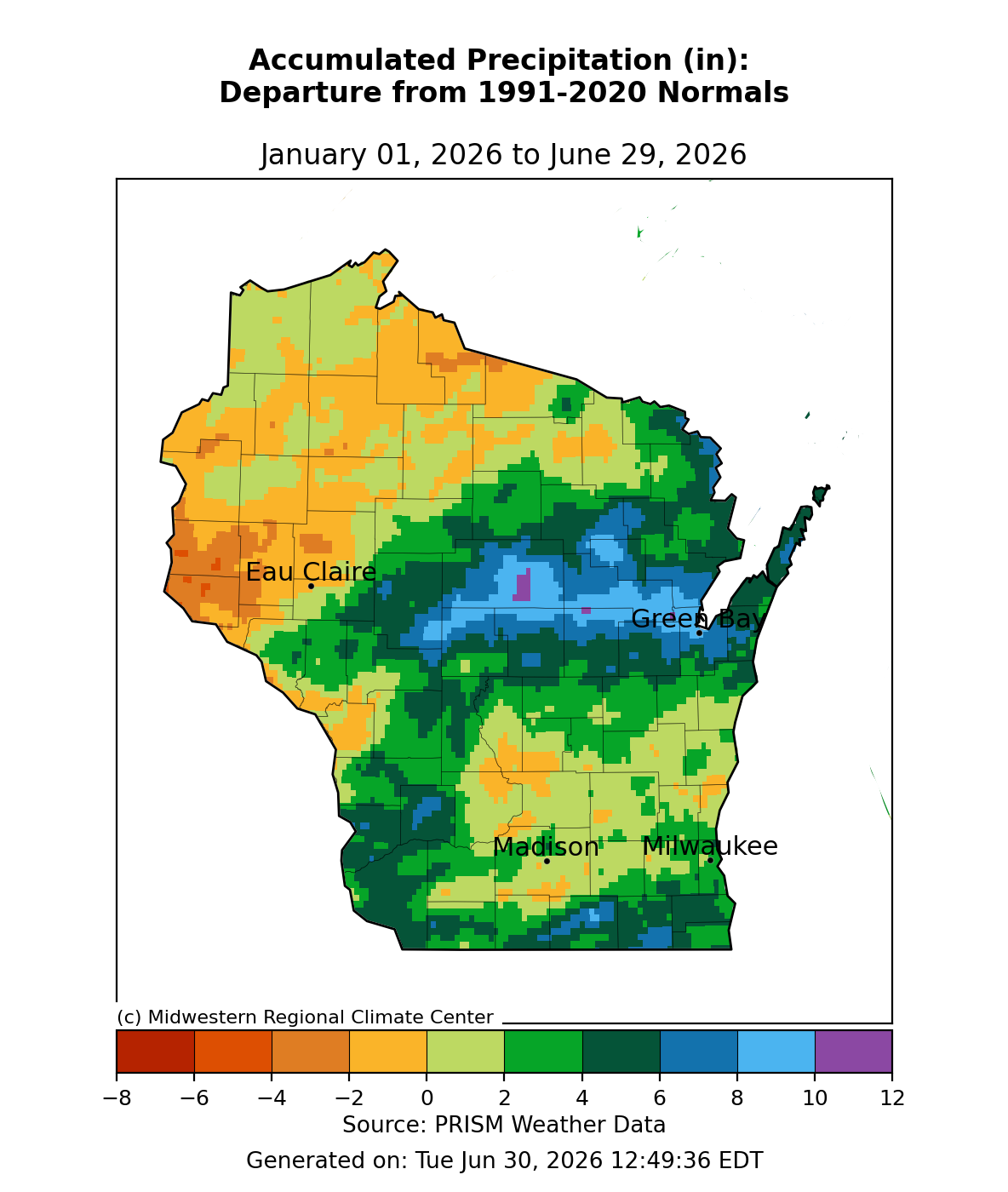
Image Description ↓
Choropleth map titled “Accumulated Precipitation (in): Departure from 1991-2020 Normals, January 01, 2026 to June 29, 2026,” produced by the Midwestern Regional Climate Center using PRISM weather data, generated June 30, 2026. A color scale ranges from dark red (-8 in) through orange, yellow, light green, green, dark green, blue, light blue, to purple (+12 in). Northwestern and northern Wisconsin, including the area around Eau Claire, show orange-to-yellow shading indicating precipitation deficits of roughly -2 to -6 inches. A broad band across central Wisconsin, stretching from west of Eau Claire through the area between Madison and Green Bay, shows green, dark green, and blue shading indicating surpluses of about 4 to 10 inches, with a small purple patch near the center exceeding 10 inches. Southern Wisconsin, including Madison and Milwaukee, shows mixed light green and yellow shading, roughly near normal to slightly above. City markers are labeled for Eau Claire, Green Bay, Madison, and Milwaukee.
Soil Moisture and Temperature Trends
Soil Moisture Models
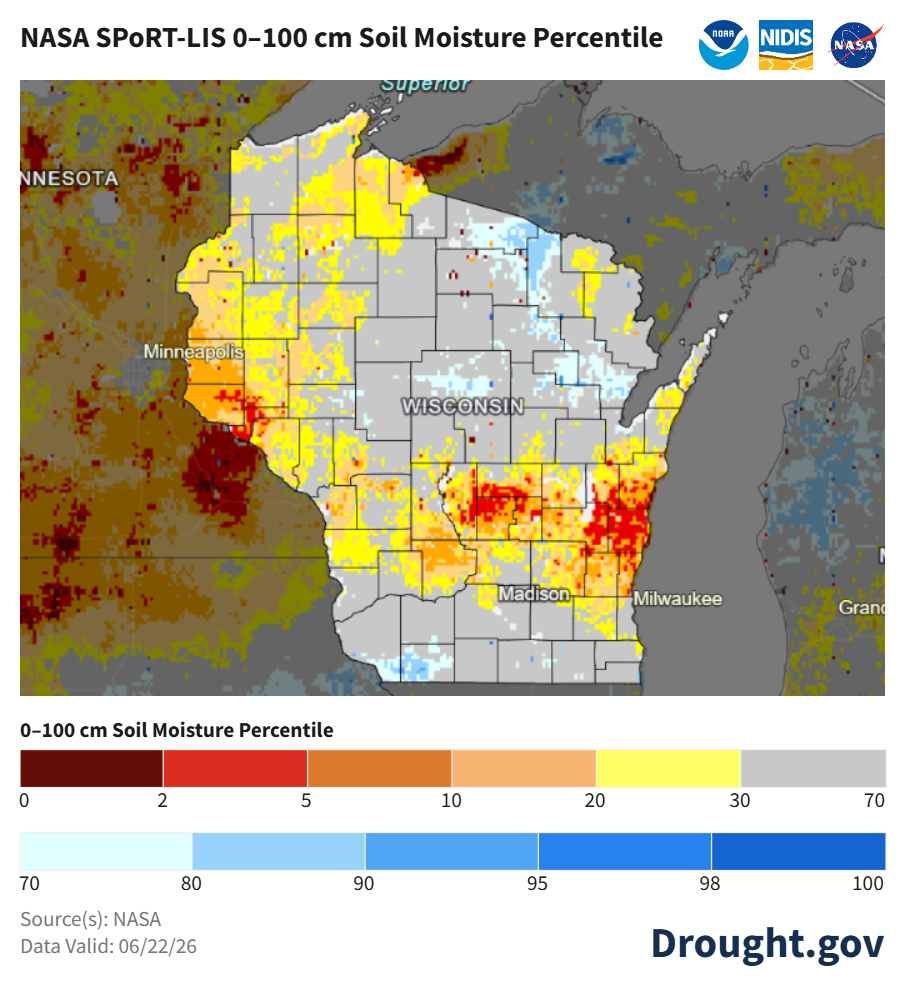
Image Description ↓
NASA SPoRT-LIS map titled “0–100 cm Soil Moisture Percentile” covering Wisconsin and parts of neighboring states, data valid 06/22/2026, sourced from NASA via Drought.gov. Soil moisture is shown on a color scale from dark red (0–2nd percentile, driest) through red, orange, tan, yellow (2–30th percentile) to gray (30–70th, near normal), and light blue to dark blue (70–100th percentile, wettest).
Most of Wisconsin shows gray (normal) to yellow (below-normal, 20–30th percentile) conditions. Notable dry pockets (orange to dark red, below 10th percentile) appear in west-central Wisconsin near the Minnesota border, and a pronounced dry band runs across south-central Wisconsin between Madison and the state’s east-central region, with several dark red patches indicating extreme dryness (below 2nd percentile). Small areas of above-normal moisture (light blue) appear in north-central Wisconsin and near the Lake Michigan shoreline south of Green Bay. Minnesota, to the west, shows widespread severe dryness across much of its southern and central regions.
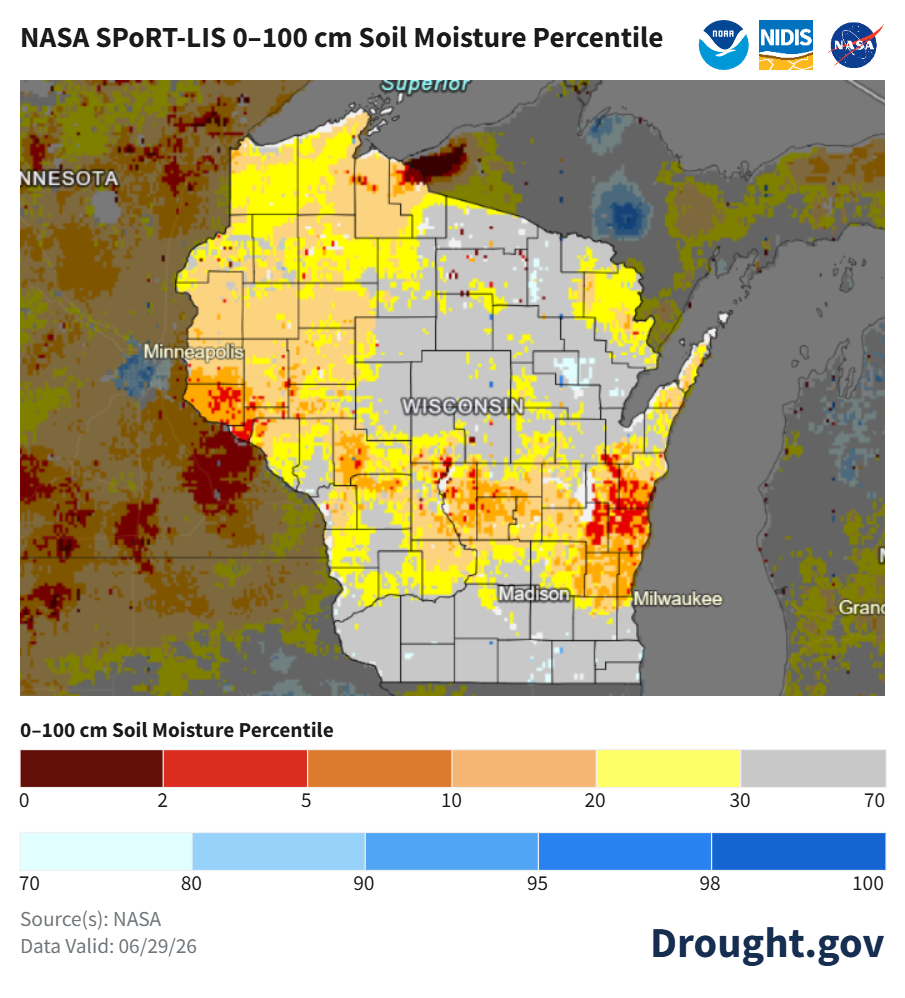
Image Description ↓
Choropleth map of Wisconsin and surrounding region showing 0–100 cm soil moisture percentile, sourced from NASA via Drought.gov, data valid 06/29/2026. Legend ranges from dark red (0–2, driest) through red, orange, tan, yellow (2–30) to gray (30–70, near normal), then light blue to dark blue (70–100, wettest). Most of Wisconsin shows yellow to tan shading, indicating low soil moisture percentiles (roughly 10–30). Pockets of red and dark red (below 5th percentile) appear in western Wisconsin near the Minnesota border, and in the southeast near Milwaukee and along the Lake Michigan shoreline. Central Wisconsin, including the Madison area, shows a mix of gray (near-normal, 30–70 percentile) and yellow patches. Far western Minnesota near Minneapolis shows scattered dark red areas indicating very dry conditions. No significant blue (wet) areas appear over Wisconsin itself, though small blue patches are visible over Lake Superior and Lake Michigan regions.
- Satellite-based soil moisture estimates indicate drier soils in the northwest compared to last week’s report. Elsewhere, change was minimal.
- Counties in northwest, central, and east-central Wisconsin are still indicated as abnormally dry.
- Notes on how to interpret the maps:
- Red areas = top 5 driest in 100 years.
- Dark red areas = top 2 driest in 100 years.
- Dark blue areas = top 2 wettest in 100 years.
Wisconet Soil Moisture
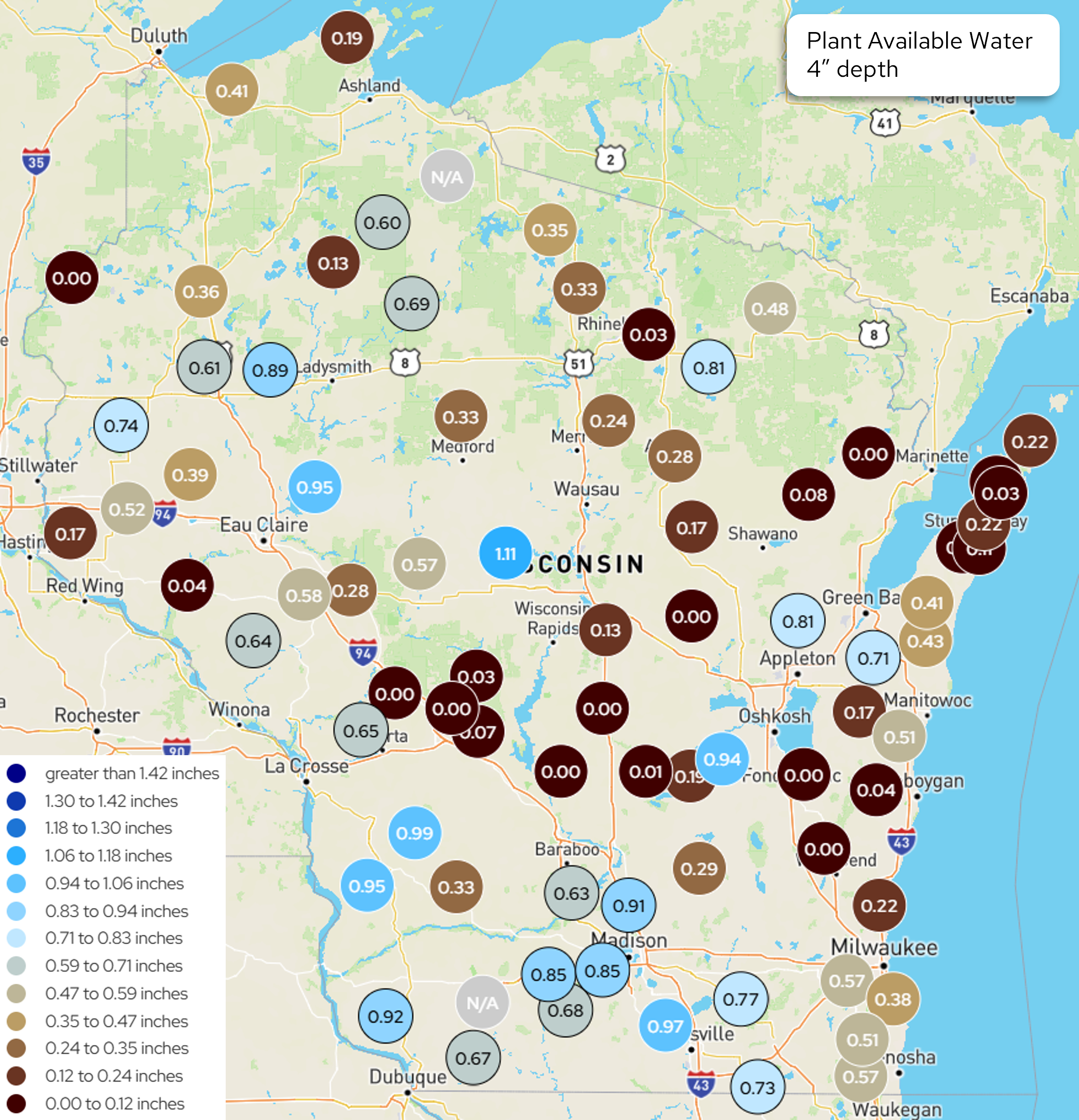
Image Description ↓
A map of Wisconsin and surrounding areas titled “Plant Available Water, 4″ depth.” Circular markers at roughly 70 locations across the state show numeric values (in inches) color-coded by an 11-category legend ranging from dark navy blue (“greater than 1.42 inches”) through light blue, gray, and tan tones, down to dark maroon (“0.00 to 0.12 inches”); one marker is labeled “N/A” and shown in light gray. Values cluster mostly between 0.00 and 0.95 inches, with most of central, eastern, and southern Wisconsin (including areas near Wausau, Green Bay, Fond du Lac, and Sheboygan) showing low values in the dark maroon and brown range (0.00–0.35 inches), while parts of western and south-central Wisconsin (near Eau Claire, La Crosse, and Madison) show higher values in the light blue and gray range (0.6–0.99 inches). The highest single value shown is 1.11 near central Wisconsin.
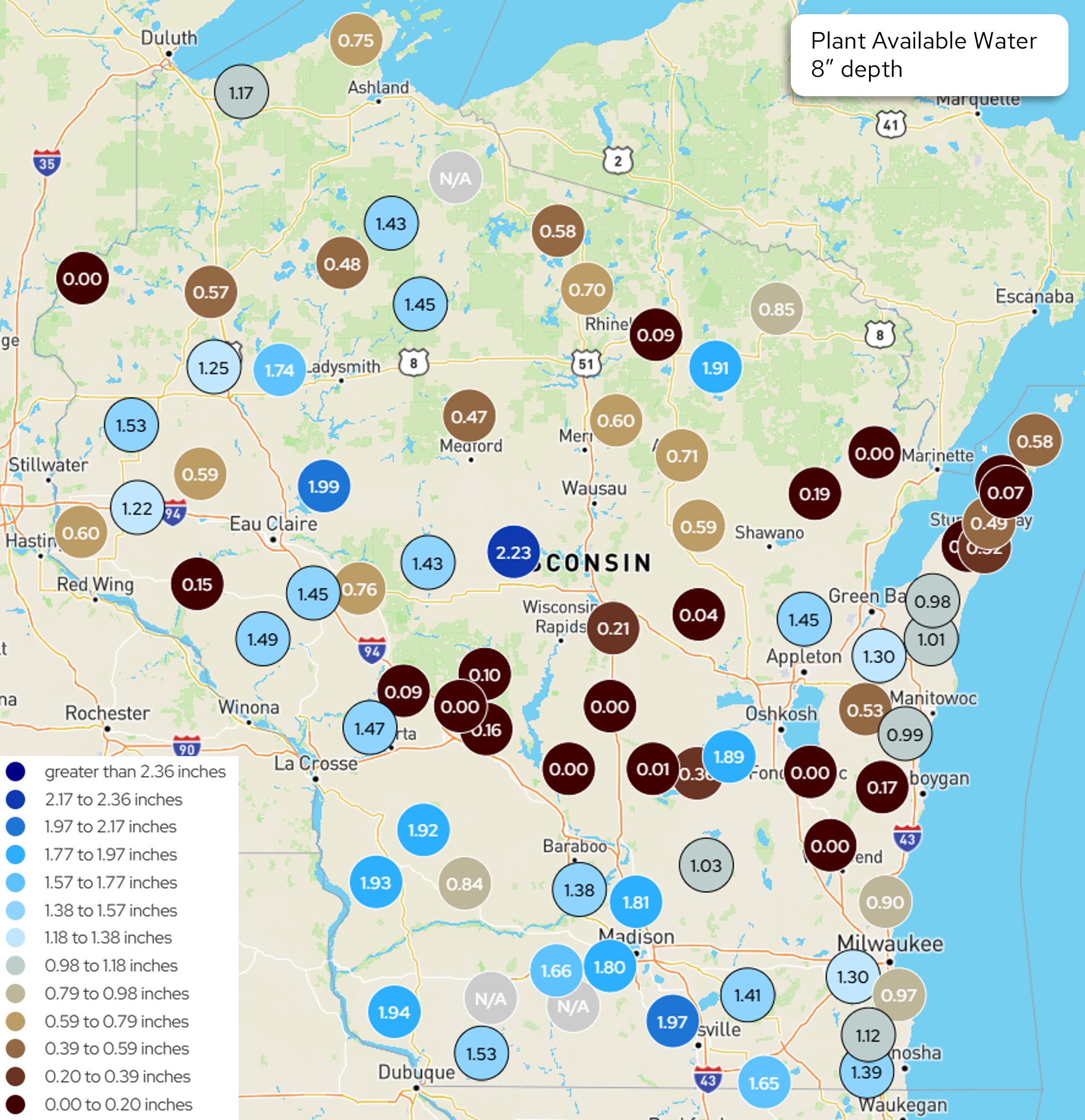
Image Description ↓
Map of Wisconsin showing Plant Available Water (8″ depth) readings at approximately 60 monitoring stations, each marked with a colored circle showing a numeric value in inches and colored by an 11-category legend ranging from dark navy (greater than 2.36 inches) through blues, tans, browns, to dark red (0.00 to 0.20 inches). The highest reading, 2.23 inches, appears near central Wisconsin close to Wausau. The lowest readings, 0.00 inches, appear at multiple stations including near the Minnesota border in the northwest, near Marinette in the northeast, and at several central and south-central locations near Wisconsin Rapids and Fond du Lac. Several stations show “N/A” in gray. Readings generally trend higher (lighter blue, indicating more available water) in the west-central and south-central regions near Eau Claire and Madison, and lower (dark red, indicating less available water) in a cluster of stations across central Wisconsin and the Lake Michigan shoreline near Green Bay through Sheboygan.
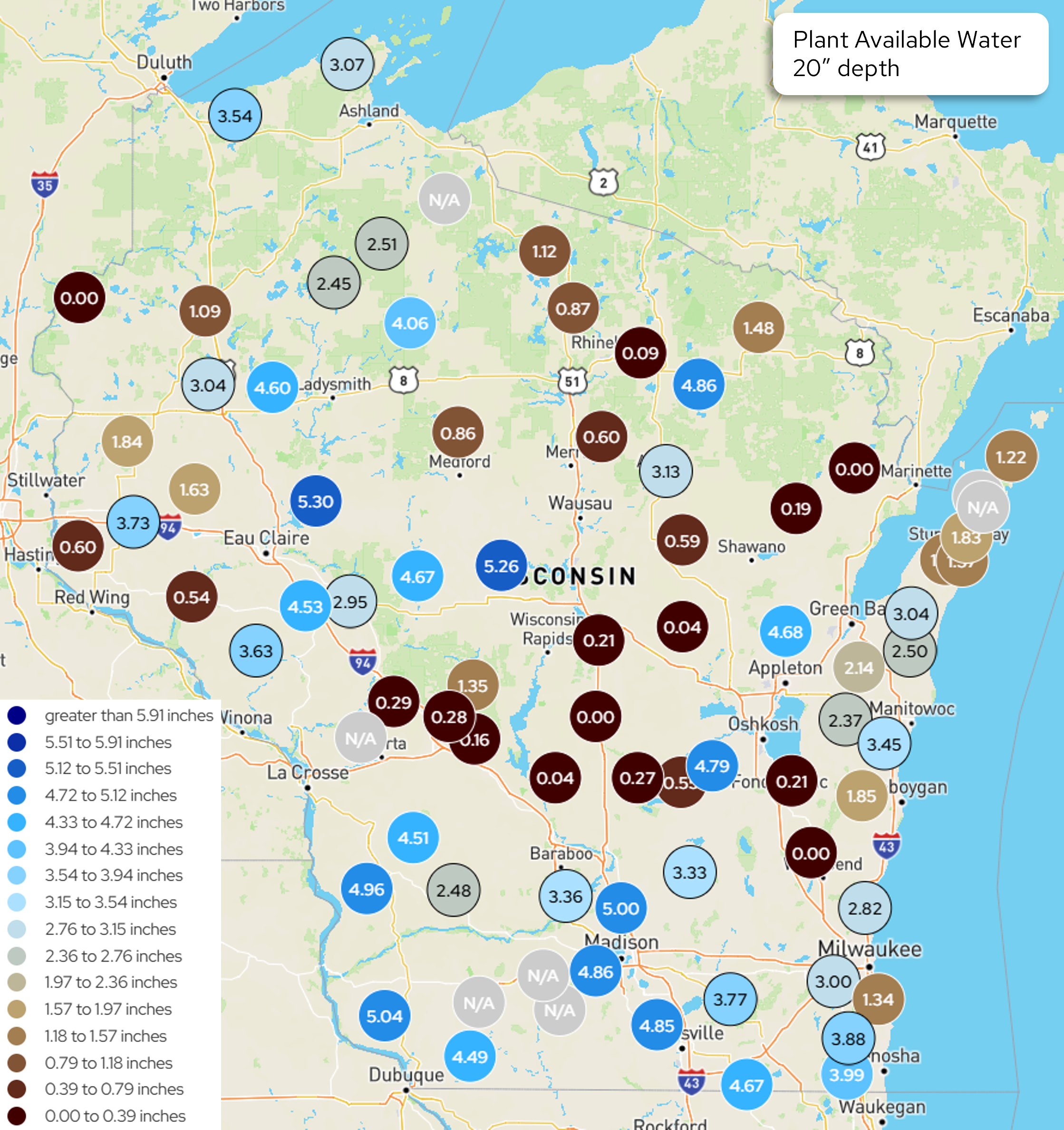
Image Description ↓
Map of Wisconsin and border areas showing plant available water at 20-inch soil depth for roughly 60 monitoring stations, each marked with a colored circle and numeric value in inches. Color scale ranges from dark red (0.00–0.39 inches) through browns/tans (0.39–2.36), grays (2.36–2.76), light blues (2.76–3.94), to dark blue (greater than 5.91 inches); some stations show “N/A.”
Values cluster into two groups: very low readings (0.00–1.48 inches, dark red/brown) concentrated in the north-central and east-central regions near Rhinelander, Wausau, Wisconsin Rapids, Fond du Lac, and Marinette; and higher readings (3.3–5.3 inches, light-to-dark blue) concentrated in western and southern Wisconsin near Eau Claire, La Crosse, Madison, and the Illinois border.
Selected values by area: Duluth/border area 0.00; Ashland 3.07; Eau Claire area 5.30; Wausau area 3.13; Rhinelander 0.09; Wisconsin Rapids 0.21; Madison area 4.86–5.00; Milwaukee area 3.00–3.88; Fond du Lac area 4.79; Green Bay area 4.68; several stations near Sturgeon Bay and Baraboo marked N/A.
- Most Wisconet research farm stations showed minimal change in 4-inch moisture from last week’s report. Rhinelander and Sturgeon Bay both saw more substantial decreases after minimal rainfall.
- The maps (above) show the daily average Wisconet plant available water (inches) on June 29th.
- The table (below) shows total precipitation and changes in plant available water from June 22nd (Start) to June 29th (End).
- What is plant available water? To learn more, read this article from UW Extension Ag Water Quality on plant available water. There is also a webinar from UW Extension on soil water management that you can watch.
- Example: Imagine that you have 4 inches of soil in the bottom of a bucket. In that soil, there are 1.5 inches of plant available water. Therefore, if you removed the soil and left only the water available for plant roots to take up, you would have 1.5 inches of water in the bottom of the bucket.
- The wilting point is when plant available water is at 0 inches, and the plant can no longer access water at that depth in the soil.
| Research Farm | County | Total Precipitation (in.) | 4″ Start | 4″ End | 8″ Start | 8″ End | 20″ Start | 20″ End |
|---|---|---|---|---|---|---|---|---|
| Arlington | Columbia | 1.26 | 0.86 | 0.92 | 1.73 | 1.84 | 4.92 | 5.03 |
| Black River Falls | Jackson | 0.37 | 0.02 | 0.00 | 0.19 | 0.01 | 0.59 | 0.32 |
| Dairy Forage ARS | Sauk | 0.63 | 0.73 | 0.65 | 1.13 | 1.10 | 3.14 | 3.08 |
| Hancock | Waushara | 0.40 | 0.00 | 0.00 | 0.00 | 0.00 | 0.00 | 0.00 |
| Kemp | Oneida | 0.89 | 0.39 | 0.34 | 0.83 | 0.73 | 1.07 | 0.93 |
| Lancaster | Grant | 0.96 | 0.93 | 0.93 | 1.91 | 1.95 | 5.01 | 5.05 |
| Marshfield | Marathon | 0.78 | 1.14 | 1.13 | 2.26 | 2.24 | 5.29 | 5.27 |
| O.J. Noer (Turfgrass) | Dane | 0.79 | 0.83 | 0.86 | 1.78 | 1.82 | 4.83 | 4.88 |
| Peninsular | Door | 0.10 | 0.45 | 0.24 | 0.84 | 0.52 | 2.26 | 1.87 |
| Rhinelander | Oneida | 0.08 | 0.32 | 0.04 | 0.51 | 0.12 | 0.51 | 0.12 |
| Spooner | Washburn | 0.96 | 0.44 | 0.41 | 0.61 | 0.63 | 1.11 | 1.14 |
| Research Farm | Current 4″ Soil Moisture | Last Week’s 4″ Soil Moisture | 1 Month Ago 4″ Soil Moisture |
|---|---|---|---|
| Arlington | 0.92 | 0.86 | 0.51 |
| Black River Falls | 0.00 | 0.02 | 0.00 |
| Dairy Forage ARS | 0.69 | 0.65 | 0.40 |
| Hancock | 0.00 | 0.00 | 0.02 |
| Kemp | 0.34 | 0.39 | 0.16 |
| Lancaster | 0.93 | 0.93 | 0.41 |
| Marshfield | 1.13 | 1.14 | 0.69 |
| O.J. Noer (Turfgrass) | 0.86 | 0.83 | 0.16 |
| Peninsular | 0.24 | 0.45 | 0.24 |
| Rhinelander | 0.04 | 0.32 | 0.00 |
| Spooner | 0.41 | 0.44 | 0.10 |
USDA Soil Moisture Reports
*Note that USDA soil moisture maps were not updated this week.
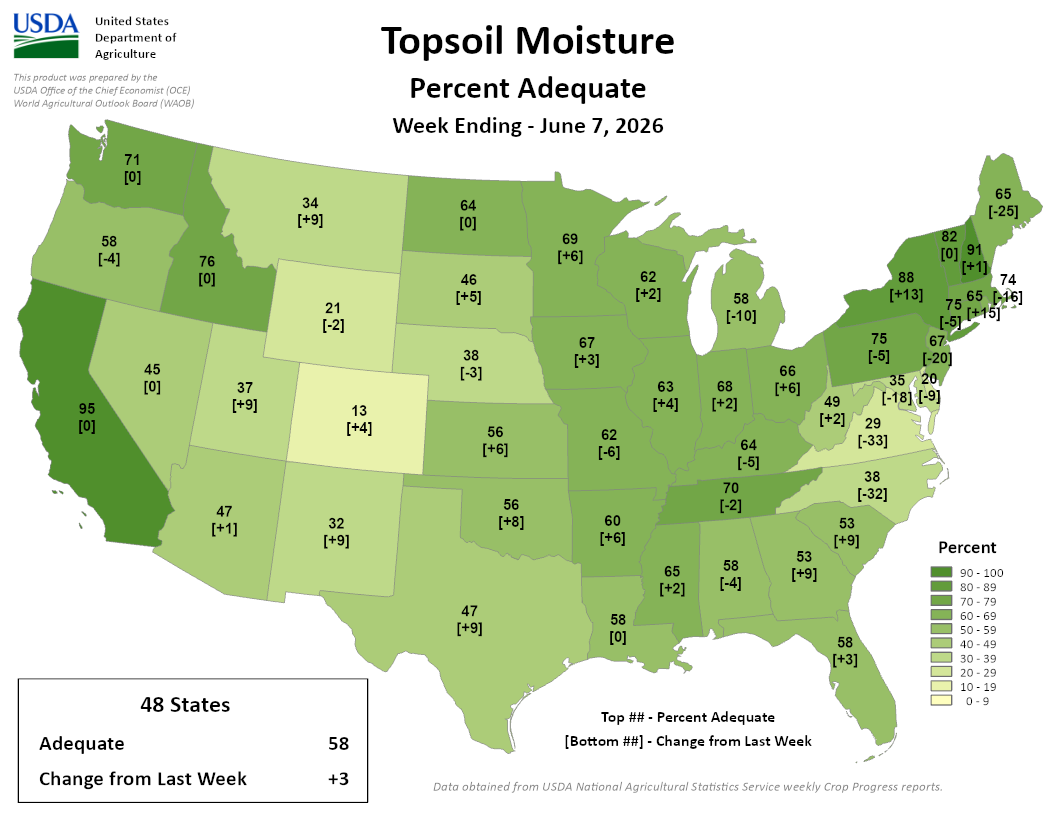
Image Description ↓
USDA topsoil moisture map, week ending June 7, 2026, showing percent adequate by state. 48-state average: 58%, +3 from last week. Image description below.
Image description: Choropleth map of the contiguous US titled “Topsoil Moisture: Percent Adequate, Week Ending – June 7, 2026,” from USDA’s Office of the Chief Economist/World Agricultural Outlook Board, using Crop Progress report data from USDA NASS. Shading ranges from pale yellow (0-9%) to dark green (90-100%). Each state shows percent adequate followed by change from prior week in brackets.
State values: Washington 71 [0], Oregon 58 [-4], California 95 [0], Idaho 76 [0], Nevada 45 [0], Montana 34 [+9], Wyoming 21 [-2], Utah 37 [+9], Colorado 13 [+4], Arizona 47 [+1], New Mexico 32 [+9], North Dakota 64 [0], South Dakota 46 [+5], Nebraska 38 [-3], Kansas 56 [+6], Oklahoma 56 [+8], Texas 47 [+9], Minnesota 69 [+6], Iowa 67 [+3], Missouri 62 [-6], Arkansas 60 [+6], Louisiana 58 [0], Wisconsin 62 [+2], Illinois 63 [+4], Michigan 58 [-10], Indiana 68 [+2], Ohio 66 [+6], Kentucky 64 [-5], Tennessee 70 [-2], Mississippi 65 [+2], Alabama 58 [-4], Georgia 53 [+9], Florida 58 [+3], South Carolina 53 [+9], North Carolina 38 [-32], Virginia 29 [-33], West Virginia 49 [+2], Pennsylvania 35 [-18], New York 75 [-5], Vermont 88 [+13], New Hampshire 82 [0], Maine 65 [-25], Massachusetts 91 [+1], Connecticut 67 [-20], New Jersey 20 [-9], Delaware/Maryland region 75/65 [+15], Rhode Island 74 [-16].
A summary box states: 48 States, Adequate 58, Change from Last Week +3.
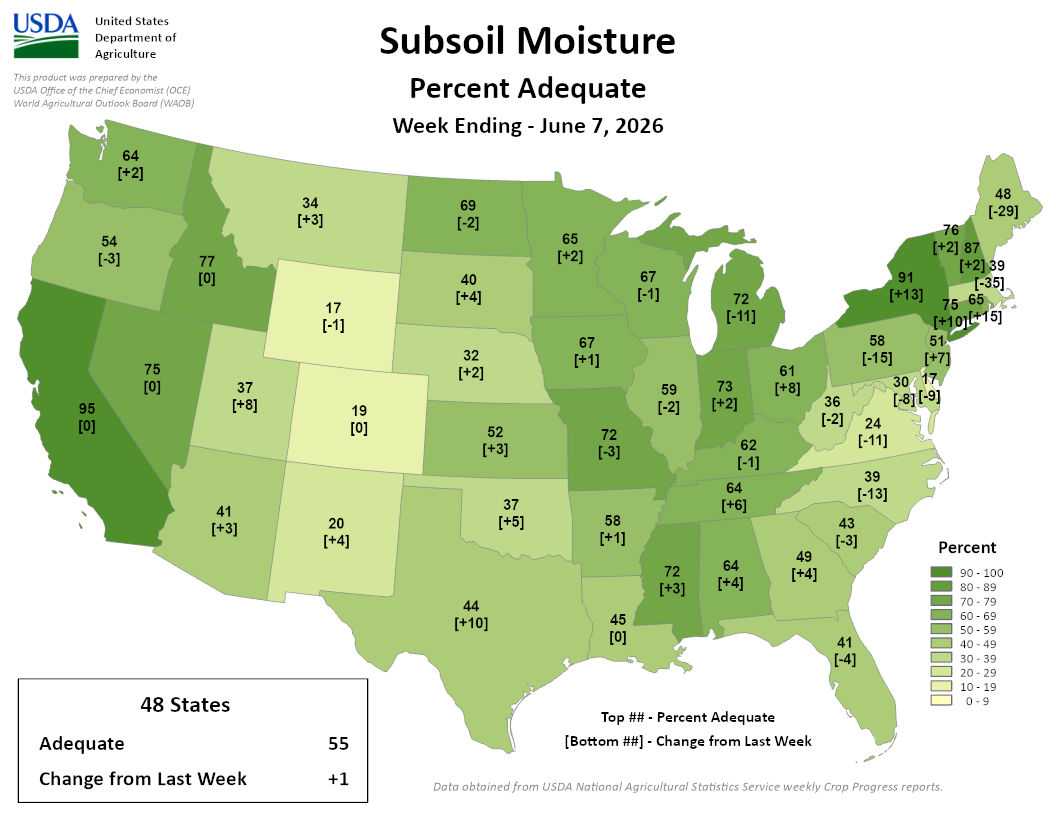
Image Description ↓
Choropleth map of the contiguous United States titled “Subsoil Moisture, Percent Adequate, Week Ending – June 7, 2026,” prepared by the USDA Office of the Chief Economist and World Agricultural Outlook Board. Each state is shaded on a green scale from 0-9% (palest) to 90-100% (darkest) adequate, with a percentage value and change from the prior week (in brackets) labeled on each state.
State values (percent adequate [change from last week]):
Washington 64 [+2]; Oregon 54 [-3]; California 95 [0]; Idaho 77 [0]; Nevada 75 [0]; Utah 37 [+8]; Arizona 41 [+3]; Montana 34 [+3]; Wyoming 17 [-1]; Colorado 19 [0]; New Mexico 20 [+4]; North Dakota 69 [-2]; South Dakota 40 [+4]; Nebraska 32 [+2]; Kansas 52 [+3]; Oklahoma 37 [+5]; Texas 44 [+10]; Minnesota 65 [+2]; Iowa 67 [+1]; Missouri 72 [-3]; Arkansas 58 [+1]; Louisiana 45 [0]; Wisconsin 67 [-1]; Illinois 73 [+2]; Kentucky 61 [+8]; Tennessee 62 [-1]; Mississippi 72 [+3]; Alabama 64 [+4]; Michigan 72 [-11]; Indiana 59 [-2]; Ohio 64 [+6]; Georgia 49 [+4]; Florida 41 [-4]; South Carolina 39 [-13]; North Carolina 24 [-11]; Virginia 36 [-2]; West Virginia 58 [-15]; Pennsylvania 78 [+8] (Kentucky/Pennsylvania area shown as 61 [+8] on map — verify); Maryland/Delaware area 30 [-8]; New Jersey 17 [-9]; New York 75 [+10]; Connecticut/Rhode Island 65 [+15]; Massachusetts 51 [+7]; Vermont 91 [+13]; New Hampshire 87 [+2]; Maine 76 [+2]; Virginia (northern) 39 [-35].
A summary box states: “48 States — Adequate: 55; Change from Last Week: +1.” A legend defines the color scale in 10-point increments from 0-9 to 90-100 percent. Footer text reads: “Data obtained from USDA National Agricultural Statistics Service weekly Crop Progress reports.”
- 79% and 76% of agricultural soils in the state are reported as having adequate topsoil and subsoil moisture, respectively. The subsoil value increased from last week’s report.
- 10% and 14% of agricultural soils in the state are reported as having short to very short topsoil and subsoil moisture, respectively. The subsoil value decreased from last week’s report.
Wisconet Soil Temperature
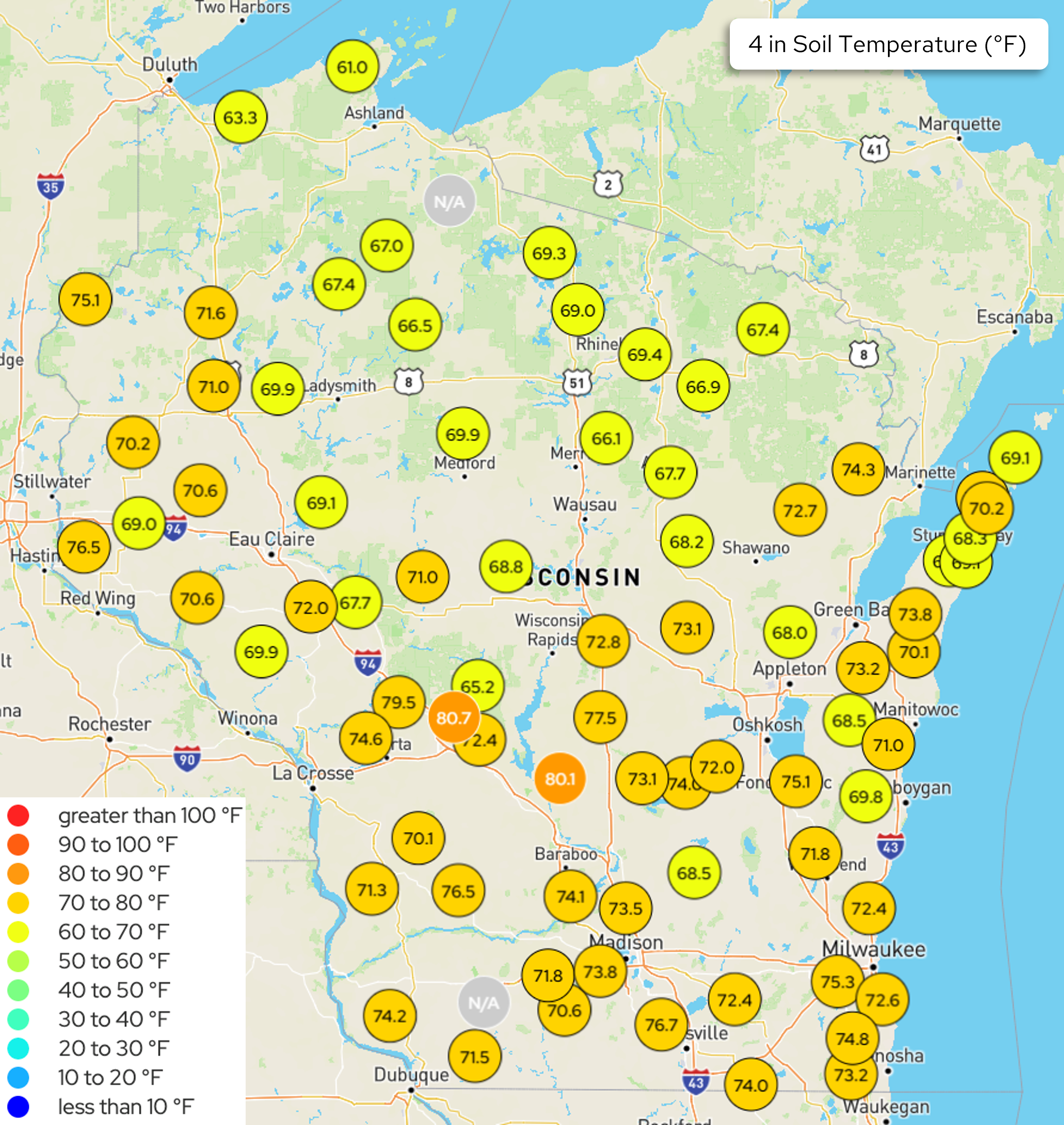
Image Description ↓
Map of Wisconsin titled “4 in Soil Temperature (°F)” displaying numbered circular markers at weather station locations across the state, color-coded by a legend ranging from “less than 10°F” (blue) to “greater than 100°F” (red). Most markers fall in the 60–70°F range (yellow) in the northern part of the state and 70–80°F range (orange/gold) in the central and southern parts, with a cluster of higher readings (80.1–80.7°F, darker orange) near Wisconsin Rapids/Tomah area. Two stations, near Medford and south of Baraboo, are marked “N/A” in gray. Readings span roughly 61°F in the far north to 80.7°F in central Wisconsin, with southeastern stations near Milwaukee, Racine, and Kenosha generally in the 72–76°F range.
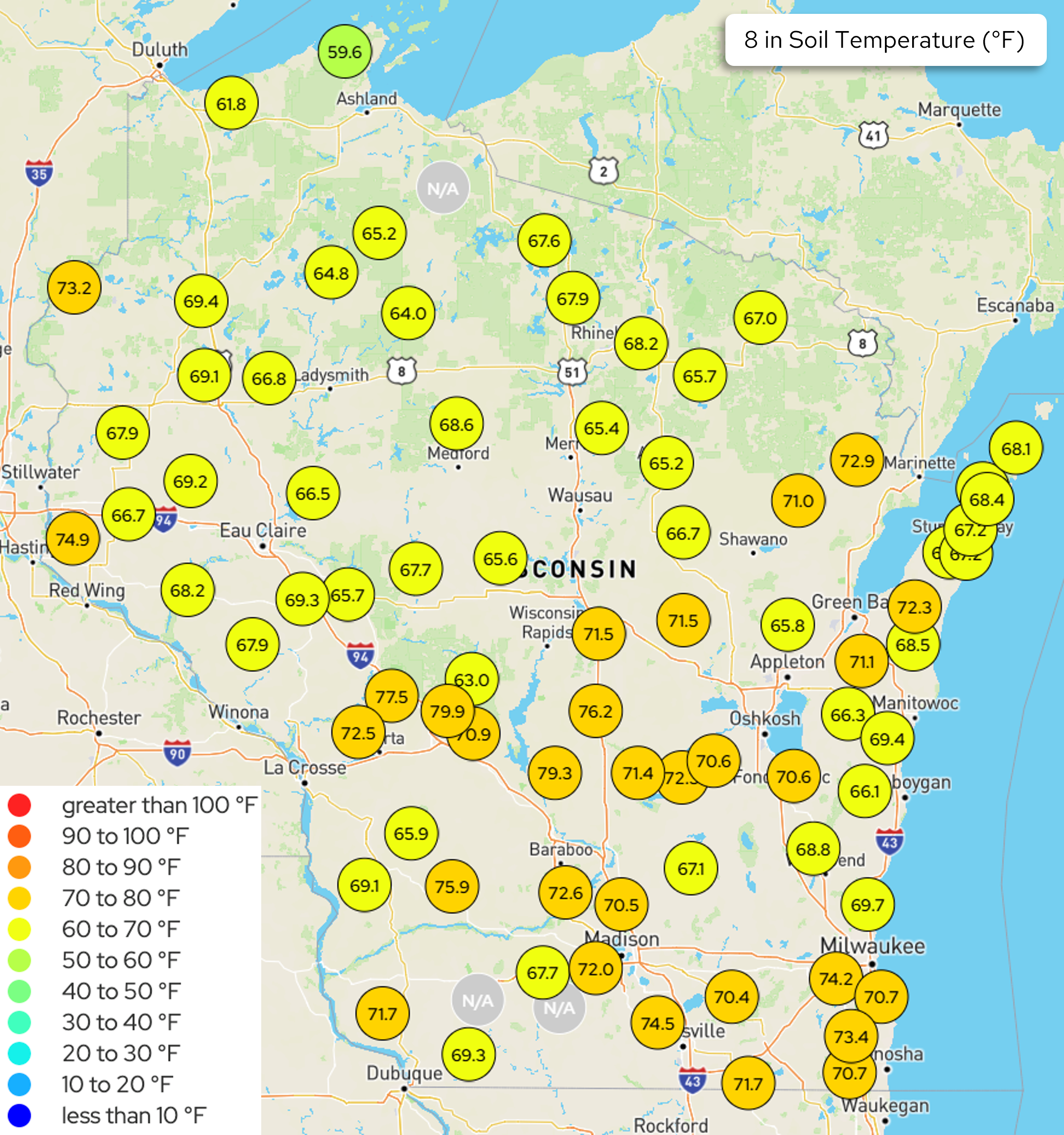
Image Description ↓
Map of Wisconsin titled “8 in Soil Temperature (°F)” showing numbered, color-coded circles at roughly 90 monitoring locations statewide. Most readings fall in the yellow (60–70°F) and orange (70–80°F) ranges, with values spanning from 59.6°F (light green, near Ashland in the north) to a high of 79.9°F (orange, near central Wisconsin). Southern and south-central Wisconsin, including areas near Madison, Milwaukee, and the Wisconsin Dells region, show more readings in the 70–80°F orange range, while northern Wisconsin readings cluster mostly in the 60–70°F yellow range. Two stations are marked “N/A” (gray circles) — one near Medford and one south of Wisconsin Dells. A legend in the bottom left maps ten color bands from “less than 10°F” (dark blue) through “greater than 100°F” (red), though only the green through orange bands appear on this map. City labels visible include Duluth, Ashland, Rhinelander, Wausau, Eau Claire, La Crosse, Green Bay, Appleton, Oshkosh, Fond du Lac, Sheboygan, Madison, and Milwaukee, along with major highways (I-35, I-94, I-90, I-43, US-51, US-8, US-2, US-41).
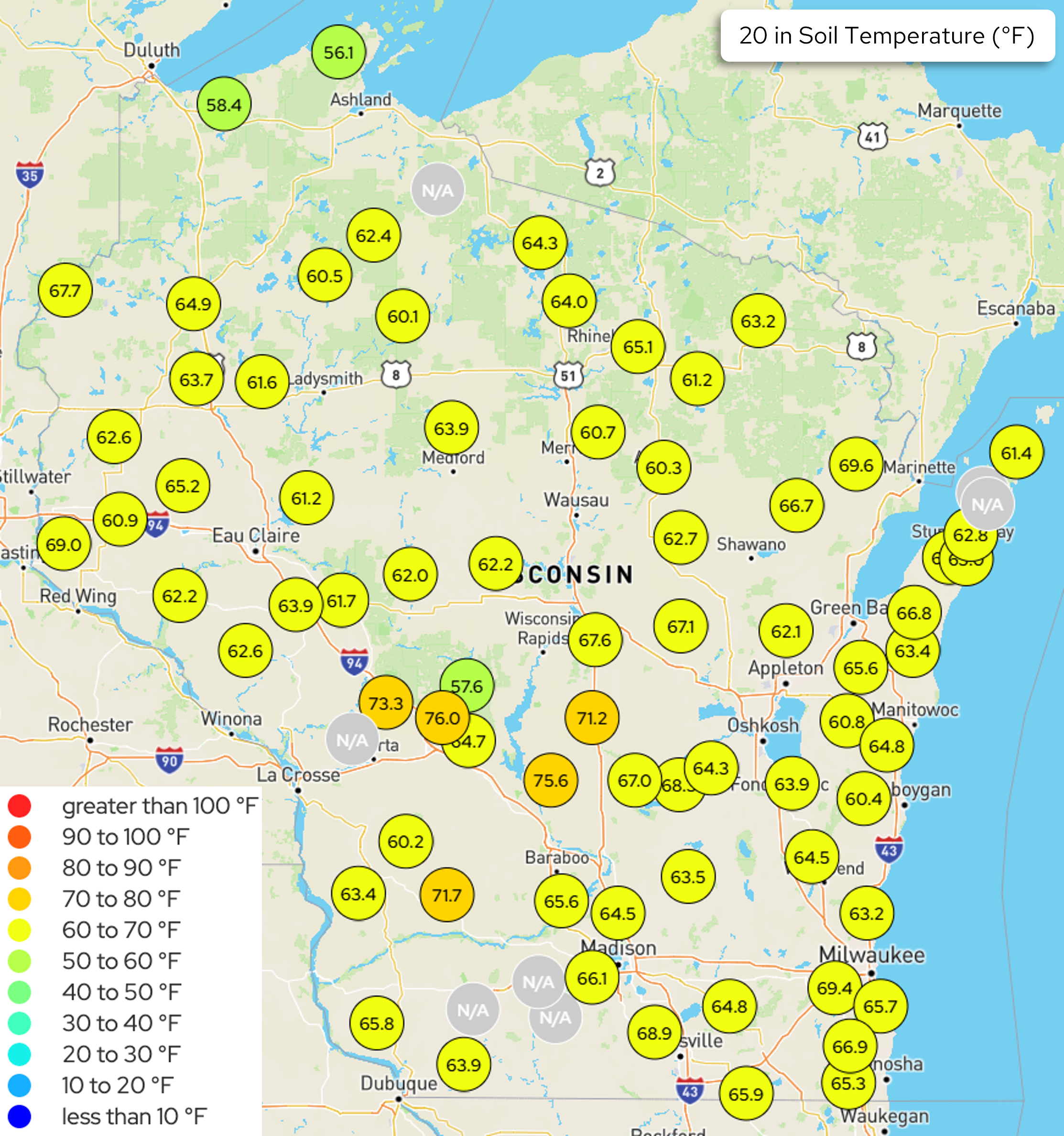
Image Description ↓
Map of Wisconsin showing 20-inch soil temperature readings (°F) at numerous monitoring stations across the state, color-coded by a legend ranging from “greater than 100°F” (red) down to “less than 10°F” (blue). Nearly all displayed values fall in the 60–70°F range (yellow), with a few stations reading 50–60°F (light green) in the north and near Wisconsin Rapids, and several isolated stations near the La Crosse/Wisconsin Dells area reading 70–80°F (gold, e.g., 71.2, 71.7, 73.3, 75.6, 76.0). Several stations across the state show “N/A” (no data), including locations near Highway 2, Sturgeon Bay, Wisconsin Dells, and south of Madison. Values are overlaid on a base map showing major cities (Duluth, Eau Claire, Wausau, Green Bay, Appleton, Oshkosh, Madison, Milwaukee, Rockford), highways (I-35, I-90, I-94, I-43, US-41, US-51, US-2, US-8), and lakes/rivers.
- The maps show daily average Wisconet soil temperature conditions on June 29th
U.S. Drought Monitor
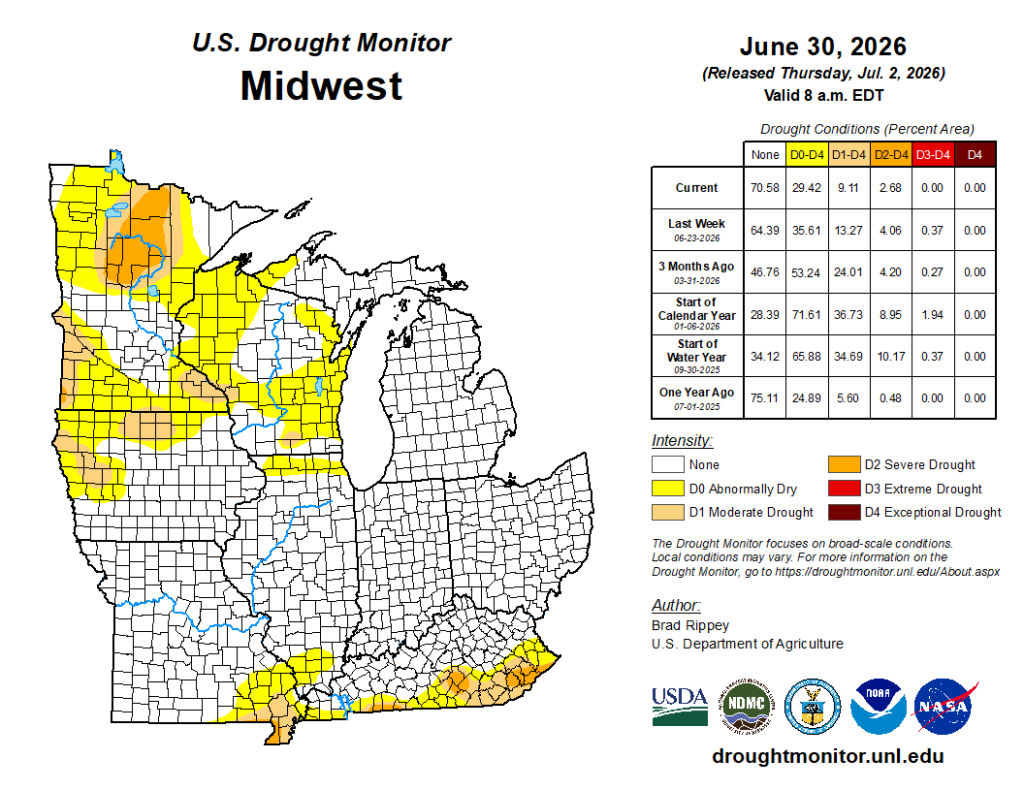
Image Description ↓
Map titled “U.S. Drought Monitor: Midwest,” dated June 30, 2026 (released Thursday, July 2, 2026, valid 8 a.m. EDT), covering Minnesota, Iowa, Missouri, Wisconsin, Illinois, Indiana, Ohio, and Michigan. Shaded areas of abnormal dryness (yellow) and moderate to severe drought (tan/orange) appear across northern and western Minnesota, the Minnesota-Iowa border region, scattered spots in western Iowa, and a band across southern Missouri; no extreme (red) or exceptional (dark red) drought is shown. Most of Wisconsin, Illinois, Indiana, Ohio, and Michigan are unaffected (white).
A table of drought conditions by percent area reads:
- Current: None 70.58%, D0–D4 29.42%, D1–D4 9.11%, D2–D4 2.68%, D3–D4 0.00%, D4 0.00%
- Last Week (06-23-2026): None 64.39%, D0–D4 35.61%, D1–D4 13.27%, D2–D4 4.06%, D3–D4 0.37%, D4 0.00%
- 3 Months Ago (03-31-2026): None 46.76%, D0–D4 53.24%, D1–D4 24.01%, D2–D4 4.20%, D3–D4 0.27%, D4 0.00%
- Start of Calendar Year (01-06-2026): None 28.39%, D0–D4 71.61%, D1–D4 36.73%, D2–D4 8.95%, D3–D4 1.94%, D4 0.00%
- Start of Water Year (09-30-2025): None 34.12%, D0–D4 65.88%, D1–D4 34.69%, D2–D4 10.17%, D3–D4 0.37%, D4 0.00%
- One Year Ago (07-01-2025): None 75.11%, D0–D4 24.89%, D1–D4 5.60%, D2–D4 0.48%, D3–D4 0.00%, D4 0.00%
Intensity legend: None (white), D0 Abnormally Dry (yellow), D1 Moderate Drought (tan), D2 Severe Drought (orange), D3 Extreme Drought (red), D4 Exceptional Drought (dark red). A note states the map focuses on broad-scale conditions and local conditions may vary, with a link to droughtmonitor.unl.edu/About.aspx. Author: Brad Rippey, U.S. Department of Agriculture. Logos for USDA, NDMC, NOAA, and NASA appear at the bottom, along with the URL droughtmonitor.unl.edu.
Compared to last week:
- Midwest: 4% reduction in D1-D4 drought coverage from last week’s report. Widespread 1 class improvement across the south (KY, IL, MO) as well as Wisconsin and Minnesota.
- 90.9% of the Midwest region is drought free (~9.1% in D1-D4).
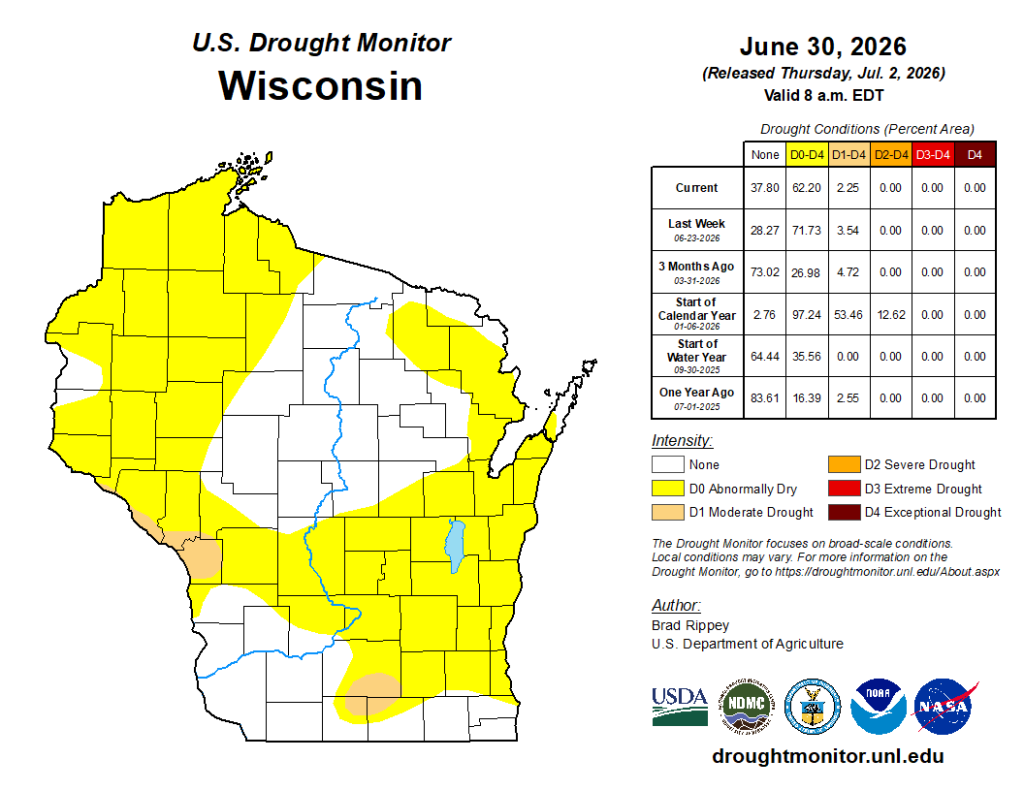
Image Description ↓
Map and table titled “U.S. Drought Monitor, Wisconsin,” dated June 30, 2026 (released Thursday, July 2, 2026, valid 8 a.m. EDT), authored by Brad Rippey, USDA.
The state map shows most of Wisconsin as “None” (white) or “D0 Abnormally Dry” (yellow), with small pockets of “D1 Moderate Drought” (tan) in west-central and south-central counties. Yellow D0 bands run along the western border, northern border, and much of the eastern/southern regions. No areas show D2 Severe, D3 Extreme, or D4 Exceptional Drought.
Accompanying table, “Drought Conditions (Percent Area),” lists None, D0-D4, D1-D4, D2-D4, D3-D4, and D4 percentages for six time periods:
- Current: 37.80% None, 62.20% D0-D4, 2.25% D1-D4, 0% D2-D4, 0% D3-D4, 0% D4
- Last Week (06-23-2026): 28.27% None, 71.73% D0-D4, 3.54% D1-D4, 0%, 0%, 0%
- 3 Months Ago (03-31-2026): 73.02% None, 26.98% D0-D4, 4.72% D1-D4, 0%, 0%, 0%
- Start of Calendar Year (01-06-2026): 2.76% None, 97.24% D0-D4, 53.46% D1-D4, 12.62% D2-D4, 0%, 0%
- Start of Water Year (09-30-2025): 64.44% None, 35.56% D0-D4, 0%, 0%, 0%, 0%
- One Year Ago (07-01-2025): 83.61% None, 16.39% D0-D4, 2.55% D1-D4, 0%, 0%, 0%
A legend defines intensity categories: None (white), D0 Abnormally Dry (yellow), D1 Moderate Drought (tan), D2 Severe Drought (orange), D3 Extreme Drought (red), D4 Exceptional Drought (dark red). A note states the map focuses on broad-scale conditions and directs readers to droughtmonitor.unl.edu for more information. Logos for USDA, NDMC, NOAA, and NASA appear at the bottom.
- Wisconsin: D1 drought is in place near Madison and La Crosse.
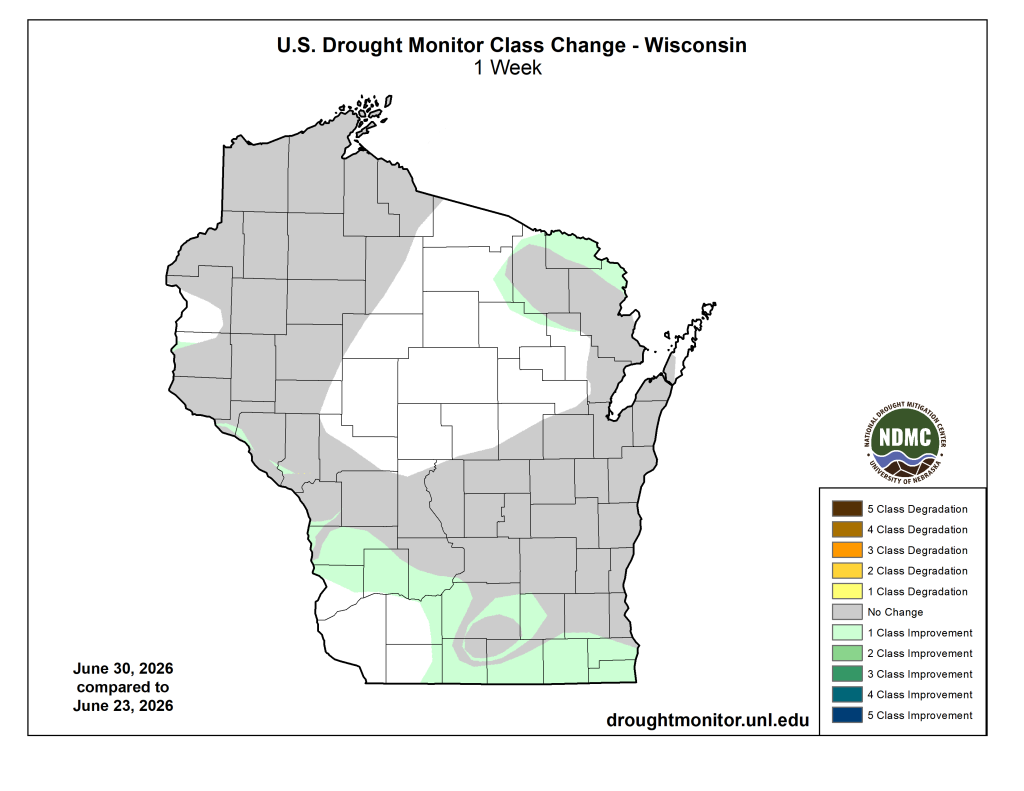
Image Description ↓
Map titled “U.S. Drought Monitor Class Change – Wisconsin, 1 Week,” comparing June 30, 2026 to June 23, 2026. Most of the state shows no change (gray). A white band with no drought designation runs through the central counties. Light green areas indicating 1-class improvement appear in the far northeast (Door/Kewaunee area), along the western border near the Mississippi River, and across the southern tier of counties from the southwest through the south-central and southeast regions. No areas show degradation. Source: National Drought Mitigation Center, University of Nebraska; droughtmonitor.unl.edu.
- D0 coverage decreased by nearly 10%, and D1 coverage decreased by 1%.
- Most of the drought/dryness improvements were in southern counties.
U.S. Drought Monitor Time Series
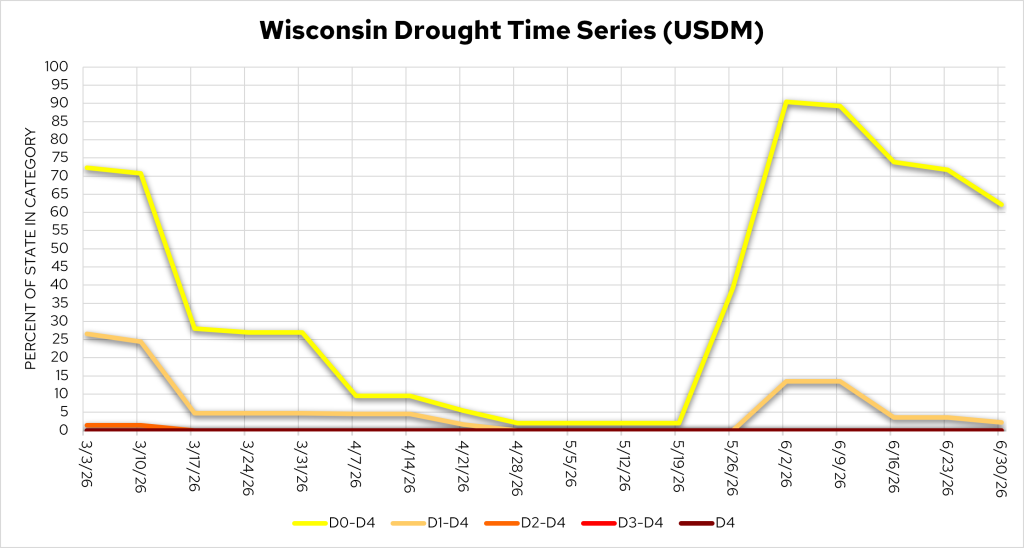
Image Description ↓
Line chart titled “Wisconsin Drought Time Series (USDM),” y-axis “Percent of State in Category” (0–100), x-axis weekly dates from 3/3/26 to 6/30/26. Five lines: D0-D4 (yellow), D1-D4 (light orange), D2-D4 (orange), D3-D4 (red), D4 (dark red).
D0-D4 starts at 72% (3/3), holds near 70% through 3/10, drops sharply to about 27% by 3/17, stays flat near 27% through 3/31, declines to about 9% by 4/7–4/14, falls further to near 2–3% from 4/28 through 5/19. Beginning 5/26 it rises steeply to 90% by 6/2, stays around 88–90% through 6/9, then declines to about 71% by 6/16, holds near 70–71% through 6/23, and drops to about 62% by 6/30.
D1-D4 tracks a similar but lower pattern: starts around 26%, drops to about 24% by 3/10, falls to roughly 4–5% from 3/17 through 4/14, declines to near 0–1% from late April through late May, rises to about 13–14% by 6/2–6/9, then falls to roughly 2–3% by 6/16 through 6/30.
D2-D4 stays low throughout, around 1–2% in early March, dropping to near 0% by mid-March and remaining at or near 0% for the rest of the period.
D3-D4 and D4 remain at or near 0% across the entire time series.
- D0 coverage = 62.2%; D1 coverage = 2.3%
Temperature Trends
7 Day Temperatures
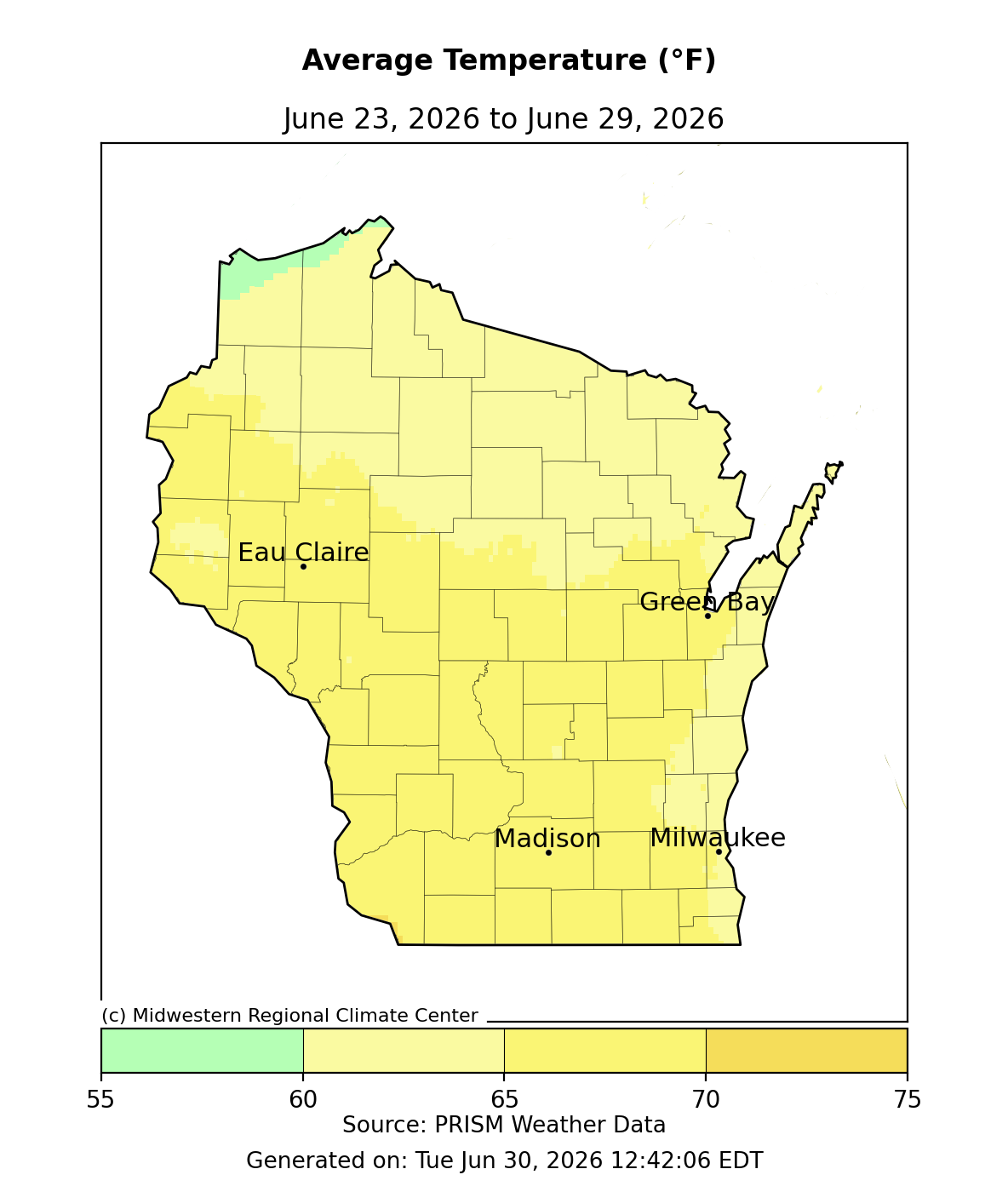
Image Description ↓
Choropleth map titled “Average Temperature (°F), June 23, 2026 to June 29, 2026,” sourced from PRISM Weather Data via the Midwestern Regional Climate Center, generated Tue Jun 30, 2026, 12:42:06 EDT. Wisconsin is shaded in a color scale from 55°F (green) to 75°F (dark gold). Most of the state falls in the 65–70°F (yellow) range, with slightly cooler areas (60–65°F) in parts of the northwest, west-central, and southeast regions, and a small area of 55–60°F (green) along the far northern border near Lake Superior. Cities labeled with markers: Eau Claire, Green Bay, Madison, and Milwaukee, all located within the 65–70°F zone.
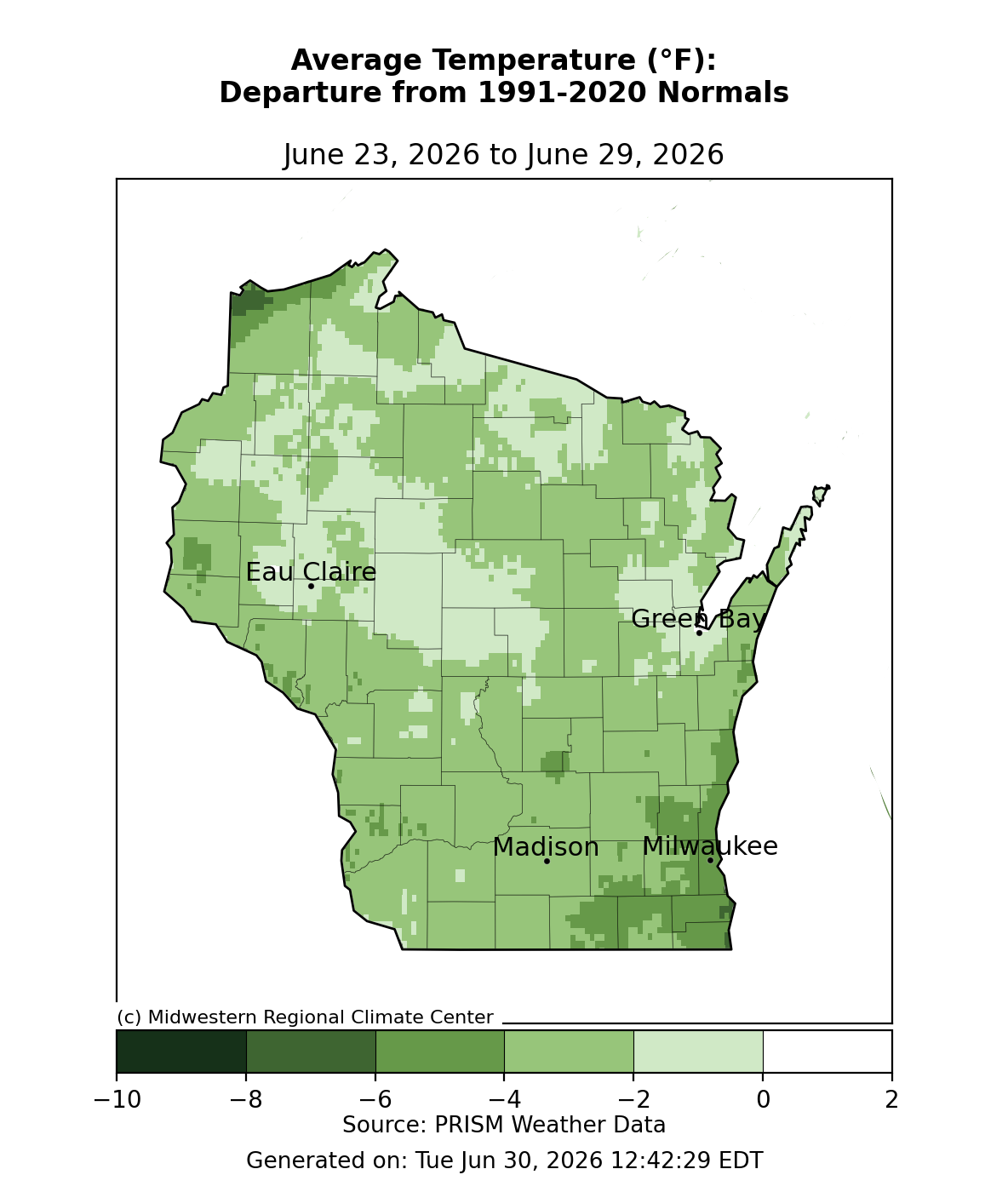
Image Description ↓
Choropleth map of Wisconsin titled “Average Temperature (°F): Departure from 1991-2020 Normals, June 23, 2026 to June 29, 2026.” A color scale from dark green (−10°F) to white (2°F) shows below-normal temperatures across the entire state. The far northwest corner shows the largest departure, around −8 to −10°F. Most of the state falls between −2°F and −6°F below normal, with lighter patches (near 0°F) scattered through the north-central and central regions. Southeastern Wisconsin, including areas near Milwaukee, shows moderate departures around −4 to −6°F. Cities labeled: Eau Claire, Green Bay, Madison, and Milwaukee. Source: PRISM Weather Data, credited to the Midwestern Regional Climate Center, generated Tuesday, June 30, 2026, 12:42:29 EDT.
- Average temperatures ranged from 65-70°F in the southern 2/3 of the state; to 55-60°F along Lake Superior.
- Temperatures were 2-6°F below normal across most of the state, with the southeast and far northwest corners of the state being the most below normal (4-6°F).
30 Day Temperatures
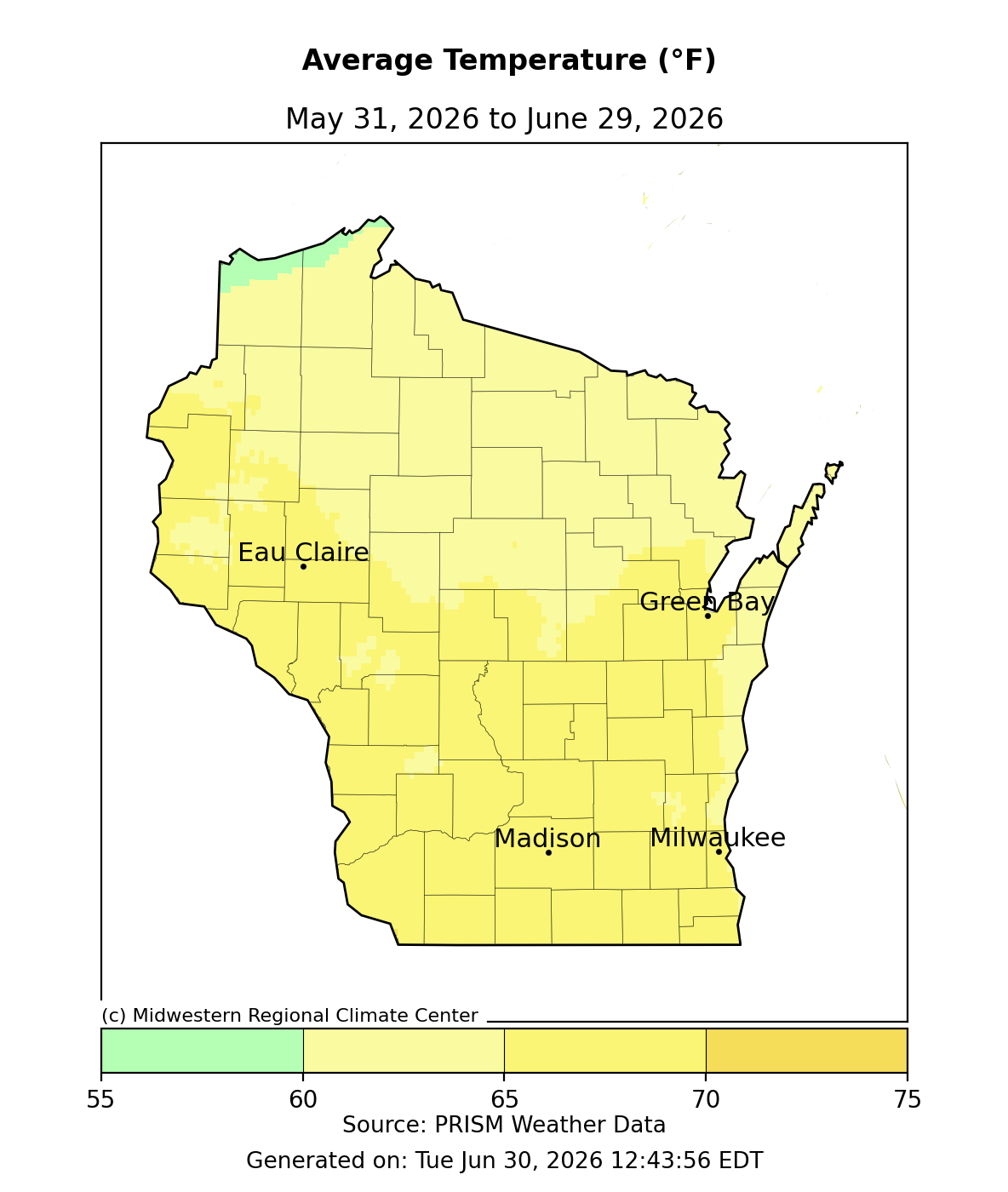
Image Description ↓
Choropleth map titled “Average Temperature (°F), May 31, 2026 to June 29, 2026,” sourced from PRISM Weather Data via the Midwestern Regional Climate Center, generated June 30, 2026. Wisconsin is shaded on a color scale from 55°F (green) to 75°F (dark gold). Most of the state falls in the 65-70°F range (yellow), with a small green band of 57-60°F along the far northern tip near Lake Superior. Slightly warmer pockets (70-75°F, gold) appear in scattered areas including parts of the west-central region and near Green Bay. Four cities are labeled with markers: Eau Claire (west-central), Green Bay (northeast, on the bay), Madison (south-central), and Milwaukee (southeast, on Lake Michigan).
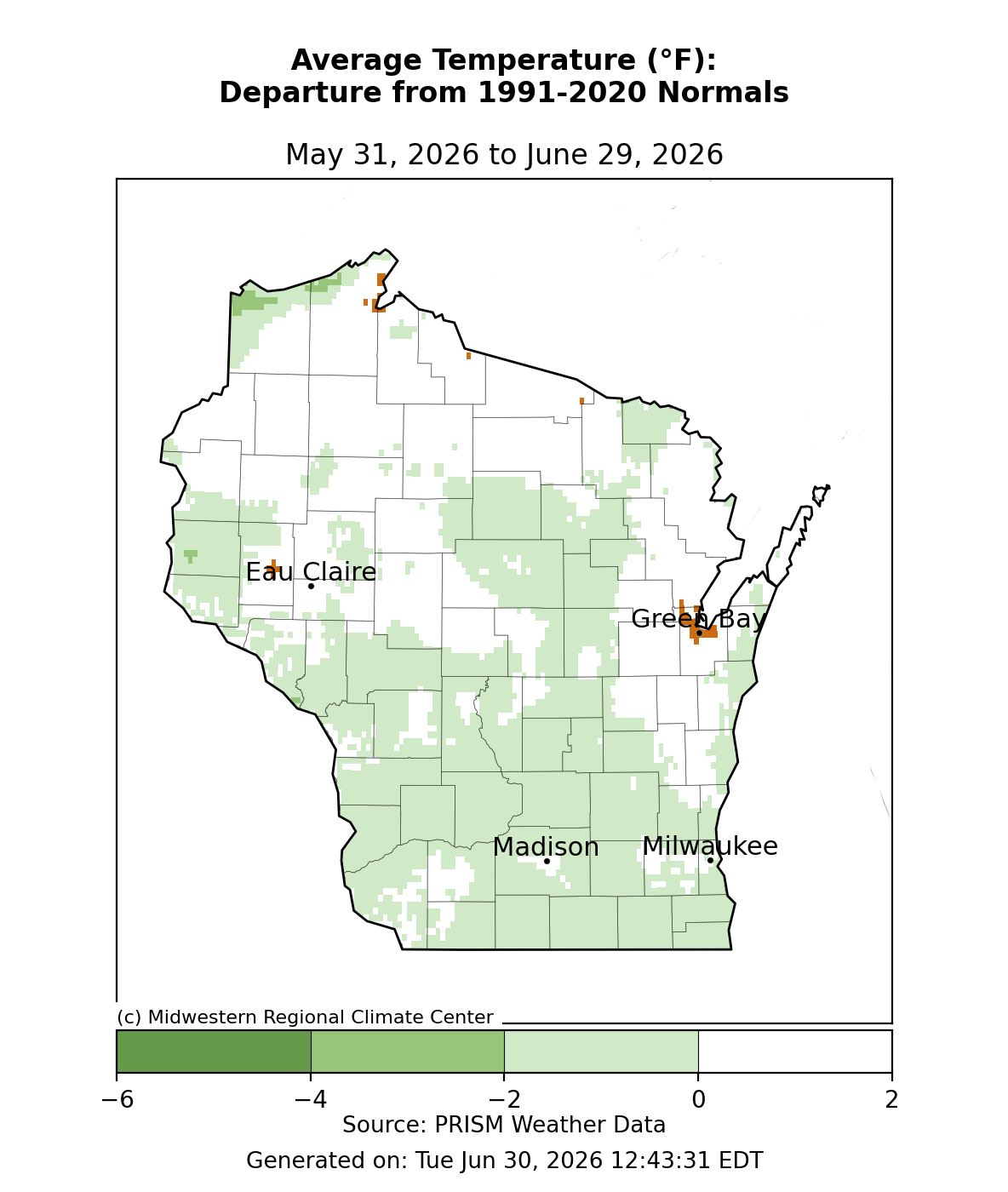
Image Description ↓
Choropleth map titled “Average Temperature (°F): Departure from 1991-2020 Normals, May 31, 2026 to June 29, 2026,” sourced from PRISM Weather Data via the Midwestern Regional Climate Center, generated Tue Jun 30, 2026, 12:43:31 EDT. Color scale ranges from dark green (−6°F) through light green (−2°F) to white (0°F) and orange (2°F, above normal). Most of the state shows white to light-green shading, indicating temperatures near normal to about 2–4°F below normal, with the darkest green (largest departures below normal) concentrated in far northwestern Wisconsin. Small isolated orange patches (above-normal temperatures) appear near the Door Peninsula/Green Bay area and a few scattered spots in north-central Wisconsin. Cities labeled: Eau Claire, Green Bay, Madison, and Milwaukee.
Growing Degree Days (Base 50°F)
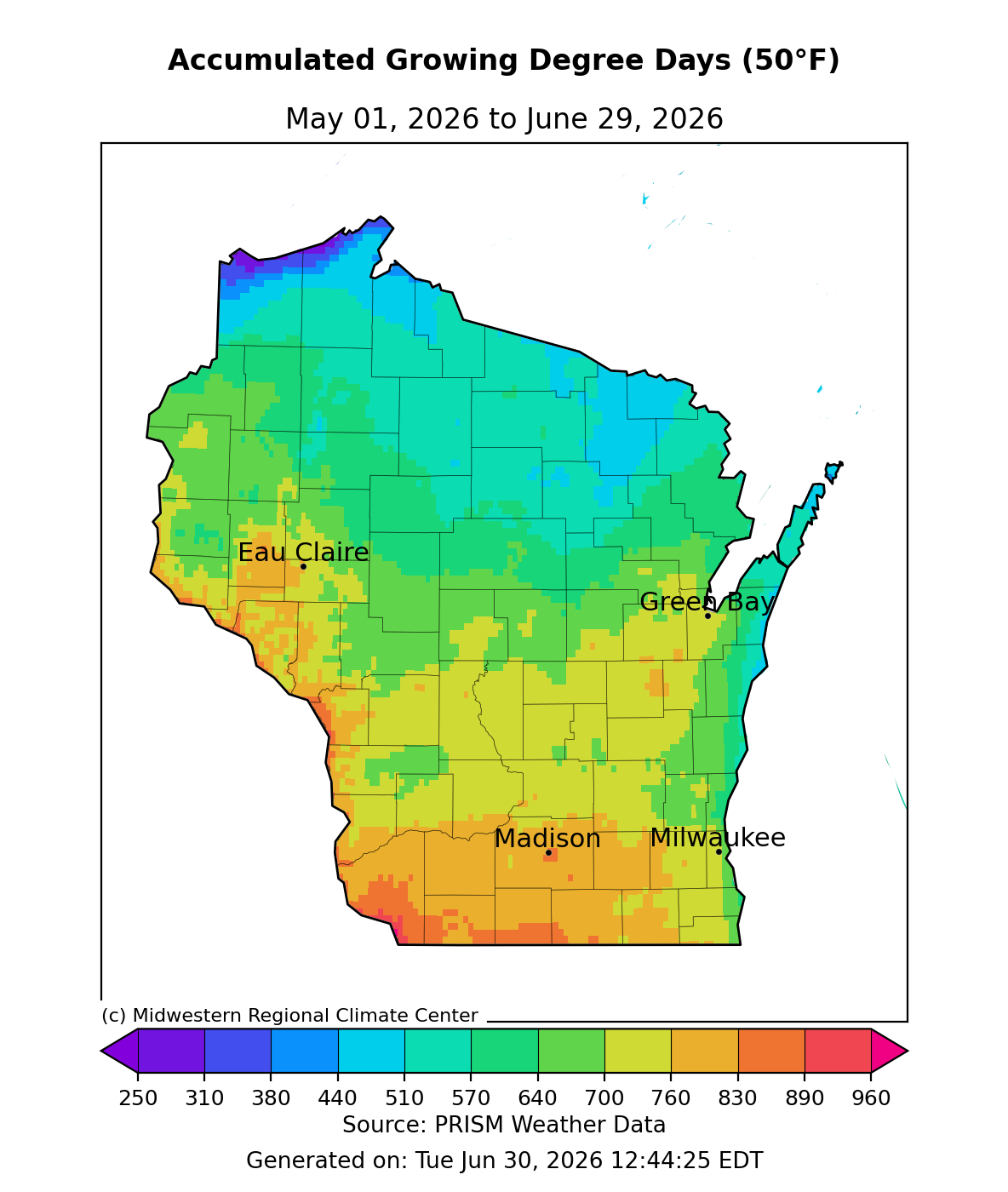
Image Description ↓
Color-shaded map of Wisconsin titled “Accumulated Growing Degree Days (50°F), May 01, 2026 to June 29, 2026.” A color scale from purple (250) through blue, teal, green, yellow, orange, to red (960) indicates GDD accumulation. Values are lowest (blue-purple, roughly 300–450) in the far northern counties near Lake Superior, increasing through teal and green (450–650) across central and northeastern Wisconsin, and reaching the highest levels (yellow-orange, roughly 700–850) across southern Wisconsin. Four cities are marked with dots: Eau Claire and Green Bay in intermediate green-yellow zones (roughly 600–700 GDD), and Madison and Milwaukee in the higher orange zone in the south (roughly 750–800 GDD). Text at bottom reads: “(c) Midwestern Regional Climate Center,” “Source: PRISM Weather Data,” and “Generated on: Tue Jun 30, 2026 12:44:25 EDT.”
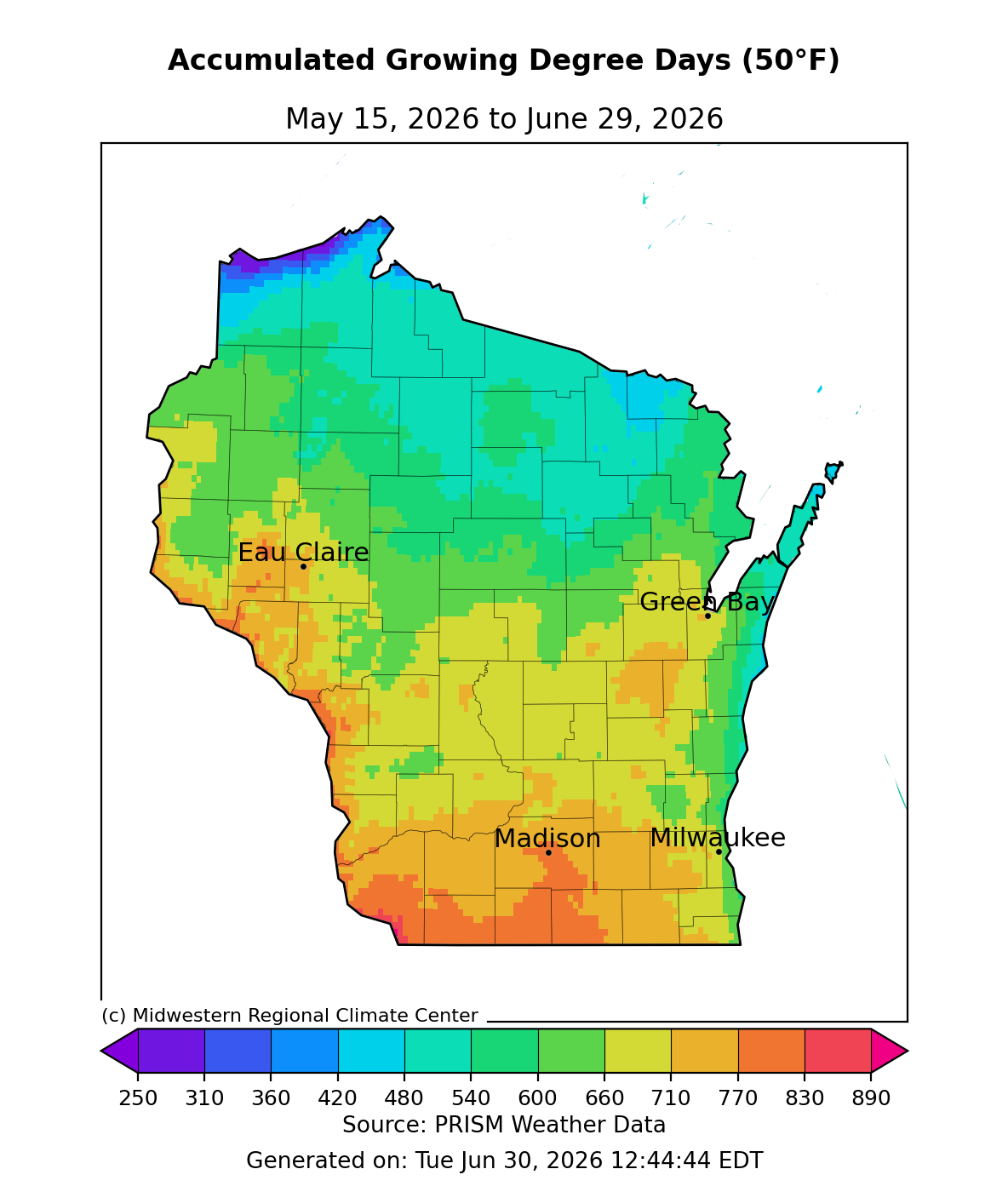
Image Description ↓
Color-coded map of Wisconsin displaying accumulated growing degree days (GDD, base 50°F) from May 15, 2026 to June 29, 2026, sourced from PRISM Weather Data via the Midwestern Regional Climate Center. Values range from 250 to 890 GDD on the color scale, with purple/blue indicating lowest accumulation and orange/red indicating highest. The far north exhibits the lowest values (250–360 GDD, purple/blue). Central and northeastern Wisconsin, including areas near Green Bay, show moderate accumulation (480–600 GDD, teal/green). Southern Wisconsin, including Madison and Milwaukee, shows higher accumulation (660–830 GDD, yellow/orange). Eau Claire, in west-central Wisconsin, falls in a mid-range zone (approximately 540–600 GDD). A narrow band of cooler values appears along the Lake Michigan shoreline near Green Bay and Milwaukee. City locations for Eau Claire, Green Bay, Madison, and Milwaukee are marked with dots and labels. Map generated Tuesday, June 30, 2026, 12:44:44 EDT.
- Starting May 1 – Growing degree day accumulation ranges from 890 GDD in the far south and west to 510 GDD in the far north. These values are 100-105% of normal.
- Starting May 15 – Growing degree day accumulation ranges from 830 GDD in the far south and west to 480 GDD in the far north. These values are 105-110% of normal.
Crop Progress and Condition
Crop Progress Report for Wisconsin for the Week Ending on June 28, 2026
*Note that USDA crop progress maps were not updated this week. However, the percentages in the bullet points below the maps are updated values.
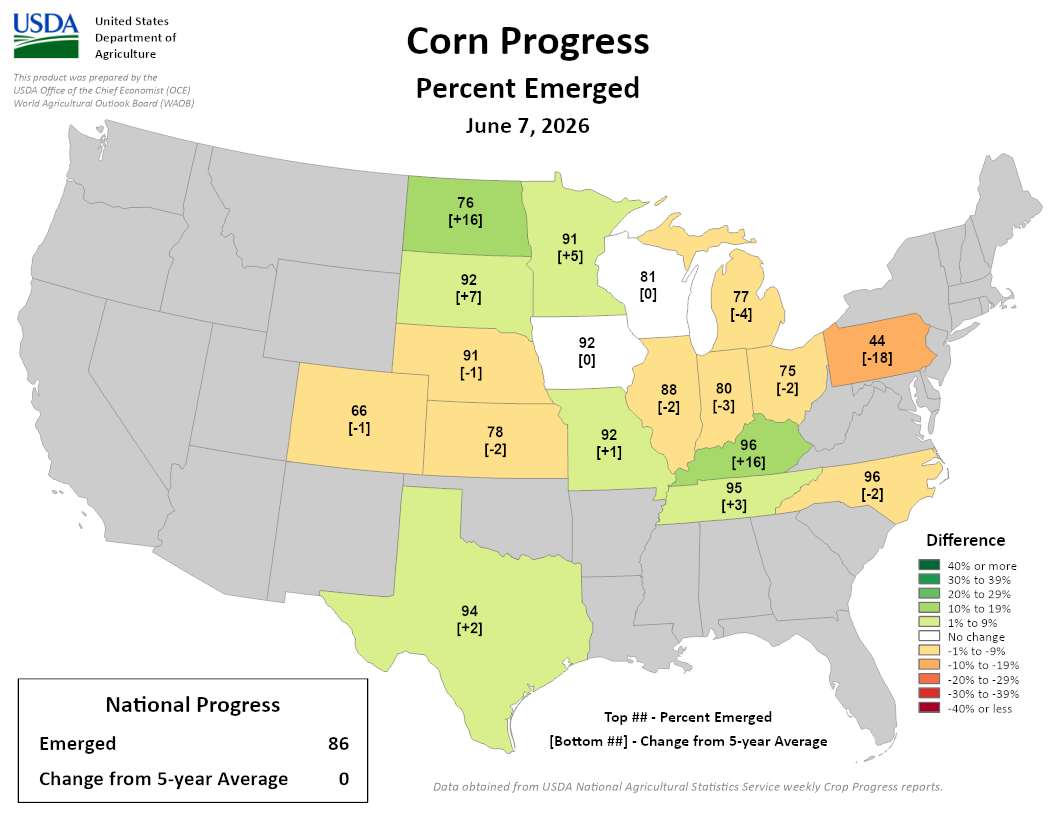
Image Description ↓
USDA/OCE-WAOB map titled “Corn Progress: Percent Emerged, June 7, 2026.” National total: 86% emerged, 0 change from 5-year average. Each state shows percent emerged with change from average in brackets, color-coded by difference (dark green = 40%+ above average through dark red = 40%+ below average):
- Pennsylvania: 44% [-18]
- Colorado: 66% [-1]
- Kansas: 78% [-2]
- South Dakota: 76% [+16]
- Minnesota: 91% [+5]
- North Dakota: 92% [+7]
- Nebraska: 91% [-1]
- Iowa: 92% [0]
- Wisconsin: 81% [0]
- Missouri: 92% [+1]
- Illinois: 88% [-2]
- Indiana: 80% [-3]
- Ohio: 75% [-2]
- Michigan: 77% [-4]
- Kentucky: 96% [+16]
- Tennessee: 95% [+3]
- North Carolina: 96% [-2]
- Texas: 94% [+2]
Source: USDA National Agricultural Statistics Service weekly Crop Progress reports.
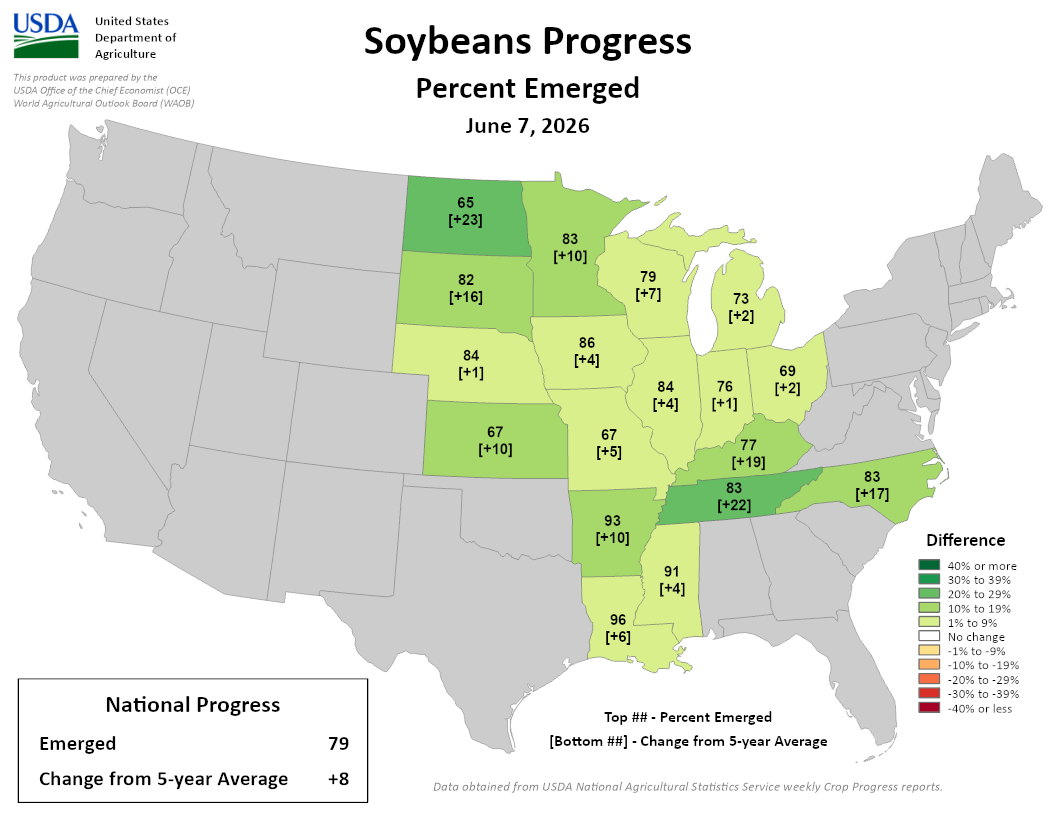
Image Description ↓
USDA Office of the Chief Economist map titled “Soybeans Progress: Percent Emerged, June 7, 2026,” showing state-level shading by change from the 5-year average (dark green = highest increase, gray = no data). State values (percent emerged, [change from 5-year average]):
- North Dakota: 65% [+23]
- South Dakota: 82% [+16]
- Nebraska: 84% [+1]
- Minnesota: 83% [+10]
- Iowa: 86% [+4]
- Kansas: 67% [+10]
- Wisconsin: 79% [+7]
- Illinois: 84% [+4]
- Missouri: 67% [+5]
- Arkansas: 93% [+10]
- Louisiana: 96% [+6]
- Michigan: 73% [+2]
- Indiana: 76% [+1]
- Kentucky: 77% [+19]
- Mississippi: 91% [+4]
- Ohio: 69% [+2]
- Tennessee: 83% [+22]
- North Carolina: 83% [+17]
National summary: 79% emerged, +8 percentage points versus the 5-year average. Data source: USDA National Agricultural Statistics Service weekly Crop Progress reports.
- Wisconsin had 5.0 days suitable for fieldwork statewide, which was slightly up from the previous week.
- Soybeans are 8% blooming, equal to the five-year average.
- Corn and soybean conditions are 82% and 78% good to excellent, respectively.
- Winter wheat is 96% headed and is rated 79% good to excellent (same as last week).
- Oats are 64% headed and 12% coloring. Oat condition is 82% good to excellent.
- Pasture and range were rated 65% good to excellent, down 1% from last week.
- The first cutting of alfalfa is 97% complete, and the second cutting is 29% complete.
- Read the full USDA report.
Forecasts and Outlooks
7 Day Precipitation Forecast
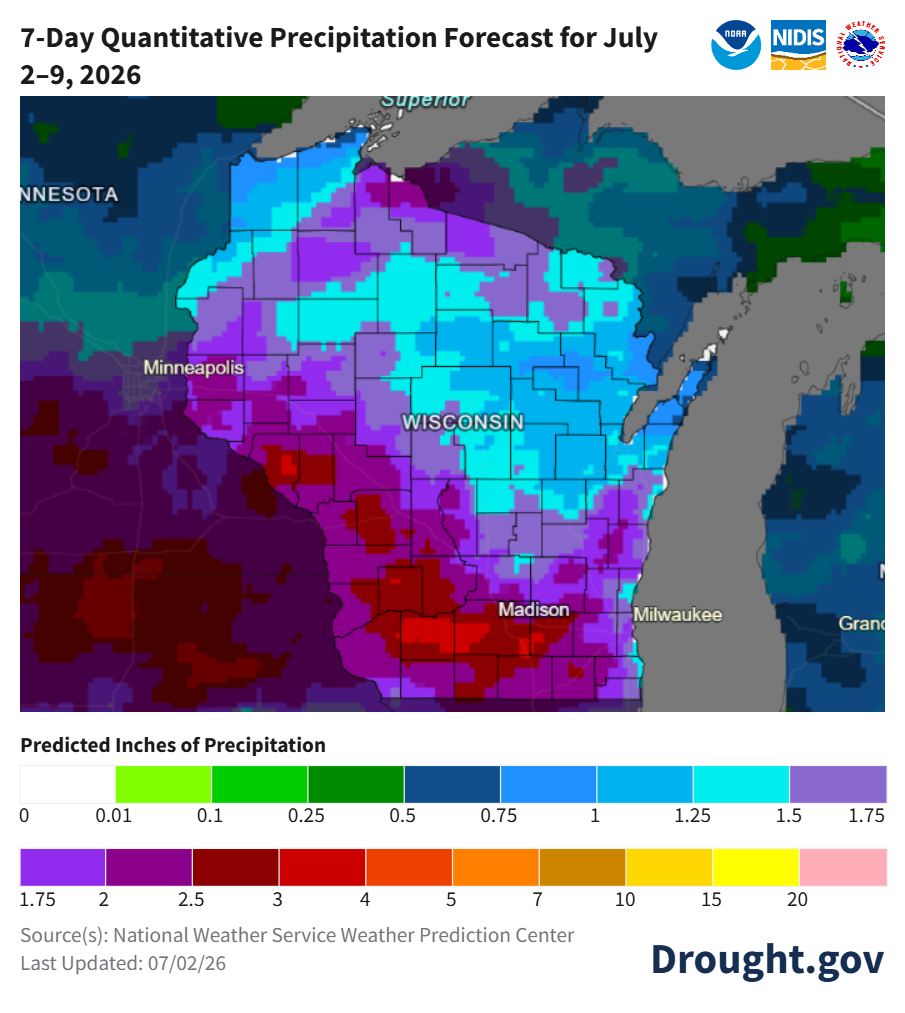
Image Description ↓
NOAA/NWS Weather Prediction Center map titled “7-Day Quantitative Precipitation Forecast for July 2–9, 2026,” sourced from Drought.gov, last updated 07/02/26. The map covers Wisconsin and parts of surrounding states (Minnesota, Michigan) with a color-coded scale ranging from 0 to 20+ inches of predicted precipitation. Southwestern Wisconsin, including the area around Madison, shows the highest forecast totals, in the 2–4 inch range (dark red to magenta shading), with isolated pockets exceeding 4 inches near the Minnesota border. Precipitation amounts decrease moving northeast across the state, transitioning through purple and cyan shading (roughly 1–1.75 inches) in central Wisconsin. The northeastern part of the state, near Lake Michigan and Green Bay, shows the lowest totals, generally under 1 inch (blue and teal shading). Milwaukee is forecast to receive approximately 0.75–1.25 inches. County boundaries are outlined in black, and state borders are marked.
- When? – An active next few days are on tap. Rain chances are highest on Thursday (7/2), Friday (7/3), and Saturday (7/4)
- Where? – Rain chances are highest in southern and western counties. Across the state, there is a risk for excessive rainfall between Thursday (7/2) and Sunday (7/5).
- Check your local forecast for details on totals and timing.
- Average precip (1991-2020) for this week: 0.94”.
8-14 Day Temperature and Precipitation Outlook
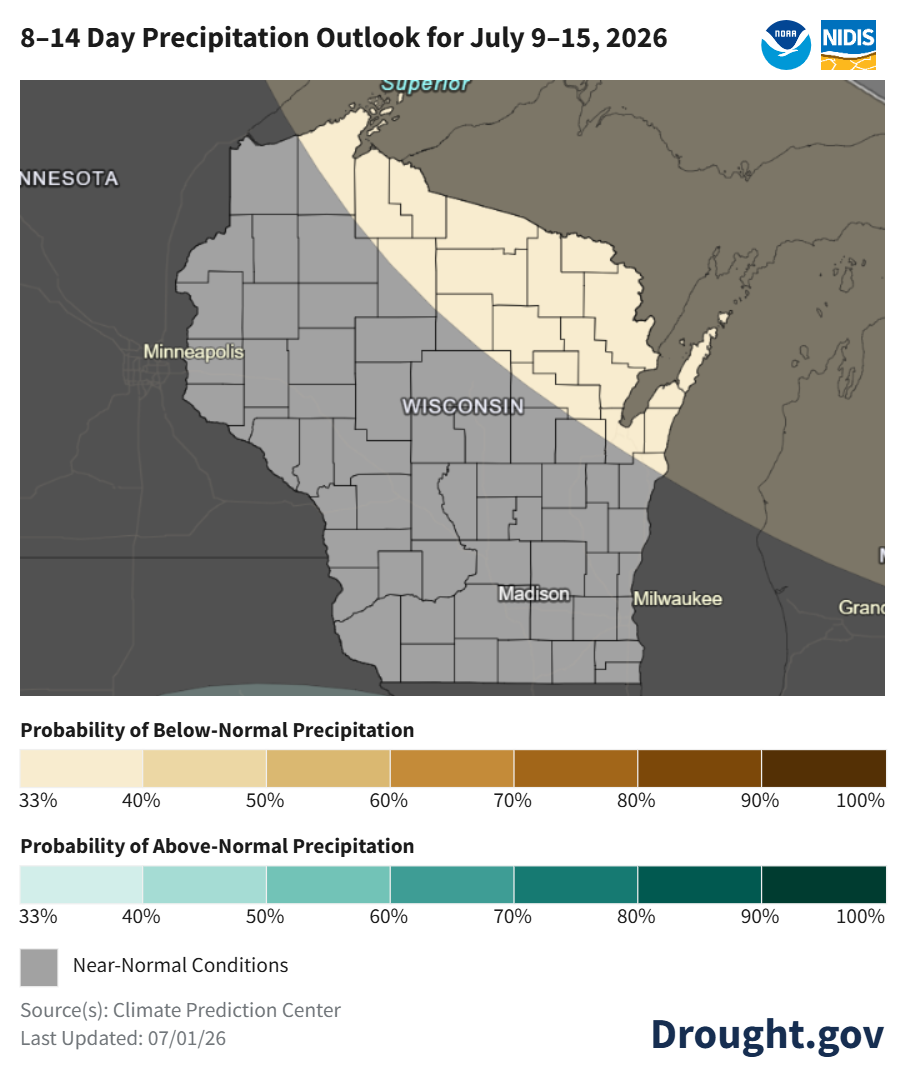
Image Description ↓
Map titled “8–14 Day Precipitation Outlook for July 9–15, 2026,” sourced from NOAA/NIDIS Climate Prediction Center, last updated 07/01/26. Wisconsin is divided into two zones: a light tan northeastern/northern strip (roughly the area north and east of a line running from the Superior coast through Green Bay) showing “Below-Normal” probability in the 33–40% range, and gray covering the remainder of the state (including Madison and Milwaukee) labeled “Near-Normal Conditions.” No above-normal precipitation probability is shown for Wisconsin. Two color-scale legends appear below the map: “Probability of Below-Normal Precipitation” (cream to dark brown, 33%–100%) and “Probability of Above-Normal Precipitation” (light to dark teal, 33%–100%), plus a gray swatch labeled “Near-Normal Conditions.”
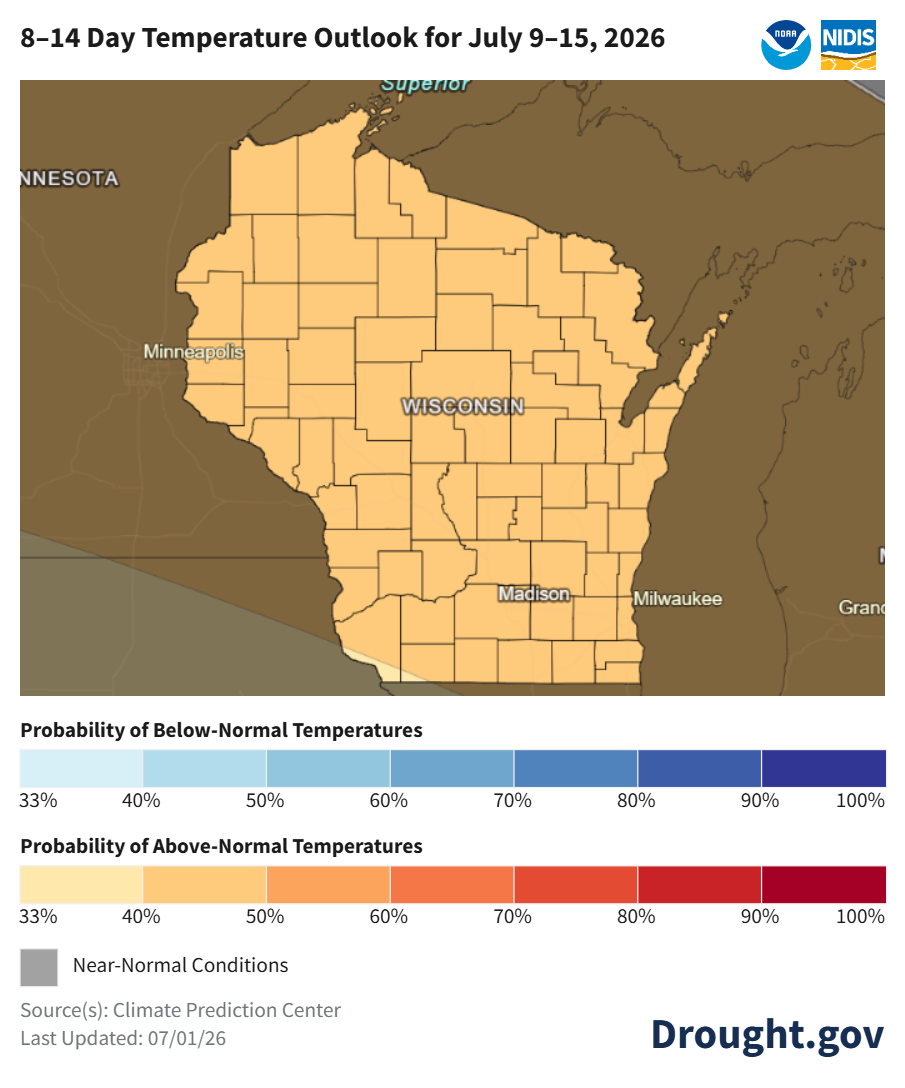
Image Description ↓
Map titled “8–14 Day Temperature Outlook for July 9–15, 2026,” sourced from the Climate Prediction Center via Drought.gov, last updated 07/01/26. The entire state of Wisconsin is shaded tan/orange, indicating “Near-Normal Conditions” per the legend, with no areas forecast for above- or below-normal temperature probabilities. Two color-scale legends are shown but not applied to Wisconsin: a blue scale for “Probability of Below-Normal Temperatures” (33%–100%) and an orange-to-red scale for “Probability of Above-Normal Temperatures” (33%–100%). Surrounding states and Lake Superior/Michigan are shown in dark brown outside the outlook area. Cities labeled include Minneapolis, Madison, and Milwaukee.
- Mid- July: Temperatures are leaning above normal statewide (40-50% odds). Precipitation is leaning towards near normal for most of the state, with a below-normal lean in the northeast and far north (33-40% odds).
- Statewide normals (1991-2020) for July 9-15 are 69.4°F and 0.92”.
30 Day Temperature and Precipitation Outlook
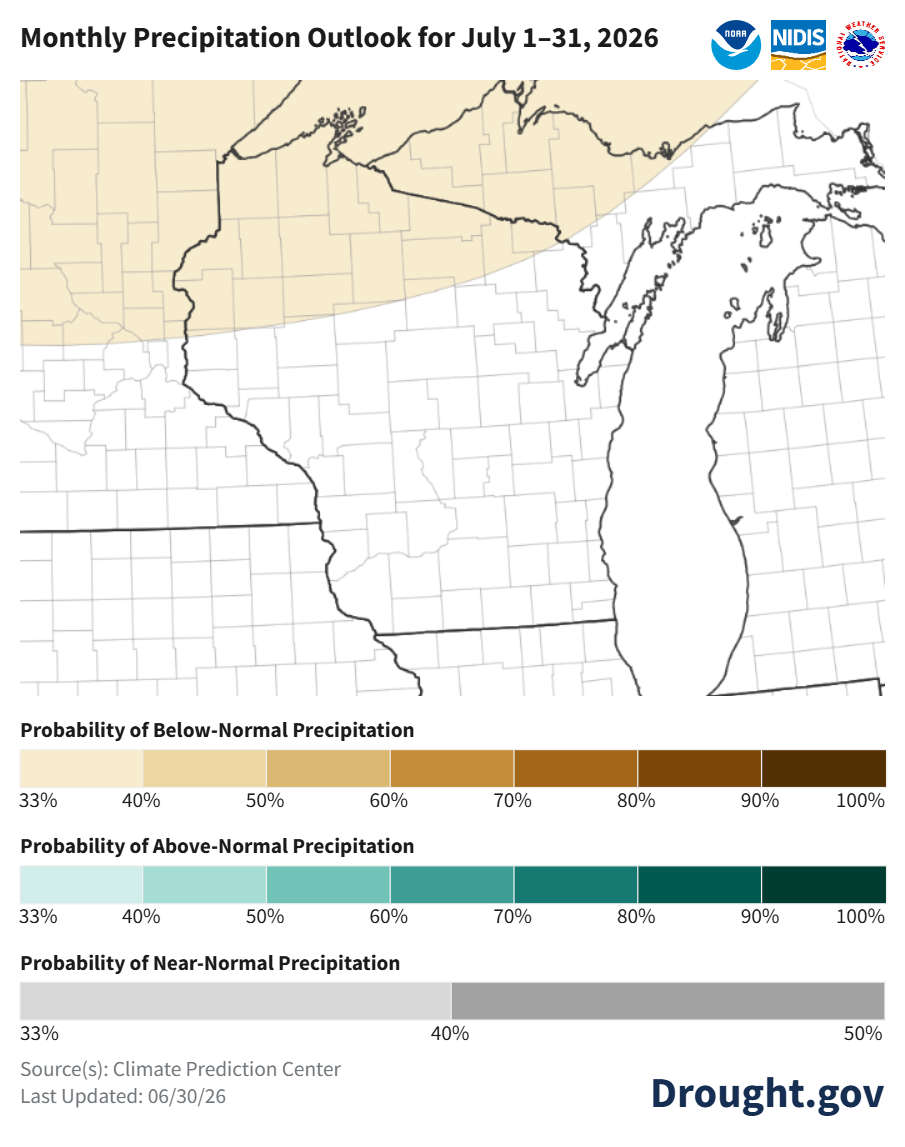
Image Description ↓
Choropleth map titled “Monthly Precipitation Outlook for July 1–31, 2026,” covering Minnesota, Wisconsin, Michigan, and surrounding states/Lake Michigan, sourced from NOAA’s Climate Prediction Center via Drought.gov, last updated 06/30/26. A tan-shaded region covering northern Minnesota and the northwest corner of Wisconsin indicates a 33-40% probability of below-normal precipitation. The remainder of the mapped area (most of Wisconsin, all of Michigan, and Lake Michigan) is unshaded, indicating equal chances among below-normal, near-normal, and above-normal precipitation. Three horizontal color-scale legends appear below the map: “Probability of Below-Normal Precipitation” (cream to dark brown, 33% to 100%), “Probability of Above-Normal Precipitation” (pale to dark teal, 33% to 100%), and “Probability of Near-Normal Precipitation” (light to dark gray, 33% to 50%).
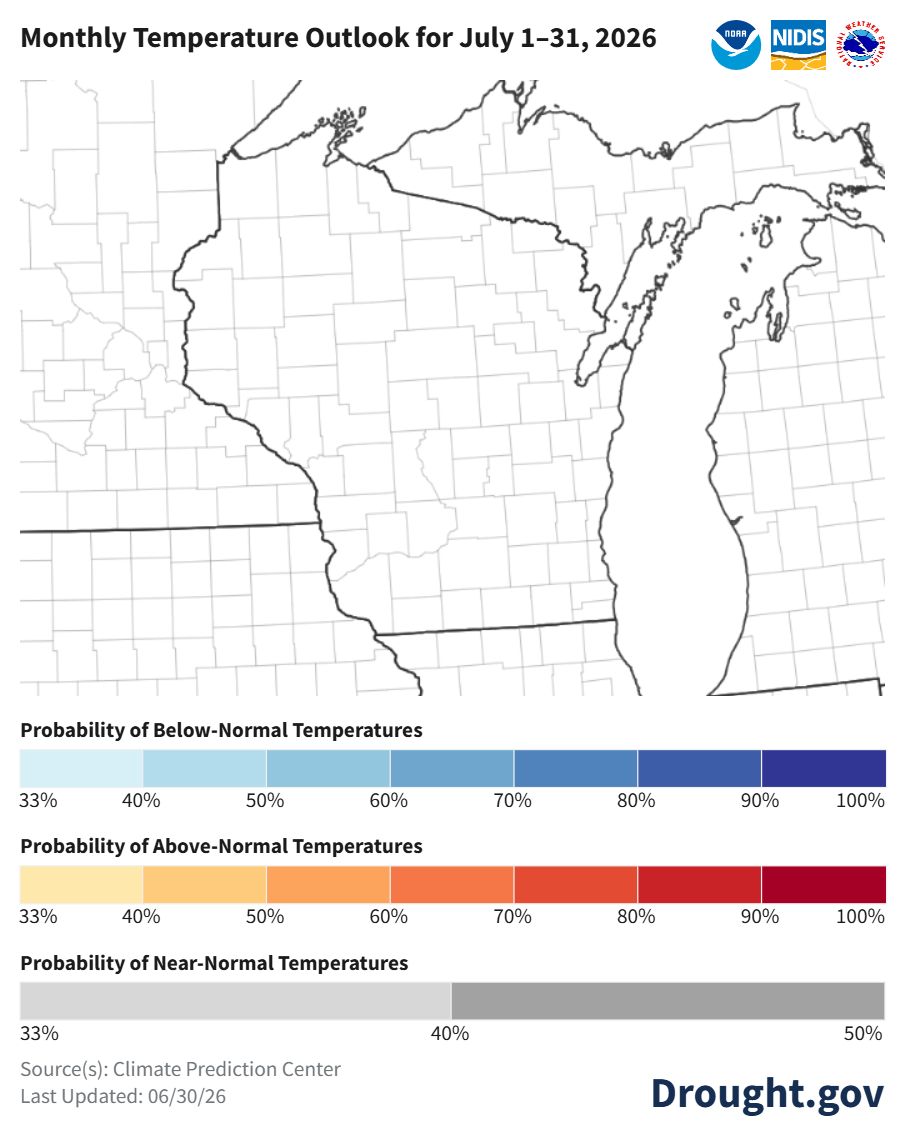
Image Description ↓
NOAA/NIDIS/National Weather Service map covering Wisconsin, Michigan, and parts of Iowa, Minnesota, and Illinois for the period July 1–31, 2026. The map area itself shows no shaded probability data. Below the map are three color-coded legend scales: “Probability of Below-Normal Temperatures” (light to dark blue, 33%–100%), “Probability of Above-Normal Temperatures” (light yellow to dark red, 33%–100%), and “Probability of Near-Normal Temperatures” (light to dark gray, 33%–50%). Source: Climate Prediction Center. Last updated 06/30/26. Drought.gov logo in bottom right.
- July: No strong leans in the temperature or precipitation probabilities. There is a slight lean towards drier-than-normal in the north (33-40% odds).
- Statewide normals (1991-2020) for July 1-30 are 69.2°F and 4.04”.
90 Day Temperature and Precipitation Outlook
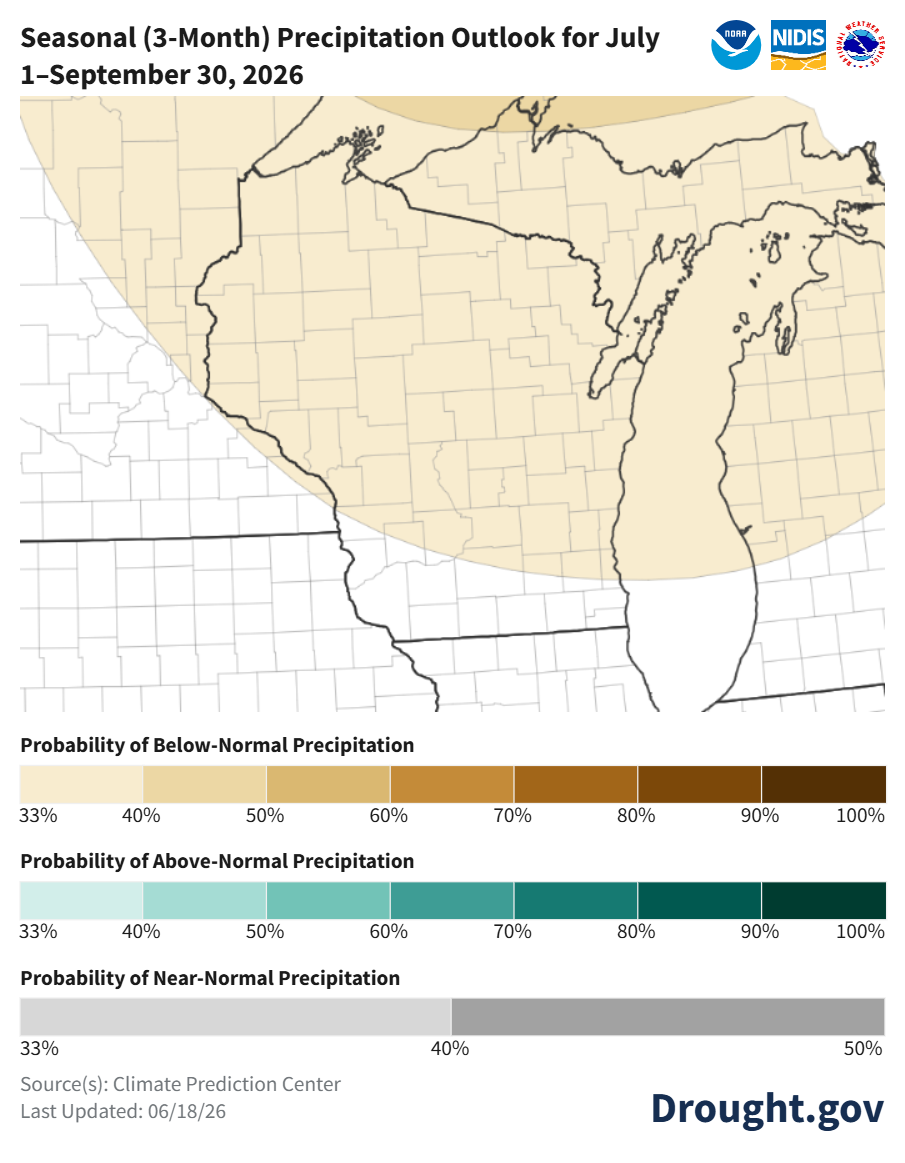
Image Description ↓
A map titled “Seasonal (3-Month) Precipitation Outlook for July 1–September 30, 2026” showing Wisconsin and surrounding Midwest states. NOAA, NIDIS, and National Weather Service logos appear in the upper right. State and county boundaries are visible, with Wisconsin centered.
Most of Wisconsin is shaded light tan, indicating a 33–40% probability of below-normal precipitation across the July–September period. The tan shading extends across northern, central, and eastern Wisconsin. The southern edge of Wisconsin and nearby regions appear gray, indicating near-normal precipitation probabilities (about 33–50%) with no strong tilt toward wetter or drier conditions.
Legends below the map include:
“Probability of Near-Normal Precipitation,” shown in gray (about 33–50%), present mainly in southern areas.
“Probability of Below-Normal Precipitation,” ranging from 33% to 100% (light tan to dark brown), with Wisconsin mainly in the lowest category (33–40%).
“Probability of Above-Normal Precipitation,” ranging from 33% to 100% (light teal to dark green), not represented over Wisconsin.
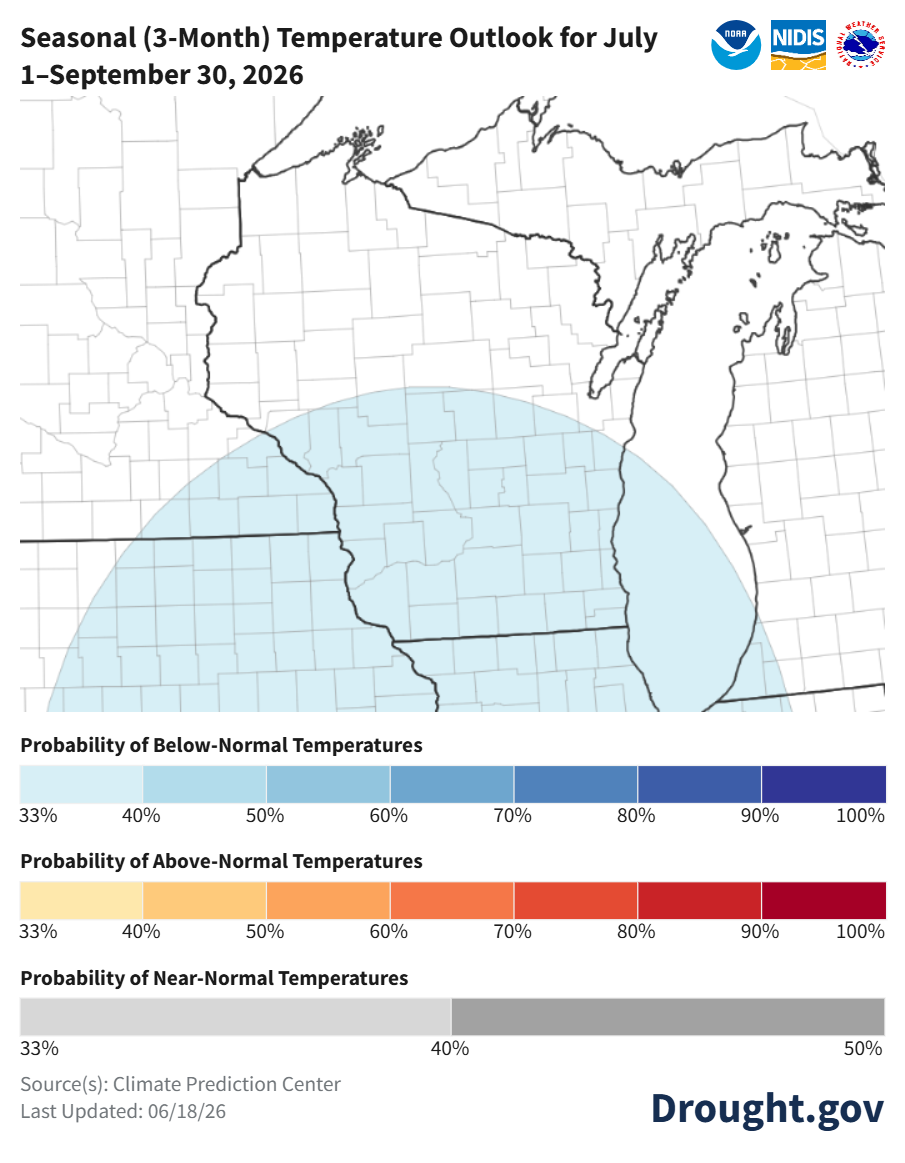
Image Description ↓
A map titled “Seasonal (3-Month) Temperature Outlook for July 1–September 30, 2026” showing Wisconsin and surrounding Midwest states. NOAA, NIDIS, and National Weather Service logos appear in the upper right. State and county boundaries are visible, with Wisconsin centered.
Southern Wisconsin is shaded light blue, indicating a 33–50% probability of below-normal temperatures during the July–September period. This cooler-than-normal signal covers much of the southern half of the state and extends into neighboring states. Northern Wisconsin appears mostly gray, indicating near-normal temperature probabilities (about 33–50%) with no strong tilt toward above- or below-normal conditions.
Legends below the map include:
“Probability of Near-Normal Temperatures” (gray, about 33%–50%), covering northern Wisconsin.
“Probability of Below-Normal Temperatures” (blue gradient, 33%–100%), with southern Wisconsin in the lowest category (33–50%).
“Probability of Above-Normal Temperatures” (tan to red gradient, 33%–100%), not represented over Wisconsin.
- July-Sept: Temperatures in southern and central counties are leaning towards below normal temperatures (33-40% odds), with uncertainty further north. Precipitation is leaning towards below normal for most of the state (33-40% odds), with uncertainty in the far south.
- Statewide normals (1991-2020) for July-Sept are 65.4°F and 11.53”.
User Survey
Are you a regular user of the Ag Weather Outlook for Wisconsin (AgWOW)? Or maybe you are viewing this page for the first time this week? Either way, we want to hear your feedback on this resource! Please take a few minutes and fill out this survey. Your feedback will help us better serve your ag-weather data needs through AgWOW.
If you have any trouble accessing or filling out the survey, please email Josh Bendorf at jbendorf@wisc.edu. Thank you!