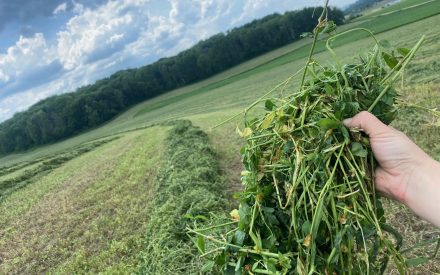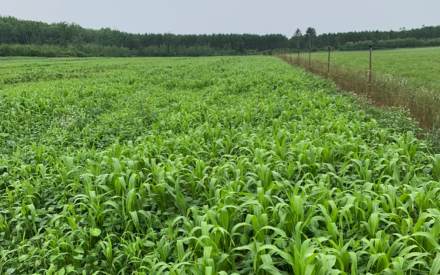
Maximizing your forage supply is key to having a well-fed, productive herd. One way to accomplish this is by identifying and incorporating summer annual and brassica forages in your crop rotation.
When managed and harvested correctly, these options can meet forage yield goals and the nutritional needs for a variety of livestock species and categories. Depending on the forage species that you choose, there is significant flexibility in how they can be harvested, stored, and fed – including green chop, silage, dry hay, grazing, stockpiling, and windrow chopping.
Summer annuals can provide quick, substantial growth that is beneficial when forage inventory is short, while brassicas can be utilized to bridge forage needs by extending the grazing season into the fall.
What annual forage species should you select?
Selecting a forage species that meets your forage goals and growing environment is a critical step to success. Crop management recommendations, attributes, and average nutritional values are detailed below and can help you identify which forage best fits your needs.
Summer Annual Grasses
Summer annuals have significant growth during the ‘summer slump’ our perennial pastures go through. In addition, in the instance of wheat or alfalfa winterkill or problems with corn silage production such as drought, summer annuals can be planted to maintain forage supply. Summer annual grasses tend to grow very quickly and thrive in hot, dry weather, making them relatively drought resistant. Warm season annual pasture was found to yield more than cool season perennial pasture while having comparable nutritive value (Ritz et al., 2020). When weather conditions allow, they can boost forage inventories significantly during the summer months.
Forage Sorghum
Nutritive value of forage sorghum
| Dry Matter | Crude Protein | ADF | NDF |
|---|---|---|---|
| 35–48% | 8–12% | 34–40% | 60–75% |
Sudangrass
Nutritive value of sudangrass
| Dry Matter | Crude Protein | ADF | NDF |
|---|---|---|---|
| 21% | 11% | 36% | 66% |
Sorghum-sudangrass
Nutritive value of sorghum-sudangrass
| Dry Matter | Crude Protein | ADF | NDF |
|---|---|---|---|
| 17% | 13% | 37% | 58% |
Pearl Millet
Nutritive value of pearl millet
| Dry Matter | Crude Protein | ADF | NDF |
|---|---|---|---|
| 38% | 15% | 41% | 69% |
Foxtail Millet
Nutritive value of foxtail millet
| Dry Matter | Crude Protein | ADF | NDF |
|---|---|---|---|
| 40% | 8% | 33–44% | 48–72% |
Beware of Nitrates and Prussic Acid
During periods of drought or plant stress, warm season grasses can accumulate nitrates. Avoid heavy nitrogen applications to reduce excess nitrates in the soil. Nitrates can poison livestock when consumed at high levels. It is important to note that forages will not decrease nitrate levels when preserved as hay. When silage is fermented completely, nitrate levels may drop by 50% but will not be fully reduced.
Another risk that is possible with sorghum species and hybrids is prussic acid poisoning. Sorghum plants that are less than 24” tall or have new tillers have a concentration of prussic acid that can result in cyanide poisoning. When growth is stunted by drought or plant tissue freezes, dhurrin in plant tissue is converted to cyanide. Prussic acid dissipates through hay curing and silage fermentation after one to two weeks. When grazing, animals must be removed when stands are smaller than 8”, to avoid grazing of young, basal tillers, or after a frost for at least a few days. Click here to read more about these conditions.
If you have any concerns regarding the accumulation of nitrates or prussic acid in your harvested forage, either test the forage to identify issues or avoid feeding potentially contaminated feed until the chance of poisoning has subsided.
Brassicas
Most commonly used for grazing, brassica species provide very high-quality forage, especially at the end of summer and into fall. One common place in crop rotation for brassica establishment is after winter wheat harvest as brassicas grow in cooler temperatures. Brassicas can be drilled into wheat stubble and allow for grazing into November. Grazing can begin when the plants reach 12 inches tall, which can start occurring 60 to 70 days after planting.
Brassica planting recommendations
Drill seed on 6-8″ row spacing at no more than ½” deep.
Nutritive value of brassica above-ground biomass
| Total Digestible Nutrients | Crude Protein | ADF | NDF |
|---|---|---|---|
| 65–80% | 20–25% | 12–18% | 18% |
Turnips
Canola
Kale
Notes about feeding brassicas
Brassicas are very high in protein but lack fiber. For this reason, an animal’s diet should not consist of more than two-thirds brassicas, and supplemental roughage is recommended. Nitrate poisoning can also be a concern with brassicas. Several other conditions such as polioencephalomalcia (PEM), hemolytic anemia, and pulmonary emphysema can occur if livestock consume too many brassicas in their diet (Arnold & Lehmkuhler, 2014). Turn animals onto brassica pasture slowly and monitor them for any signs of distress.
Summer annuals and brassicas are great options to both diversify your forage feeding system and incorporate different species into your crop rotations. It is always recommended to have these forages tested for nutrient content after harvest to ensure the nutrients provided are appropriate for the species of livestock that will be consuming the forage. Working with a nutritionist is a good step to matching these forages to the appropriate animal species and category.
References
Arnold, M., & Lehmkuhler, J. (2014). Brassicas: Be Aware of the Animal Health Risks ID- 223. University of Kentucky Cooperative Extension Service. https://publications.ca.uky.edu/files/ID223.pdf
Dillard, S.L., Billman, E.D., & Soder, K.J. (2019). Assessment of forage brassica species for dairy and beef-cattle fall grazing systems. Applied Animal Science 36: 157-166. https://projects.sare.org/media/pdf/D/i/l/Dillard-et-all-Assessment-of-forage- brassica.pdf
Heins, B. (2023). Sorghum-sudangrass and teff as summer forages for livestock systems. University of Minnesota Extension. https://extension.umn.edu/forage-selection/sorghum-sudangrass-and-teff-summer-forages-livestock-systems
Huezé, V., & Tran, G. (2015). Sudan grass (Sorghum x drummondii). Feedipedia, a program by INRAE, CIRAD, AFZ, and FAO. https://www.feedipedia.org/node/375
Huezé, V., Tran, G., & Sauvant, D. (2020). Foxtail millet (Setaria italica). Feedipedia, a program by INRAE, CIRAD, AFZ, and FAO. https://www.feedipedia.org/node/382
Jaster, E.H., Fischer, C.M., & Miller, D.A. (1985). Nutritive Value of Oatlage, Barley/Pea, Pea, Oat/Pea, Pearl Millet, and Sorghum as Silage Ground Under a Double Cropping Forage System for Dairy Heifers. Journal of Dairy Science 68: 2914-2921. https://www.journalofdairyscience.org/article/S0022-0302(85)81185-1/pdf
McIntosh, D., & Bates, G. (2020). Teff Grass SP 800. University of Tennessee Extension Institute of Agriculture. https://utbeef.tennessee.edu/wp-content/uploads/sites/127/2020/11/Teff-Grass.pdf
Millet, Foxtail (green foxtail). (2025). Upper Midwest Forages, University of Wisconsin-River Falls. https://uppermidwestforages.org/catalogprint.php?type=grasses&species=Millet,%20Foxtail%20(green%20foxtail)
Newman, Y. (2025). Prussic acid and nitrate toxicity in sorghums. Crops and Soils; University of Wisconsin-Madison Division of Extension. https://cropsandsoils.extension.wisc.edu/articles/prussic-acid-and-nitrate-toxicity-in-sorghums/
Ritz, K.E., Heins, B.J., Moon, R., Sheaffer, C., & Weyers, S.L. (2020). Forage yield andnutritive value of cool-season and warm-season forages for grazing organic dairy cattle. Agronomy 10: 1963. https://doi.org/10.3390/agronomy10121963
Sedivec, K.K., & Schatz, B.G. (1991). Pearl Millet Forage Production in North Dakota R-1016. North Dakota State University. https://library.ndsu.edu/server/api/core/bitstreams/74980b6a-9522-4e6c-a8e2-125e153c55e7/content
Sheahan, C.M. (2014). Comparison of Five Millet Species for Conservation Use in the United States. United States Department of Agriculture. https://www.nrcs.usda.gov/plantmaterials/njpmctn12841.pdf
Undersander, D. (2003). Sorghums, Sudangrasses, and Sorghum-Sudan Hybrids. Wisconsin Team Forage. https://fyi.extension.wisc.edu/forage/sorghums- sudangrass-and-sorghum-sudan-hybrids/
Undersander, D. (1996). Use of Brassica Crops in Grazing Systems. University of Wisconsin-Madison Division of Extension. https://fyi.extension.wisc.edu/forage/files/2017/03/Use-of-Brassica-Crops-in-Grazing-Systems.pdf
Updated: June 2, 2025
Reviewed by: Marta Kohmann