Crop removal of potassium (K) is high in common Wisconsin crops like alfalfa, corn silage, and high-yielding soybeans. When soil test levels slip too low, yields and crop quality can both suffer.
Recent University of Wisconsin research updates reinforce one clear message: potassium is one of the best nutrient investments on the farm when managed wisely.
A Soil-Test-Based Philosophy to Potassium Guidelines
The University of Wisconsin potassium guidelines are grounded in a simple but powerful concept: start with where your soil is today.
Soil test potassium levels fall into three broad management ranges (Figure 1):
- Build-Up Range
- Maintenance Range
- Drawdown Range
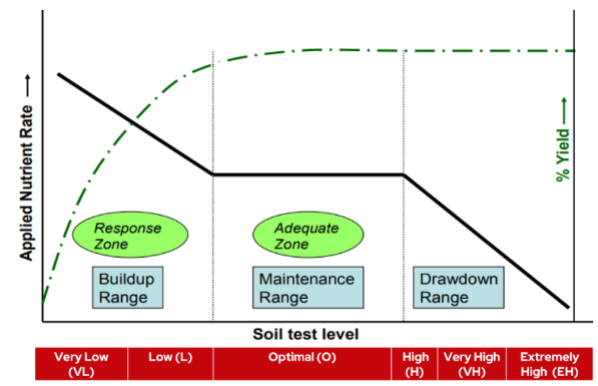
Figure 1 compares applied nutrient rates with soil test levels. The green, dashed line shows percent yield rising quickly at low soil test levels and leveling off at optimal and higher levels. The three labeled zones, Buildup, Maintenance, and Drawdown Ranges, are labeled with corresponding soil test levels (Very Low, Low, Optimal, High, Very High, Excessively High).
Build-Up Range: Very Low (VL) and Low (L) soil test categories
These soils require potassium to meet crop removal plus additional fertilizer to raise soil test levels into the desired optimal range. This soil test category is where potassium delivers the highest return on investment with a greater than 76% chance for a return on investment. Additional fertilizer for building up, or the amount needed above and beyond expected crop removal, is typically between 30 and 45 lbs. K2O/ac. Potassium response studies in Wisconsin suggest that, in general, corn and soybean yield potential is significantly lower in Very Low (VL) and Low (L) testing soils—regardless of K2O application rate—than in Optimum (O) or higher-testing soils.
Maintenance and Crop Removal Range: Optimum (O) soil test category
Fertilizer rates are designed to match expected crop removal (based on a realistic yield goal) and to keep soil test levels within the optimum range over the crop rotation. UW research suggests that this is the desired soil test category to stay in from an agronomic and profitability standpoint.
Drawdown Range: High (H), Very High (VH) or Excessively High (EH) soil test categories
Fields testing High (H), Very High (VH) or Excessively High (EH) require less K from fertilizer (or no K, such as on EH soils) than lower testing fields. On these soils, yield increases from applied K2O are much less than those on Very Low (VL) and Low (L) testing soils; however, lesser amounts of applied K2O are still profitable in H and VH soils.
Potassium fertilizer application guidelines are still provided on H and VH soils, but they are at reduced rates of half (on H soils) or one quarter (on VH soils) of expected crop removal rates. Fields testing in this range present an opportunity to reduce or eliminate K2O applications in the short term, especially with tight farm budgets, low commodity prices, and high fertilizer prices.
Where Potassium Pays the Most: Probability of crop response
Are you playing catch-up on building soil test K? Do you have rented ground, and how long are those agreements? Do you have high K-demanding crops in your rotation? What do your historical (6 to 8 years) soil test results show? These are all great questions to consider when deciding how to manage potash inputs moving forward, especially in high production cost and low commodity price years.
Potassium is the quality and the quantity nutrient. Beyond yield, it influences:
- Nitrogen use efficiency
- Stalk strength and lodging resistance
- Alfalfa winter hardiness
- Soybean oil content
- Kernel weight and kernels per acre
Recent UW research shows similar probabilities of profitable crop response to K2O in VL, L, and O testing soils as compared to previous research (Table 1). Probabilities of crop response to K2O on H and VH testing soils, however, were found to be substantially higher than in previous work. Despite the high probability of response in H and VH testing soils, keep in mind that the recommended K2O rates are one-quarter to one-half of those on O testing soils.
| Soil Test Category | Probability of Yield Increase (Table 3.2 A2809) | Probability of Yield Increase for Potassium in Corn & Soybeans |
|---|---|---|
| Very Low (VL) | 90% | 91% |
| Low (L) | 60-90% | 76% |
| Optimal (O) | 30-60% | 51% |
| High (H) | 5-30% | 45% |
| Very High (VH) | 2-5% | 23% |
| Excessively High (EH) | Less than 2% | N/A |
Very Low and Low testing soils have a 60–91% probability of yield increase from potassium fertilizer.
High and Very High testing soils: Even here, updated research shows up to a 45% probability of response to half or quarter application rates.
The higher-than-expected observed probability of a positive yield response to potassium surprised the UW phosphorus and potassium recommendation team but reinforces a key point: UW fertilizer guidelines are accurate in predicting response, even if they are not perfectly precise for every field.
Why Potassium Can Be Tricky
Potassium exists in several pools in the soil:
- K+ in soil solution (1–2%) is immediately available to crops and is what is measured by soil tests.
- Exchangeable and slowly available K pools (1–2%) replenish K through drying/wetting and freezing/thawing cycles.
- Mineral forms (90–98%) are fixed and unavailable to the crop.
See more on the potassium cycle in our publication, Elevate Your Knowledge of the Potassium Cycle.
Below are situations where potassium deficiency symptoms may show up in crops even when soil test K levels are adequate. Soil testing remains the foundation of smart potassium management, so how and when you sample matters.
What Affects Soil Test Potassium (K) Levels?
Soil Tests: Soil tests are the best tool we have to predict plant-available K+ in soil samples
Seasonal Variability:
- Spring vs. fall sampling
- How close after harvest did you sample soil? K can be held in crop residue until a rainfall or snowfall flushes it out.
Actual Crop Removal:
- UW K2O rate guidelines assume a specific removal rate (lb K2O per bushel of yield).
- Removal rates are not always uniform, and there may be value in doing grain (or forage) testing on your farm to assess local crop removal rates.
Representative Sample:
- Depth of sampling (stratification of K, if too shallow, elevates K test result)
- Number of cores
- Change in number of samples per field
- Field variability
What Affects Potassium (K) Uptake By Crops?
Starting Soil Test Category:
- Soil tests Low (L) or Very Low (VL) for K
- Sandy soil
- Low organic matter (OM) soils
Soil Moisture:
- Crops uptake K via diffusion — water must be present. Therefore, short- and long-term drought conditions will reduce K uptake
- Prolonged periods of cool soil temperatures and/or waterlogged conditions can reduce K uptake
Natural Cycles Contributing to K Release:
- Drying and wetting
- Freezing and thawing
Unhealthy Crop Roots:
- Compaction
- Pest or disease damage to roots
Do Not Overlook Crop Removal of Potassium
High yields mean high potassium removal. This involves harvesting whole plants plus grain/straw or multiple cuttings. Examples include:
- Corn silage
- Alfalfa and multiple-cut forage systems
- High-yield soybeans
If you have yield maps, grain tests, or forage analyses, or add a with/without test strip. These tools can further refine crop removal estimates and fertilizer decisions.
When to Spend and Save Potassium Dollars
Recent UW–Madison Extension fertilizer surveys estimate potash prices average around $460 per ton, down from recent highs. That makes potassium a more attractive investment, especially in low-testing or rented fields. Potassium economic takeaways include the following:
- Low (L) and Very Low (VL) Testing Soils
- The probability of crop response to applied K2O is high (~ >60%) on these soils. Yields are severely reduced when K2O is not applied at removal plus build rates. If possible, do not cut back on K2O on fields with L or VL soil test K values.
- High (H) and Very High (VH) Testing Soils
- Reducing or eliminating K for one year likely has minimal impact on yield (for grain crops) and soil test levels. For example, a 60-bushel soybean crop removes about 76 lb K2O per acre. Without replacement, soil test potassium could drop by roughly 10–11 ppm in a single year. Long-term elimination or reduced-from-recommended rates of K2O is not advised.
- Rented Land
- Fields testing Low (L) may require attention, especially if high-demand crops like corn silage or alfalfa are planned in the future. If rental agreements are short-term, and building soil test levels are too risky, consider applying crop removal rates instead of recommended build-rates.
Key Potassium Management Takeaways
Smart potassium management protects yield, improves efficiency, and supports long term soil productivity. Using UW potassium guidelines and careful planning, potassium remains one of the best nutrient investments on Wisconsin farms.
- Follow UW fertilizer guidelines and manage potassium across the entire crop rotation.
- Prioritize potassium applications on Low (L) and Very Low (VL) testing soils.
- Use soil test trends, yield maps, and crop removal data to refine decisions.
- Consider variable-rate potassium on highly variable fields.
- Choose potassium sources strategically. Use potash for general potassium needs and consider potassium sulfate when sulfur is also required.
Published: February 10, 2026
Reviewed by:
- Chris Bandura, soils program manager, UW–Madison Extension
- Kevin Jarek, regional crops educator, UW–Madison Extension
- Natasha Rayne, assistant professor and soil fertility extension specialist, UW–Madison
- Matt Ruark, professor and nutrient cycling extension specialist, UW–Madison