Skip to content
UW Madison Crest

Crops and Soils

Division of Extension

  • Topics
    • Economics, Budgets and Financials
    • Emerging Crops
    • Forage Production and Management
    • Fruit and Vegetable Production
    • Grain Production and Management
    • Grazing
    • On-Farm Research
      • Nitrogen Optimization Pilot Program
    • Pest Management
    • Soils, Nutrient Management, and Soil Health
  • Events
    • Events Calendar
    • UW Forage and Cover Crop Field Day
    • Agronomy and Soils Field Day
    • Wisconsin Extension Weed Management Workshop
    • WWASH Conference
    • Badger Crops and Soils Update Meetings
  • News
    • News
    • Get Connected
      • The Wisconsin Crop Manager
    • Hay Market Report
    • Ag Weather Outlook for Wisconsin
  • Programs
    • Webinars
      • Badger Crop Connect
      • Emerging Crops Webinars
      • Focus on Forage
      • Foundational Crop Scouting Training
      • Vegetable Production Webinars
    • Podcasts
  • Articles
  • People
  • About
  • Contact Us
Search
University of Wisconsin-Extension
Articles > Soils, Nutrient Management & Soil Health

Predict Manure Runoff with the Runoff Risk Advisory Forecast

Written by CHRISTINE ANNE CLARK
Share
  • Share:
  • Share on Facebook
  • Share on X (Twitter)
  • Share via Email
  • Copy Link

Copied!

Will snowmelt, rainfall, or saturated soil result in potential runoff from your crop fields? The Wisconsin Runoff Risk Advisory Forecast (RRAF) is a web-based tool to help you predict manure runoff potential on a very local level (2.0km x 2.0km grids or 6.56 ft x 6.56 ft). It is easy to use the RRAF, just follow these 4 steps:

1. Visit the Website and Check the Color on the Map

Visit the RRAF website. The main webpage displays a map of Wisconsin color coded by runoff risk.

The runoff risk categories are based on the model’s many years of historical weather data, calibrated against real world, edge-of-field monitoring data. Here is what each color category means:
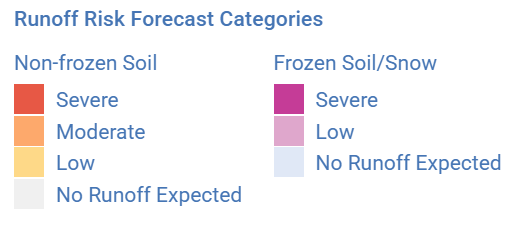
Color key for Runoff Risk Forecast Categories: non-frozen soil (severe to none) and frozen soil/snow (severe to none).

The Golden Rule
“If it’s RED, do not SPREAD.”

Non-frozen Soil

When the soil is not frozen you could see a range of risk from no runoff expected to severe risk. The RRAF tool looks out three days into the future to determine the potential risk.

Frozen or Snow Covered Soil

When soil is frozen or snow-covered, the RRAF looks out 10 days into the future because applications are applied to the surface during this time, and even a small runoff event can wash away large amounts of applied nutrients, like manure.

2. Plan and Use the “Look Ahead” Feature

The RRAF map is updated four times a day and allows for short term planning. It displays the current day’s risk and uses precipitation model forecasts to predict risk for the next three days. During the winter, the model uses temperature forecasts to look up to 10 days ahead to predict potential snowmelt, a major factor in winter runoff.

The date slider, located below the map in RRAF, allows you to view the forecast for five days.
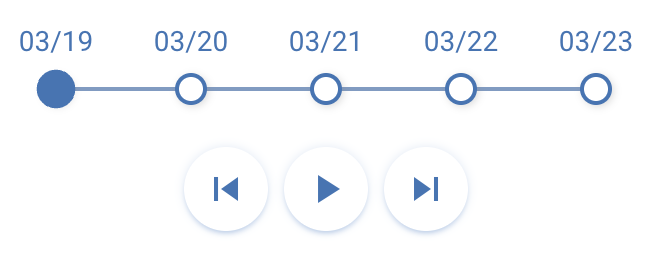
Interactive timeline showing dates March 19–23, with March 19 selected. Playback controls below allow navigation between dates.

A multi-day forecast is used, rather than a single-day forecast, to help prevent manure applications on days before runoff triggering events.

Manure applied today could runoff with tomorrow’s rain or snowmelt!

3. Get Local Forecast Details

You can get runoff risk data specific to your farm fields by following these steps:

1. Click the “Get Forecast Details” button.

Button: Get Forecast Details

2. Hover over the map and select a location on your farm by clicking directly on the map or entering an address in the search bar.
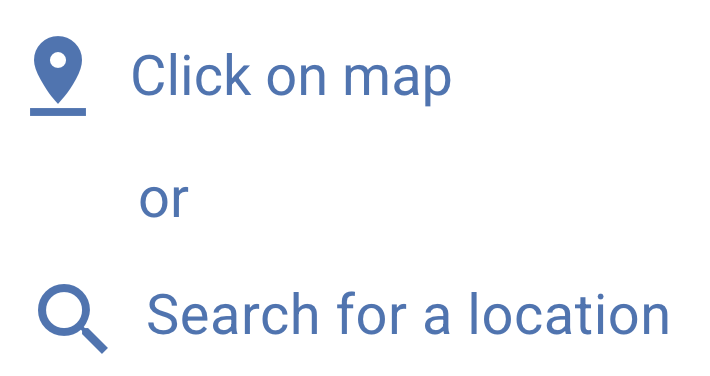
Two location input options: Click on map, or Search for a location.

3. The forecast will show the selected location’s coordinates, county name, and the current runoff risk (e.g., Low, Moderate, Severe).
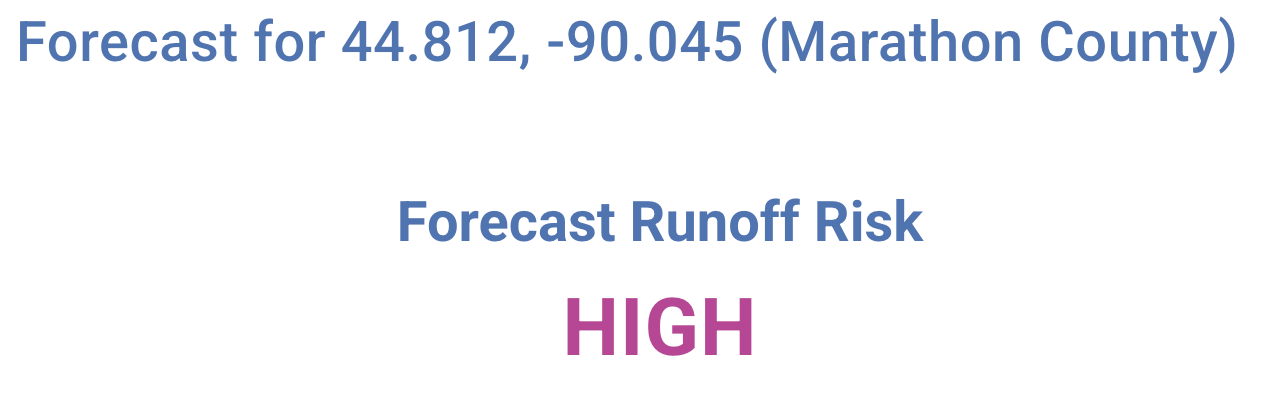
Forecast for 44.812, -90.045 (Marathon County): Forecast Runoff Risk — HIGH.

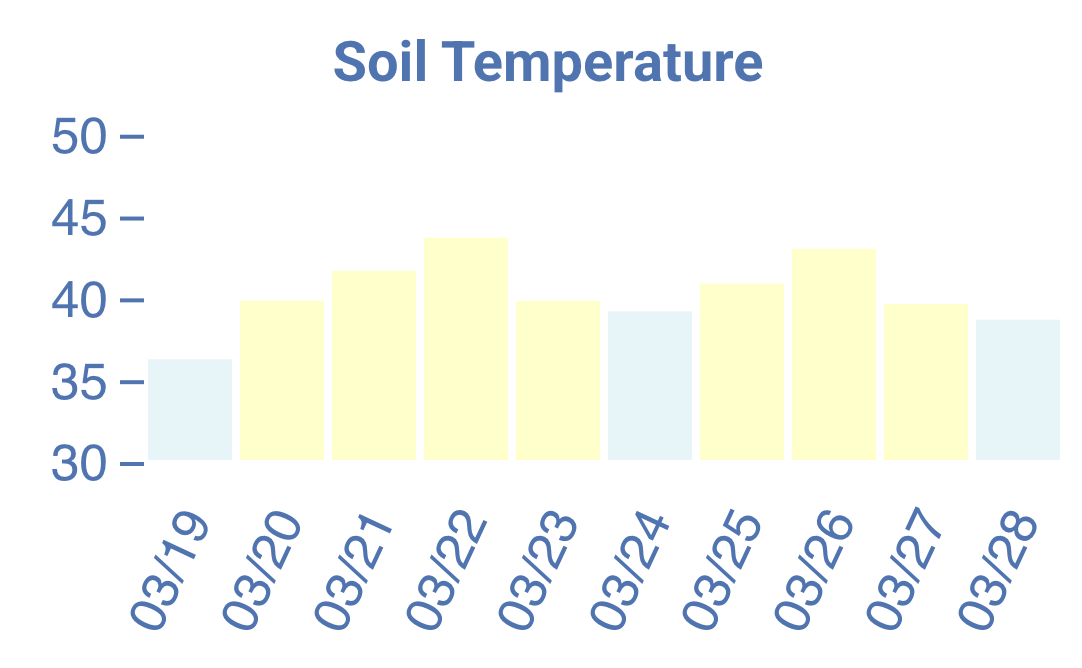
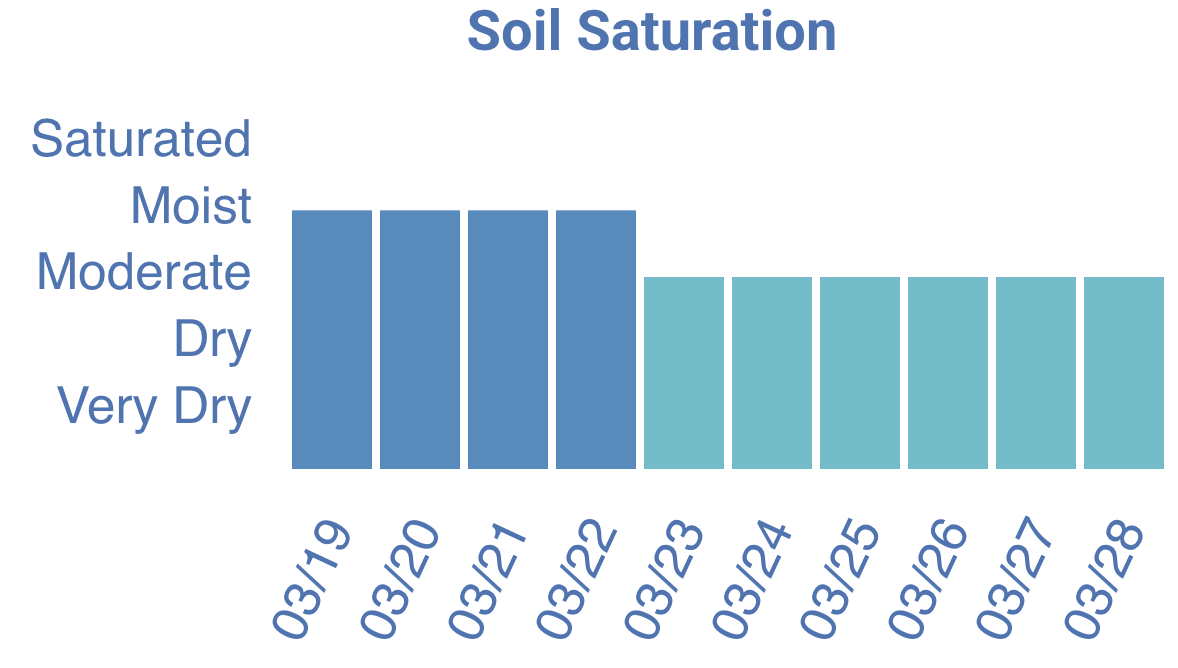
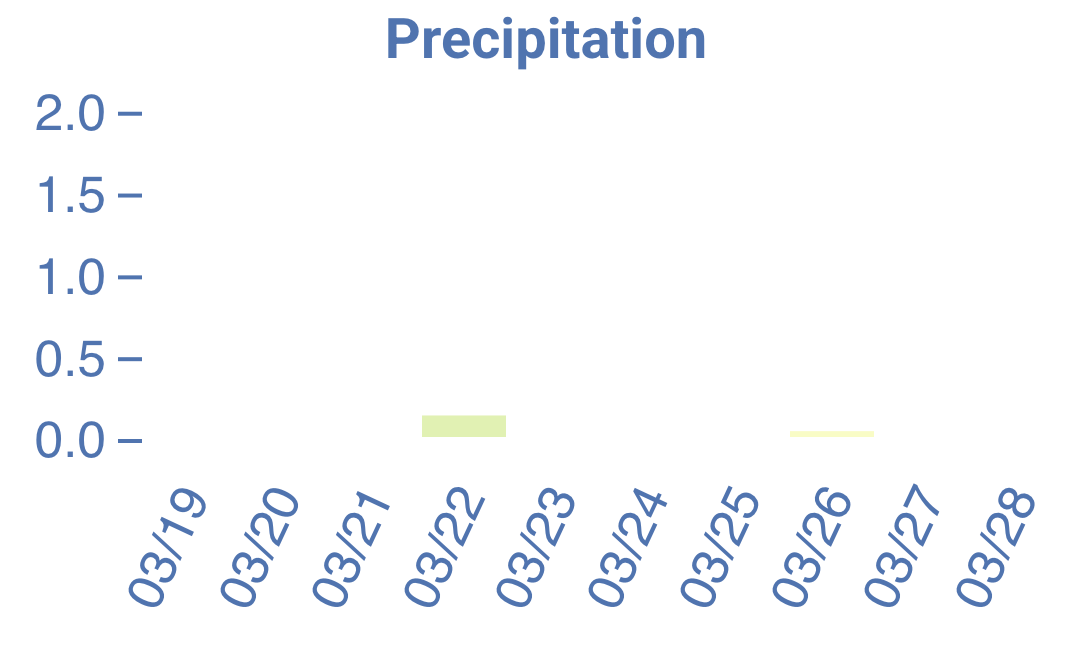
RRAF will also show 10-day outlooks for runoff risk, precipitation, soil temperature, and soil saturation. Example graphs are shown below.
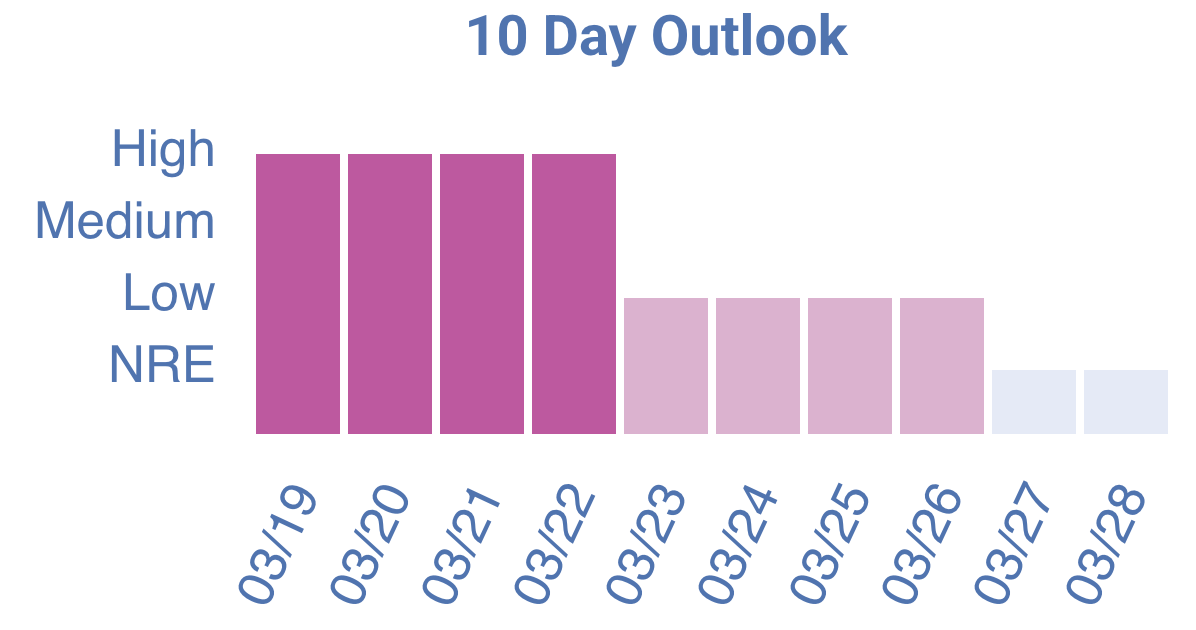
Runoff Risk 10 Day Outlook graph
Precipitation 10 Day Outlook graph
Soil Temperature 10 Day Outlook graph
Soil Saturation 10 Day Outlook graph

4. Helpful Resources

Historical Data

Use the Historical Snapshots button on the top right of the website to look back at past runoff risk data. Enter the date and download the maps for your records.

An image indicating what the Historical Snapshots link looks like on the RRAF site, reading, "Historical Snapshots."

If you must spread or empty a storage, but the forecast indicates a severe runoff risk, the review RRAF’s guidance about spreading on high-risk days. You should also contact your nutrient management planner and local county land and water conservation department or DNR specialist (for WPDESP permit holders) to discuss options. By assessing these factors – soil moisture, weather forecasts, crop cover, and slope – the RRAF helps you avoid runoff problems before they occur.

More Information

For more information on using RRAF and manure spreading, check out this short video: ▶ Tools for Planning and Spreading Manure – Crops and Soils.

Reviewed by: Andrea Topper and Kevin Erb
Print This Page

You May Also Like

  • ▶ Tools for Planning and Spreading Manure▶ Tools for Planning and Spreading Manure
  • Biomass Thresholds for Cereal Rye Cover Crop GoalsBiomass Thresholds for Cereal Rye Cover Crop Goals
  • ▶ Watch: Focus on Forage Cover Crops▶ Watch: Focus on Forage Cover Crops
  • ▶ Watch: Focus on Managed Grazing▶ Watch: Focus on Managed Grazing

Division of Extension

Connecting people with the University of Wisconsin

  • Agriculture
  • Community Development
  • Health & Well-Being
  • Families & Finances
  • Natural Resources
  • Positive Youth Development
University of Wisconsin-Madison      |        Explore Extension: Agriculture Community Development Families & Finances Health Natural Resources Youth
Connect With Us
Support Extension
Extension Home

We teach, learn, lead and serve, connecting people with the University of Wisconsin, and engaging with them in transforming lives and communities.

Explore Extension »

County Offices

Connect with your County Extension Office »

Map of Wisconsin counties
Staff Directory

Find an Extension employee in our staff directory »

staff directory
Social Media

Get the latest news and updates on Extension's work around the state

facebook iconFacebook

twitter icon Follow on X


Facebook
Follow on X

Feedback, questions or accessibility issues: info@extension.wisc.edu | © 2026 The Board of Regents of the University of Wisconsin System
Privacy Policy | Non-Discrimination Statement & How to File a Complaint | Disability Accommodation Requests

The University of Wisconsin–Madison Division of Extension provides equal opportunities in employment and programming in compliance with state and federal law.