Recently forage-testing laboratories have begun to evaluate forages for neutral detergent fiber (NDF) digestibility. Evaluation of forages for NDF digestibility is being conducted to aid prediction of total forage digestibility. There are several important reasons why forages are being evaluated for NDF digestibility.
We have paid little attention to Pure Live Seed (PLS) in the Midwest because we have generally had high quality seed (greater than 90% germ and 98% purity). But the short forage seed supply has caused some low quality seed to come on the market.
Forage Brassicas, such as rape, kale, turnips, and swedes, are high yielding, high quality, fast growing crops. The above ground parts (stems and leaves) of rape and kale and all parts (stems, leaves, and roots) of turnips and swedes are utilized by livestock. Brassicas are high quality forage if harvested before heading. Above ground parts […]
Soybeans can be harvested as a hay or silage crop. This option is often considered either when forage is short or when the soybean crop is damaged for harvest as a grain crop (for example. following hail damage or an early frost). Soybean forage, like most legumes, tends to be high in protein and low […]
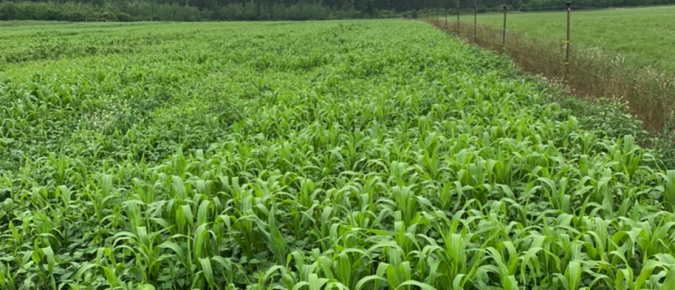
What are the different types of sorghum and sudangrasses? Sorghum and sudangrasses are warm-weather crops and will perform best in years when the growing season is characterized by higher-than-average temperatures. Cool conditions will severely limit productivity. Sorghums are diverse but generally fall into the following categories: Grain Sorghum – also called milo, used for grain production […]
Many hay growers simply sell hay. They are selling a commodity to low bidders rather than developing a market for a product. Bringing factors other than price into the market such as forage quality, consideration of customer needs, prompt delivery, steady supply, and appreciation of business can increase value and salability of product.
Limited snow cover to go along with a very cold winter leading to abnormally low soil temperatures has caused concern among forage agronomists (Ken Albrecht and Dan Undersander, UW Agronomy Dept.; personal communication) about extensive alfalfa winterkill.
Many farmers have considered including peas with small grains used as a cover crop for establishing alfalfa or as an emergency silage crop. The resulting silage is more palatable and higher in quality than small grain silage. The following information summarizes research regarding the influence of variety selection, seeding rate and mixture proportion.
In certain instances such as after a failed seeding, winterkill or in an attempt to thicken thinning stands, producers may be interested in following alfalfa with alfalfa. This practice has met with varied success due primarily to compounds produced by older alfalfa plants, which inhibit the growth of young seedlings. This process is known as autotoxicity. In this Focus on Forage, we will discuss what causes autotoxicity, factors that affect it, and ways to reduce the effect.
There is considerable debate about the value of applying calcium to Wisconsin soils used for forage production. Calcium is the dominant exchangeable cation in Wisconsin soils because it is held more tightly by the soil particles than most other cations including magnesium and potassium.
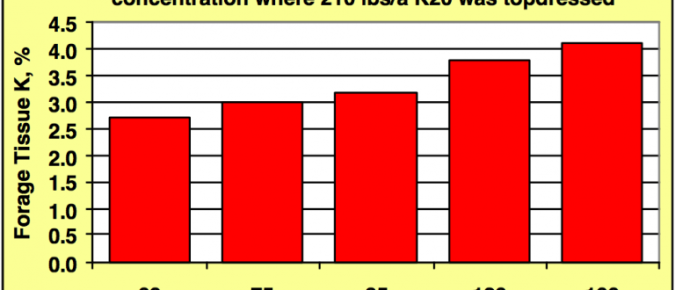
The potassium (K) content of harvested forage has become an increasingly important issue in recent years. As most dairy producers already know, a high level of K in forages has been identified as the causative factor for milk fever in dry and transition cow diets.
Seeding perennial forage species such as alfalfa during the late summer in Wisconsin can result in vigorous and productive stands when proper establishment practices are followed. Late summer alfalfa seeding does not replace traditional spring-seeding recommendations, but rather provides growers with an establishment alternative when crop rotation allows.