Skip to content
UW Madison Crest

Crops and Soils

Division of Extension

  • Topics
    • Economics, Budgets and Financials
    • Emerging Crops
    • Forage Production and Management
    • Fruit and Vegetable Production
    • Grain Production and Management
    • Grazing
    • On-Farm Research
      • Nitrogen Optimization Pilot Program
    • Pest Management
    • Soils, Nutrient Management, and Soil Health
  • Events
    • Events Calendar
    • UW Forage and Cover Crop Field Day
    • Agronomy and Soils Field Day
    • Wisconsin Extension Weed Management Workshop
    • WWASH Conference
    • Badger Crops and Soils Update Meetings
  • News
    • News
    • Get Connected
      • The Wisconsin Crop Manager
    • Hay Market Report
    • Ag Weather Outlook for Wisconsin
  • Programs
    • Webinars
      • Badger Crop Connect
      • Emerging Crops Webinars
      • Focus on Forage
      • Foundational Crop Scouting Training
      • Vegetable Production Webinars
    • Podcasts
  • Articles
  • People
  • About
  • Contact Us
Search
University of Wisconsin-Extension

Articles

Nitrate poisoning in cattle, sheep, and goats

Nitrate poisoning in cattle, sheep, and goats

Nitrate poisoning is a condition that may affect ruminants consuming certain forages or water that contains an excessive amount of nitrate. Horses are much less sensitive to nitrate toxicity since they are hindgut ferments and do not have a rumen.

Estimating the weight of forage in a forage wagon

Estimating the weight of forage in a forage wagon

Most dairy farmers do not have a drive-over scale available on their farms. Frequently it would be useful to know the weight of forage harvested from a field. Measuring alfalfa or corn silage yield is necessary to adjust management practices, to maintain crop inventories, and for crop reporting purposes.

Options for double-cropping barren corn

Options for double-cropping barren corn

The optimum crop to plant in an emergency forage situation should be determined by 1) when and how it will be utilized, 2) the forage quality needed, and 3) seed availability and cost.

Harvesting and storage

Harvesting and storage

Planting Corn For Silage Following Winter-Killed Alfalfa

Planting Corn For Silage Following Winter-Killed Alfalfa

What happens to corn silage yield and quality with later planting dates? The following is a summary of planting date trials conducted at Arlington, WI. The objective of these trials is to measure the impact of planting date on corn forage yield and quality.

On-farm moisture testing of corn silage

On-farm moisture testing of corn silage

Accurately determining corn whole plant moisture is important when harvesting for corn silage. Harvesting corn for silage too early (high moisture content) or too late (low moisture content) can affect forage yield, quality and silage fermentation.

Costs and benefits of Roundup Ready® Alfalfa in the establishment year

Costs and benefits of Roundup Ready® Alfalfa in the establishment year

Weed suppression can be important during alfalfa establishment as weeds can reduce stand life, alfalfa biomass, and forage quality. To reduce these impacts producers commonly apply herbicides to establishing alfalfa.

Removal of Roundup Ready Alfalfa: What can we learn from 2012

Removal of Roundup Ready Alfalfa: What can we learn from 2012

Alfalfa stands are typically terminated by herbicides in Wisconsin. While many options are available, combinations of 2,4-D and glyphosate are most commonly used.

Corn shredlage for dairy cows

Corn shredlage for dairy cows

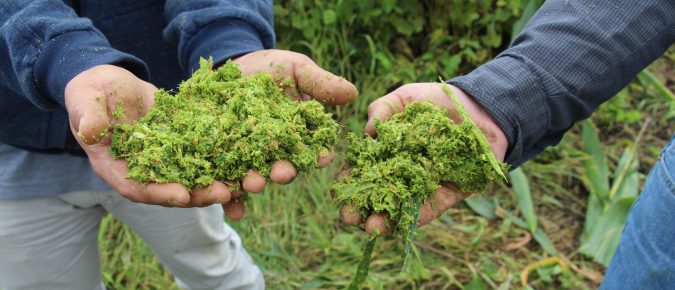
Garnering much recent interest by dairy producers and their nutritionists has been a new method of harvesting whole-plant corn for silage. The resultant product has been called corn shredlage by the developer of the process Shredlage™

Ensiling

Ensiling

Plant sugars are fermented by anaerobic bacteria to organic acids which reduce the pH of the plant material. This process preserves the crop during long-term storage.

Calculating grain yield utilizing a corn silage forage test

Calculating grain yield utilizing a corn silage forage test

Routine laboratory forage analysis of corn silage typically includes percent starch determination for the feed. Nutritionists utilize this information to partition Non-Fiber Carbohydrate (NFC) portions into % starch, % sugar and other NFC components to optimize production and animal health.

Alfalfa Grass Mixtures

Alfalfa Grass Mixtures

Research is developing new understanding of forage, fiber, and the animal’s ability to use them. We have also increased understanding of the genetics of alfalfa to allow improved variety selection methods and enhanced performance for the farmer. This paper will consider both topics. Growing Alfalfa/Grass Mixtures Generally dairymen have perceived grasses to be too high […]


Posts navigation

Posts pagination

◄ Page 1 … Page 38 Page 39 Page 40 Page 41 Page 42 Page 43 Page 44 Page 45 Page 46 ►

Division of Extension

Connecting people with the University of Wisconsin

  • Agriculture
  • Community Development
  • Health & Well-Being
  • Families & Finances
  • Natural Resources
  • Positive Youth Development
University of Wisconsin-Madison      |        Explore Extension: Agriculture Community Development Families & Finances Health Natural Resources Youth
Connect With Us
Support Extension
Extension Home

We teach, learn, lead and serve, connecting people with the University of Wisconsin, and engaging with them in transforming lives and communities.

Explore Extension »

County Offices

Connect with your County Extension Office »

Map of Wisconsin counties
Staff Directory

Find an Extension employee in our staff directory »

staff directory
Social Media

Get the latest news and updates on Extension's work around the state

facebook iconFacebook

twitter icon Follow on X


Facebook
Follow on X

Feedback, questions or accessibility issues: info@extension.wisc.edu | © 2026 The Board of Regents of the University of Wisconsin System
Privacy Policy | Non-Discrimination Statement & How to File a Complaint | Disability Accommodation Requests

The University of Wisconsin–Madison Division of Extension provides equal opportunities in employment and programming in compliance with state and federal law.