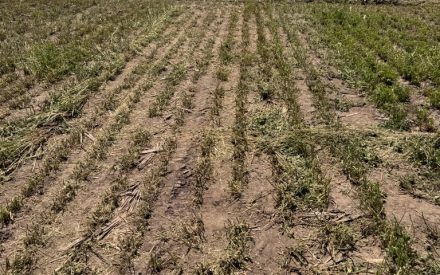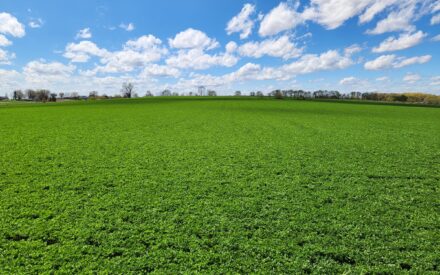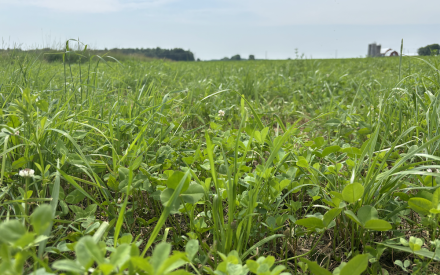
Wheat is an important agronomic crop in the rotations of many Midwestern states and is often followed by a late-summer seeding of alfalfa.
In this situation, wheat seed not collected in the combine becomes a weed and impacts alfalfa establishment and productivity, especially in no-till and reduced-till fields. Previous research in Wisconsin has shown that volunteer wheat can reduce alfalfa density by up to 50%, resulting in shorter alfalfa stand life and reduced forage quality the following spring.
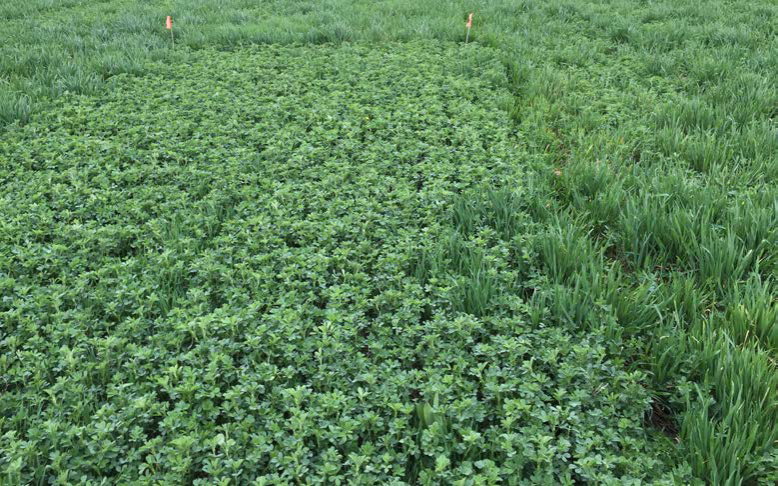
This past research documented that a well-timed application of sethoxydim (Poast Plus) during establishment in the fall, when wheat is less than 6 inches tall, can alleviate this impact and provide excellent control (see photo below).
This research (done between 2008-2010) led to further questions about managing volunteer wheat in alfalfa:
- Does glyphosate (Roundup) in Roundup Ready Alfalfa or imazamox (Raptor) provide similar control as sethoxydim (Poast Plus)?
- Is performance maximized when applied to volunteer wheat that is less than or equal to 6 to 6-½ inches tall?
- What level of volunteer wheat control is needed to prevent impact on alfalfa establishment while maximizing forage productivity and quality for dairy-based systems?
A well-timed herbicide application during alfalfa
establishment in the fall can provide excellent control of volunteer winter wheat
Methods
To address these questions, a study was initiated in 2015 at three locations across Wisconsin to compare the effectiveness of Roundup (glyphosate), Raptor (imazamox) and Poast Plus (sethoxydim) in controlling volunteer wheat in alfalfa. Research sites were located in central, eastern and southwestern parts of the state.
Roundup Ready alfalfa was seeded into fields where winter wheat was harvested earlier that summer. Roundup WeatherMAX at 22 fl oz per acre, Poast Plus at 2.25 pt per acre, and Raptor at 4 fl oz per acre were compared to an untreated control at all three locations.
Adjuvants were used per label recommendations for each product. Early applications were made when wheat was 4-6 inches tall, and alfalfa was at the 2-3 trifoliate leaf stage; the later application was made 12-20 days later, when wheat was 6-12 inches tall.
Results are averaged across all three locations.
Volunteer Wheat Control
By 28 days after treatment (late October – early November), both herbicide treatments and timings of application affected control of volunteer wheat (P < 0.05). Roundup controlled volunteer wheat the best (100%), followed by Poast Plus (88%) and Raptor (66%).
Roundup and Poast Plus control was maintained through spring as cover of volunteer wheat was less than 5% present. Raptor treated plots had on average half the cover of untreated plots (65%) [data not shown]. Although an earlier application timing provided better volunteer wheat control, it averaged less than 10% improvement versus the later timing [data not shown].
Figure 1. Percent Weed Control 28 Days After Treatment
| Roundup |
|
||||||
| Poast Plus |
|
||||||
| Raptor |
|
||||||
| Control |
|
||||||
|
|||||||
| Percent (%) Weed Control (28 days after treatment) |
Data Table ↓
| Herbicide | Percent Weed Control (28 days after treatment) |
|---|---|
| Roundup | 100% |
| Poast Plus | 88% |
| Raptor | 66% |
| Control | 0.05% |
Alfalfa Stem Density
April alfalfa stem density increased with herbicide and the early application timing compared to the untreated areas (P < 0.05).
Stem density was greatest with Roundup resulting in the highest stem density (83 stems per ft2) followed by Poast Plus applied early (72 stems per ft2). Stem density from Raptor treatments and untreated areas were, on average, unacceptable as stem density was below the recommended levels for established alfalfa fields of 55 stems per ft2.
Low stem density from Raptor treatments was likely due to the variable and poor volunteer wheat control and could be improved if higher rates and/or an earlier application timing is used. Application timing also influenced stem density, with early application timings providing 22% greater stem density compared to later timings [data not shown].
Figure 2. Spring Alfalfa Stem Density After Herbicide Applications
| Roundup |
|
||||||
| Poast Plus |
|
||||||
| Raptor |
|
||||||
| Control |
|
||||||
|
|||||||
| Stems per ft² (April) |
Data Table ↓
| Herbicide | April Alfalfa Stem Density (stems per ft2) |
|---|---|
| Roundup | 83.4 |
| Poast Plus | 72 |
| Raptor | 52.9 |
| Control | 26.3 |
Forage Yield
Yield in May was 0.5-0.6 tons of dry matter per acre higher in the Raptor and untreated plots compared to Poast Plus and Roundup (P < 0.05).
Increased forage in the Raptor and untreated plots was from volunteer wheat biomass, as it averaged 84% and 53% of the total forage biomass.
Forage biomass from the Roundup and Poast Plus treatments, in contrast, were mostly alfalfa with, on average, 5% and 16% wheat biomass, respectively.
Figure 3. May Alfalfa and Weed Dry Matter Yields
| Roundup |
|
||||||
| Poast Plus |
|
||||||
| Raptor |
|
||||||
| Control |
|
||||||
|
|||||||
| Yield Tons per Acre (May) |
Data Table ↓
| Herbicide | Alfalfa Yield Tons Per Acre | Weed Yield Tons Per Acre | Total Yield Tons Per Acre |
|---|---|---|---|
| Roundup | 1.62 | 0.08 | 1.70 |
| Poast Plus | 1.32 | 0.33 | 1.64 |
| Raptor | 1.00 | 1.14 | 2.14 |
| Control | 0.33 | 1.86 | 2.19 |
Forage Quality
Crude protein and relative feed quality (RFQ) were maximized, and acid detergent fiber (ADF) and neutral detergent fiber (NDF) minimized when Roundup or Poast Plus were utilized, regardless of timing.
Due to these differences, milk per ton of forage calculated used the 2016 MILK* model was highest in Roundup and Poast Plus treatments. In contrast, milk per acre was highest in non-treated and Raptor treatments due to the increased biomass.
Table 1. Forage Quality Averaged Across Three Locations When Volunteer Wheat Was Managed by One of Three Herbicides
| Treatment | Crude Protein | ADF | NDF | RFQ | Milk per ton of forage | Milk per acre of forage |
|---|---|---|---|---|---|---|
| Roundup (glyphosate) | 21.6a | 30.2b | 375c | 184a | 3190a | 5405b |
| Poast Plus (sethoxydim) | 20.9a | 30.3b | 38.9c | 178a | 3169a | 5200b |
| Raptor (imazamox) | 16.7b | 32.1a | 47.0b | 152b | 3030b | 6412a |
| Control (non-treated) | 14.0c | 32.7a | 51.5a | 138c | 3010b | 6967a |
*Dan Undersander, former University of Wisconsin–Madison Extension Agronomy Professor, developed the MILK model method for estimating milk per ton of forage dry matter (DM) as an index of forage quality of alfalfa and grasses.
Acceptable Thresholds for Volunteer Wheat in Alfalfa
In developing a threshold, one must consider the benefits of volunteer wheat to forage production as well as the reduction in forage quality and impact on alfalfa stand establishment. While yield and resulting milk per acre were highest in uncontrolled areas the following spring, the forage quality and resulting milk per ton of forage is reduced. Additionally, stem density is reduced if volunteer wheat is not controlled, potentially impacting alfalfa stand life.
We found that at least 60% control of volunteer wheat was needed to, on average, meet the minimum alfalfa stand stem density that will allow for maximum yield (55 stems per ft2). The relationship was linear, and for every increase in control by 10%, an increase of 6 stems per ft2 was observed.
Thus, higher yields can be expected in the first harvest in spring if winter wheat is not controlled, but the forage quality will be reduced, and wheat presence could reduce alfalfa stand life.
To offset these conflicting results, we recommend producers aim to keep volunteer wheat less than 35% of the total forage. This translates to 70% or better control in the fall. To obtain these levels of control, several herbicides could be utilized at a range of timings.
Summary
Results across three locations confirm that volunteer wheat can impact summer seedings of alfalfa. Applications of Roundup or Poast Plus to volunteer wheat that was 4-6 inches tall provided the best control in these experiments 28 days after treatment and the following spring with minimal amounts of volunteer wheat in the total forage.
As the volunteer wheat does have value as a forage, its presence in the forage can increase milk production per acre; however, this impacts the alfalfa stem density and long-term stand life of the alfalfa.
Based on our results, we recommend that producers prevent volunteer wheat from becoming more than 35% of the total forage the following spring. This would translate to 70% control of volunteer wheat 28 days after application.
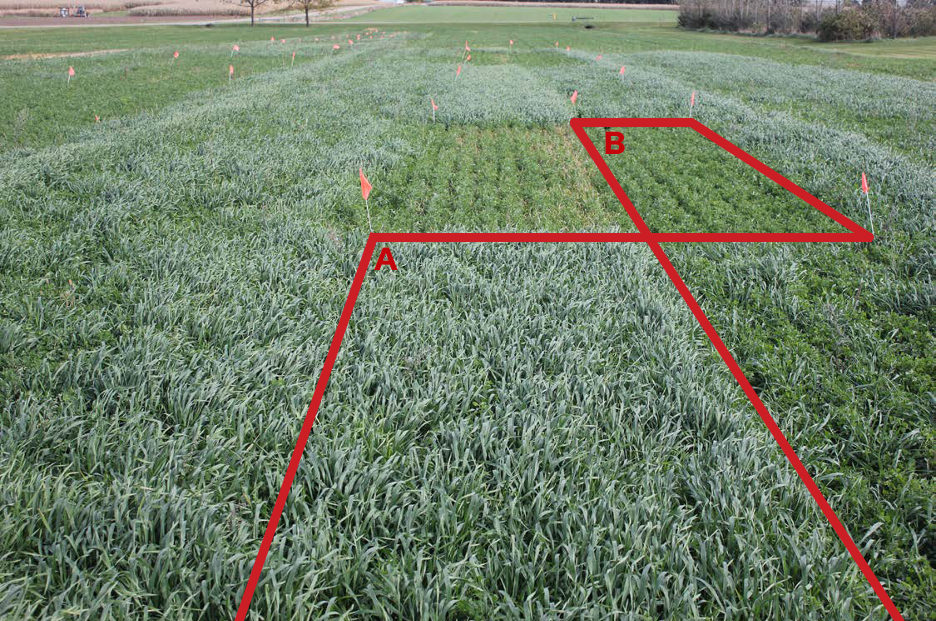
Plot A (left): Untreated alfalfa plot with volunteer winter wheat.
Plot B (right): Roundup-treated alfalfa plot.
This publication is intended for download, local use, or for print.
Originally Published: 2018
Reviewed by:
Dan H. Smith, UW–Madison Extension weed science outreach specialist