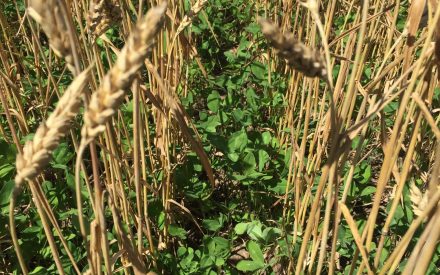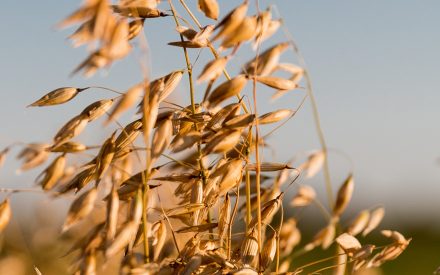
Learn about cover crop termination timing, residual herbicides, and yield. Kolby Grint, MS candidate in the UW-Madison Cropping Systems Weed Science Program gives a brief update on his research projects investigating the impact of fall-seeded cereal rye cover crops on weed control in corn and soybean fields in Wisconsin.
Show Transcript
Hi folks I hope you’re having a great day. I’m Kolby Grint and I’m a master’s student in Dr Rodrigo Werle’s UW Extension cropping systems weed science program and I’m going to be talking to you today about some of my graduate research on the impact of a cereal rye cover crop on weed control and crop productivity in Wisconsin.
Before we get into some of the research I’d like to thank some of the funding sources for our program especially the north central region SARE which provided a graduate student grant that was essential for this research specifically. As well as our team and Dan Smith with the NPM program for the field work. So the purpose of this research was to look at integrated weed management with soil management practices and pre-herbicides and we wanted to approach it from the perspective of a producer looking at his first few years of adopting a cover crop. So we used six different soil management practices which were tillage, no-till and then we had four methods of cereal rye cover crop termination which included an early termination two weeks before planting and at plant termination at the time of crop planting, a forage harvest at the time of crop planting and then a late cover crop termination two weeks after planting and then we had our two herbicide programs which were the inclusion of a pre-herbicide or no pre-herbicide.
We conducted this research at both Arlington and Lancaster Wisconsin with both corn and soybean studies going in both 2019 and 2020 for both locations. The planting dates for this study were kind of later in May and we chose this because we wanted our late cover crop termination to pretty much be at the maximum point of cover biomass so reaching those reproductive stages. So we could really get an idea of the effect of what’s our biomass potential on the system. Briefly going over the herbicide applications for this research we decided to go with a chemical termination for our cover crops which was glyphosate we also used this for a burn down treatment in our no-till plots at the time of crop planting. For a pre-herbicides when they were used we used acuron flexi and corn and soy and then in soybean we used authority mtz and then our post programs were glyphosate and dicamba for both corn and soybean we use glyphosate tolerant crops and then xtend soybeans.
We’re going to start off by looking at visual weed control for our corn studies. Approximately 28 days after planting on the y-axis of our figures you’ll see percent visual weed control and then on the x-axis you’ll see our soil management practices ct is conventional tillage nt is no-till c-c-e-t is cover crop early termination ccpt is plant termination ccfh is our forage harvest and cclt is our late termination.
We’re going to see two different kinds of figures today for ones that look like this with only one point above our soil management practices that means that the effective pre-herbicide was consistent between all of our soil management strategies and then for figures that look like this we can see that there was an interaction where our pre-herbicide had a similar effect or different effects depending on soil management practice. The first thing I’m going to point out is that use of a pre-herbicide improved weed control across the board for all of our soil management practices for the Arlington 2019 site year. And then for three out of our four site years we saw a separation between use of with no pre-herbicide with our black dots versus when there was a pre-herbicide used for a soil management treatment with the black triangle for quite a few of our soil management practices. This wasn’t always the case our late termination for all of our site years had pretty similar weed control good weed control regardless of the use of a preherbicide and often had the best weed control.
Now looking at corn yield, on these figures we have yield in bushels per acre on our y axis. For the Arlington 2020 site here we saw that pre-herbicides increased yield for all of our soil management practices by 8.3 percent, remember from the previous figure the site here had the worst weed pressure.
And then we also noticed that our Arlington site years we had reduced corn yield for a cover crop late termination.
Now looking at weed control in soybean. Once again percent visual weed control on our y axis and here we can see that similar to corn for two of our site years we saw that a pre-herbicide really improved weed control compared to when no pre-herbicide was used and then once again we saw that our late cover crop termination was often giving us the best weed control regardless of preherbicide use.
Now looking at soybean yield once again we have yield and bushels per acre on our y axis at Arlington 2020 we saw that pre-herbicide increased yield by 3.1 for all of our soil management treatments. If you remember from the previous slide this site year had the highest weed pressure but for the most part we saw a pretty consistent yield regardless of soil management practice between site years. So we can really see that at Arlington that at Lancaster other than some anomalies yield was pretty steady and then we did even see a bit of a yield reduction at Lancaster 2020 from our conventional tillage treatment.
I’m going to wrap things up with some take homes from this research. So the first thing that we saw was that our pre-herbicides were providing us with really reliable weed control for the majority of our soil management practices, especially when we had heavy weed pressure. Next we saw that a late terminated cereal rye cover crop was useful to improve visual weed control for both corn and soybean. So you’re taking some of that pressure off the pre-herbicide and then in soybean we saw that a late terminated cereal rye cover crop was really a good tool to help us manage weeds and we’re seeing that late season yield impact from our late termination. So i think if i was a farmer trying out these practices i would try a cover crop ahead of soybean. And then in corn we saw that soil management can have a varying impact on yield with the potential for a yield reduction with our late termination.
That’s it for my presentation today, if you have any questions feel free to email me at the email below and be sure to check out our WiscWeeds blog posts to keep current on what we’ve been doing with weed science with that. thanks for watching!