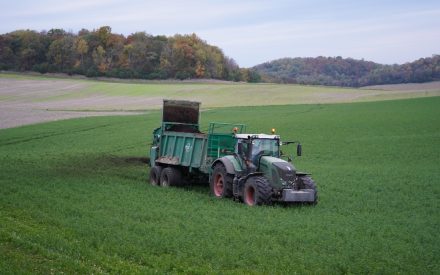
On the sixth and final episode of the BMPs of NMPs, Landon Baumgartner and Dan Smith discuss the trends that they have seen in their home area of southwestern Wisconsin’s driftless area. They highlight the importance of farmer innovation, particularly in the area’s steep slopes, in forwarding the goals of nutrient management, including no-till planting, cover crops, and variable rate applications. While emphasis on reducing phosphorus losses from soil runoff and manure management remain key in the area, new attention is being paid to nitrogen loading, especially with the proximity of the Mississippi River.

Transcript
Landon Baumgartner 0:01
Welcome back to field notes today, we’re joined by Daniel Smith, the program manager for the nutrient pest management program under the UW Madison division of extension, and yours truly, Landon Baumgartner, the Southwest Regional outreach specialist for the nutrient pest management program here talking about some on farm implementation of nutrient management.
Dan Smith 0:20
Landon, I was lucky enough to have your position prior to my new role here, working in the Driftless region, Southwest Wisconsin. Farmer Innovation is key in adopting many new practices and getting those on the landscape through nutrient management planning. What have you seen out there?
Landon Baumgartner 0:34
Yeah, so when I leave a nutrient management farmer education class, you know, a lot of times it’s sort of filling out the paperwork. It’s just, you know, demonstrating compliance. It’s uploading soil tests, maybe changing a few things for, you know, your crop rotation or animal numbers. But other times we have to have a little bit of deeper conversations, because farming in the driftless is a fragile landscape. You know, meeting compliance, which is kind of the main goal for a lot of folks in farmland preservation or other incentive programs, isn’t always the easiest thing. So one of the things I run into is a lot of these innovative ideas that come out of having to change the way that we actually implement our cropping systems from from a planting perspective and managing residue. So I’ve really gotten into this whole, you know, role of listening to people think through the ways that they can tweak their planter setup, or ways that they can implement cover crops. Because when I mentioned, well, you know, we have to work on this field. Is it possible to no till this or is it possible to add a cover crop here? The first place that I feel like a lot of people’s minds go is, you know, the machine shed. And maybe that should be just because farmers really like to, you know, kind of be those armchair mechanics, or just, you know, a mechanic, straight up, they start to really think about, well, I’ve been toying with the idea, or maybe I want to upgrade this, and, you know, save some time while I’m at it. So those are the kind of innovations that I see, you know, play out most is really people start to tweak or adjust the way that they’re actually, you know, delivering seed to the soil or incorporating, you know, different crops into their systems. But first they need to figure out, Okay, can I physically do this on my soils? Because they know their land and their soils best.
Dan Smith 2:07
Absolutely. And I’m always amazed at what innovation comes out of this nutrient management planning process and the improvement in profitability in many cases, when we start looking at this field by field, the fields down by the barn, typically, have had manure applied to them regularly throughout the wintertime in southwest Wisconsin, because it’s hard to haul manure on slopes, let alone there’s some environmental disadvantages to doing so as well. So we’ve seen a lot of things come out of these plans. What are some cool things you’ve seen over your years?
Landon Baumgartner 2:35
Well, when I think about distributing nutrients equally and profitably across the landscape. I think one thing I would like to see more is definitely that delivery of manure farther away more economically. So one thing I really am interested in seeing more is these sort of dewatering systems of manure, or maybe ways in which we can take digested manures, just so that people can actually deliver nutrients to a farm without 90% of it being water and not being economical in the first place. And nobody wants to make that trip along the road because the roads posted anyway. You know, that’s one thing that I think is really interesting. You know, delivering these potent but yet on farm nutrient sources isn’t in an economical, much more efficient and sustainable way. So that’s one thing that I that I like to see out there. But also, you know, when we talk about starter fertilizer being implemented, going back to the whole planter setup thing and making sure that we’re allocating nutrients, you know, at that right time, going back to the four R’s, right place, right time, if all we need is starter, you know, and maybe a little bit of nitrogen for whatever crop we’re putting on there, making sure that we can variable rate these applications, that’s something that’s really come out, not necessarily a new technology. And variable rate can mean a lot of different things to other people, but kind of varying, you know, where those sources end up and when they end up there is really kind of a big one that’s come out.
Dan Smith 3:55
Right? Yeah, taking those soil test data and going out to the landscape and applying those nutrients where they’re really needed, hauling them a little bit farther, because in the Driftless it is a little bit challenging to get to some of those fields a little bit farther away from the barn. Landon. What about soil conservation in the Driftless region? What are you seeing for innovative ways of managing that?
Landon Baumgartner 4:13
Yeah, so, you know, this is something that’s just been been fighting for, you know, years, because whenever you have 16,18, 20% slopes that you’re ended up farming, it’s going to become a challenge, especially if we end up, you know, having, you know, not necessarily the need for forages or bedding that we needed before, because animals have, you know, been merged onto fewer and fewer operations. It becomes, you know, more of a challenge going forward. So getting away from, you know, necessarily the mechanical side of it. One thing that I think is really interesting is the different ways that we can integrate multiple covers at one time. So interceding has become one of those things, although not what I would call commonplace. The people who get into it really get into it. And so hearing people get really passionate about the ways that they can integrate, because. Cover crops into pretty necessarily, you know, pretty simple cropping systems, even just a simple grain system, a lot of folks are incorporated into. It doesn’t have to be silage and alternative forages and annual cover crops and things that they’re chopping. So I think that’s going to become a bigger thing, especially as drones get out there more and people are finding that it’s really easy, fun, economical, and not necessarily much of a hindrance anymore to start adopting some of these novel practices that are going to have a really big impact, especially in the driftless area where we haven’t had things like planes and choppers going out there for seeding cover crops that maybe some of the high states and other flatter areas have, a drone is one of the cheapest pieces of equipment on a farm anymore, yet it can really change the way that we integrate these soil conservation measures in places that really need it.
Dan Smith 5:48
Yeah, absolutely. We’ve seen tremendous interest in cover crops in Wisconsin as a whole, but in the Driftless in particular, to try and hold the soil in the landscape. Another thing that I ran into more than once was composting in southwest Wisconsin for our beef operations. What do you think about composting and hauling manure that way?
Landon Baumgartner 6:04
Yeah. So I’ve specifically seen this pop up more along the producer led watershed groups. So people are really getting into seeing how they can make this work on farm. And so there’s, again, not that many out there yet, but I want to try and get this expanded out throughout the region a little bit more. We have a lot of small operations, whether they are beef operations, poultry operations, there’s quite a few of those around, or dairy operations. For that matter, there are people, at least one person, in each of those, in each of those systems, actively doing this in the region. And so getting that, that word out and how they’re doing, it can have a really big impact, because people aren’t wanting to pay for the concrete and rebar to necessarily, like, you know, build massive storage systems anymore, or just any storage for that matter. It’s not necessarily something that they see is going to provide a return on their investment or add value to the farm in the long run, but that’s really the whole point of storage is having that management flexibility, which is of great value. So how can we be flexible offer an agronomic, you know, benefit to the farmer by having, you know, something where they can set aside manure in a place that’s not in field and still manage it without having a whole lot of overhead. And so composting is something that’s really that should be captured more on more farms, regardless of what kind of animals you’re raising. And there’s a lot of resources, resources out there from other states that we need to get brought down to southwest Wisconsin.
Dan Smith 7:30
Yeah, absolutely. So to wrap this up, Landon, what do you think’s next in nutriment management, planning in the Driftless region? What’s the next big thing we can incorporate into plans? Or what’s the next big thing we can think about more?
Landon Baumgartner 7:42
Yeah, so one thing that I like to focus on more, I think I may be a little bit of kind of the black sheep of the family when I’m when I when I think about this, but nitrogen management is something that I’m really passionate about addressing, I think specifically because we’ve, you know, seen at in the water bodies around the driftless area, especially as we get closer to the Mississippi, that the thing that we’re still not getting a good grasp on, and you know, rightly so, considering that it changes, you know, season to season, especially the loading off farm into waterways. Getting that nitrogen load under control is something that is going to continue to gain a lot of attention from both people in the farming community and outside of the farming community who are asking us to do more. We’ve known about phosphorus impacts for a while. We’ve known about soil conservation. There’s been a lot of investment in those but I think there’s still a lot more to learn about how we can properly, really fine tune our nitrogen management techniques. So I’m focused on that going forward, whether that be because we’re gonna, you know, add more cover crops in the landscape, because we’re gonna have different environmentally safe nitrogen applications, because we’re just going to be out there, you know, split applying more all these things. It’s such a moving target, and I’m really interested to see where that goes, because that’s changed in just the 70 years I’ve been doing this?
Dan Smith 9:01
Absolutely. Thanks, Landon.
Landon Baumgartner 9:03
Thanks, Dan.
Will Fulwider 9:13
Thanks for listening. This has been field notes from UW Madison extension. My name is Will Fulwider regional crops, educator for Dane and Dodge counties. A big thank you to Joe Ryan for creating our theme music and to Abby Wilkimacky for our logo. If you have any questions about anything you’ve heard today or about your farming practices in general, reach out to the extension agriculture educators serving your region.