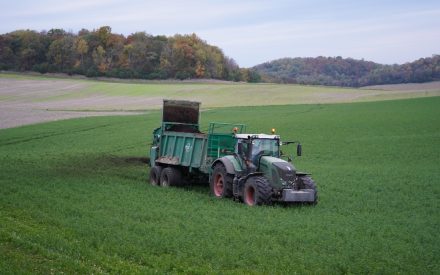
In this fourth episode of the BMPs of NMPs, Hava Blair and Andrea Topper join host Landon Baumgartner to unpack how Wisconsin’s diverse soils and sensitive land features shape farming practices. They explore the unique challenges of regions like the Driftless Area, Central Sands, and Silurian bedrock zones, and explain common restrictions such as setbacks near water bodies, wells, and wetlands. The discussion highlights differences between 590 farms and CAFO operations, and introduces SnapPlus, Wisconsin’s free nutrient management planning software that helps farmers visualize soil types, sensitive features, and regulatory requirements on their own fields.
Transcript
Landon Baumgartner 0:00
Okay, and here for our next installment on nutrient management planning, specifically regarding soils and land feature restrictions, we have Hava Blair. Hava is the nutrient management specialist and SnapPlus Lead under the UW Madison College of Agriculture and Life Sciences, as well as back joining us is Andrea topper with the Department of Ag Trade and Consumer Protection’s Nutrient Management outreach specialist role. And so for you two, I kind of wanted to dive into, first off, the soils aspect of all this. This is one of those things where in all of our efforts and all of the decades that we work on nutrient management, that we’re going to kind of have what we have because, you know, geology, we can change a lot of different things on our farm, soils is not one of those things we have to live with what we’ve been given. That being said, there are a lot of different soils in Wisconsin. What are the biggest differences between how we manage or should be managing these soils in Wisconsin? I kind of want to get that from Hava.
Hava Blair 0:54
Yeah, I love this question, because I’m a soil scientist, and so I love to think about how many, like you said, diverse soils we have in the state of Wisconsin, how many different landscapes? And when you go out and talk to people, I think farmers and anybody who’s working the land just has this really intuitive understanding and sense of like, where their heavy ground is, where their sandy ground is, where does it get dry? So when I think about the state of Wisconsin, like bird’s eye view, let’s start in the southwest corner, where we have the Driftless region, this region that has much more distinct slopes and older soils in general, because that’s an area where the glacier in Wisconsin did not cover and so on those highly sloped soils, I think some of the things that you’re seeing out on the landscape and people are doing, you’re more likely to see contour farming, strip cropping, some of these different efforts to control soil loss or erosion on these slopes that that are prone to be more erodible. And I know you know this because you’re in that region, and have been in that region, so that’s what I think of there. And then, you know, if we just think about maybe the central region of the state, the central sands known for, you know, incredible growing vegetables, potatoes, like that’s a really characteristic soil region there we have the sandy soils. And so you’re seeing irrigation. You’re seeing soils that need that irrigation, in a lot of cases, to produce the crops that are being grown. The other thing that goes hand in hand with having maybe sandy soils, or what we’d call highly permeable soils, is that anything you put on there is going to infiltrate or percolate more quickly. And in some cases, we actually have restrictions for what we’d call those P soils, those highly permeable soils. So we want to be careful about, for example, fall nitrogen applications in those cases where you might have some restrictions, in cases where you want to avoid losing and leaching a lot of that nitrate into these permeable soils. Going over to the eastern side of the state. I mean, this is something that a lot of us are working on right now, related to Silurian bedrock and areas where you have shallow bedrock. So Silurian bedrock area is kind of a special case, because not only is the bedrock relatively close to the soil surface, but the nature of that Silurian dolomite, which is the type of rock that it is, is that it has a lot of these fractures and cracks that allow manure that’s applied to infiltrate really quickly and potentially contaminate groundwater. So that’s kind of another example of this special landscape where we have to be thinking about things differently, and you do have a different set of restrictions and rules associated with that.
Landon Baumgartner 3:21
And you may have, even on one farm, you kind of took this regional approach, but even on one single farm, you may have these different types of soils present, sub field level,
Hava Blair 3:32
absolutely, absolutely. And I think that’s the fascinating thing, if you’re looking at a soil map, if you’re ever looking at a soil map of your land, and you can see that you might have 6, 7, 8, 10, different soil types. So we would say a soil type in a field. And so again, I think many people who are farming already kind of know this, because they know their fields. They know the areas that are kind of wet, or that spot that always gets drowned out. And so that’s a direct reflection of these different soil types, like what’s going on under our feet.
Landon Baumgartner 3:59
So one of the other things, one of the other things, one of the things we’re stuck with on a farm are some of these sensitive features. You mentioned, things like Silurian, you know, dolomite, that comes with some of these very specific features to that area, driftless area, same thing we have to care for, safeguard, our our ground, our groundwater, surface waters. What are some of the most common setbacks or strategies we use in Wisconsin to do this? And I think I want to start with Andrea on that one.
Andrea Topper 4:28
Yeah, I feel like Hava and I could talk about this topic for at least a half hour, but some of the really common ones that come to mind are what we fondly know as SWQMA’s, surface water quality management areas. So these are areas that are protected in a sort of mindset, whether you have a pond or a lake, you’re going to see a 1000 foot setback, versus if you were a stream or a river, you’re going to have a 300 foot setback. Now that does not mean that within those regions you’re not able to apply nutrients of any kind. It’s that we have some guidelines to be able to apply within those areas. So in the non winter season, if you’re going to be applying liquid manure, you’re going to be needing to use a rate of 12,000 gallons or less. Additionally, there’s some other practices that need to be implemented, making sure that we are applying within like 10 days of a crop being planted, making sure that there is at least 30% ground cover. Just other things that we’re making sure that if there is a nutrient application, it’s not going to move off that field and reach that surface water body. The one big thing about SWQMA’s, though, is in the winter, it’s a no spread zone. So if you have mechanical applications of manure going out in the winter, SWQMA’s are an area in which you’re not allowed to apply that manure. The one fun caveat that we do have is that if you happen to have cattle that you’re grazing or gleaning on corn stalks in the winter, they are able to be within that SWQMA range, and they can deposit their own manure within that SWQMA. But it’s specific to mechanical applications. The one last thing I’ll say before I switch it over to Hava is direct conduits to groundwater is a huge resource concern for us, and there’s a bunch of different types of them, but one of the most common types that we have are wells, whether that be a private well, a non community well, or a public well, all of those different types of features are going to have different prohibition areas or setbacks, and those areas are considered no spread zones. So for example, a private well is going to have a 50 foot setback in the non winter season, and then that turns into a 300 foot setback in the winter season of a no spread zone. Other wells have different setbacks and things, but those are just some of the common ones that come to mind for me.
Hava Blair 6:41
Yeah, absolutely. You know, we talked a little bit about the soil based restrictions too. We talked about the the P soils, or the highly permeable soils. We talked about bedrock close to the surface. But I think it’s also worth mentioning wetlands and soils where the groundwater is very close to the surface. We have parts of the state where we have very wet soils. We have soils that were formerly wetlands, that were drained, and they’re now farmed some of our muck soils. So we do have a category of soils that are our W soils, where, where you have the groundwater close to the soil surface, that we have some additional restrictions on spreading there too.
Landon Baumgartner 7:12
So there’s obviously a lot of different features we have to look out for, and I don’t want to get too into the weeds in this one. But are all of these restrictions the same across farms, or do depending on what kind of farm and the regulations we’re held to? Is that going to be a little bit different that can go to either of you? Yeah.
Andrea Topper 7:29
So there are two distinct differences between farm operations that have nutrient management plans. There are going to be our 590 operations. The 590 operations are operations that have less than 1000 animal units, they are required to follow and implement the NRCS 2015, 590 standard versus if you are considered a CAFO, an operation with greater than 1000 animal units, you are then required to have a WPDES operating permit through the DNR. And they are then required to implement NR 243 which has additional rules and setbacks on top of the 590 standard. So whether your manure is coming from a CAFO operation or a 590 farm, you are going to see different rules and setbacks if you are a CAFO versus if you were a 590 farm.
Landon Baumgartner 8:19
So when it comes to the nutrient management planning aspect of this Hava, where can people go if they have some more questions about their farm and what rules they need to follow, and maybe what these look like on a map of their farm?
Hava Blair 8:32
Absolutely, yeah, I’m just gonna put in a plug for snapplus, which is the team that I lead and that everyone here on the podcast today contributes to. But we are really lucky in Wisconsin to have a free piece of software that farms can use and learn how to use to write their nutrient management plan to see these very restrictions that we’re talking about. And one of the awesome things about snapplus is that we have all of these different types of rules and restrictions and setbacks built in. And you can look at this on a map. So we have GIS your geospatial capabilities within SnapPlus. So we have the ability to look at some aerial photographs, zoom into your operation, look at the fields, and kind of draw out the field boundaries, and then turn on different layers to see what kind of soils do I have here. And you have the ability to draw some of these important features that we’ve been talking about, like wells, and get those on the map. And that allows you to see, in the context of your different fields, what’s going on, where are the best places to spread in these different seasons, in these different contexts. So it’s, it’s a great tool, and I just, I’m proud of Wisconsin, because not every state has something like this. So I think it’s a great resource, and we have training videos available on the DATCP nutrient management website. And recently, we’ve gone to a web based version of the SnapPlus software, so it’s even easier to access. I think it’s easier to get on there and start looking at some of this stuff. If you’ve never spent a lot of time with nutrient management planning, you know, there’s a lot there, but I hope that the software kind of makes it easy to deal with all these different kind of intersecting things that we’ve been talking about, soils and regulations and different types of manure. Like, there’s a lot there, but there’s tools, and there’s people to help with that for sure.
Landon Baumgartner 10:21
And if people have trouble piloting that software, it is free and available and can end up on, you know, on your computer screen in a matter of seconds just by creating an account with version three. Sometimes can be hard to navigate, but there’s lots of resources out for out there for Wisconsin farmers and farm managers to help navigate them, whether it’s DATCP or extension or any other resource as well. So absolutely awesome. Well, thank you both for joining us for the soils and land features part of it, and we’ll have you back for another one here soon. Super thanks, Landon, thank you.
Will Fulwider 10:57
Thanks for listening. This has been field notes from UW Madison extension. My name is Will Fulwider regional crops, educator for Dane and Dodge counties. A big thank you to Joe Ryan for creating our theme music and to Abby Wilkimacky for our logo. If you have any questions about anything you’ve heard today or about your farming practices in general, reach out to the extension agriculture educators serving your region.