
DOI Citation: http://digital.library.wisc.edu/1793/96980
Biomass Thresholds for Cereal Rye Cover Crop Goals
Biomass Thresholds for Cover Crop Goals
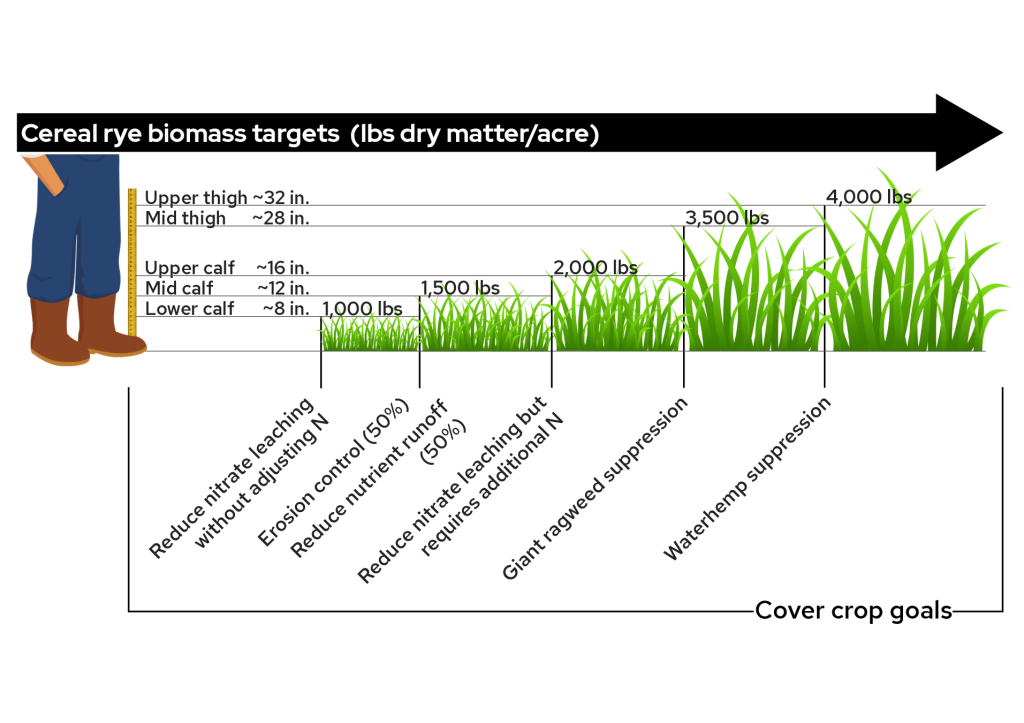
Image Description ↓
The above graphic is a generalization of cereal rye planted after soybeans at 60 lbs./acre. If you want to get a more accurate biomass reading for your farm, especially for cereal rye following a different crop, we encourage you to take a biomass sample. Cover crop sampling instructions are in development.
Across the graphic, increasing winter rye growth is shown, labeled with biomass thresholds: 1,000 lbs., 1,500 lbs., 2,000 lbs., 3,500 lbs., and 4,000 lbs. Below each threshold are associated goals: reducing nitrate leaching without adjusting nitrogen (1,000 lbs), erosion control (50%) and reduced nutrient runoff (1,500 lbs), further reduced nitrate leaching but definitely requires additional N (2,000 lbs), giant ragweed suppression (3,500 lbs), and waterhemp suppression (4,000 lbs).
What benefits do cover crops provide?
Cover crops can provide a wide range of benefits in dairy and grain production systems, but no single cover crop species or management approach can deliver every benefit at once. One of the keys to making cover crops successful is starting with a clear goal. Common goals include:
- scavenging nitrogen that might otherwise leach away
- reducing erosion and nutrient runoff
- suppressing troublesome weeds
Once a goal is established, choose the cover crop species best suited to achieve it. Equally important is managing the cover crop so it has the time and conditions needed to deliver on its purpose without compromising the cash crop. A clear goal minimizes risk, helps measure success, and keeps expectations realistic.
Other goals, like building soil health or promoting beneficial insects, are also valuable. However, they tend to develop more gradually and are harder to directly measure on an annual basis. That said, goals like erosion control, nitrogen scavenging, and weed suppression often contribute to long-term improvements in soil health and promote beneficial insects, even if those aren’t the primary targets.
Ultimately, the effectiveness of a cover crop depends on one critical factor: the amount of biomass it produces (1). The biomass required is different depending on the goal for the cover crop. What’s adequate for erosion control may not be enough for weed suppression. It’s also essential to consider the trade-offs between increasing cover crop biomass and managing the cash crop.
To help farmers set realistic biomass targets, researchers in Wisconsin have studied one of the most widely used cover crops—cereal rye (also known as winter rye or annual rye, but not to be confused with annual ryegrass)—and identified biomass thresholds that align with three common cover crop goals: reducing nitrate leaching, minimizing erosion and runoff, and suppressing weeds.
What is biomass?
Biomass is the amount of plant material a cover crop produces, both aboveground shoots and belowground roots.
On farms, biomass can be estimated by clipping the aboveground shoots from a measured area, drying them, and recording the weight as pounds or tons of dry matter per acre. This provides a standardized way to compare cover crop growth across fields and seasons.
Check out the Wisconsin Cover Crop Data Network to see cover crop biomass records from farms across Wisconsin that are experimenting with cover crops.
Biomass Thresholds for Cover Crop Goals
What the research says ↓
Research from UW-Madison’s Nutrient Cycling and Agroecosystems Lab shows that if cereal rye biomass is 1,000 lbs/acre or less at the time of termination there is no need to adjust nitrogen management for the cash crop (2).
In manured systems, for biomass between 1,000-2,000 lbs/acre, subtract 35 lb/acre from the N credit from manure. Above 2,000 lbs/acre, additional N is required, often between 40-80 lb-N/acre depending on the rate of manure applied.
How it works ↓
Cereal rye can mitigate nitrate leaching by drawing up excess soil nitrogen into its biomass. Research from Wisconsin shows that cereal rye biomass of 1,000 lbs/acre at the time of termination can trap up to 25 lbs./acre of potentially leachable nitrogen, and there is no need to adjust nitrogen management for the cash crop.
Greater biomass can enhance nitrate leaching reductions, but this can lead to less available nitrogen for the following cash crop early in the growing season.
What the research says ↓
Research from UW-Madison’s Sustainable Soil Management lab shows that 1,500 lbs/acre of cereal rye biomass can reduce sediment and total phosphorus losses by 50% compared to no cover crop during a simulated 1.5-inch rainfall event at a rate of 3 inches per hour (3). More or less biomass might be needed depending on specific field conditions and storm events.
How it works ↓
Runoff can carry away both sediment and nutrients such as phosphorus. In runoff, phosphorus may be bound to soil particles or dissolved in water; together, these forms are referred to as total phosphorus.
What the research says ↓
Research from UW–Madison’s WiscWeeds lab shows that the amount of cereal rye biomass required for weed suppression when measured 42 days after cover crop termination depends on whether the goal is to slow weed growth or to reduce overall weed infestation.
For waterhemp, approximately 2,500 lbs/acre of cereal rye biomass can reduce waterhemp biomass by 50%, indicating slower growth and reduced vigor.
However, achieving a 50% reduction in waterhemp density—that is, fewer plants emerging—requires a higher level of biomass, around 4,500 lbs/acre (4).
A similar pattern is seen with giant ragweed. About 3,500 lbs/acre of cereal rye biomass can reduce giant ragweed biomass by 50%, while roughly 4,250 lbs/acre is needed to achieve a 50% reduction in seedling emergence (5,6).
How it works ↓
Under field conditions, it is difficult to accumulate 3,500 lbs/acre of rye biomass early enough in the season to suppress giant ragweed due to the weeds’ early emergence in the spring.
Waterhemp on the other hand does not begin to emerge until mid to late May, making cereal rye suppression of waterhemp a more viable option than giant ragweed. Accumulating enough biomass for this effective suppression often requires delaying termination until or after planting (e.g., “planting green”).
What Affects Cereal Rye Biomass Accumulation?
Cereal rye growth and biomass accumulation are primarily driven by planting date, termination timing, and seeding rate. The period between planting date and termination date is tied to growing degree days, and earlier planting allows the cover crop to experience more growing degree days. Environmental conditions like temperature and precipitation can also affect biomass production.
Planting Date
The prior crop matters. Cereal rye after an earlier harvested crop like corn silage creates a longer fall growing window. This allows rye to tiller and establish more roots before winter, setting the plant up for more biomass earlier in the spring. Corn or soybean hybrids with earlier maturity can allow for earlier cereal rye planting. Rye biomass can be suppressed after a high-yielding corn crop.
Cereal rye planted in mid-October or later will have minimal fall growth but can overwinter and provide some biomass in the spring. Note that open-winter (no snow) conditions combined with extreme cold temperatures may result in cereal rye winter kill, although this is a rare occurrence (7).
Seeding Rate
The standard seeding rate (assuming high seed germination) to optimize biomass is 60 lbs/acre if using a drill. Increase by 5-20% for broadcast seeding to counter lower germination and seed loss by predation (2).
If planting after an earlier harvested crop like corn silage, seeding rates can be reduced to as low as ~40 lbs/acre. This rate will still allow you to meet water quality and erosion control goals while reducing the risk of overproduction. Too much biomass in the spring before corn can tie up nitrogen.
Seeding Method
Drill seeding after cash crop harvest can provide more precise planting depth, accurate seeding rates, and good seed-to-soil contact (8) which leads to more biomass accumulation compared to pre-harvest planting methods like broadcasting and interseeding (9). Optimal drill seeding depth for cereal rye is 0.75-1.5” (8). Be sure to verify seeding depth when planting into residue.
Broadcasting is also an option. It is quick and economical, but results can be more variable than drill seeding and are dependent on soil moisture and precipitation.
Interseeding cereal rye into standing corn early (V3-V7) or late (corn drydown) via highboy, drone, or aerial-seeder in the growing season is a viable strategy for maximizing fall growth, but success varies and is dependent on corn row spacing, low weed pressure in the corn crop at the time of interseeding, adequate soil moisture, herbicide program, and forecasted precipitation (8).
Variety
Earlier maturing cereal rye varieties (e.g., ND Gardner) will grow more quickly in the spring to maximize biomass earlier.
Spring Termination
Delaying termination in the spring can allow for more biomass production, especially if the cover crop is planted late, or there is minimal fall growth.
Cover crop biomass is 35% greater, on average, when planting green instead of terminating the cereal rye two weeks before soybean planting (10).
Termination Timing Tradeoffs
When shooting for different biomass thresholds to meet cover crop goals, there are tradeoffs to be considered, especially when pushing termination later into the spring. Adaptive management is key. For example, if there is no rain in the 2-week forecast around planting time, farmers should consider terminating earlier to adapt to the risk of the cover crop’s water use impeding cash crop growth. The tables below provide a rundown of the different tradeoffs stemming from cover crop termination timing by crop.
Risk to Cash Crop Growth Legend:
| Risk | Meaning |
|---|---|
| ☺︎ | Reduced risk to cash crop, no intervention needed |
| ⚠ | Chance of risk, likely a wash |
| ⚠⚠ | Elevated risk, perhaps requiring management intervention |
| ⚠⚠⚠ | Risk of yield drag to the cash crop, management intervention necessary, recommended intervention italicized |
Table 1 – Termination Timing Tradeoffs Before Corn ↓
Table 2 – Termination Timing Tradeoffs Before Soybean ↓
Early Termination Risks to Crop Growth
Water ↓
Early termination of cover crops prevents significant water uptake by cover crops that could introduce additional risk in dry years.
Nitrogen ↓
While nitrogen tie up does not necessarily impact soybeans, corn is a heavy nitrogen user, and terminating a cover crop early in the spring helps to prevent the nitrogen tie up in corn.
Weeds ↓
Even early termination of a cereal rye cover crop can help in suppressing waterhemp, but more biomass is needed for maximum control.
Intervention: Use of a pre-emergence herbicide will be necessary to achieve waterhemp control.
Planter Setup ↓
Early termination results in a dead cover crop without excessive biomass, which likely does not require additional adjustments on the planter.
Pests and Diseases ↓
Early termination prior to corn planting disrupts the green bridge that help pests and plant pathogens persist—as well as beneficial natural enemies—from cover to cash crop. This is especially important in corn, which like cereal rye, is a grass and therefore holds more pests and pathogens in common with cereal rye, than compared to soybeans.
Termination At Planting Risks to Crop Growth
Water ↓
Water use by cereal rye accelerates as the stem elongates and peaks as it nears flowering. In wet years, this can be helpful as the cover crop uses the excess water, potentially drying out the soil. Even in dry years like 2023, corn and soybean trials with cereal rye terminated at planting did not see yield losses (11).
Intervention: Unirrigated, coarser soils might require an earlier termination timing in the event of a dry spring.
Nitrogen ↓
As cereal rye grows in the spring and nears maturity the percent nitrogen in the plant drops, increasing the carbon to nitrogen ratio, or C:N ratio. Decomposing cereal rye with a high C:N ratio can reduce soil nitrogen available to the cash crop. Soybeans are largely unaffected because of their nitrogen fixation capabilities. While corn is a heavy nitrogen user, nitrogen needs early in the season are low and corn can grow out of early nitrogen deficits without reducing yield. However, how long this deficit lasts matters and these early deficits expose corn to increased risk of nitrogen deficiency that could result in yield loss.
Intervention: Consider frontloading more nitrogen to help break down cereal rye residue and avoid nitrogen tie up.
What is the carbon-to-nitrogen (C:N) ratio, and why does it matter?
The carbon-to-nitrogen ratio is the amount of carbon relative to the amount of nitrogen in plant matter. Soil microbes use nitrogen to break down the carbon building blocks of plants, leading to decomposition. When plants contain far more carbon than nitrogen, soil microbes must use existing soil nitrogen for decomposition. This process temporarily ‘ties up’ nitrogen that would otherwise be available for the cash crop, slowing down decomposition. Nitrogen tie up typically begins to occur when the C:N ratio exceeds 20:1. Below that ratio, there is more nitrogen than is needed by decomposer microbes and as a result is released to the soil. The ability of a soil to break down plant matter is also partly dependent on the amount of biological activity in the soil, which helps to release nitrogen from soil organic matter.
Weeds ↓
When terminated at planting, cereal rye reduced early-season weed density by 31% and reduced weed biomass by 61% compared with no-till without a cover crop in both corn and soybeans (12).
Intervention: Use of herbicide with residual control is likely necessary to achieve waterhemp control.
Planter Setup ↓
Farmers often describe planting into soil with a living cover as mellower than those with an early terminated or no cover crop. Planter adjustments, outside of routine maintenance, might need to be considered for planting into higher levels of biomass.
Intervention: It might be necessary to remove or adjust spiked components like row cleaners to prevent wrapping. When delaying termination until or after planting the cash crop, it’s recommended that front no-till coulters are 1 inch shallower than target seeding depth and down pressure on row units and closing wheels is increased. This provides good seed-to-soil contact, accurate seeding depth, and furrow closure.
Pests and Diseases ↓
Planting green can create a “green bridge” between cereal rye and corn, which can increase the incidence of pests and seedling pathogens, like Pythium, that reduce yield (13, 14). Current and emerging research shows that cover crop termination at planting vs early termination significantly increases the population of beneficial natural enemies that prey on pests in corn and soybean (15).
Delayed Planting Risks to Crop Growth
Water ↓
Cereal rye in mid to late May uses a lot of water as it heads out, and with its established root system, outcompetes the newly emerged corn and soybean crops for water. In the historically dry spring of 2023, soybean yields which had not previously taken a yield hit from a delayed termination of a cereal rye cover crop, did see a significant yield reduction in the WiscWeeds cropping systems trial (11).
Intervention: Adaptive management. If the forecast does not show any rain two weeks following planting, terminate the cover to avoid excessive cover crop water use.
Nitrogen ↓
Delaying termination of rye 10-14 days after corn planting may result in a headed-out cereal rye cover crop that has a C:N ratio of about 40:1 (16). The decomposition of this high carbon, high biomass rye will tie up a lot of nitrogen from the soil. Front-loading nitrogen may not be able to circumvent this nitrogen tie up. In corn, this is problematic and can result in yield loss. In soybeans, this may be desirable as weeds will also be nitrogen limited in their competition against soybeans.
Intervention: The high risk of nitrogen tie up and yield loss in corn requires front-loading of nitrogen, but this may not be enough to offset tie up. High risk of practice in corn makes it inadvisable.
Weeds ↓
Maximum cover crop control of waterhemp is achieved with delayed termination. A PRE herbicide is still recommended. The weed suppression by the cover crop and a PRE herbicide working in tandem ensures maximum waterhemp suppression through multiple modes of action (17).
Planter Setup ↓
In a delayed termination situation, planting is still conducted at the same time as terminating at planting. All planter adjustments recommended for planting green remain the same.
Intervention: It might be necessary to remove or adjust spiked components like row cleaners to prevent wrapping. When delaying termination until or after planting the cash crop, it’s recommended that front no-till coulters are 1 inch shallower than target seeding depth and down pressure on row units and closing wheels is increased. This provides good seed-to-soil contact, accurate seeding depth, and furrow closure.
Pests and Diseases ↓
Green bridge and seedling disease issues continue for corn in delayed termination. Research has shown that terminating cereal rye at anthesis, when the cereal rye can be crimped for effective termination, can suppress white mold in soybeans by nearly 100% (18, 19). Delaying termination significantly increases the population of beneficial natural enemies that prey on pests in corn and soybean (15).
Conclusion
Success with cereal rye cover crops begins with a clear goal and managing to meet the biomass thresholds determined through years of research in Wisconsin. It is critical to recognize tradeoffs to biomass accumulation to minimize risk to the following cash crop (water competition, nitrogen tie-up, seedling disease, etc.) through adaptive, weather-aware management decisions. Over several years, consistently managing specific biomass targets based on cover crop goals will build soil health and support beneficial organisms, improving long-term farm sustainability.
References
- Finney, D. M., White, C. M., & Kaye, J. P. (2016). Biomass production and carbon/nitrogen ratio influence ecosystem services from cover crop mixtures. Agronomy Journal, 108(1), 39–52. https://doi.org/10.2134/agronj15.0182
- Ruark, M., West, J., & Siemering, G. (2019). Cover crops, manure, and nitrogen management (Publication A4178). University of Wisconsin–Madison Division of Extension. https://frc.soils.wisc.edu/wp-content/uploads/sites/58/2021/11/A4178-Cover-crops-manure-and-nitrogen-management.pdf
- Crane, W. (2023). Optimizing cover crop and manure management practices for corn silage systems to reduce water quality impacts (Master’s thesis, University of Wisconsin–Madison, Advisor: F.J. Arriaga).
- Nunes, J. J., Arneson, N. J., Smith, D., Ruark, M., Conley, S., & Werle, R. (2024). Elucidating waterhemp (Amaranthus tuberculatus) suppression from cereal rye cover crop biomass. Weed Science, 72(3), 284–295. https://doi.org/10.1017/wsc.2024.21
- Chudzik, K., & Werle, R. (2023). Cereal rye vs. giant ragweed. https://wiscweeds.info/posts/2023cerealryevsgiantragweed/
- Chudzik, K., Arneson, N. J., & Werle, R. (2023). Giant ragweed management. https://wiscweeds.info/posts/2023giantragweedmanagement/
- Nutrient and Pest Management Program. (2020). Cover crop selection card: Northern and Southern Wisconsin. University of Wisconsin–Madison. https://ipcm.wisc.edu/blog/2020/05/new-cover-crop-selection-cards/
- Grint, K. R., et al. (2022). Cereal rye cover crop management in Wisconsin. University of Wisconsin–Madison Extension. https://ipcm.wisc.edu/wp-content/uploads/sites/54/2022/11/UW_CerealRyeMgmt_final.pdf
- Klopp, G., et al. (2024). Choosing whether to preharvest broadcast vs. post-harvest drill cover crops. South Dakota State University Extension. https://extension.sdstate.edu/choosing-whether-preharvest-broadcast-vs-post-harvest-drill-cover-crops
- Nunes, J., Arneson, N. J., & Werle, R. (2023). Soybean planting green system. https://wiscweeds.info/posts/2023soybeanplantinggreensystem/
- Felsman, J. H., Baxter, C. A., DeWerff, R. P., Smith, D. H., & Werle, R. (2023). Exploring the system: Multi-year agronomic and weed management implications of cereal rye cover crop in corn and soybean rotations. Proceedings of the North Central Weed Science Society Annual Meeting, 78, Minneapolis, MN. https://ncwss.org/wp-content/uploads/Official-2023-NCWSS-Proceedings.pdf
- Grint, K. R., Arneson, N. J., Oliveira, M. C., Smith, D. H., & Werle, R. (2022). Cereal rye cover crop terminated at crop planting reduces early-season weed density and biomass in Wisconsin corn–soybean production. Agrosystems, Geosciences & Environment, 5(1), e20245. https://doi.org/10.1002/agg2.20245
- Almeida, T. F., Robinson, E., Matthiesen-Anderson, R., Robertson, A. E., & Basche, A. (2024). Effect of cover crop species and termination timing on corn growth and seedling disease. Agronomy Journal, 116, 1792–1803. https://doi.org/10.1002/agj2.21601
- Acharya, J., Moorman, T. B., Kaspar, T. C., Lenssen, A. W., Gailans, S., & Robertson, A. E. (2022). Effect of planting into a green winter cereal rye cover crop on growth and development, seedling disease, and yield of corn. Plant Disease, 106(1), 114–120. https://doi.org/10.1094/PDIS-04-21-0836-RE
- Carmona, G. I., Robinson, E., Rosa, A. T., Proctor, C. A., & McMechan, A. J. (2022). Impact of cover crop planting and termination dates on arthropod activity in the following corn. Journal of Economic Entomology, 115(4), 1177–1190. https://doi.org/10.1093/jee/toac090
- Clark, A. J., Decker, A. M., Meisinger, J. J., & McIntosh, M. S. (1997). Kill date of vetch, rye, and vetch–rye mixture: I. Cover crop and corn nitrogen. Agronomy Journal, 89, 427–434. https://doi.org/10.2134/agronj1997.00021962008900030010x
- Nunes, J., Arneson, N. J., Wallace, J., Gage, K., Miller, E., Lancaster, S., Mueller, T., & Werle, R. (2023). Impact of cereal rye cover crop on the fate of preemergence herbicides flumioxazin and pyroxasulfone and control of Amaranthus spp. in soybean. Weed Science, 71, 493–505. https://doi.org/10.1017/wsc.2023.46
- Pethybridge, S. J., Brown, B. J., Kikkert, J. R., & Ryan, M. R. (2020). Rolled–crimped cereal rye residue suppresses white mold in no-till soybean and dry bean. Renewable Agriculture and Food Systems, 35(6), 599–607. https://doi.org/10.1017/S174217051900022X (doi.org in Bing)
- Debbink, K., Rocco da Silva, C., Silva, E. M., Mueller, B. D., Telenko, D. E. P., & Smith, D. L. (2025). Integrated management of Sclerotinia stem rot of soybean including organically allowed fungicides in the Midwest. PhytoFrontiers. https://doi.org/10.1094/PHYTOFR-05-24-0053-R
Published: March 16, 2026
Reviewed by:
- Chris Bandura, soils program manager, UW–Madison Extension
- Dan Marzu, soils outreach specialist, UW–Madison Extension
- Laura Paletta, agriculture water quality outreach specialist, UW–Madison Extension
- Anne Pfeiffer, crops and soils program manager, UW–Madison Extension
- Daniel H. Smith, weed management outreach specialist, UW–Madison Extension