

Elderberries
ELDERBERRIES
Crop Profile
Get Involved!
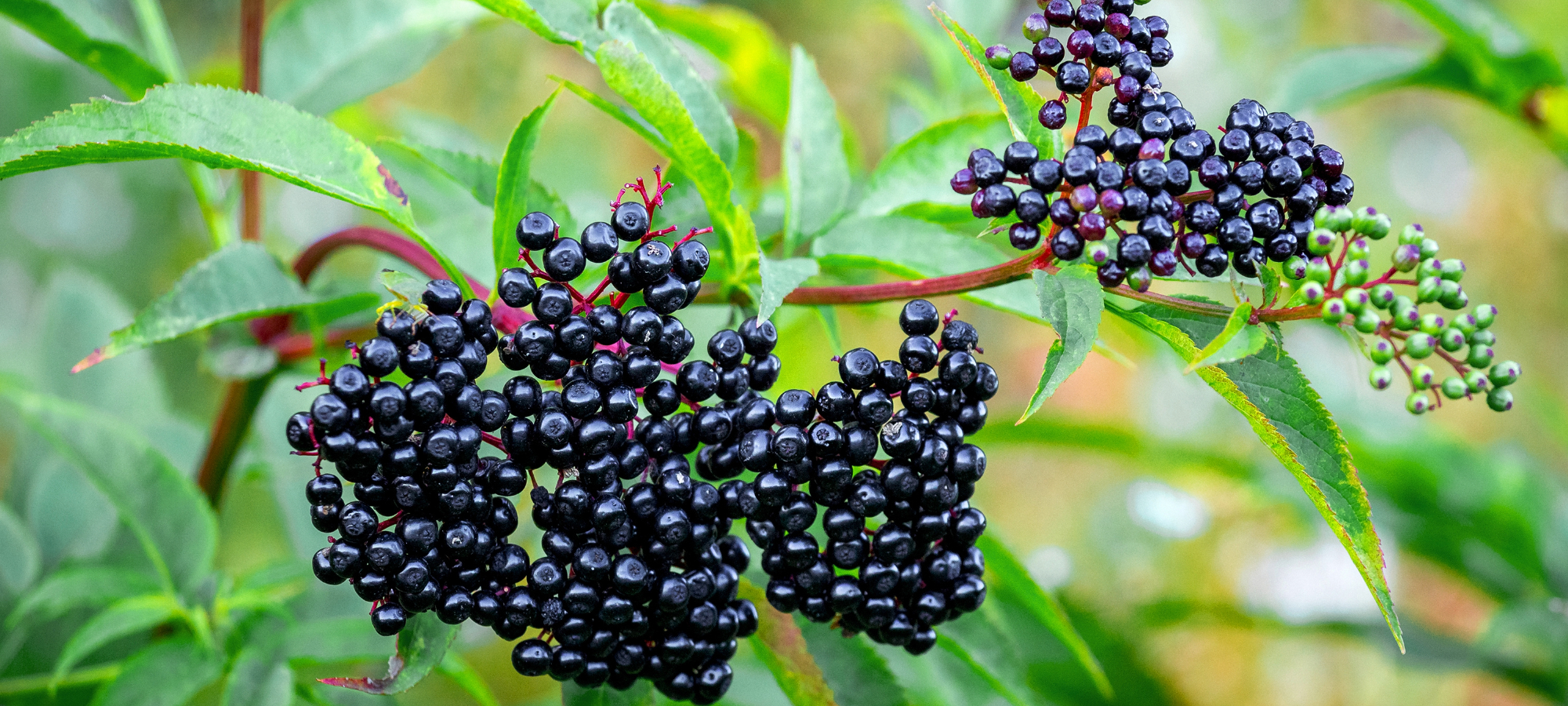
The American elderberry (Sambucus canadensis) is a perennial shrub native to Wisconsin, growing from the East Coast to the Rocky Mountains and from Canada to the Gulf Coast. Although it has been wild harvested for hundreds of years, elderberries are a relatively new commercial crop in the United States. In the mid-1990s, there was little to no commercial cultivation of elderberry in the US. Today, there are over 1000 acres in production, with 400-500 acres in Missouri alone.
Most elderberries grown in the Midwest are sold as ingredients in food and beverage products and dietary supplements. Elderberries are very high in antioxidants and Vitamin C and their products are often marketed as nutraceuticals. The berries can be turned into jams, jellies, pies, and other baked goods and beverages such as wine, gin, liqueur, tea, juice, syrup and cordial. They are also used in dietary supplements, especially cold and flu remedies, and included as an ingredient in gummies and tablets. The pigments in the berries can also be used as a food colorant. There are also markets for elderflowers, particularly in the wine and beverage industries.
Production
Elderberries are a relatively easy crop to grow. They are propagated from dormant stem cuttings and usually stuck in the ground in the spring. Plants fruit on one year old wood, though it’s usually advised to prune flowers from first year plants to encourage root development. Plants are widely adaptable, but prefer full sun, well-drained soil, and high organic matter. They send up new shoots from the crown regularly, requiring annual pruning. Many growers cut or mow all the shoots down to the ground each year to help promote a concentrated ripening period the following season. Plants have either determine or indeterminate growth habits. Determinate types produce shoots with a single blossom on top. Indeterminate types have side blossoms in addition to a large central flower cluster.
Flowering occurs in June and berries ripen in August. Both the flowers and fruit can be harvested for market. Research has shown that up to 15-20% of flowers can be harvested without negatively affecting fruit production. Fruit is hand-harvested and berries are destemmed, washed and sanitized. Destemming berries is the major bottleneck in elderberry production. Grape destemmers or custom built models can be used. Most berries are then frozen before being sold.
For more information on elderberry production, see the publications in the “Resources and Information” section below.
Research Status and Priorities
The history of elderberry research and breeding in North America is relatively short. The original research was conducted in New York in the 1920s, which resulted in the release of two varieties: Adams 1 and Adams 2. These have largely merged into one variety called ‘Adams’, which is still common today. These two varieties were the parents for many other subsequent varieties, including ‘York’, ‘Kent’ and ‘Victoria’. A breeding program at the Nova Scotia Experiment Station in the mid-1900s released several other varieties still available, including ‘Johns’ in 1954 and ‘Nova’ and ‘Scotia’ in 1960.
Most elderberries under cultivation today are improved selections of wild plants. These cultivars have the desired characteristics of uniform ripening, large clusters of berries, large berry size, and good quality fruit. The availability of these cultivars has been the result of joint efforts between growers and researchers.
The University of Missouri has led the way in terms of modern research and breeding efforts with the establishment of the Missouri Elderberry Development Program in 1997. This program has focused on finding improved selections from wild plants. So far, the university has released four cultivars: Bob Gordon, Wyldewood, Ranch, and Pocahontas. It is unknown how well these varieties perform in Wisconsin. Some growers have reported success, while others have had little to no yield. In 2021, the University of Missouri received a USDA grant for a multi-institutional, multi-disciplinary project called Moving American Elderberry Forward with a mission of propelling elderberry into mainstream production.
Very little research has been conducted in Wisconsin, with small scale, diversified farms taking the lead in testing varieties and exploring markets. The Savanna Institute is beginning some research trials on their Spring Green campus and has put together excellent resources for prospective growers.
Markets
Demand for elderberries continues to outstrip supply and US manufacturers of elderberry products rely heavily on imports from Eastern Europe. Elderberries can be harvested for their flowers and their berries and made into a wide variety of products. Flowers can be sold fresh, frozen, or dried and used in beer, maple syrup, liqueurs, and herbal infusions. The berries can be processed into juice, syrup, jellies, jams and wines. Marketing options will vary depending on location and individual circumstances. Growers will need to find their own markets and processors. Many growers sell direct to consumers through U-pick operations, farmers markets, and direct to retail. Growers may also have the option to sell to small scale processors in their area. There are a few wholesale markets, such as The Midwest Elderberry Cooperative and River Hills Harvest. Fresh or frozen berries direct to consumer usually fetch $5-$7 per pound while wholesale buyers will pay $2-$5 per pound. Dried berries sell online for $20-$30 per pound and dried elderflowers for $4-$4.50 per ounce.
Plant Material
Visit the Midwest Elderberry Cooperative website for a list of sources for plant material. Another great place to source cuttings is from growers in your area.
Resources and information
Read
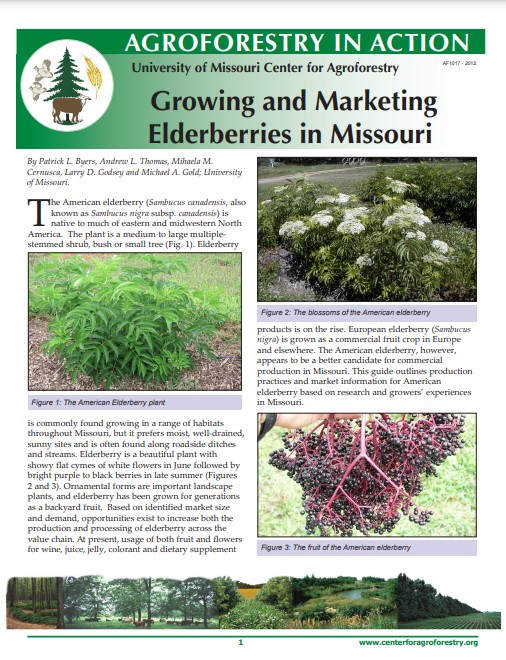
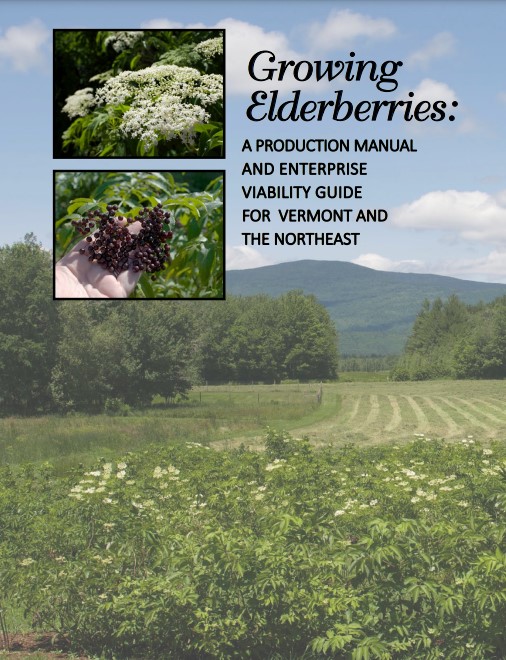
The publications below are great resources for getting started with elderberries. The Midwest Elderberry Cooperative and Savanna Institute are also excellent sources of information on elderberries in the Upper Midwest.

Watch
Patrick Byers (University of Missouri Extension)
(Savanna Institute)
Elle Sullivan (Lily Springs Farm, Osceola, WI)
Terry Durham (River Hills Harvest)
Listen
More Resources
Midwest Elderberry Cooperative
Savanna Institute
University of Missouri
University of Wisconsin-Madison Fruit and Nut Compass (financial planning tool)