

Malting Barley
MALTING BARLEY
Crop Profile
Get Involved!
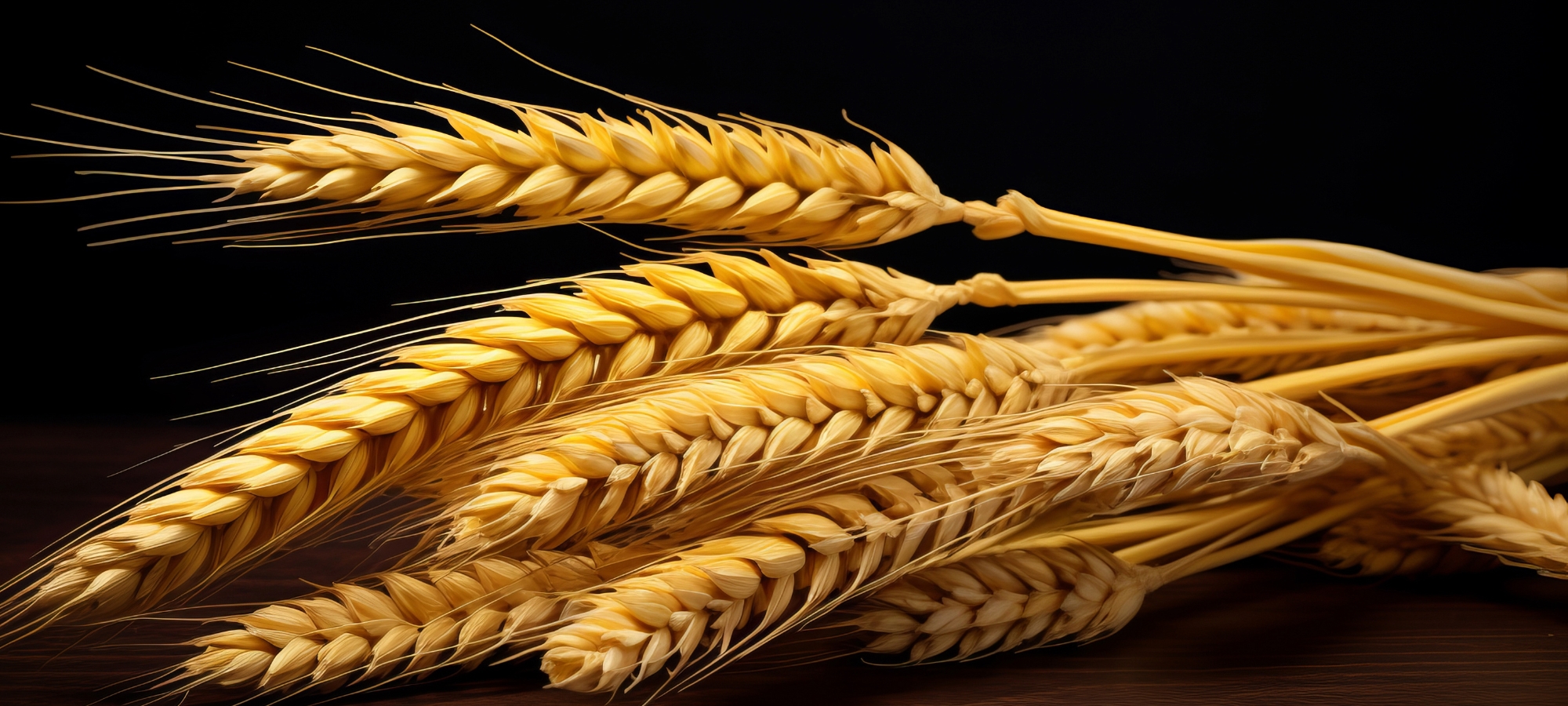
Malting barley is a small grain or cereal grass in the barley family (Hordeum vulgare) with varieties specifically for extraction of malt for the beer and brewing industry. The exact origin of barley is unknown, although many speculate Asia and the Mediterranean. Malting barley varieties are annuals and can be planted in winter or spring. Barley is typically lighter in color than rye or wheat.
Malting barley is produced to meet specific characteristics for the beer industry. Barley varieties are often identified as two-row or six-row barley. The brewing industry currently prefers two-row barley varieties for their malt. Barley quality factors for malt consist of kernel plumpness, germination, protein, and thin, skinned, or broken kernels. Two-rowed & six-rowed varieties have similar grain yield potential.
Early European settlers in North America were trying to make beer from malted maize. Beer can be brewed from a range of cereals, but by the 17th century beers brewed from barley malt predominated in Europe and North America. Today in the United States, barley is grown primarily in the northern great plains and northwest with the leading states being west of the Mississippi River. Wisconsin was a leading barley state from the late 1800’s until the early 1940’s.
Research Status and Priorities
Interest in locally grown barley for malt increased with the growth of the craft brewing industry. Research at the University of Wisconsin continues on malting barley agronomic production practices such as variety evaluation, soil fertility, and pest management. The Cereal Crops Research Unit at UW-Madison is a national leader in conducting and supporting research in barley quality. Oregon State University has a program called Barley World led by Dr. Patrick Hayes that is studying the flavor components of malting barley varieties. The well-established University of Minnesota barley breeding program is currently focused on developing two-rowed winter and spring type malting barley varieties. The American Malting Barley Association provides national leadership to help fund public research, develop grain quality standards, and approve new malting barley varieties.
Markets
Market potential for locally produced barley relies on having malthouses in Wisconsin that can process small batches for the craft brewing industry. Minimum batch levels for traditional maltsters can be in the hundreds of thousands of pounds of barley, requiring hundreds of acres of production. There are currently no small-scale maltsters in the state. However, the strength of the craft beer industry in the state presents an opportunity for the growth of local maltsters.
Maltsters typically contract with producers for their barley and include specifications on the qualities of the grain such as protein and fusarium head blight levels. If these conditions aren’t met, the maltster will reject the grain. Hence, growing malting barley comes with a certain degree of risk, making it important to explore alternative markets for barley that doesn’t meet the specifications, such as livestock feed.
Resources and information
Read
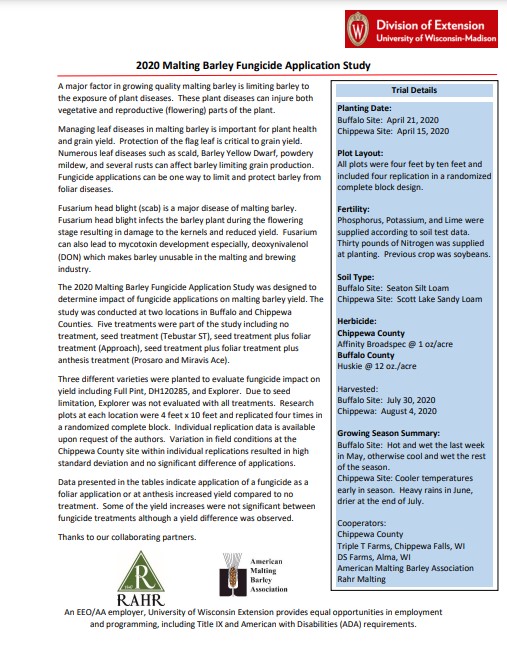
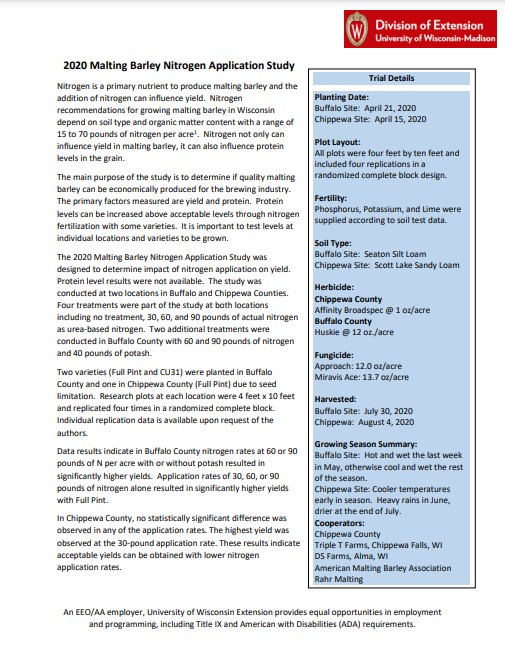
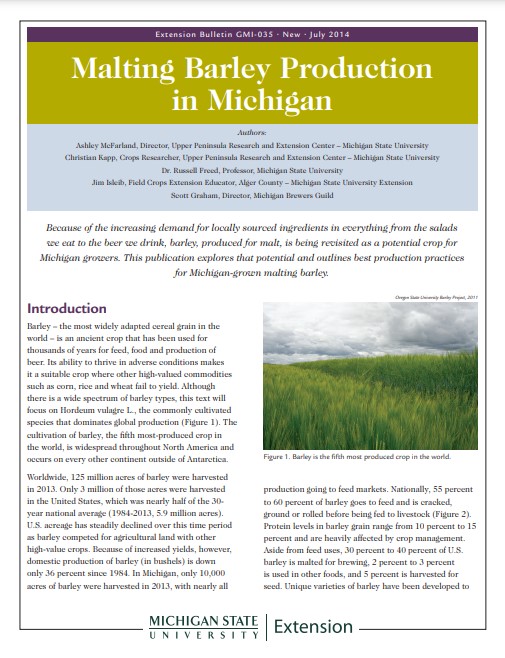
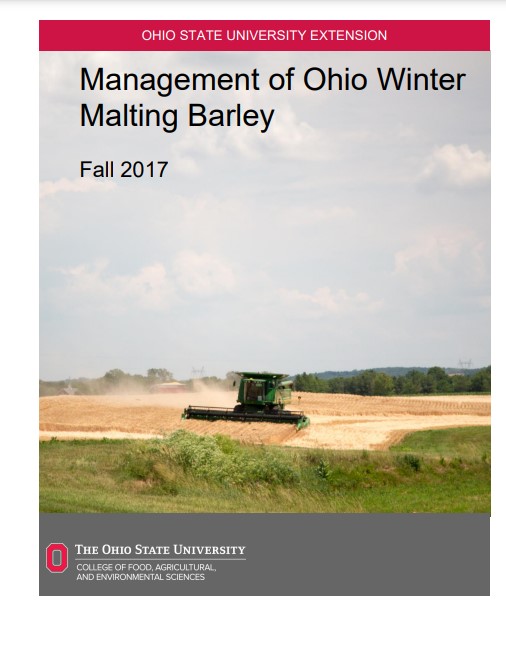
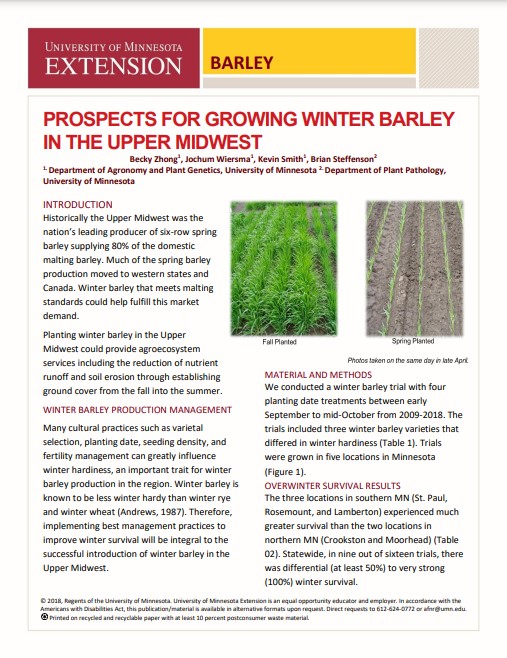
The University of Minnesota and Cornell University are also excellent sources of information on malting barley for Upper Midwest producers. Oregon State University has an article on producing malting barley in the Willamette Valley with relevant information for Wisconsin growers.

Watch
Penn State University has a series of videos on malting barley in Pennsylvania. Cornell University Extension also has a video on malting barley for New York.
Jerry Clark (UW-Madison Extension)
Joe Bragger (dairy farmer, Independence, WI)
Penn State Extension
Listen


More Resources
American Malting Barley Association
Artisan Grain Collaborative
Brewers Association
Cereal Crops Research Unit
Colorado State University (malt quality testing)
Cornell University
Craft Maltsters Guild
Oregon State University – Barley World
Penn State Extension
University of Minnesota Extension
Washington State University