

Kernza
KERNZA
Crop Profile
Get Involved!
Interested in growing Kernza?
The Land Institute has put together an information sheet to help you decide if Kernza is a good fit for your farm. If you would like to apply to be a grower, please click here.
What is Kernza?
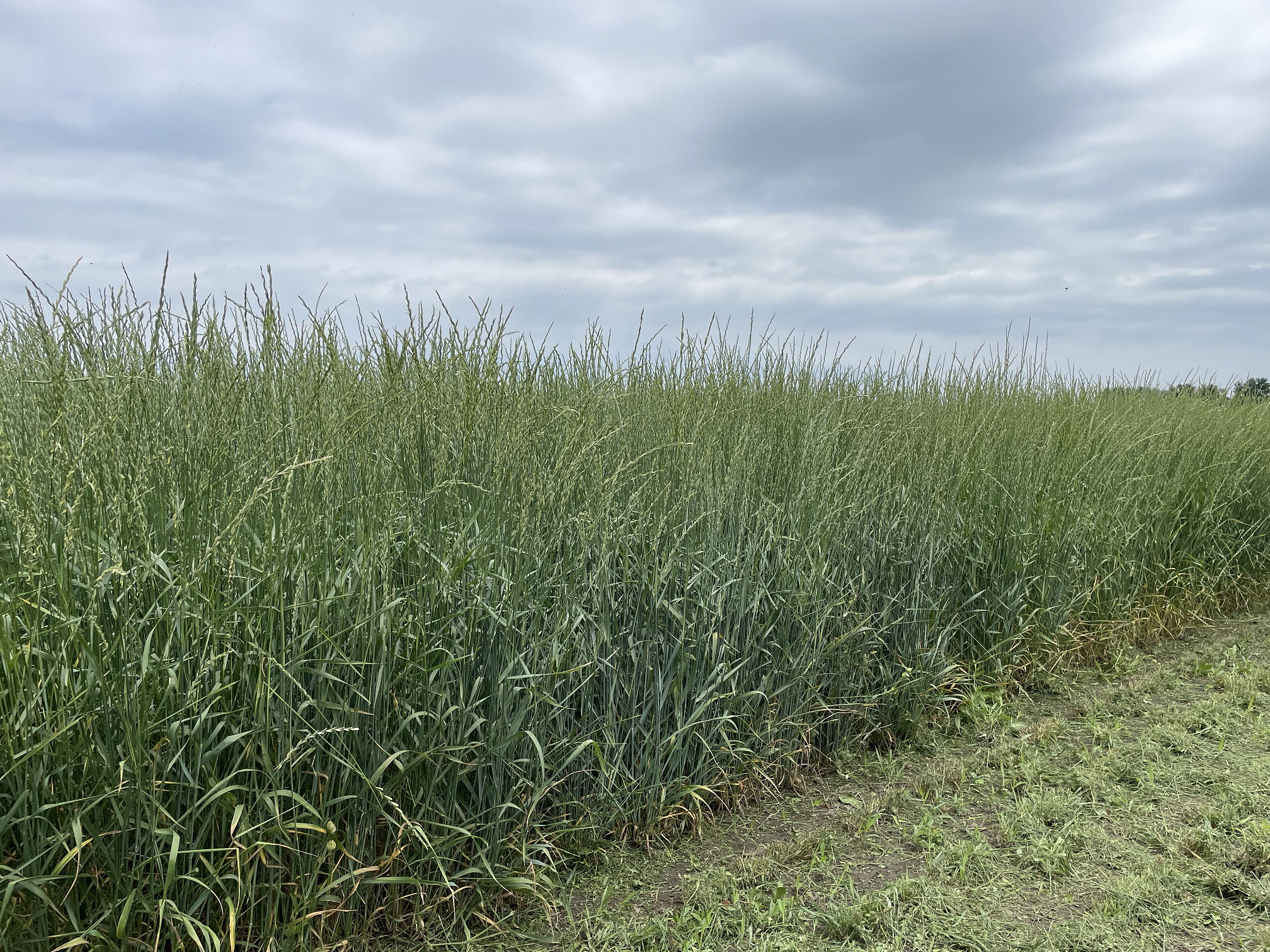
Kernza is a perennial grain closely related to annual wheat. Because it is a perennial, Kernza does not need to be replanted each year, unlike annual wheat. Its roots can extend 10’+ into the soil, providing enormous environmental benefits like reducing soil erosion, sequestering carbon, and mitigating nutrient leaching into groundwater. Kernza can be grown as both a grain and fodder crop.
History of Kernza
The story of Kernza begins in the early 1980s when plant breeders at the Rodale Institute selected a Eurasian forage grass called intermediate wheatgrass (Thinopyrum intermedium) as an alternative to annual wheat using Wes Jackson’s vision for a perennial-based agriculture as inspiration. Researchers at the USDA and Rodale Institute began breeding in 1988, selecting for traits such as improved fertility and seed size. In 2003, the Land Institute, a non-profit in Salina, Kansas, took over the work under the direction of Dr. Lee DeHaan. Breeding and research efforts continue today among a collaborative network of international partners, including the University of Wisconsin.
The first Kernza perennial grain variety was released in 2019 by University of Minnesota and is named MN-Clearwater. Five other varieties were released in 2022 for a total of six approved varieties on the market today. Today, Kernza is an emerging crop that is being grown on a small scale for niche markets. As the genetics and agronomic understanding of the crop improve, the goal is for Kernza to be widely grown throughout the northern United States and around the world.
Wisconsin Kernza Supply Chain Hub
The Wisconsin Kernza Supply Chain Hub is a collaboration between Clean Wisconsin, Michael Fields Agricultural Institute, UW-Madison’s Picasso Research Group, UW-Madison Extension, Rooster Milling and Wisconsin Kernza growers to help address supply chain bottlenecks in Wisconsin and coordinate activities aimed at overcoming these obstacles. Partners are working together to provide technical assistance to growers and help facilitate sourcing, processing, and purchasing between Wisconsin growers and businesses with the goal of increasing the supply and demand of Kernza in Wisconsin.
For more information on Kernza, see kernza.org and The Land Institute.
Production
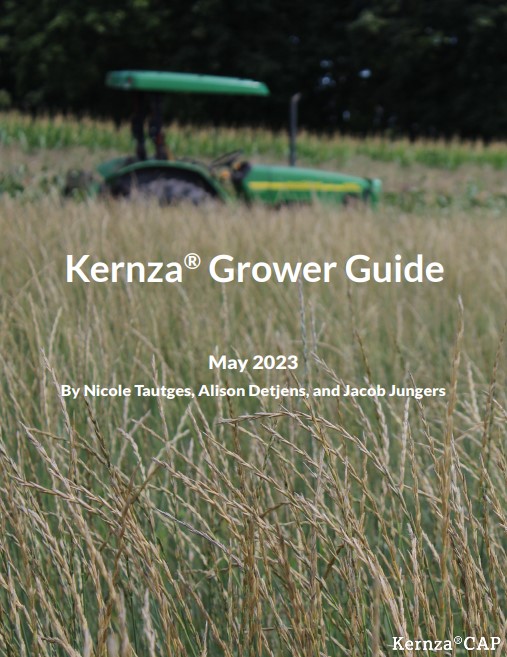
Extensive research is being conducted on the production of Kernza. For the most up-to-date guide on growing Kernza, read the “Kernza Grower Guide” in the Resources and Information section below. Kernza.org and The Land Institute also have many resources on Kernza production.
For information on post-harvest processing, handling and storage of Kernza grain, check out the Post-Harvest Resource Toolkit.
Research and Breeding Priorities
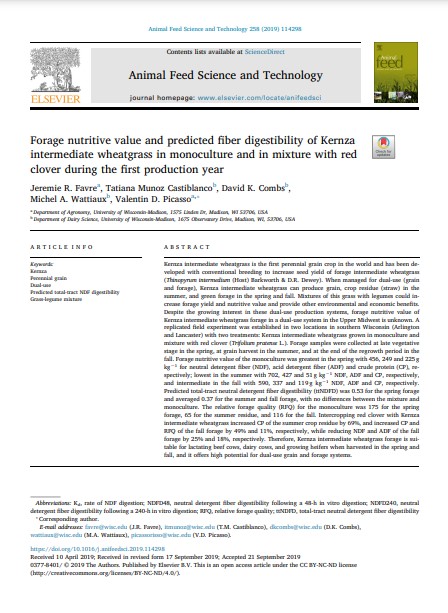
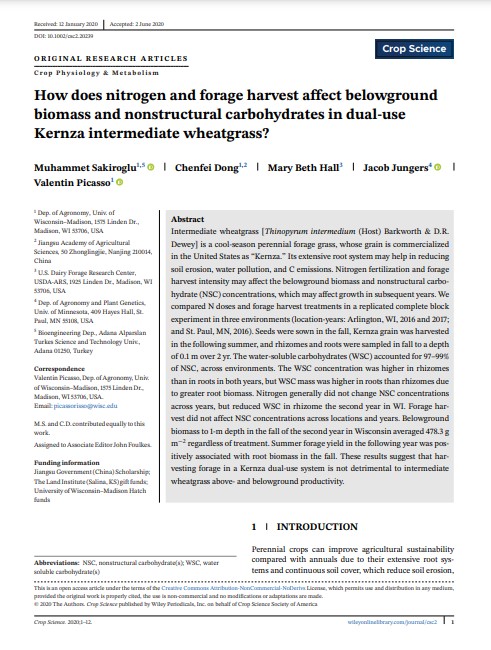
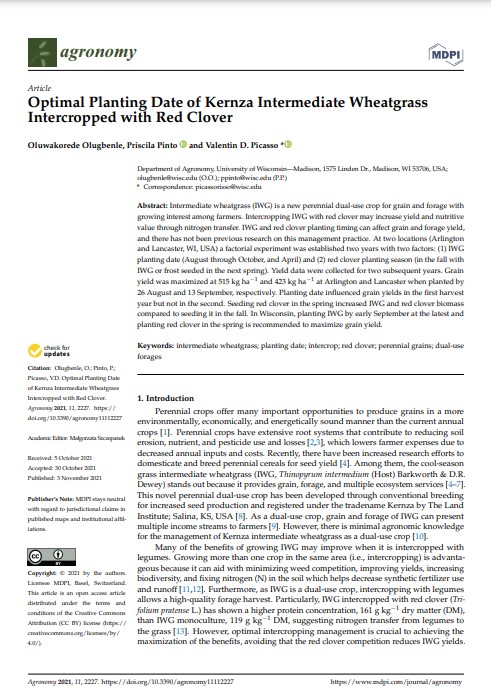
Research is being conducted by a wide network of universities and non-profit organizations throughout the United States and internationally, including the University of Wisconsin. Research at the University of Wisconsin is focused on developing Kernza as a dual-use, grain and forage crop. Dr. Valentin Picasso and his research group are evaluating forage yield and nutritive value of Kernza dual-use systems, agronomic practices that optimize grain and forage yield, and legume-Kernza polycultures. For the latest publications from the Picasso lab, see the Resources and Information section below.
There are currently four breeding programs working on Kernza: the foundational program at The Land Institute and programs at the University of Minnesota, University of Manitoba, and USDA-ARS at Utah State University. Among their top priorities is increasing grain size to 50% of annual wheat within the next ten years, from its current size of 25%. Other breeding objectives include higher yield, shatter resistance, free threshing ability, and grain quality. Long-term goals include developing varieties that resist lodging and have improved bread baking quality.
For more information see kernza.org and The Land Institute.
Markets
In 2013, the Birchwood Cafe in Minneapolis, MN was the first to offer Kernza products on its menu. Today, Kernza is being grown by over 100 farmers on almost 4000 acres in 18 states across the country. Producers, millers, and distributors are helping move grain from farm to market, and consumers are enjoying a wide variety of food products created by bakers, brewers, distillers, and chefs. Large companies such as Cascadia Farm (a subsidiary of General Mills) and Patagonia Provisions have begun incorporating Kernza into some of their foods, while dozens of smaller companies have developed commercial retail products. Because Kernza production remains experimental and seed supply is limited, interested growers must apply through The Land Institute and meet certain criteria. At this point, Kernza is still a niche product but the goal is to scale up production significantly and bring it to the mainstream.
For more information see kernza.org and The Land Institute.
Resources and information
Read
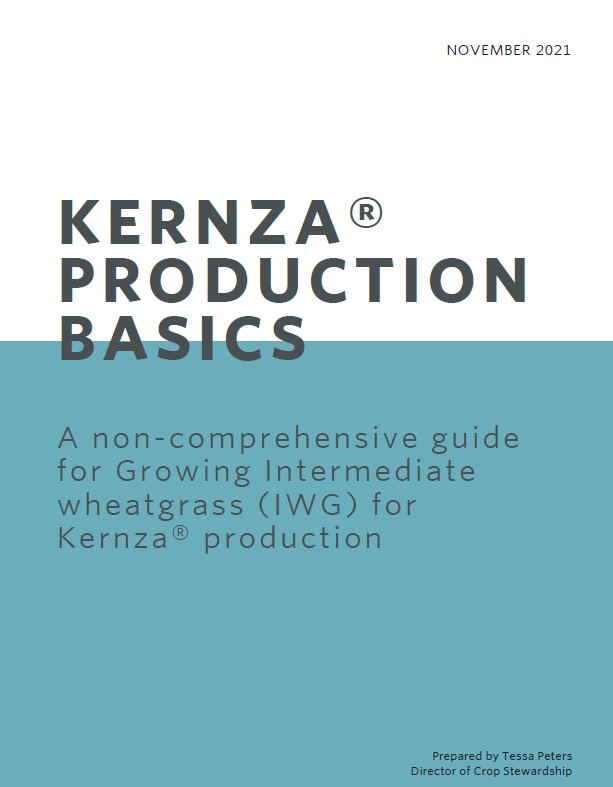
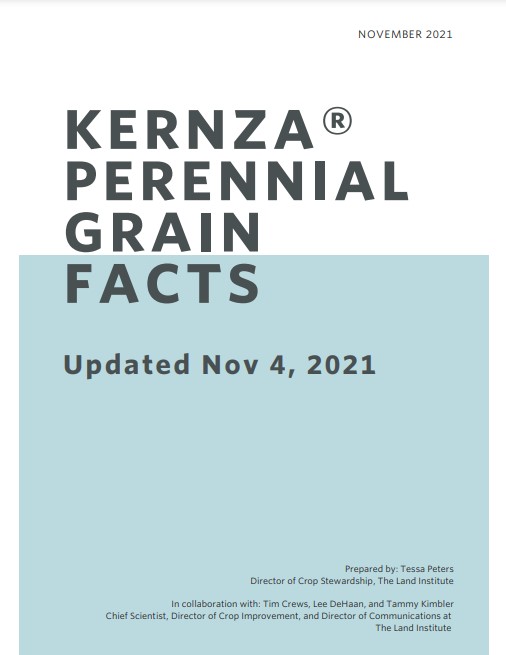
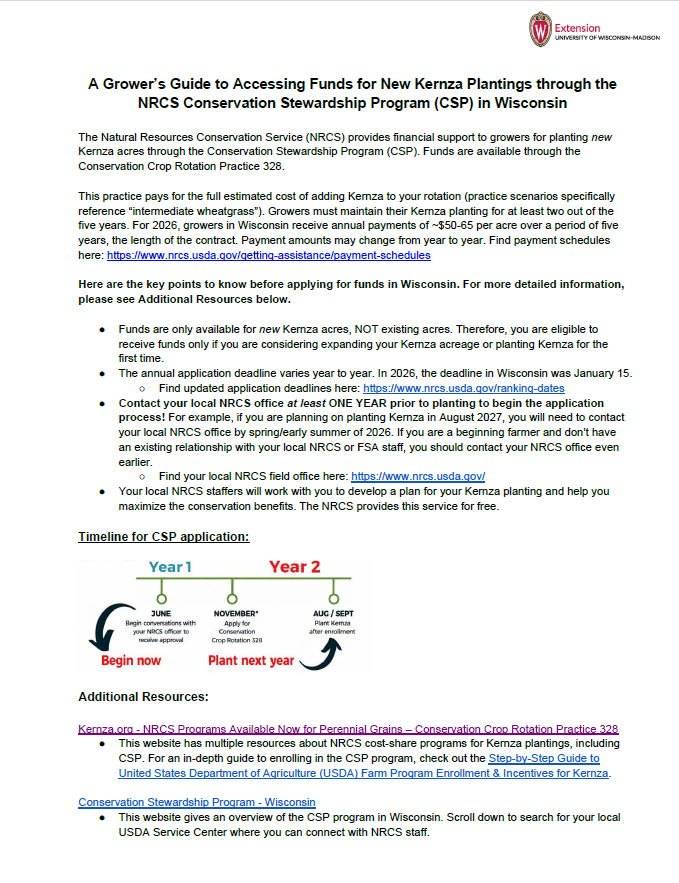
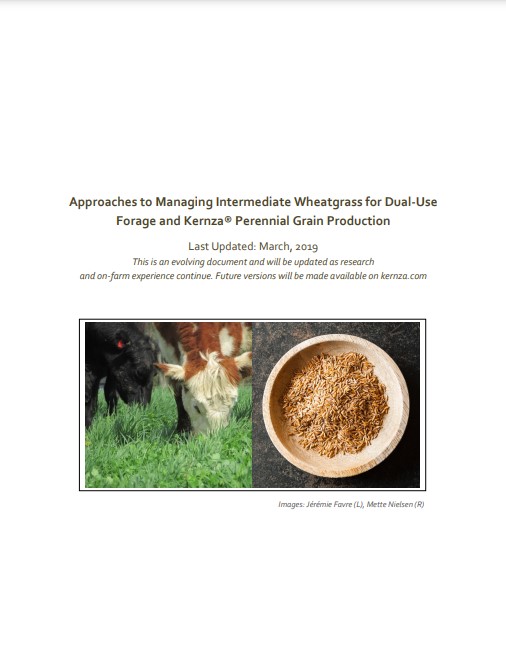
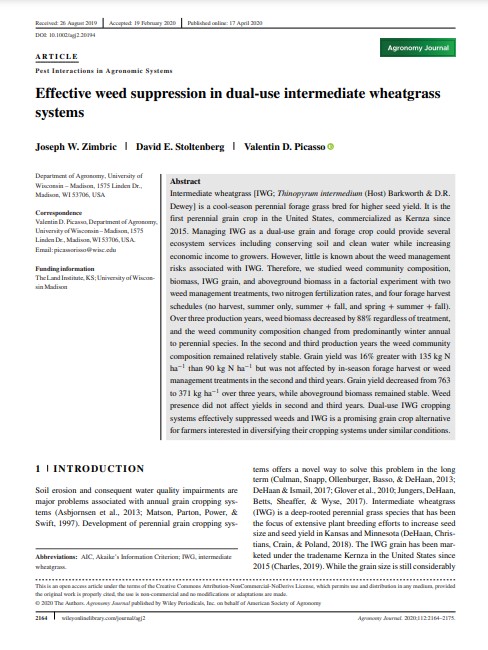
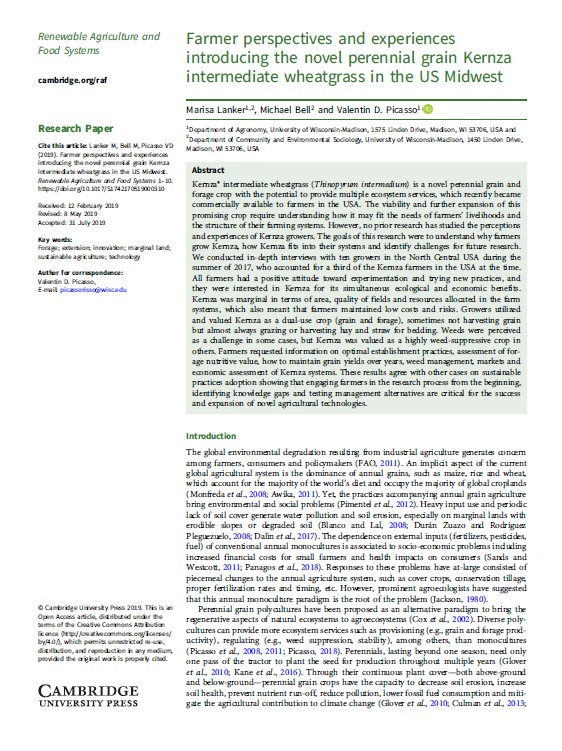
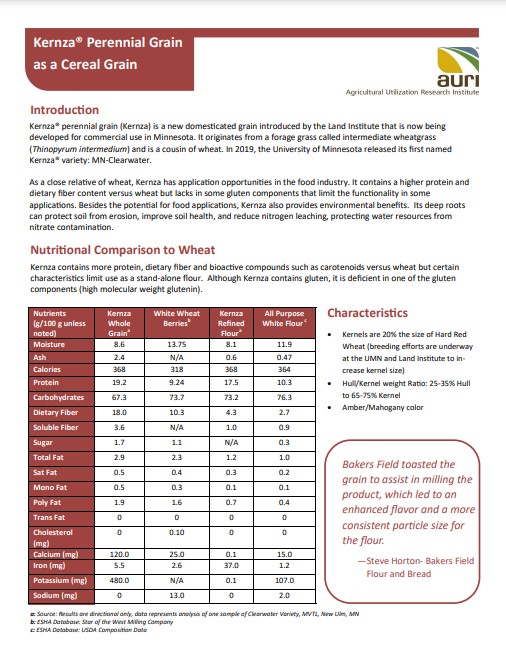
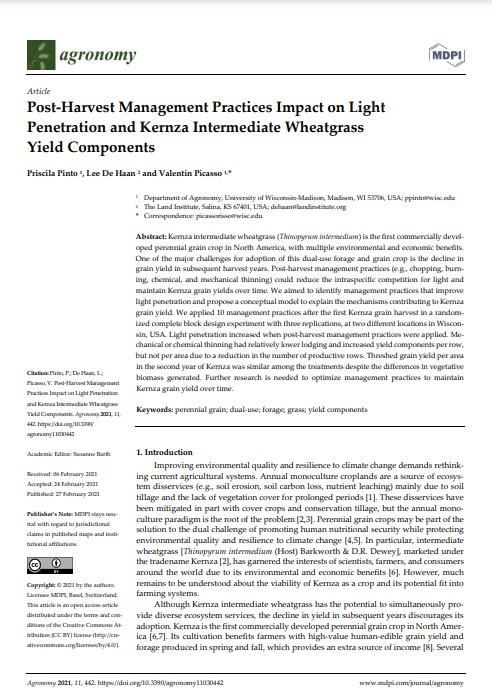
The publications below are good primers on Kernza. For more information, visit kernza.org.
For information on post-harvest processing, handling and storage of grain, check out the Post-Harvest Resource Toolkit.
Watch
For practical, how-to videos related to planting and harvesting Kernza, as well as how to make it a “dual use” crop by grazing it and harvesting it as a forage, check out this series of videos produced Greener Pastures in collaboration with KernzaCAP, the Land Stewardship Project, the Forever Green Initiative, and Green Lands Blue Waters.
Tessa Peters (The Land Institute) and Christopher Abbott (Sprowt Labs and Perennial Pantry)
Listen

More Resources
Agricultural Utilization Research Institute
Forever Green Initiative
https://kernza.org/
Michael Fields Agricultural Institute
The Land Institute
University of Wisconsin-Madison, Valentin Picasso Lab