Skip to content
UW Crest

Crops and Soils

Division of Extension

  • Topics
    • Economics, Budgets and Financials
    • Emerging Crops
    • Forage Production and Management
    • Fruit and Vegetable Production
    • Grain Production and Management
    • Grazing
    • On-Farm Research
      • Nitrogen Optimization Pilot Program
    • Pest Management
    • Soils, Nutrient Management, and Soil Health
  • Events
    • Events Calendar
    • UW Forage and Cover Crop Field Day
    • Agronomy and Soils Field Day
    • Wisconsin Extension Weed Management Workshop
    • WWASH Conference
    • Badger Crops and Soils Update Meetings
  • News
    • News
    • Get Connected
      • The Wisconsin Crop Manager
    • Hay Market Report
    • Ag Weather Outlook for Wisconsin
  • Programs
    • Webinars
      • Badger Crop Connect
      • Emerging Crops Webinars
      • Focus on Forage
      • Foundational Crop Scouting Training
      • Vegetable Production Webinars
    • Podcasts
  • Articles
  • People
  • About
  • Contact Us
Search
University of Wisconsin-Extension
Articles > Soils, Nutrient Management & Soil Health

Cover crop options for soybeans in Wisconsin

Written by Cover Crops Resources
Share
  • Share:
  • Share on Facebook
  • Share on X (Twitter)
  • Share via Email
  • Copy Link

Copied!

Cover crop species recommendations change depending on where you are.  The map below is divided between Northern and Southern Wisconsin – click one of the maps below to view the recommendations for that area.

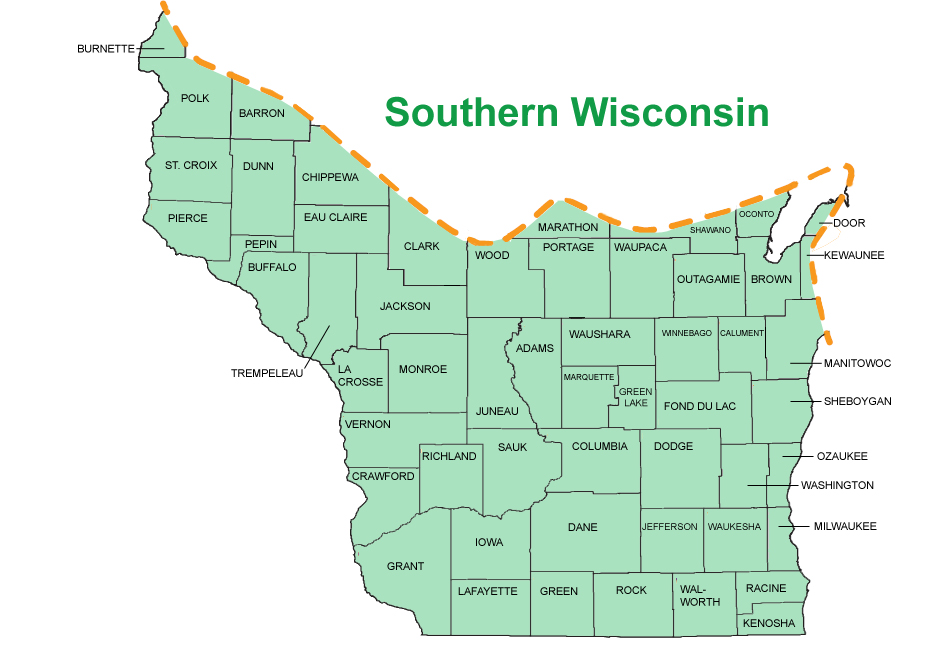
 

Northern Wisconsin Cover Crop Options

Small grains / grasses

Cereal rye is the most reliable option for seeding grass cover crops after October 1st. If able to seed prior to October 1st, triticale is another grass cover crop option. With sufficient snow cover, both cereal rye and triticale will survive the winter and require termination in the spring. Triticale has higher feed quality than cereal rye. Therefore, for dairy operations looking to harvest the cover crop in the spring, triticale may be preferable.  If harvesting the cover crop as a forage, significant attention should be paid to harvest restrictions of herbicides used during the previous two growing seasons.

Brassicas

Due to limited time for establishment and growth, it is not recommended to plant any of the brassicas after soybeans.  There is not enough growing degree days left in the season to provide any cover crop benefits.

Legumes

Due to limited time for establishment and growth, it is not recommended to plant any of the legumes after soybeans. There is not enough growing season for them to develop nodules and fix nitrogen.

Southern Wisconsin Cover Crop Options

Small grains / grasses

Cereal Rye and triticale are both cover crops that can be planted well into October in Southern WI.  Both will survive the winter and require some management to terminate them in the spring.  Rye is more winter hardy than triticale so for very late planting dates, rye is preferable.  Triticale has higher feed quality than rye so for dairy operations looking to take a spring forage cut, triticale may be preferable. If harvesting the cover crop as a forage, significant attention should be paid to harvest restrictions of herbicides used during the previous two growing seasons.

Other grasses, such as annual ryegrass. oats, barley are generally not recommended for planting after soybeans because they will winterkill and there are not sufficient enough growing degree days after soybean harvest for these cover crops to produce enough residue to protect the soil in the spring.  However, if these grasses are planted  during the soybean growing season, they may be options.  Please see the aerial seeding page to read more about this option.
 

Print This Page

You May Also Like

  • ▶ Watch: Focus on Forage Management▶ Watch: Focus on Forage Management
  • Smart Potassium ManagementSmart Potassium Management
  • BMPs of NMPs #6: On-Farm Implementation of Nutrient Management in Southwest WIBMPs of NMPs #6: On-Farm Implementation of Nutrient Management in Southwest WI
  • BMPs of NMPs #5: Nutrient Management Planning and Soil HealthBMPs of NMPs #5: Nutrient Management Planning and Soil Health

Division of Extension

Connecting people with the University of Wisconsin

  • Agriculture
  • Community Development
  • Health & Well-Being
  • Families & Finances
  • Natural Resources
  • Positive Youth Development
University of Wisconsin-Madison      |        Explore Extension: Agriculture Community Development Families & Finances Health Natural Resources Youth
Connect With Us
Support Extension
Extension Home

We teach, learn, lead and serve, connecting people with the University of Wisconsin, and engaging with them in transforming lives and communities.

Explore Extension »

County Offices

Connect with your County Extension Office »

Map of Wisconsin counties
Staff Directory

Find an Extension employee in our staff directory »

staff directory
Social Media

Get the latest news and updates on Extension's work around the state

facebook iconFacebook

twitter icon Follow on X


Facebook
Follow on X

Feedback, questions or accessibility issues: info@extension.wisc.edu | © 2026 The Board of Regents of the University of Wisconsin System
Privacy Policy | Non-Discrimination Statement & How to File a Complaint | Disability Accommodation Requests

The University of Wisconsin–Madison Division of Extension provides equal opportunities in employment and programming in compliance with state and federal law.