

Farmers played a key role in shaping the agenda at the 2025 Wisconsin Water and Soil Health Conference, held December 16–17 in Wisconsin Dells. Hosted by the University of Wisconsin–Madison Division of Extension, the event emphasized real-world experience, highlighting farmer-led experimentation paired with measured on-farm research to advance soil health, water quality, and farm profitability across Wisconsin.
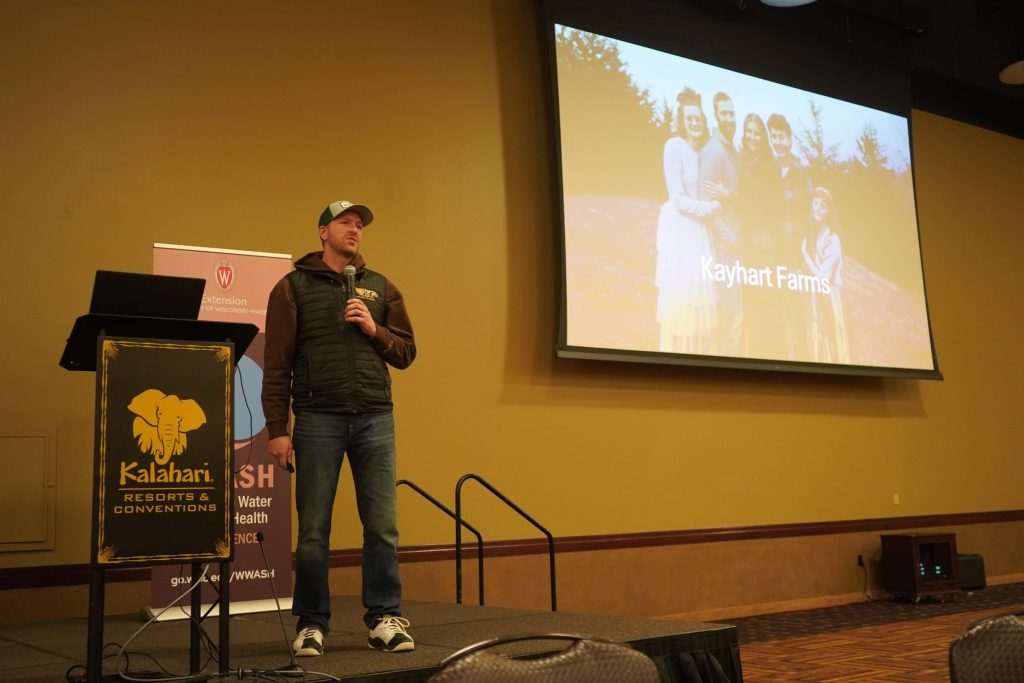
Throughout the conference, speakers reinforced a shared reality: everything farmers do is driven by purpose, with economic viability often guiding decision-making. As farmer keynote speakers Ken Kayhart (Kayhart Farms) and David Trimner (Miltrim Farms) emphasized, conservation practices must make sense not only for soil and water protection, but also for a farm’s bottom line. Farming, they noted, must remain profitable while meeting environmental goals; a balance many Wisconsin farmers are actively working to achieve.
Day one’s keynote speaker was Dr. Matt Helmers, Professor at Iowa State University and Director of the Iowa Nutrient Research Center. Helmers’ talk highlighted that there is no silver bullet to conservation, rather, we need a little bit of everything. He also stressed how the rate of adoption needs to be accelerated, while ending with the message of the importance to, “always be growing,” and to keep the soil covered as many months of the year as possible.
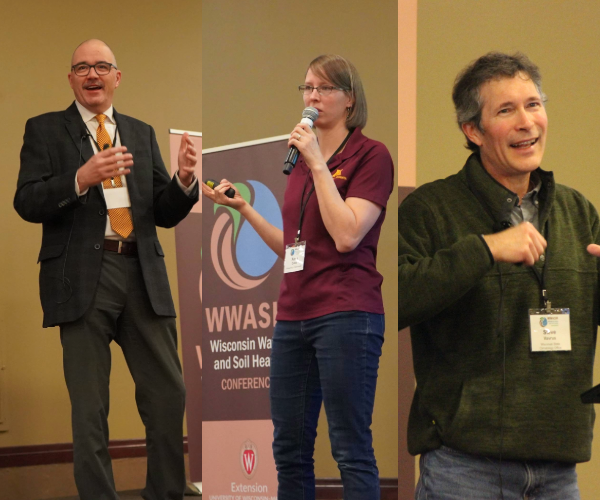
Farming decisions and overall success are also shaped by weather and climate. Presenter Steve Vavrus, Director and State Climatologist at the Wisconsin State Climatology Office, shared that Wisconsin is experiencing warmer, wetter conditions on average. While these trends can extend the growing season, they also create challenges related to both excessive rainfall and periods of drought.
Day two keynote speaker Dr. Anna Cates, Associate Extension Professor and State Soil Health Specialist at the University of Minnesota, outlined three critical elements farmers need to adopt and sustain conservation practices. First, farmers need clear evidence of what works. Second, they need practical guidance on how to make those practices work within their own operations. Third, they need the capacity and logistical support to implement change, including favorable markets, cost-share opportunities, and accessible programs.
Farmer testimonials throughout the conference brought these concepts to life. Breakout session presenters shared lessons learned from on-farm research and conservation implementation, covering topics such as manure application techniques, cover crop strategies, and water quality practices that have proven effective under real-world conditions.
Marty Weiss, a cash crop and beef farmer from Beaver Dam, Wisconsin participating in a nitrogen study on his farm, shared how site-specific decision-making has shaped his management approach. “What could be working for me on my farm might be a disaster for you,” Weiss said.
The value of pairing observations with research data was another recurring theme. “It is important to put data to what we are seeing with our eyes,” said Nick Dallmann, a dairy farmer from Brillion, Wisconsin. While farmers often recognize what appears to work in their fields, data-backed research helps validate those observations and builds a stronger case for broader adoption.
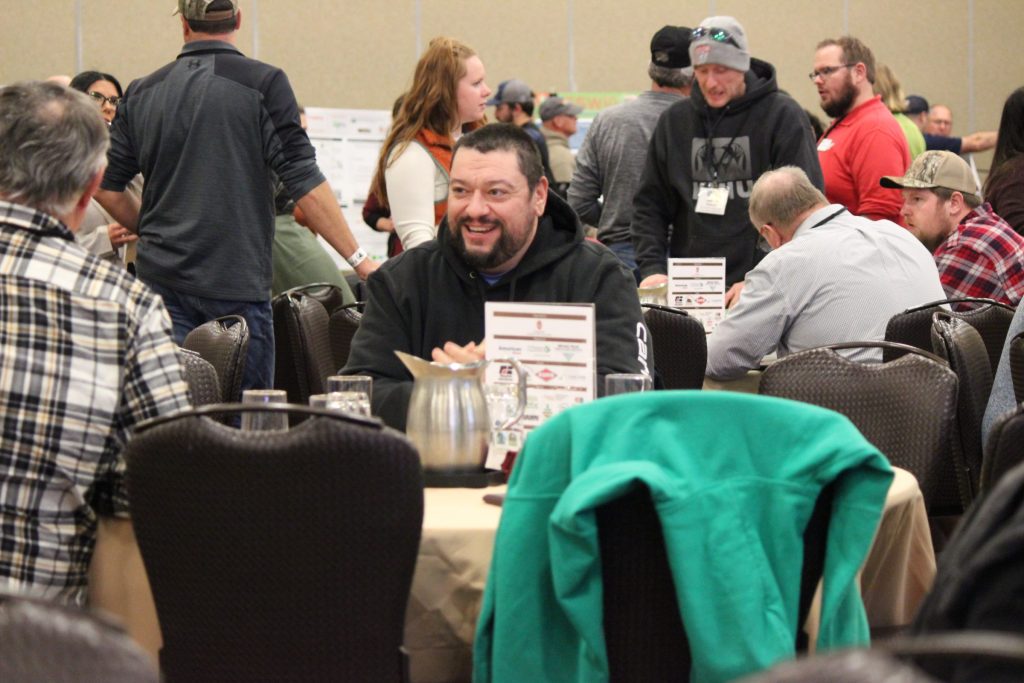
In addition to formal presentations, informal roundtable discussions encouraged attendees to move throughout the room and engage directly with one another. Topics ranged from interseeding cover crops to variable nitrogen rates and small grains, creating space for peer-to-peer learning and practical problem-solving.
By centering farmer experience and supporting it with research, the 2025 Wisconsin Water and Soil Health Conference demonstrated how evidence-based conservation can be both economically viable and environmentally impactful when farmers are part of the conversation from the start. The conference provided a space to compare results, ask hard questions, and learn from both successes and setbacks.
The conference planning committee extends a special thank you to the sponsors, speakers, and attendees whose contributions helped make the event a success and supported impactful outcomes to improve water quality and soil health across Wisconsin.