Most dairies in the northeastern U.S. and eastern Canadian provinces still plant their alfalfa acres as part of a grass mixture. In other parts of North America, including in Wisconsin, incorporating more grass into a dairy herd’s rations has been looked at unfavorably as forage tonnage and protein content have been prioritized over other metrics.
However, the benefits of incorporating grasses into dairy forage rotations are being explored from both agronomic and forage quality aspects. As alfalfa seed prices climb and less reliable snowpack levels leave alfalfa acreage at greater risk of winterkill, grasses are getting a second look by many dairy managers. There are multiple ways grasses fit into a dairy system from field to bunk, whether seeking overseeding options, more resilience when applying manure, or more biodiversity in in-field ecosystems.
Seeding grasses into thinning alfalfa stands
Given the timing of this article’s publication, I suspect that some readers have recently made decisions about at least one alfalfa field that looked rougher than expected after last winter. One option worth exploring before rotating that field back to corn would be overseeding grasses. Options include annual grasses, cereal grains, or perennial cool season grasses, depending on how long- or short-term of a solution you are looking for.
Some work done at the UW Lancaster Ag Research Station in the late 1990s showed that Orchard grass, Italian ryegrass, or oats followed by Sorghum/Sudangrass can all produce yields and forage quality like that of a retained poor quality alfalfa stand.
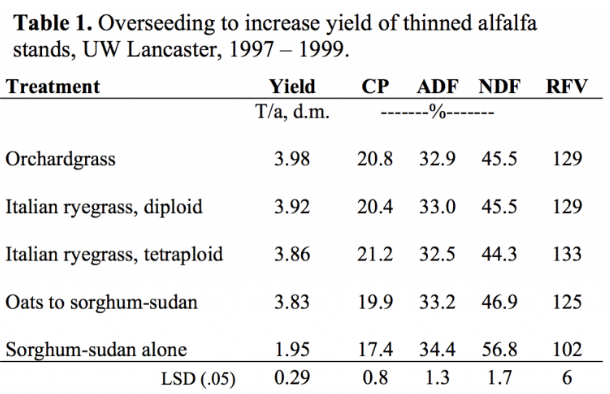
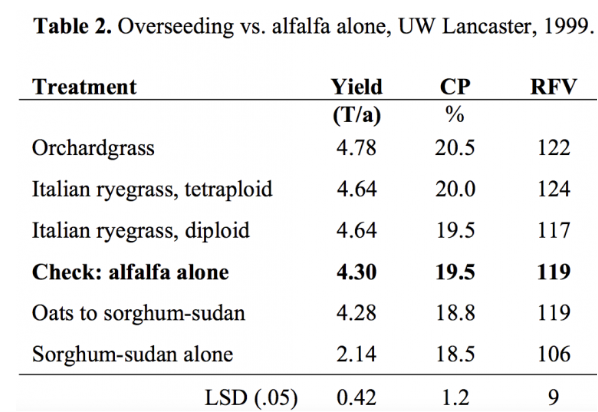
Benefits of overseeding as opposed to retaining an alfalfa stand pencil out if you are seeing alfalfa stands of <5 plants/sq ft that are relatively weed-free. Solid stands of quack grass or dandelions in your alfalfa field are better candidates for rotating out to a different crop. As for timing to introduce grasses into alfalfa stands, cool season grasses can be planted as early as field conditions allow, while warm season annuals should wait until soil temperatures reach a minimum of 60-65° F for sorghums and 70° F for pearl millet.
Establishing a grass-alfalfa stand
Grass/alfalfa mixtures initially seeded in place of pure alfalfa draw their strength from a healthy dose of biodiversity. Agronomically, grasses are adapted to a wider array of soils and are more resilient to traffic, ponding, and manure applications. These blends also cover bare ground that would otherwise be left vacant and prone to increased erosion or weed encroachment often found in pure alfalfa stands. Mixed stands also have lower potential for alfalfa weevil and potato leaf hopper colonization, quicker dry-down periods, and a more rapid response to fertilization/manure applications than pure alfalfa plantings.
Managing a grass-alfalfa stand
The keys to managing alfalfa-grass mixtures for high-quality dairy forage are to maintain a proper ratio of grass to legume in the field to ensure symbiotic relationships are optimized, meet the nutrient and fiber demands of lactating dairy cows, and keep the risk of grass tetany low. This particular risk is more common in grazing settings, and knowing how to balance for mineral content is a vital consideration, too, in any ration.
Of course, farmers must be confident that all nutrient needs of the herd are met. One of the main challenges with feeding grasses can be reduced overall intake. Research shows that, during peak lactation, feeding grasses can reduce total dry matter (DM) intake and consequently milk production. Dry cows, heifers, and late-lactation cows are safer candidates for grassier rations.
However, it is worth noting that feeding trials previously conducted at UW-Madison have shown it feasible to maintain high levels of milk production when replacing a portion of the corn silage and alfalfa with grass silage. Even though dietary Neutral Detergent Fibers (NDF) increased slightly, some high corn silage rations may especially benefit from partial replacement with a grass mix via reducing non-fibrous carbohydrate content, which can contribute to subacute rumen acidosis or lameness.
Mixed grass/alfalfa stands have the potential to benefit producers economically by extending the life of thinning alfalfa stands, agronomically as an option to improve soil cover and reduce pest pressures, and nutritionally by providing a quality dairy forage. It is worth investigating your options to include a variety of grass species into alfalfa stands to benefit the productivity of your farm.
Updated: April 22, 2025
Reviewed by: Marta Kohmann, Luiz Ferraretto, Dane Elmquist