We have paid little attention to Pure Live Seed (PLS) in the Midwest because we have generally had high quality seed (greater than 90% germ and 98% purity). But the short forage seed supply has caused some low quality seed to come on the market. To avoid being caught paying market price for low quality seed take special care to check the seed tag and compare PLS among lots of seed to be purchased.
A bag of seed consists of inert material such as dust, chaff, and seed coating; weed and other crop seed; and Pure Live Seed (PLS) of the desired species. Since every seed lot has a different analysis, and only pure live seed will produce plants, it is important to calculate the Pure Live Seed in a bag. This calculation will allow accurate price comparison and adjustment of seeding rate, if necessary.
Begin by checking the sample seed tag for the analysis. First, find the percent germination. This is the percent of seeds that germinated in a standard test. Most of our crops have been greater than 90% germination and we have seldom made any adjustments. But with some short forage supplies, some lots of seed may have germinations as low at 60%. Check the label so you are not caught off guard.
Then find the percent purity on the seed tag. This is the percent of the weight in the bag that is actually seed. High quality seed lots will be over 95% purity, but seed coating, for example, may reduce the seed purity to 66%.
Multiply percent germination times percent purity and divide by 100 to find the PLS. For example:
(95% germ. × 66% purity) ÷ 100 = 62.7% PLS
This lot of seed only has 62.7 lbs actual live seed for every 100 lbs.
Use PLS to Determine the Best Seed Buy
Since PLS is what will produce plants in the field or pasture, with varying seed qualities, seed cost per pound must be adjusted for the PLS to accurately compare seed prices. To find out what you’re really paying, first determine the PLS of seed you’re considering, as described above. Then divide the cost per pound by the PLS to get the cost per pound of PLS. For example:
$5.00 per pound ÷ 65% PLS × 100 = $7.69 per pound of PLS
or
$5.00 per pound ÷ 90% PLS × 100 = $5.55 per pound of PLS
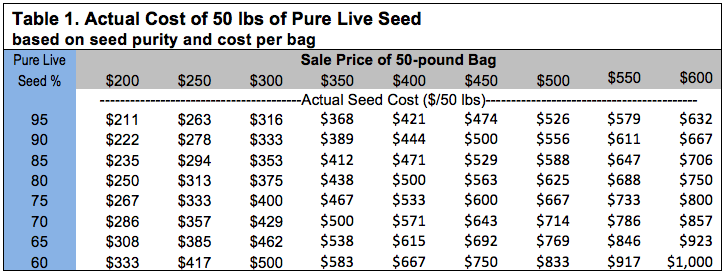
The table following gives actual seed costs for 50 lb bags of seed with varying prices and PLS.
Use PLS to Adjust Seeding Rate
To determine needed seeding rate, check the seeding rate recommendations with the hay and pasture seeding rate calculator at or in UW Extension publication A1525, available at local county extension office. If PLS seeding rate is less than 85% of those shown, you should adjust the seeding rate according the calculated PLS. For example, if the PLS is 70% and you intend to seed 10 lbs per acre:
10 pounds ÷ 70 × 100 PLS = 14.3 pounds
This is a significant difference and, if you hadn’t made this adjustment, you’d be about 40 percent under the target seeding rate.
Many times, purity and germination are high enough that a significant adjustment will not be necessary. However, even seed with 95 percent purity and 90 percent germination will have 15 percent less viable seed than you think if you don’t consider PLS. So, don’t overlook PLS when you buy or plant forage seed.