Sustainability is a common topic of discussion in agriculture. This is often viewed from the environmental perspective in terms of how agriculture may impact natural resources, either positively or negatively. But sustainability actually has three facets: environmental, financial, and social. Social sustainability involves the well-being of the people impacted, and financial sustainability involves making decisions to promote the financial viability of an entity.
When discussing the implementation of conservation or soil health practices such as cover crops or reduced tillage, discussions often center around their contributions to the environmental sustainability of a farm and their impact on the greater landscape. But the financial sustainability of these practices is key, as even the most environmentally friendly farm in the world can’t stay in business if they don’t turn a profit.
Figuring out the financial impact of these practices both in terms of costs and long-term benefits, has historically been difficult. That’s why UW-Madison Assistant Professor and Extension Specialist of Agricultural & Applied Economics, Jeff Hadachek, has developed a tool to aid farmers in this decision-making process. Using datasets from large numbers of farms, Dr. Hadachek created a model that allows farmers to input their own costs to see how their bottom line would be affected if they implemented specific conservation practices.
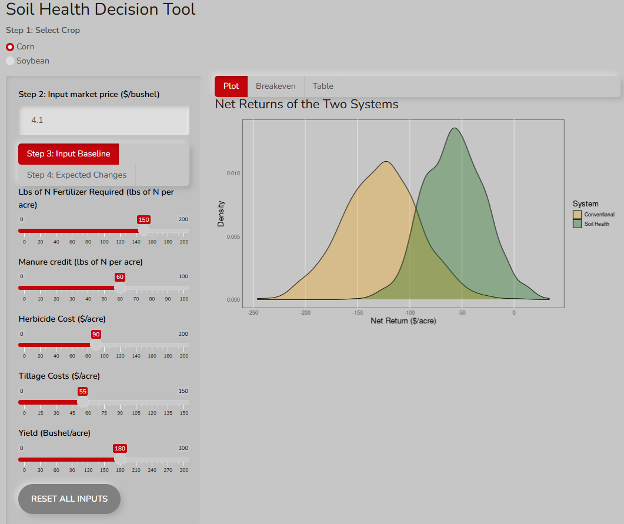
The Soil Health Decision Tool, available at go.wisc.edu/SHDecisionTool, has you start by selecting corn or soybeans as the crop you want to grow. You then enter the price you expect to receive when you sell that crop at the end of the season. Slider bars allow you to select the amount of nitrogen you want to apply, the nitrogen credit from any manure applied, herbicide costs, tillage cost, and anticipated yield for your farming system before any changes to practices are made.
Next, you decide what changes to the system you’d like to try. When it comes to cover crops you can look at the cost of the seed, the effect on nitrogen available to the main crop, changes in herbicide costs, and any extra cost associated with terminating the cover crop. You can also change your cost of tillage in either direction to factor in the reduced passes across the field or the increased cost of equipment if you’re changing the tillage regimen. If the cover crop is going to be harvested as forage, you can add the value of that forage to the equation. Finally, the tool will ask you to consider if your yield will be positively or negatively affected, and if you are receiving any cost-share incentives to adopt these practices.
The tool provides graphs that show the probability of the net return of the two sets of practices on a per acre basis, with yellow (lighter) representing the conventional status quo practices and green (darker) representing the soil health practices, and the taller the portion of the graph the higher probability of that outcome. The really interesting thing about this tool is that as you slide the various numbers around based on your projections, the results update immediately. That way you don’t have to come up with a complete set of information and wait for it to run and then start all over again. You are also provided with information about the likelihood that either scenario will break even, which is an important factor in this era of projected negative margins.
While this tool is only a model and can’t account for every in-field situation, it is a way for farmers and agribusiness professionals to be able to visualize the impact of various environmental practices on their finances in pursuit of whole-farm sustainability. For more information, please contact Natasha Paris, Regional Crops Educator, at 608-264-6509 or natasha.paris@wisc.edu, or visit cropsandsoils.extension.wisc.edu.