This article originally appeared in the June 2022 issue of the Wisconsin Crop Manager.
Interseeding of cover crops (the planting of covers into a standing cash crop) is the best option to ensure adequate growth in corn and soybean crop rotation. Corn and soybean production practices allow for only a short window for cover crop establishment in the fall, and this may not be enough time for some cover crop species to establish and provide agronomic benefits. Corn and soybean growers interested in using cover crops following corn and soybean crops may look to interseeding to establish a cover crop earlier in the season. Interseeding is defined as planting a cover crop during the vegetative growth stage of a crop, whereas overseeding typically occurs near harvest.
Cover Crop Purpose
A goal is needed to achieve maximum cover crop success. Cover crop species often have common benefits, but each species may contribute more of one benefit over another. Several cover crop goals include reducing soil erosion, scavenging for nutrients, nitrogen source, forage quality, or winter kill. It is also important to consider interseeding cover crops a long-term strategy for soil improvement. One year of interseeding will have little effect on soil health. It is the long-term and continual use of cover crops that lead to improvements in the soil condition.
Cover Crop Species
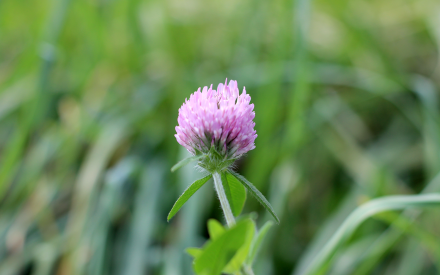
Wisconsin research has demonstrated red clover interseeded into V5 growth stage corn successfully with no significant difference in grain yield when compared to a non-interseeded plot. Red clover was seeded with a modified no-till drill at a seeding rate of 12 lb/ac planted approximately ¼ inch deep. Many cover crop species may work in an interseeding system, however, experimentation in any unproven species may result in reduction in yield, future cover crop management issues, and lack of desired cover crop performance. We have also successfully interseeded daikon radish and winter rye. Winter rye did not always survive until fall harvest and grass species survival may be more dependent on canopy development and light infiltration. Radish has worked multiple years, however, very little below ground root development occurs in most cases. Annual ryegrass has shown to be a reliable choice on Wisconsin farms and other university research. Our current research is examining how a mixture of annual ryegrass, red clover, and radish performs after using residual herbicides. Typically cover crop seed mixtures are interseeded, when interseeding a seed mix, herbicide selection should be considered for all cover crop and weed species present.
Interseeding Timing
Wisconsin research has historically focused on interseeding at the V5 corn growth stage. Over the past two seasons we have focused on interseeding earlier in the growing season. Although at this time, we do not have a recommendation for the ideal interseeding growth stage in Wisconsin, Wisconsin farmers and research at other universities have shown interseeding can be successful from V3-V7 corn growth stage. Geographic region and soil conditions are important when considering the growth stage to interseed. Interseeding into soybean during before soybean dry down has not been successful in UW-Madison research trials.
Herbicides and Interseeding
The herbicides previously applied on the desired field for interseeding may dictate whether interseeding is possible or not. In general, residual herbicides may reduce cover crop growth. Interseeding and using residual herbicides is not impossible but is challenging. Herbicide resistant weed management should be considered when planning herbicide applications. The field should be weed free prior to interseeding. The cost of herbicide program, cover crop benefits, and resistance management should all be considered. More information on cover crop interseeding and herbicides is available through Penn State Extension.
More information on herbicide rotational restrictions is available through the Herbicide Rotational Restrictions for Cover and Forage Cropping Systems publication.
Crop Insurance
Always talk with your crop insurance agent before interseeding any cover crops.
Seeding Method
Recent Wisconsin research has focused on interseeding using a no-till drill modified to allow three rows of cover crop to be planted between 30 inch corn rows. To allow the drill to plant three rows (7.5 inch row spacing) and leave space for the corn plant, one row unit (no-till coulter, double disc openers, closing wheel, and related mounting brackets) was removed from the drill over each corn row. For more info on no-till drill modification for interseeding please see the video link at the end of this article.
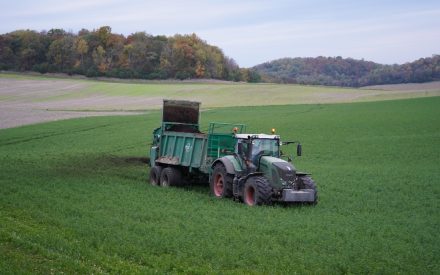
There are many ways of interseeding cover crops using commercially available equipment. Cover crops can be interseeded using specialized equipment, fertilizer spinner, or an air spreader. Larger growers have relied on overseeding cover crops in late summer via aerial applications or using specialized high clearance seeding equipment that often mounts onto a high clearance sprayer. Seeding method can influence the cover crop seeding rate, as higher rates are needed when overseeding compared to drilling. The timing of seeding relative to soil moisture conditions is important. Broadcast cover crop seeding into corn has proven difficult and especially challenging under dry soil conditions.
Cover Crops for Forage Use
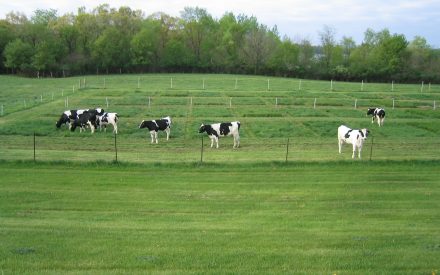
A crop is classified as a cover crop when no biomass is harvested. A cover crop becomes a forage crop when biomass is harvested for feed. When a cover crop is used for forage, however, most pesticide labels do not provide the plant back restriction time required from pesticide application to grazing or harvest for cover crops, only forage crops. If a cover crop will be planted later this cropping season, consider the rotational restrictions for any herbicides used in the field the past few seasons
Find more information on cover crops and cover crop species selection here.
Additional Resources
Updated: June 20, 2022