Skip to content
UW Crest

Crops and Soils

Division of Extension

  • Topics
    • Economics, Budgets and Financials
    • Emerging Crops
    • Forage Production and Management
    • Fruit and Vegetable Production
    • Grain Production and Management
    • Grazing
    • On-Farm Research
      • Nitrogen Optimization Pilot Program
    • Pest Management
    • Soils, Nutrient Management, and Soil Health
  • Events
    • Events Calendar
    • UW Forage and Cover Crop Field Day
    • Agronomy and Soils Field Day
    • Wisconsin Extension Weed Management Workshop
    • WWASH Conference
    • Badger Crops and Soils Update Meetings
  • News
    • News
    • Get Connected
      • The Wisconsin Crop Manager
    • Hay Market Report
    • Ag Weather Outlook for Wisconsin
  • Programs
    • Webinars
      • Badger Crop Connect
      • Emerging Crops Webinars
      • Focus on Forage
      • Foundational Crop Scouting Training
      • Vegetable Production Webinars
    • Podcasts
  • Articles
  • People
  • About
  • Contact Us
Search
University of Wisconsin-Extension
Articles > Weeds

Herbicide rotational restrictions, weed control, and cereal rye for forage

Written by Daniel Smith, Ashley Blackburn, Marta Moura Kohmann, Mark Renz and Rodrigo Werle
Share
  • Share:
  • Share on Facebook
  • Share on X (Twitter)
  • Share via Email
  • Copy Link

Copied!

Herbicide rotational restrictions, weed control, and cereal rye for forage

Designing an herbicide program to allow for cereal rye forage harvest

What if you have cereal rye that could be harvested for forage today?

Terminating cereal rye

While many Wisconsin farms use cereal rye exclusively as a cover crop, it can also be a valuable, high-quality forage for livestock. When planted after the harvest of common Wisconsin agronomic crops (e.g., soybean, corn, and wheat), it establishes quickly and provides great soil cover. Spring cereal rye harvest and management for forage production is an important consideration and more information can be found here: Planting winter rye after corn silage: managing for forage.

Additionally, if herbicides are used in the previous crop(s), the herbicide rotational interval stated on the label must be followed. A rotational interval is the required amount of time from herbicide application to subsequent crop establishment assuming the cover crop will be used for feed purposes.

For example, if an herbicide is applied to soybeans with a 10-month rotational interval for cereal rye, the rye can only be established as a feed crop 10 months after the herbicide application. While plantings that will only be used as a cover crop (prevent erosion, build soil health) do not need to follow the rotational interval, IF THE PLANT IS HARVESTED AND USED AS A FEED, THE USER IS REQUIRED BY LAW TO FOLLOW THE ROTATIONAL INTERVAL. The herbicide label lists the rotational interval and is recommended to be referenced prior to making any management decisions.

Designing an herbicide program to allow for cereal rye forage harvest

Designing an herbicide program that allows for control of your most troublesome weeds, while allowing for the use of cereal rye as feed, is challenging. Below we overview several steps that can assist you in developing a successful program.

Step 1: Start by identifying your most troublesome weeds and evaluating your previous herbicide program. Once your most troublesome and challenging weeds have been identified, reference A3646 2025 Pest Management in Wisconsin Field Crops weed control rating tables to identify preemergence and postemergence herbicide options for your crops. Consider crop herbicide-resistant trait choices to help identify a postemergence program. Remember that rotation and mixtures of multiple herbicide sites of action is important when selecting the future weed control program to postpone and prevent herbicide resistance.

Step 2: Now that you have a list of possible herbicide options that control your most troublesome and challenging weeds, reference the Herbicide Rotational Restrictions for Cover and Forage Cropping Systems publication. Check the maximum herbicide rotational restriction. This publication provides rotation intervals for common herbicides for most forage and cover crop options in Wisconsin. Select herbicides that will meet your projected interval between application of the product and planting of cereal rye.

Step 3: Now reference the herbicide label for the products of interest. Read, understand, and follow the herbicide label. The herbicide label provides the legal requirements to use the herbicide. Verify the rotational restrictions relevant to your crop rotation and check for any soil type, weather, depth to ground water, and geographic characteristics that affect herbicide requirements/restrictions, as well as other limitations of the herbicide. These label requirements will continue to reduce the list of possible herbicide options.

Step 4: Begin shopping for your herbicide choices and working with your agronomist to help navigate your herbicide choices. Consider having multiple plans that account for variable spring weather and other challenges that may arise.

What if you have cereal rye that could be harvested for forage today?

Review the herbicide labels applied for the past 24 months for rotational restrictions that would prohibit the harvest of the cereal rye for forage. If there are no rotational restrictions for the harvest of cereal rye for forage, proceed with planning for forage harvest.

Terminating cereal rye

Terminate the cereal rye after cereal rye harvest. Glyphosate is the most common active ingredient used for cereal rye termination. University studies have shown glyphosate will translocate and terminate the rye, even if minimal plant material is on the soil surface. Termination applications need to occur when the rye is actively growing to allow for herbicide translocation. Reduced rates have shown inconsistent control and are not recommended.

Work through the above steps one through four and continue to use your most troublesome and challenging weeds to guide your herbicide options. Consider herbicide tolerant crop traits when making future seed purchases that complement the cropping system. Reference the below University of Wisconsin-Madison publications to help guide herbicide selection, cereal rye harvest, and termination. Always read, understand, and follow the pesticide labels used in the crop rotation and track the herbicide rotational intervals over several seasons to ensure legal forage harvests are possible.

Resources

DeWerff R., E.N. Bick, P. Liesch, M. Renz, D. Smith, R. Werle, J. Kampa. 2025. Pest Management in Wisconsin Field Crops. University of Wisconsin-Madison Extension Publication A3646.

Paris, N., D.H. Smith, R. Werle, T. Severo Silva, R. DeWerff. 2024. Herbicide Rotational Restrictions for Cover and Forage Cropping Systems.

Smith, D.H, M. Broeske, J. Patton, K. Shelley, F. Arriaga, B. Jenson, M. Coura Oliveira, B. Briski, B. Bubolz, R. Rushmann, H. Johnson, G. Schriefer, M. Sorge. 2019. Cover Crops 101. University of Wisconsin-Madison Extension Publication A4176.

Stute, J., K. Shelley, D. Mueller, T. Wood. 2007 Planting winter rye after corn silage: managing for forage. University of Wisconsin Nutrient and Pest Management Program Publication.
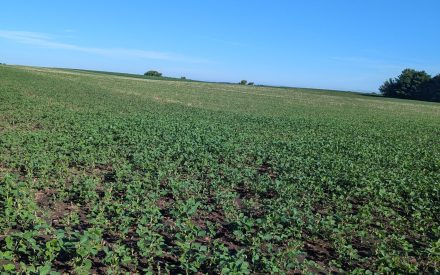
Cereal Rye Cover Crop Management in Wisconsin

Print This Page

You May Also Like

  • ▶ 2025 Corn and Soybean Weed Management: Field Observations and Research Updates▶ 2025 Corn and Soybean Weed Management: Field Observations and Research Updates
  • ▶ Machinery in Diversified Vegetable Systems▶ Machinery in Diversified Vegetable Systems
  • ▶ Combine Cleaning: A Simple Step to Reduce Weed Seed Dispersal▶ Combine Cleaning: A Simple Step to Reduce Weed Seed Dispersal
  • Johnsongrass in WisconsinJohnsongrass in Wisconsin

Division of Extension

Connecting people with the University of Wisconsin

  • Agriculture
  • Community Development
  • Health & Well-Being
  • Families & Finances
  • Natural Resources
  • Positive Youth Development
University of Wisconsin-Madison      |        Explore Extension: Agriculture Community Development Families & Finances Health Natural Resources Youth
Connect With Us
Support Extension
Extension Home

We teach, learn, lead and serve, connecting people with the University of Wisconsin, and engaging with them in transforming lives and communities.

Explore Extension »

County Offices

Connect with your County Extension Office »

Map of Wisconsin counties
Staff Directory

Find an Extension employee in our staff directory »

staff directory
Social Media

Get the latest news and updates on Extension's work around the state

facebook iconFacebook

twitter icon Follow on X


Facebook
Follow on X

Feedback, questions or accessibility issues: info@extension.wisc.edu | © 2026 The Board of Regents of the University of Wisconsin System
Privacy Policy | Non-Discrimination Statement & How to File a Complaint | Disability Accommodation Requests

The University of Wisconsin–Madison Division of Extension provides equal opportunities in employment and programming in compliance with state and federal law.