Introduction
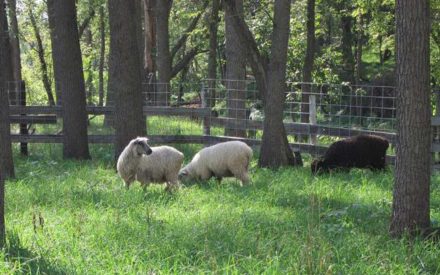
Silvopasture, the intentional, managed integration of trees with grazing systems, can provide a variety of benefits, including shade and emergency forage for livestock, carbon storage, and potential income from tree products. Establishing silvopasture by planting trees allows the farmer to control tree species and placement. It also offers climate benefits and may be eligible for technical and financial assistance from the USDA Natural Resources Conservation Service in Wisconsin.
At the same time, it takes considerable investment of money and labor to plant and tend the trees, and it takes years for them to grow big enough to provide benefits, so it is a good idea to think carefully about your overall silvopasture design before you plant any trees. This factsheet covers some key considerations for establishing silvopasture by planting trees. It can help prepare you for consultation with a silvopasture technical service provider, or provide guidance if that service is not available.
Creating a silvopasture design
Step 1: What are your silvopasture goals?
The first step to coming up with a plan is to rank your goals for establishing silvopasture, because your goals will influence every aspect of the design, from where you plant the trees to which species you choose. Providing shade for livestock is the main goal for many graziers. Other goals may include providing wind shelter, providing emergency forage or supplemental feed, sequestering carbon, restoring habitat, and harvesting tree products such as nuts or wood. In some cases, multiple goals will align well, while other sets of goals might have conflicting management requirements.
Step 2: Where does silvopasture fit on your farm?
The second step is to consider where silvopasture fits on your farm. Grazing farms benefit from having a mix of silvopasture and open pasture, so we do not recommend planting trees in every pasture. There are several reasons to retain open pasture: total forage production is greater in open pasture, grassland birds need open grassland for nesting success, and forage management (haying, renovating, etc.) is easier in open pasture. In addition, while trees provide shade during the day, they also trap some heat at night, so to reduce heat stress it makes sense to put livestock in silvopasture during the day and in open pasture at night.
The best place to plant silvopasture will vary for each farm, but there are two general approaches to consider. One is to dedicate one area of the farm to silvopasture (Figure 1a); the other is to scatter silvopasture throughout the farm (Figure 1b).


If your silvopasture goals are all livestock-focused (shade, tree fodder), then spreading the silvopasture across the operation may make the most sense. If you have other goals, such as fruit or nut production, then it may make more sense to concentrate your tree planting in one area.
Step 3: Determining tree spacing and orientation
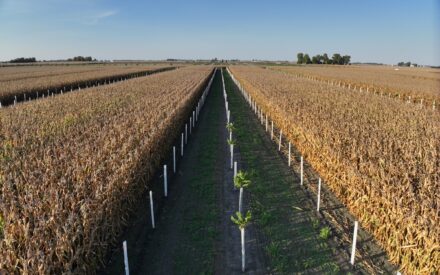
Usually, it makes sense to plant trees in rows, both because then it is easier to protect the young trees from livestock, and because having trees in rows allows you to use equipment to manage the forage between the rows. You will need to decide on row width, spacing, and orientation.
Row width is determined by how many lines of trees you plant in a tree row. If you are planting trees for shade and fodder, then single rows probably make the most sense, since they provide the optimal balance between shade and forage production. However, if you hope to harvest timber from your silvopasture you may want to plant in double or even triple rows to encourage the trees in the center row to grow straight and tall.
Whichever row width you choose, space rows far enough apart to accommodate your equipment, and leave enough space at the end of the row for machinery to turn (Figure 2).

There are several considerations to balance for row orientation. Planting rows in a north-south direction maximizes the area shaded at some time over the course of the day, so animals do not have to stay right under the tree to benefit from shade. However, for maximum heat relief you may also want to consider orienting row direction to allow the prevailing summer winds to move between the rows of trees, so your animals can benefit from the breeze as well as the shade. If you want your silvopasture to provide winter shelter you will want to orient the rows to block prevailing winter winds. If your silvopasture location is on a slope you may want to plant the tree rows on the contour, and finally, the shape of the field will influence the placement of rows as well.
Step 4: Selecting tree types and sourcing
Wisconsin has dozens of species of native trees as well as many introduced species. Your goals, livestock type, soils and location, and tree availability will narrow down your choices, but you will still have many options to choose from. It is a good idea to consult with a local forester or silvopasture technical services provider about trees suitable for your farm, but below are notes about some species commonly considered for silvopasture.
The ideal silvopasture tree would grow quickly, cast moderate shade to allow reasonable forage growth beneath, produce a marketable fruit or nut and high quality timber, and support native biodiversity, but there are trade-offs between speed of growth, timber quality, and food production. The NRCS list of native trees and shrubs ↗️ provides a brief description of many Wisconsin tree species by region of the state. Browse all NRCS forestry conservation planning resources for Wisconsin↗️ online.
Trees for shade
If shade is your primary goal you probably want a fast-growing deciduous tree that casts a moderate shade. Hybrid poplar (Populus deltoides x Populus nigra) grows extremely fast and may provide shade just three to five years after planting if conditions are favorable. On the other hand, hybrid poplars are very susceptible to wind damage, and their wood is generally only used for firewood or pulp. The trees also typically only live about 40 to 50 years, though if they are coppiced they can live longer through their sprouts. It may make sense to plant some poplar for quick shade while you wait for longer lived trees to grow.
Quaking and bigtooth aspen (Populus tremuloides and grandidentata), honeylocust (Gleditsia triacanthos), hackberry (Celtis occidentalis), mulberry, (Morus rubra or Morus alba) basswood (Tilia americana), silver maple (Acer saccharinum), and a number of other species grow relatively quickly. Like hybrid poplar, their wood is primarily used for pulp or firewood.
Trees for timber and conservation
Several slower-growing species take longer to provide shade but may offer more environmental, aesthetic, and economic value over the long term. White, black, and bur oaks (Quercus alba, Quercus nigra, Quercus macrocarpa) are important species of savanna habitat. Oak wood is also valued for timber, but the low spreading growth habit typical of savanna (or silvopasture) trees does not provide as much usable wood as the straight, tall oaks grown in a forest. Red oak and pin oak (Quercus rubra and Quercus ellipsoidalis or palustris) are not typical savanna species, but grow more quickly than black, bur, and white oaks.
Black walnut (Juglans nigra) is the most valuable timber in Wisconsin, grows relatively quickly, and casts a moderate shade. The nuts may provide feed for pigs or may be a marketable product. There is debate about how much grass growth is affected by the allelopathic juglone released by black walnut roots, but at least some species of grass grow well under walnut trees. If you want to eventually harvest deciduous trees like oak or walnut for timber, planting them in the center row of three rows of trees may encourage better form, but also risks slowing early growth due to competition for light.
Trees for winter shelter
For winter shelter fast-growing evergreens such as white or red pine (Pinus strobus or rubrus) retain their foliage and block wind year-round.
Trees for fruit or nuts
Trees produce most of our fruits and nuts, from apples and pears to emerging crops such as chestnuts, mulberries, and hazelnuts. Livestock grazing in fruit and nut orchards can provide benefits such as managing orchard floor vegetation and reducing disease and insect reservoirs by consuming dropped fruit and nuts. However, livestock in orchards also pose food safety risks, as their manure can contain parasites and pathological bacteria such as E coli and Salmonella. One approach is to allow livestock to graze orchards only after fruit harvest, and/or at least 90 days before harvest.
Fruit or nut-bearing trees or shrubs can also provide nutrition for omnivorous livestock such as pigs and poultry. These animals forage on acorns, hickory nuts, hazelnuts, honey locust seed pods, and other types of mast (edible fruits and seeds from forest trees), as well as on traditional fruits. Pigs like to root and rub, so while they are forest animals and like access to trees, they have to be kept at a low stocking density and rotated frequently to prevent damage to both trees and soils.
Sugar maples are not generally recommended for silvopasture because of concerns that their dense shade and shallow root systems will depress forage growth more than other trees. However, some farmers have found that maples in silvopasture have excellent syrup production, and because sap harvest takes place before the grazing season and sap is boiled, this integrated system does not pose food safety concerns.
Trees for fodder
Finally, silvopasture trees can provide livestock forage through their leaves. In Wisconsin poplars, basswood, mulberry, and maple trees, including box elder, resprout readily and their leaves have good forage value. Many other tree species can be used for fodder, with one notable exception. Never use trees in the cherry (Prunus) family for fodder, as their wilting leaves can contain cyanide at sufficient concentrations to kill.
Tree sourcing
The Department of Natural Resources and many local soil and water conservation districts sell native tree seedlings in bulk ↗️. Many nurseries sell fruit trees and non-native landscaping trees such as hybrid poplar. Choose a nursery in the upper Midwest or a similar climate when possible.
Site preparation and planting
Good site preparation is critical for trees to survive and thrive. The first step is to remove competing vegetation from the rows where tree seedlings will be planted. At a farm scale this will typically require tillage and/or herbicide use.
Other practices that can help with site preparation include mowing the rows low to deplete pasture root reserves and planting cover crops in the future tree rows.
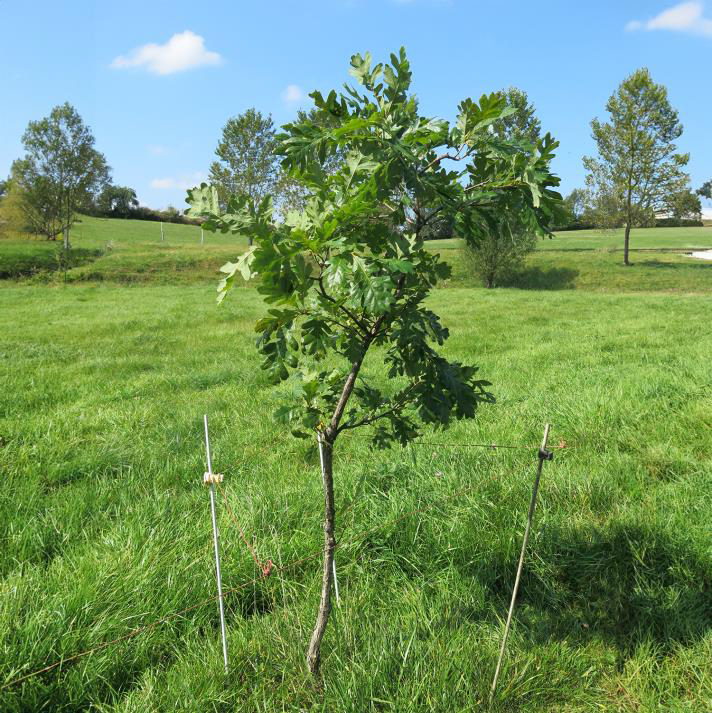
Local conservation offices can provide technical advice to help with the actual planting and may have tree-planting equipment to rent or loan. Before you plant, have a plan and the supplies to protect the young trees from wildlife. Tree tubes offer relatively reliable protection from rodents, and can also protect from deer browse if they are at least 4 or 5 feet tall. Tree tubes will need to be staked. You may also want to put netting over the top of tree tubes to prevent birds from being trapped in the tube. The netting will have to be removed when the tree reaches the top of the tree tube.

For the first season after planting it is critical to ensure the young trees have enough water. In addition, it is helpful to continue to manage competition from grasses and weeds by mulching, mowing, or herbicide use. Finally, until the trees are at least 4 inches in diameter and their canopy is more than 5 feet above the ground it is important to protect the trees from grazing livestock. The most common protection is to use movable electric fence to keep animals away from the tree rows. There are also innovative solutions that use an elevated electrified wire to protect trees without fencing off the grass (see Ask an Agroforester: Tree Protection Systems by Wyn Miller ↗️ video, especially from minute 17 to 27).
The book Perennial Pathways: Planting Tree Crops ↗️ offers in-depth advice on all these stages, from site preparation to protecting young trees from weed competition, wildlife, and livestock.
Long-term management
Even after the trees are big enough to no longer need protection from weeds and wildlife, silvopasture will need special management. The management needed will depend on your goals. If you plan to harvest fruit or nuts for human consumption, you will need to do all the pruning, pest management, and other tasks needed for those crops. If you hope to grow sawtimber you may want to prune lower branches and/or thin outside tree rows you planted to encourage straight trunks.
It is common to plant more trees than you want at maturity, both because some tree mortality is expected, and to provide adequate shade before the trees are full-grown. As a result, you may need to cut down some trees to keep the canopy coverage of the pasture below 50% and maintain adequate sunlight for forage production. You will also need to monitor the forage carefully. The forage under mature silvopasture may need shorter grazing periods and/or longer rest periods than open pasture, and you may want to renovate the pasture with more shade-tolerant grasses and legumes when canopy coverage exceeds 30%. While all this sounds like a lot of additional management, your animals will benefit from the shade and you will enjoy the many rewards of silvopasture for decades.
For more information
Silvopasture by Steve Gabriel provides a thoughtful and comprehensive discussion of silvopasture in the northeastern US.
The Savanna Institute ↗️ has silvopasture technical service providers, as well as many information resources on agroforestry.
The University of Missouri Center for Agroforestry ↗️ and National Agroforestry Center ↗️ websites offer a variety of agroforestry resources, including a Handbook for Agroforestry Design ↗️.
Review and Design
Jason Cavadini, Natasha Paris, Ariana Abbrescia, and Matt Wilson
Funding Acknowledgement
This material is based upon work that is supported by the National Institute of Food and Agriculture, U.S. Department of Agriculture, under agreement number 2021-38640-34714 through the North Central Region SARE program under project number WNC22-112. USDA is an equal opportunity employer and service provider. Any opinions, findings, conclusions, or recommendations expressed in this publication are those of the author(s) and do not necessarily reflect the view of the U.S. Department of Agriculture.