Extreme Weather Events in Wisconsin
The Wisconsin Initiative on Climate Change Impacts projects Wisconsin will experience more extreme weather events in the future. This projection may not be surprising, given the State just dealt with a drought in 2023, followed by abundant rainfall and localized flooding events in spring 2024, and is now back into dry conditions this fall. These extreme weather events delayed timely field operations (e.g., crop planting), altered growing seasons, and negatively affected farm economics. Extreme weather events are becoming the “new normal” instead of isolated events.
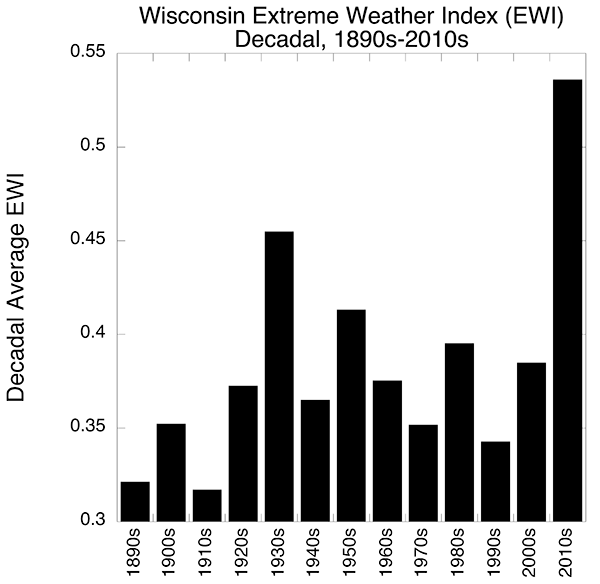
The Extreme Weather Index shows a clear spike during the 2010s and a secondary peak during the 1930s Dust Bowl. Source: Steve Vavrus, Wisconsin State Climatology Office
This “new normal” highlights the need to adopt agricultural management strategies that improve the ability of farmers to adapt to extreme weather events. How can we enhance soil resilience to extreme weather? Could cover crops be a useful tool? This article considers how cover crops can contribute to the adaptive management of extreme weather events like droughts, floods, extreme precipitation, and extreme soil temperature fluctuations.
How can cover crops affect drought resilience?
Cover crop termination timing and residue retention can be used to adapt to drought by adjusting cover crop water use and reducing soil water evaporation, respectively. Adaptive management of cover crop termination in the spring can improve drought resilience. If conditions are dry in the spring, farmers should terminate cover crops early to allow for water recharge and offset water depletion before planting cash crops. Cover crop residues on the soil surface can contribute to drought resilience by reducing soil water evaporation and regulating soil temperature. Cover crop residue may be more effective at conserving soil water under relatively mild or moderate droughts than in more severe conditions.
While specific research on how cover crops affect drought resilience is still limited, a field experiment that imposed drought conditions on corn-based rotations in a temperate environment showed that adding a red clover cover crop to the rotation enhanced corn drought resistance, maintained yields, and reduced drought-induced losses in crop yield by over 17% (Renwick et al., 2021). Cover crop effects on soil properties like aggregate stability, macroporosity, organic matter concentration, and water infiltration could help cash crop roots access water at deeper depths and are also potential long-term drought adaptation strategies.
How can cover crops capture flood waters?
Flooding risks could increase due to the localized and intense rainfall events projected to occur more frequently in Wisconsin. Management decisions that increase soil compaction and reduce infiltration can also heighten risks for flooding. Cover crops can mitigate flooding risks by taking up excess soil water and improving soil physical properties.
Cover crops can capture and use excess water during the period between cash crops. Soil water consumption by cover crops can be a problem in drought years, but it can be highly beneficial in wet years, especially in flood-prone fields. Cover crops can dry out waterlogged soils faster, allowing for more timely field access. In fields with tile drainage systems, cover crops can be a companion practice to reduce excess water and flooding risks while simultaneously absorbing excess nutrients and reducing nonpoint source pollution.
Cover crops can also mitigate flood risks by increasing water infiltration and improving other soil hydraulic properties. It can take several years of cover cropping for these soil hydraulic properties to shift, but deep-rooted cover crops (e.g., brassicas) can open up compacted layers and increase water infiltration to deeper layers in the soil profile in the short-term. While cover crops can help the management of waterlogged or moderately flooded soils, extended floods can limit their effectiveness.
How can cover crops help with extreme precipitation?
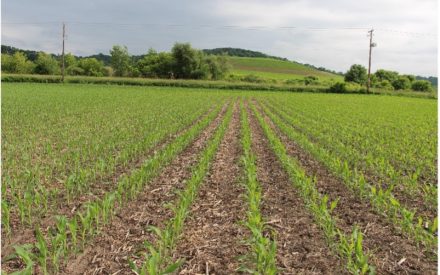
More frequent and intense heavy rain events are projected to impact Wisconsin soils. These events can delay field operations, result in replanting, and cause erosion that removes soil and nutrients from fields. Cover crops can armor and protect the soil during intense rainfalls in at least three ways. First, cover crops (canopy and residues) can intercept raindrops and buffer their erosive impact. This is one way that cover crops can reduce soil crusts compared to bare soil, thus improving infiltration. Second, soils with a history of cover crops typically have higher aggregate stability and organic matter concentrations that are more resistant to intense rainfall’s erosive energy. Third, cover crop roots hold and stabilize soils, reducing concentrated runoff that causes rill and gully erosion. Cover crop species that overwinter can mitigate erosion and flood risks in the spring more than non-winter hardy species. Data from studies in Wisconsin show winter rye cover crops can reduce runoff on an 8-15% soil slope and 2.2% soil slope by 54% and 89%, respectively, under simulated high intensity rainfall (Grabber and Jokela, 2013; Siller et al., 2016). Like other soil ecosystem services, the ability of cover crops to mitigate the effects of extreme rainfall events can be limited if aboveground and belowground biomass production is minimal.
How can cover crops help with extreme temperatures?
Temperature changes, especially higher nighttime summer temperatures and increased temperatures during late fall through early spring, are projected to impact Wisconsin agricultural soils. Can cover crops buffer extremes in soil temperatures? On a daily basis, soils under cover crops are cooler during the day and warmer at night relative to soils with no cover crops. On a seasonal basis, soils under cover crops are warmer in winter and cooler during the rest of the year. Cover crops can also decrease the amplitude of day and night temperatures more than average temperatures resulting in less temperature variability. The influence of cover crops on soil water dynamics also alters soil thermal properties that play a role in stabilizing soil temperatures and minimizing the potential adverse effects of extreme soil temperature swings.
Table 1. Ways in which cover crops can help agricultural soils develop resilience and adaptation to extreme weather events (Adapted from Blanco, 2023)
| Weather Event | Cover Crop Benefits |
|---|---|
| Drought | – Reduce evaporation – Improve macroporosity and infiltration – Improve rooting depth to access water deeper in soil profile |
| Flooding | – Reduce excess water via transpiration – Improve macroporosity and infiltration – Improve rebounding capacity after floods |
| Precipitation Extremes | – Protect soil surface from raindrop erosive impact – Improve macroporosity and infiltration, reduce surface crusting – Anchor the soil with roots and reduce concentrated runoff |
| Temperature Extremes | – Cover and insulate the soil surface – Reduce evaporation – Decrease the amplitude of day and night temperatures |
How can cover crops increase resilience to extreme weather events?
Resilience refers to the ability of soil to withstand and recover from disturbances like the extreme weather events discussed in this article. Unfortunately, resilience is tricky to measure, especially at large scales. In a significant stride towards understanding and strengthening soil resilience in the face of extreme weather, a recent study investigated whether cover crops reduce extreme weather-related production losses in the main row crop production region of the Midwestern USA (Aglasan et al., 2024). Specifically, the study evaluated whether the adoption of cover crops serves as a buffer against the economic fallout of extreme weather events, particularly looking at crop insurance losses. There were three major takeaways from the study by Aglasan and his team.
First, counties with higher cover crop adoption had significantly reduced crop insurance losses associated with extreme weather events. Second, cover crops likely have more substantial loss mitigation effects against excess precipitation events and somewhat weaker loss mitigation impacts against droughts and extreme temperatures. Third, cover crops have the potential to enhance resilience in agricultural systems, especially in the face of climate change-induced extreme weather events like those projected for Wisconsin. By mitigating crop insurance losses, cover crops are an effective and practical tool for farmers to enhance their adaptation to extreme weather events and protect their economic interests. Cover crop effectiveness, however, depends on cover crop biomass production, cover crop species, tillage systems, and the extent of weather fluctuations. Thus, cover crops should not be planted solely to adapt to extreme weather events. Instead, the most important takeaway from this article is that there appear to be few tradeoffs, if any, between the traditional benefits of cover cropping and the benefits of adaptation to extreme weather events. Farmers can expect cover cropping to simultaneously benefit soil health, water quality, and improve their adaptive capacity to manage extreme weather events.
Thanks to Francisco Arriaga and Daniel Smith for reviewing this article.
References and Resources
Aglasan, S., Rejesus, R.M., Hagen, S., Salas. W. 2024. Cover crops, crop insurance losses, and resilience to extreme weather events. American Journal of Agricultural Economics, 106 (4), 1410-1434.
Blanco, Humberto. 2023. Adaptation to Extreme Weather. In H. Blanco (Eds.), Cover Crops and Soil Ecosystem Services (pp. 210-222). Wiley.
Grabber, J. H., Jokela, W. E. 2013. Off-season groundcover and runoff characteristics of perennial clover and annual grass companion crops for no-till corn fertilized with manure. Journal of Soil and Water Conservation, 68, 411–418.
Renwick, L. L. R., Deen, W., Silva, L., Gilbert, M. E., Maxwell, T., Bowles, T. M., Gaudin, A. C. M. 2021. Long-term crop rotation diversification enhances maize drought resistance through soil organic matter. Environmental Research Letters, 16, 084067.Siller, A. R. S., Albrecht, K. A., Jokela, W. E. 2016. Soil erosion and nutrient runoff in corn silage production with Kura clover living mulch and winter rye. Agronomy Journal, 108, 989–999.
Published Oct. 11, 2024