

Weather and climate conditions this week in Wisconsin
Here are this week’s take-home points about the weather. As a reminder, AgWOW reports will be published weekly throughout the growing season. Scroll down for the full report.
Additionally, we’re collecting user feedback. Regardless of whether it’s your first time here or if you are a regular user, we’d love to hear from you!
Key Points
One Month Conditions
- Temperatures were 5-10°F above normal across Wisconsin last week, with portions of the southwest at 10-12°F above normal.
- Precipitation totals were highest in the northwest counties (2-4”) and were well above normal. Further east, totals were commonly 1” or less.
Impact
- Precipitation totals across UW research farm stations (Wisconet) were a mixed bag, and thus 4” soil moisture change was variable across stations. Satellite-based soil moisture models indicate improvement in the 0-100cm soil moisture profile across the northwest due to above-normal precipitation last week.
- Nearly half of Wisconsin fields have surplus topsoil moisture, according to the latest USDA NASS report.
- A less-active week of precipitation provided more days that were suitable for fieldwork with soybean planting now reported as underway. However, oat planting is lagging well behind normal pace.
- The state is drought-free after D1 drought was eliminated in the northwest. This is the first time that Wisconsin has been drought free since 9/30/25.
Outlook
- Precipitation chances are highest in the southeast and northeast counties, with multiple chances for scattered rainfall over the next 7 days.
- May outlooks are showing a lean towards conditions being cooler and drier than normal, but take note that this is not a strong lean (33-40% for most).
- Outlooks for late spring into summer (May-July) indicate uncertainty about temperatures and precipitation, showing equal chances for above-, near-, or below-normal conditions.
Agronomic, Fruit and Vegetable Considerations
Field Conditions
- Avoid trafficking fields in wet conditions to prevent compaction and rutting.
- Keep livestock out of critical and sensitive areas with soft, muddy ground, see this article on the value of keeping cattle clean.
- 2-4″ soil temperatures are warming with increased temperatures, especially in the southern half of the state. Soil temperatures should be consistently at 50 degrees F to reduce the risk of imbibitional chilling and soil-borne pathogens. Planting is underway in Southern WI.
Forage Management
- Alfalfa is greening up nicely in Southern WI. Cool temperatures will slow growth. Consider using a PEAQ (Predictive Equations for Alfalfa Quality) stick to estimate relative feed value as you decide when to make the first cut.
- As scissor clips begin throughout the state, find UW and UMN quality data using the Alfalfa Harvest Alert dashboard.
Pest Management
- Start scouting fields on foot to note which early weed species are emerging.
- Be observant of black cutworm and true armyworm moths migrating through the state. Check the DATCP Pest Trap Network Maps.
- Ensure temperatures are conducive to herbicide applications. Pre-emergent herbicides require moisture for activation.
- Monitor insect degree days. Start scouting for alfalfa weevil at 300 DD.
Manure Applications
- Reminder of Wisconsin’s NR 151 Runoff Rules with the timing of manure spreading and current runoff levels. Check DATCP Runoff Risk Advisory Forecast.
Small Grains
- Assess winter grain stands. Check winter wheat for any signs of winterkill. Reports have been minimal.
- Avoid fertilizer applications in wet and cool conditions. Nitrogen loss is greater in wet conditions. Review small grain fertility. Feekes 5 is the stage where fertilizer and herbicide applications should take place. Review growth stages here.
Fruit Considerations
- Wisconsin fruit growers can reference the updated 2026/2027 Midwest Fruit Pest Management Guide (MFPMG) for a list of registered products and recommended best pest management practices. View the MFPMG online.
- Dr. Kerik Cox (Cornell), Plant Pathologist, posts weekly NEWA apple scab and fire blight updates for New England and Wisconsin apple growers. Wisconsin locations include: Eau Claire, Gays Mills, Door County, Rochester, Trempealeau, and Verona. Check out the YouTube playlist here: New England and Wisconsin Apple Scab and Fire Blight
- Apple growers can reference the NEWA weather station network to monitor disease infection events. Make sure to keep track of green tip and petal fall dates. Check out your nearest weather station: NEWA Weather Station Network (Cornell).
- Grape growers should begin tracking phenology and keep an eye out for flea beetle and cutworms feeding on developing buds.
- Growers may consider visually scouting for lepidopteran larvae feeding on young leaf material. Keep an eye out for small holes, curled leaves and webbing.
- Tree fruit growers with historic populations of plum curculio may consider monitoring orchard perimeters and/or using pheromone monitoring traps.
- Codling moth mating disruption: If you have not done so yet, hang codling moth mating disruption dispensers prior to emergence.
- Codling moth traps: If you have not done so yet, hang codling moth pheromone traps to track first generation biofix.
- Reminder: During bloom, delay insecticide applications until petal fall to protect pollinators.
- Need insect lures or traps? Place your order here: https://www.greatlakesipm.com/
Vegetable Considerations
- Risk of crop damage from asparagus beetle larvae is high or very high for southern and central WI. When scouting, sample twenty plants from five different areas to determine if you have reached the threshold for treatment. Row cover can be a good option to exclude the beetles if eggs have not already been laid.
- Imported cabbageworm adults, white butterflies with black markings on wingtips, are now active in southern WI. Start scouting for eggs which are laid as a single egg that are yellow to orange in color. Young plants can be particularly susceptible to damage so either use insect netting to exclude adults if they are not yet active in your area or time insecticide spray to larval hatch.
- Onion maggot risk is now very high in southern WI as enough growing degree days have accumulated for peak adult flight activity. Risk will be increasing around Black River Falls, Mauston, Fond du Lac, and other cities in similar latitudes in the next week. Use the Vegetable Disease and Insect Forecasting Network to see the risk in your area. Preventative soil insecticide applications are recommended for the first generation larvae if damage to the last year’s crop was over 5-10%. For small plantings of onions, row cover can be effective if adults are not yet active in your area.
- Black cutworm moths will likely start migrating into WI in May. Check the DATCP Pest Trap Network Maps.
- The deadline for disposing of potato cull piles is May 20th. This includes waste piles of harvested potatoes, seed cutting slivers, and storage remnants. Find more details in the Vegetable Crop Update newsletter.
- Monitor lettuce for symptoms of bottom rot. Rhizcotonia solani which also causes damping off in seedlings, can also infect older plants. Symptoms start on the oldest leaves as rusty brown patches. When favorable conditions are present- warm and wet- the rot can spread to midribs and leaf blades. Management options include choosing varieties that grow more upright to reduce soil contact, planting into raised beds to help with moisture management, and weed management to reduce the number of alternative hosts. Chemical options can be found in the Commercial Vegetable Production Guide.
- Risk from the first generation of adult seed corn maggots is now high or very high in central and north central WI. This first generation overwinters in WI. When flies emerge, they are attracted to fields with high organic matter. If possible, terminate and incorporate cover crops 2-3 weeks before planting your cash crop to reduce the attractiveness of these fields as egg laying sites.
- Starting with healthy transplants is an important part of your IPM plan. Many tomato and pepper viruses are transmitted by aphids and thrips which love the warm environment of your greenhouse. Be sure to scout transplants regularly to look for these pests. Their populations can grow quickly and be difficult to control with chemical or biological methods. Therefore, it is important to limit potential sources of these viruses by not starting ornamentals in the same greenhouse as your vegetables. More information on control methods can be found here.
Dive deeper into each report section by clicking a topic below.
Precipitation Trends
7 Day Precipitation
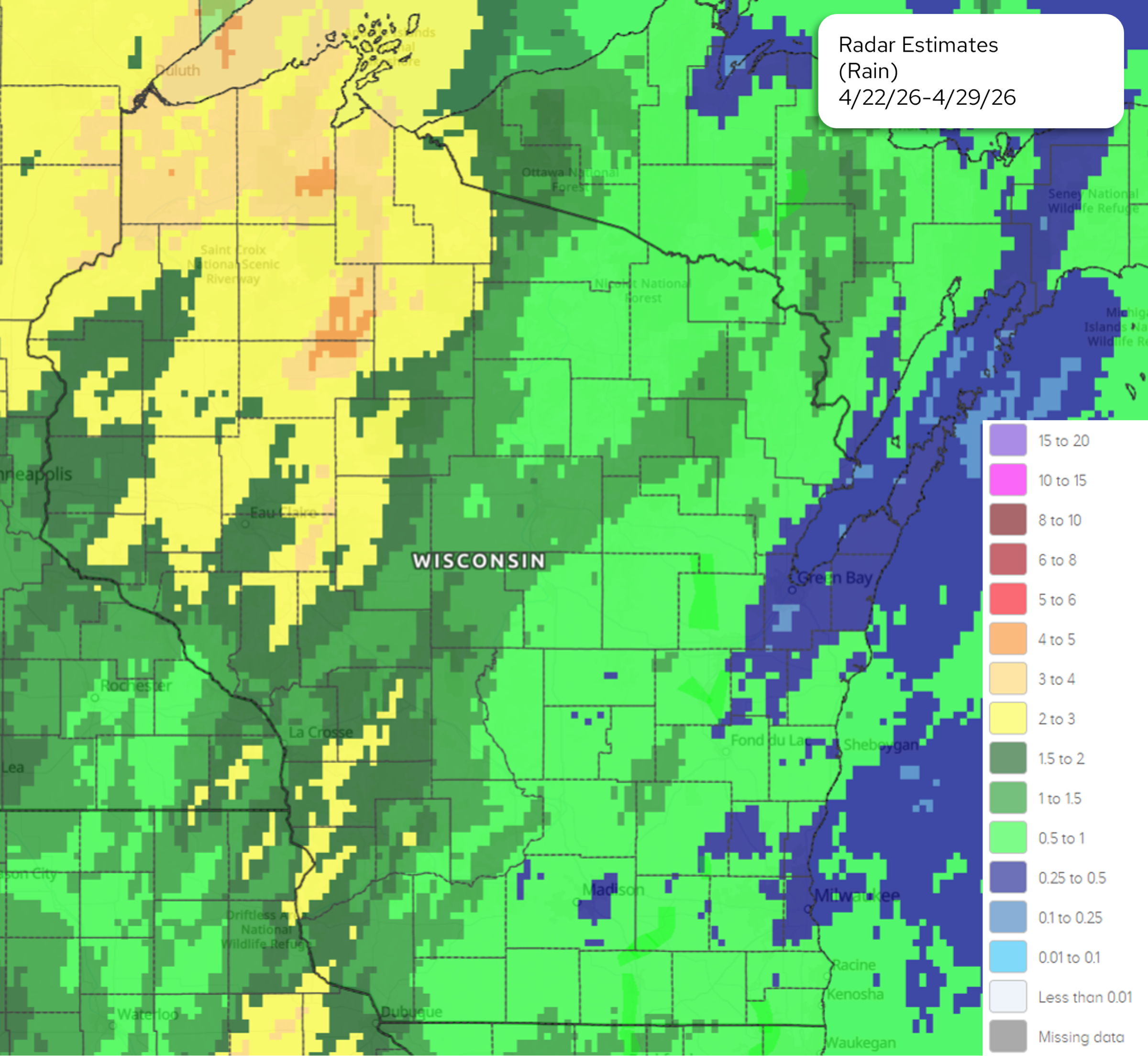
Image Description ↓
NOAA 7-day radar rainfall estimate map covering Wisconsin and surrounding regions for April 22–29, 2026. The map uses a color-coded legend measured in inches. Western Wisconsin and parts of Minnesota show yellows and oranges indicating 2–5 inches of rainfall. Central Wisconsin displays dark and medium greens representing 1–2 inches. The eastern edge of Wisconsin along Lake Michigan, including the Green Bay and Milwaukee corridors, shows dark blue indicating only 0.25–0.5 inches. The far northeast corner shows scattered light blue patches (0.01–0.25 inches). Madison, located in south-central Wisconsin, falls in the light-to-medium green range (1–1.5 inches).
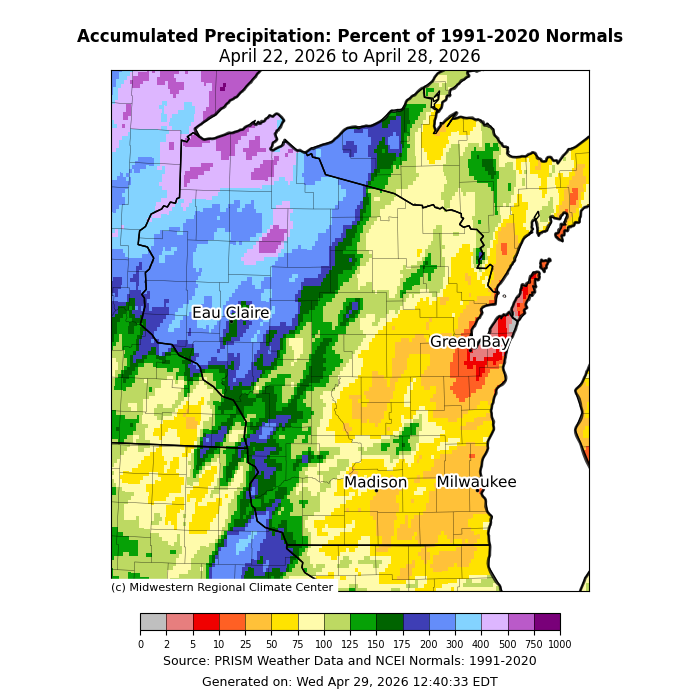
Image Description ↓
Choropleth map from the Midwestern Regional Climate Center showing accumulated precipitation as a percent of 1991–2020 normals across Wisconsin, Minnesota, and parts of surrounding states for April 22–28, 2026. Western Wisconsin and much of Minnesota received 125–300% of normal precipitation (shown in blue and purple). Central and southern Wisconsin, including the Madison area, received 50–100% of normal (yellow-green). The Green Bay and Milwaukee region shows a mix of below-normal (orange/yellow) and above-normal (red, 300–400%+) precipitation. A diagonal band of above-normal rainfall (green/blue) runs through west-central Wisconsin near Eau Claire. Data sourced from PRISM Weather Data and NCEI Normals. Generated April 29, 2026.
- The heaviest precipitation was in northwestern counties, where 2-4” of rainfall was common (200% or more of normal). There were localized areas of 5” or more in the northwest.
- Southwestern and west-central counties received 1-3” (100% or more of normal).
- Further to the east, central and eastern counties received 1” or less. The area around Green Bay and Door County received the lowest totals in the state (0.1-0.5”).
- Flood warnings are in place around the Fox Cities and in the southeast region. Check the National Weather Service website for details.
30 Day Precipitation Total and Departure from Normals
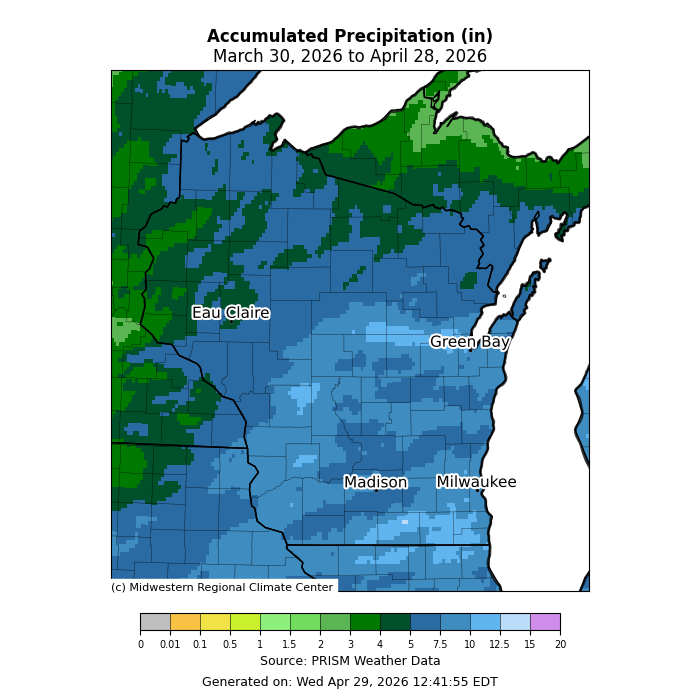
Image Description ↓
Map of Wisconsin showing accumulated precipitation (inches) from March 30–April 28, 2026. Northern Wisconsin received 5–12.5+ inches (dark green). Central Wisconsin received 3–5 inches (medium blue-green). Southern Wisconsin, including Madison and Milwaukee, received 1.5–3 inches (light blue). The western edge near Eau Claire shows localized pockets of higher precipitation (5–7.5 inches). Data sourced from PRISM Weather Data via the Midwestern Regional Climate Center.
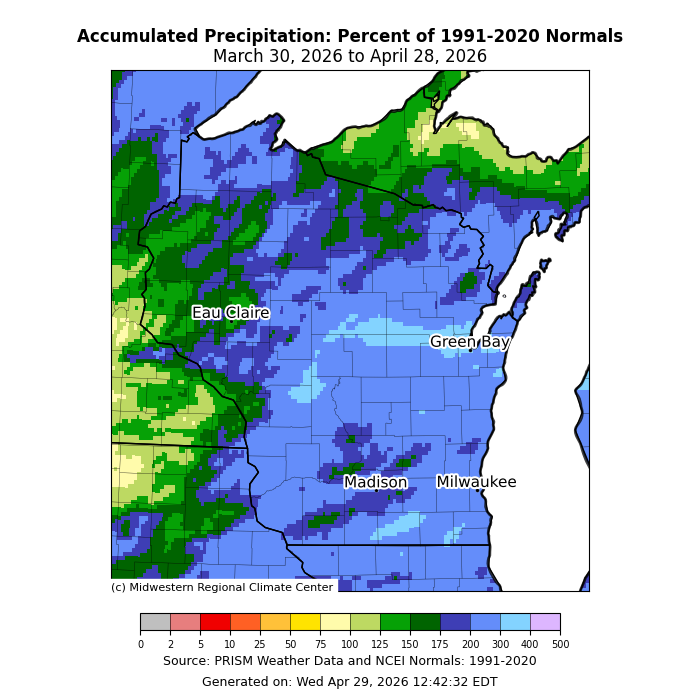
Image Description ↓
Map of Wisconsin and surrounding states showing accumulated precipitation as percent of 1991–2020 normals, March 30–April 28, 2026. Most of Wisconsin falls in the 25–75% range (blue/purple tones), indicating well-below-normal precipitation over the past 30 days. The central and south-central regions near Madison show the driest conditions, dipping into the 10–25% range. Northern Wisconsin and the Lake Superior shoreline show near-normal to above-normal precipitation (green tones, 100–175%). Western border areas of Minnesota and Iowa display above-normal precipitation (green to yellow-green, 100–200%+). Visible city labels: Eau Claire, Green Bay, Madison, Milwaukee. Source: PRISM Weather Data and NCEI Normals 1991–2020, Midwestern Regional Climate Center, generated April 29, 2026.
- Totals of 5-10” were common across most of Wisconsin, excluding portions of the north. These 30-day totals were at or above 200% of normal for most of southern and central Wisconsin.
- In the north-central and northwest regions, totals of 3-7.5” were observed. These 30-day totals were at or above 150% of normal for most.
90 Day Precipitation Total and Percent of Normals
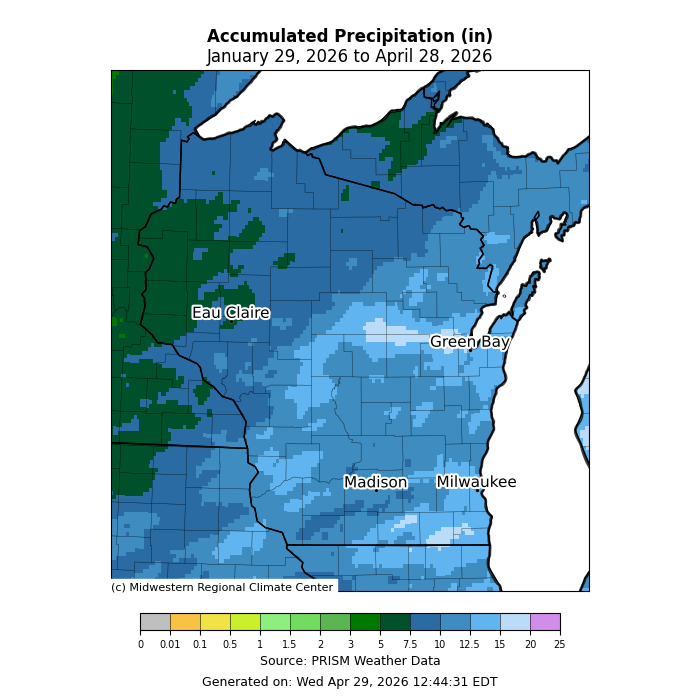
Image Description ↓
PRISM weather data map from the Midwestern Regional Climate Center showing 90-day accumulated precipitation (inches) across Wisconsin and parts of Minnesota, Michigan, and Illinois. Northwestern Wisconsin and adjacent Minnesota received the highest totals (10–20+ inches, shown in dark green). Central and southern Wisconsin, including Madison and Milwaukee, received 3–7.5 inches (light blue). Green Bay area shows slightly higher totals than Madison. A color scale runs from 0 (gray) to 25 inches (purple). Generated April 29, 2026.
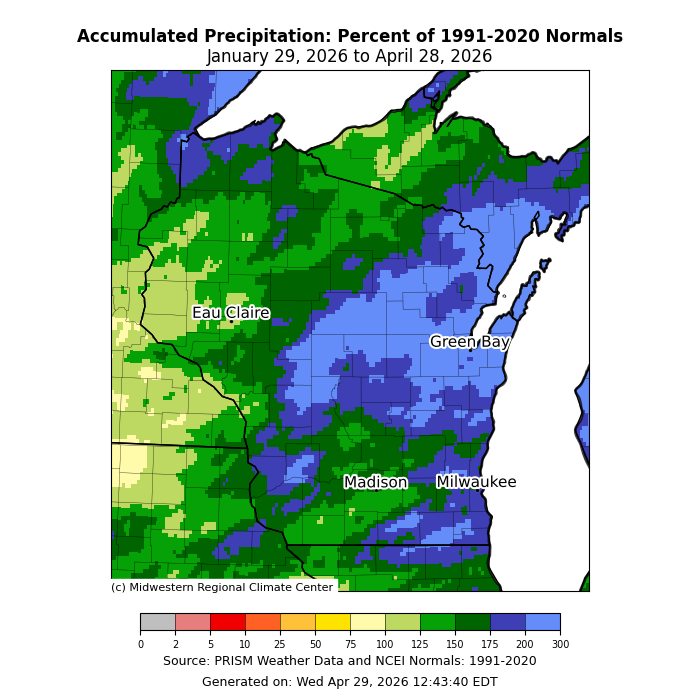
Image Description ↓
Map of Wisconsin and Upper Michigan showing 90-day accumulated precipitation as percent of 1991–2020 normals (Jan 29–Apr 28, 2026). Eastern and central Wisconsin, including the Madison and Milwaukee areas, received 125–200%+ of normal precipitation (shown in blue/purple). Northern Wisconsin and the Upper Peninsula show near-normal to above-normal totals (green, 75–150%). Western Wisconsin near Eau Claire shows below-normal precipitation (yellow-green, 25–75%), with far western areas approaching 0–10% of normal (white/light yellow). Source: PRISM Weather Data and NCEI Normals 1991–2020. Generated April 29, 2026.
- The highest precipitation totals were in east central and far southeastern counties (15” or more). A large portion of the state received over 10”.
- Precipitation totals were lowest in the northwest (5-7.5”).
- The entire state received precipitation totals that were at or above normal. In the southern, central, and eastern counties, 90-day totals were commonly at or above 150% of normal.
2026 Precipitation
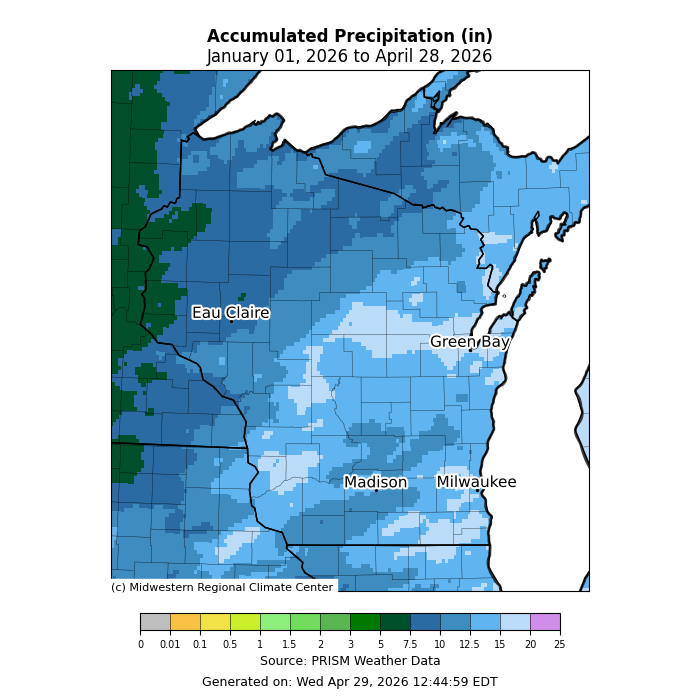
Image Description ↓
PRISM-sourced choropleth map of Wisconsin showing accumulated precipitation from January 1 to April 28, 2026. The majority of the state shows 5–12.5 inches (medium to darker blue). A notable dry pocket of 2–5 inches (light blue/white) appears in central Wisconsin between Eau Claire and Green Bay. Northwestern areas near Eau Claire trend slightly wetter. The Minnesota border region visible on the left edge shows dark green, indicating 20–25+ inches. Southern Wisconsin including Madison and Milwaukee falls in the 7.5–12.5 inch range. Color scale runs from gray (0 in.) through green, yellow, orange, and blue to pink/purple (25 in.). Data source: PRISM Weather Data; generated April 29, 2026.
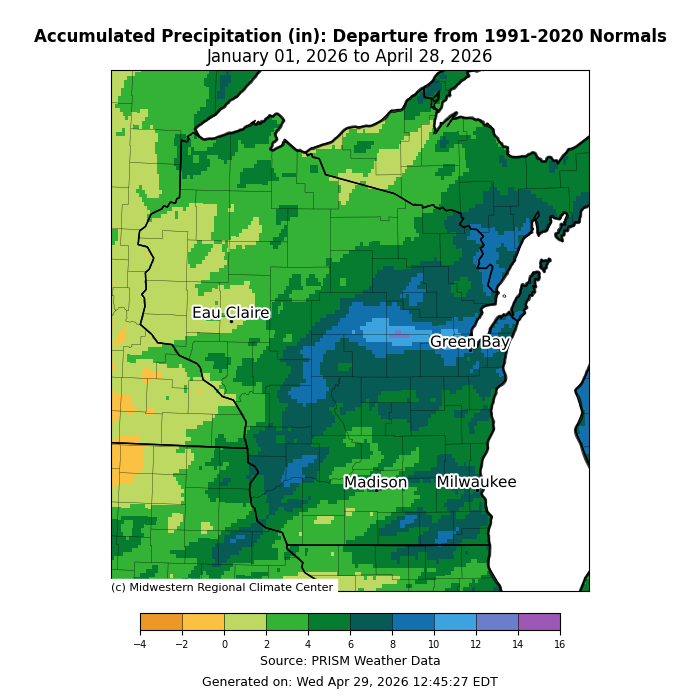
Image Description ↓
Map of Wisconsin and Minnesota showing accumulated precipitation departure from 1991–2020 normals, January 1–April 28, 2026. Most of Wisconsin shows above-normal precipitation (dark blue/teal = +8 to +14 inches), especially central Wisconsin near Green Bay. Madison and Milwaukee fall in the +4 to +8 inch range. Western Minnesota shows below-normal precipitation (orange/yellow = −2 to −4 inches). Color scale ranges from −4 (orange) to +16 inches (purple). Source: PRISM Weather Data via Midwestern Regional Climate Center.
Soil Moisture and Temperature Trends
Soil Moisture Models
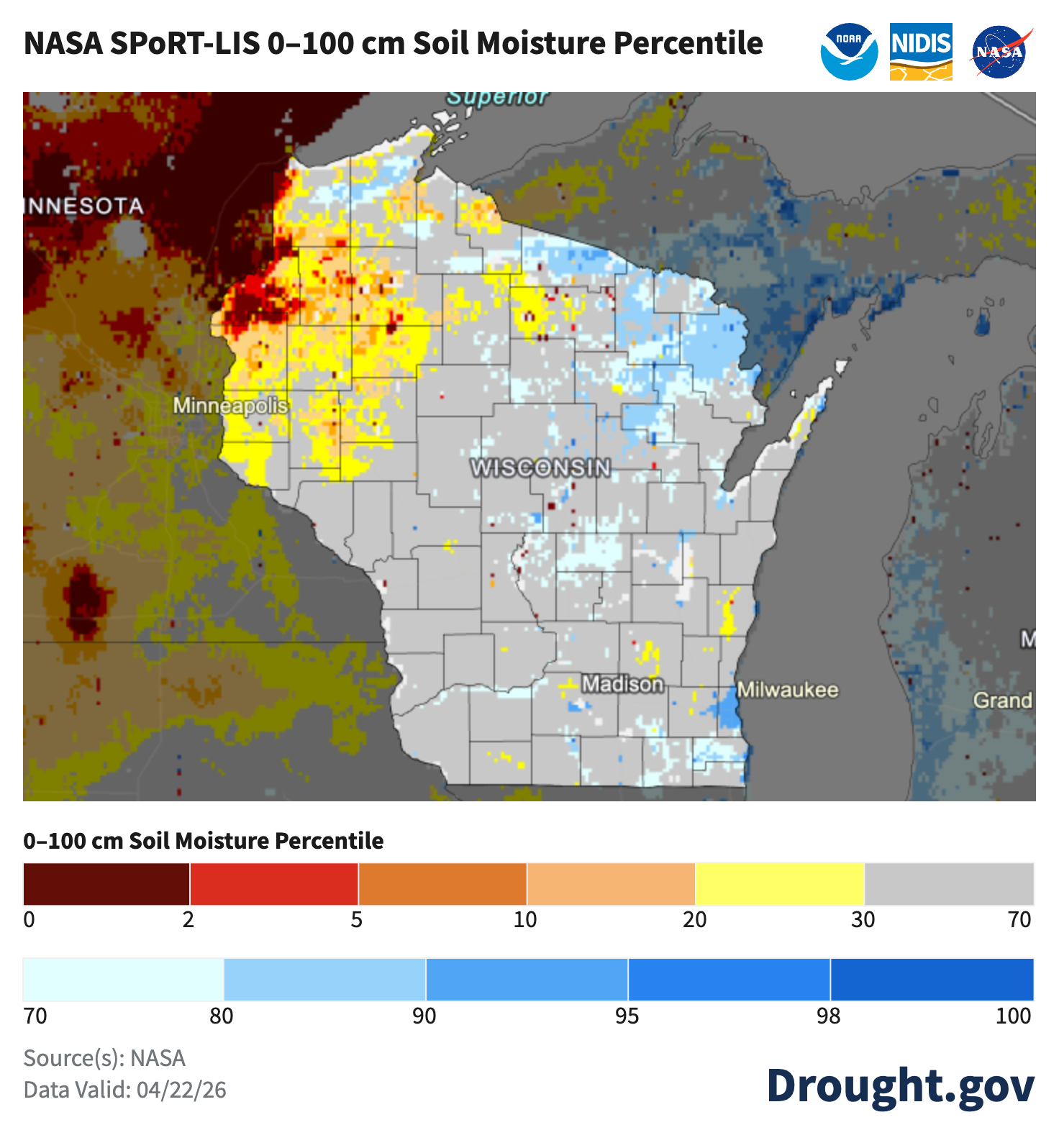
Image Description ↓
NASA SPoRT-LIS 0–100 cm Soil Moisture Percentile map valid April 22, 2026, centered on Wisconsin and eastern Minnesota. A color scale ranges from dark red/maroon (percentile 0–2, extreme dryness) through orange, yellow, and gray (near-normal, ~30–70), to light through dark blue (70–100, extreme wetness). Western Wisconsin and most of Minnesota show severe to extreme drought conditions (dark red, red, orange, yellow). Central Wisconsin is largely near-normal (gray). Northern and eastern Wisconsin, plus Lake Michigan’s western shore, show above-normal to exceptionally wet conditions (light to dark blue). Madison and Milwaukee are in or near the gray/near-normal zone with some blue patches to the east. Logos for NOAA, NIDIS, and NASA appear in the upper right. Source: NASA. Data valid 04/22/26 via Drought.gov.
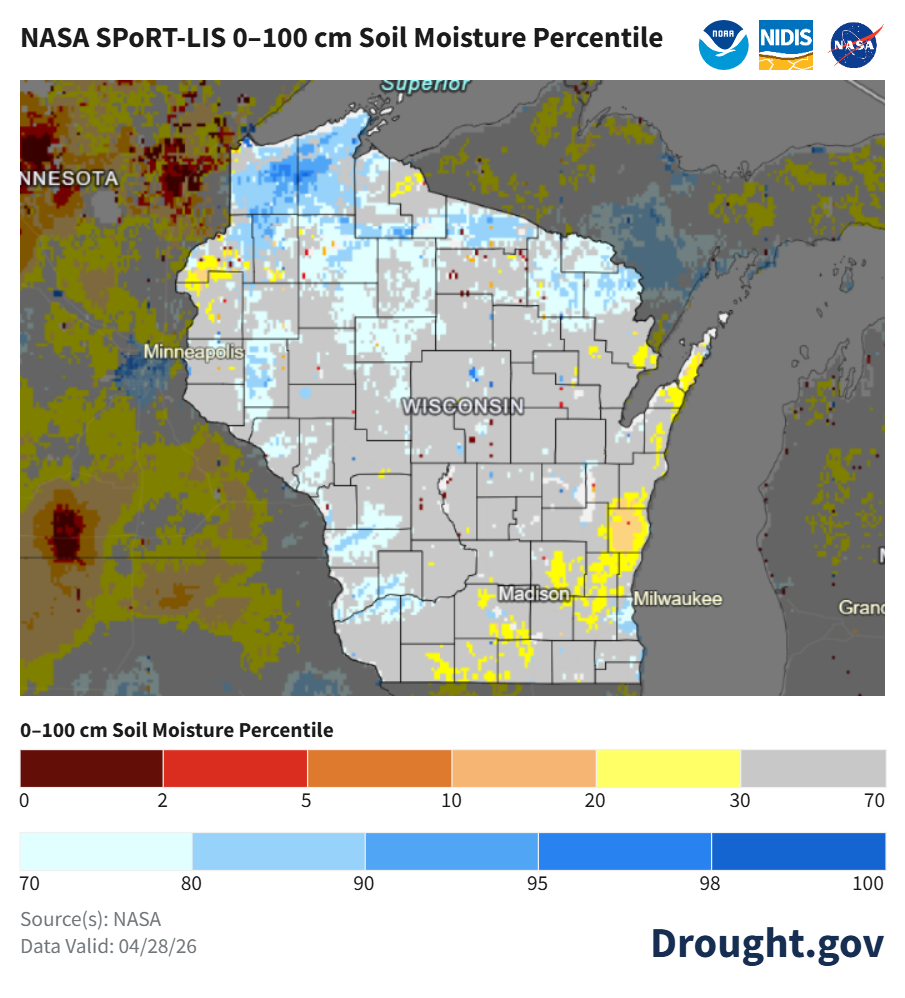
Image Description ↓
NASA SPoRT-LIS 0–100 cm Soil Moisture Percentile map centered on Wisconsin, data valid 04/28/2026. Most of central and southern Wisconsin shows near-normal soil moisture (gray, 30–70th percentile). Northern Wisconsin displays above-normal moisture (light to medium blue, 70–90th percentile). The southeastern corridor near Milwaukee and portions of south-central Wisconsin show below-normal moisture (yellow, 20–30th percentile), with isolated patches of orange and red (5–10th percentile) scattered statewide. Minnesota to the west shows severe to exceptional dryness (dark red to brown, 0–2nd percentile). The color scale ranges from dark brown (0) through yellow (20–30) for dry conditions, gray (30–70) for near-normal, and light through dark blue (70–100) for wet conditions. Source: NASA/Drought.gov.
- Soil moisture change across Wisconet stations were a mixed bag. Increases in 4-inch soil moisture were observed where precipitation totals were higher (1-2”).
- Most of the soils in the state are indicated as having near-normal moisture, with wetter-than-normal conditions common across the far north.
- Abnormal dryness is showing up in parts of southeastern and east-central counties.
- Notes on how to interpret the maps:
- Red areas = top 5 driest in 100 years.
- Dark red areas = top 2 driest in 100 years.
- Dark blue areas = top 2 wettest in 100 years.
Wisconet Soil Moisture
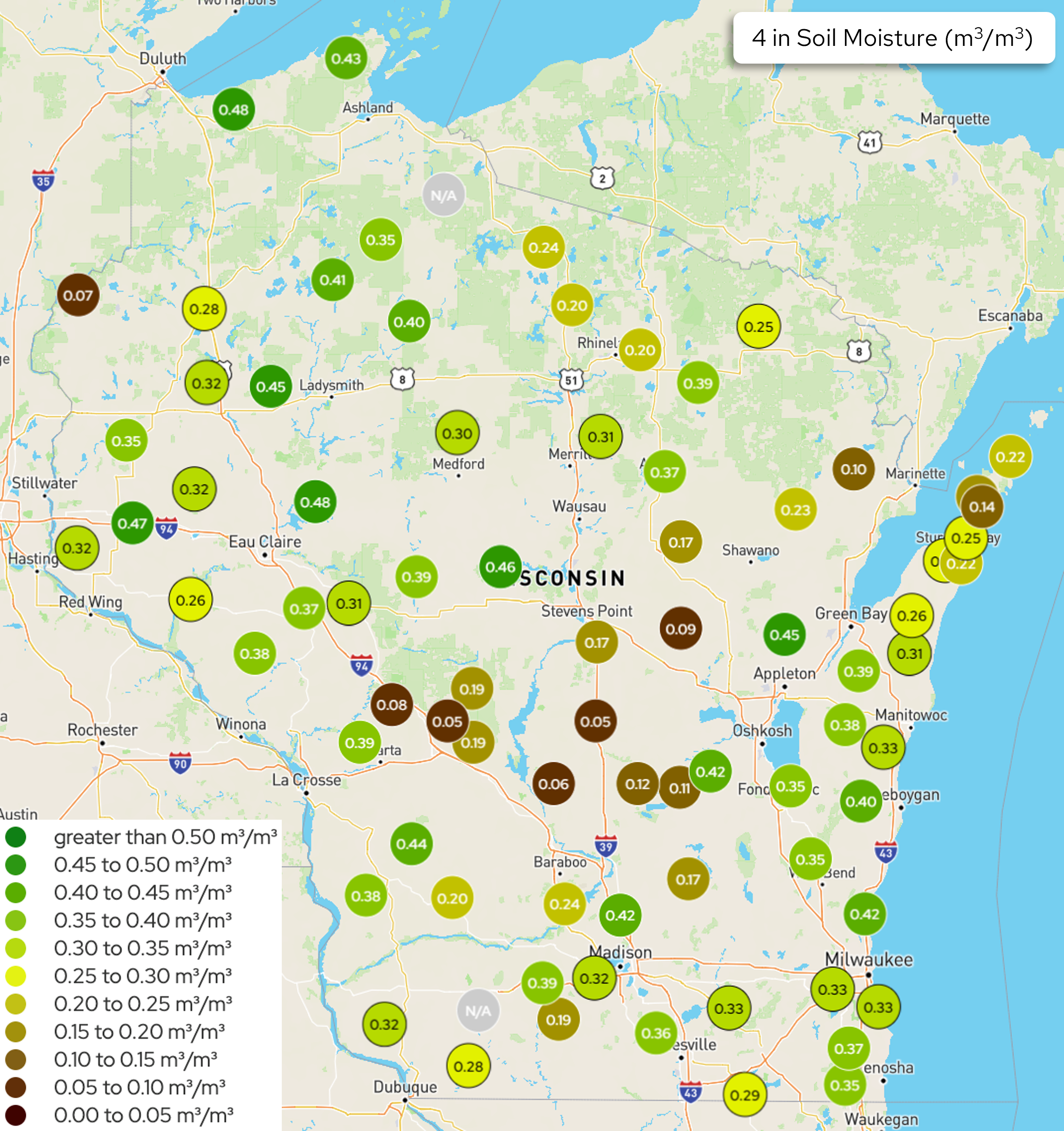
Image Description ↓
A geographic map of Wisconsin and surrounding border regions displaying soil moisture readings at a 4-inch depth, measured in cubic meters per cubic meter (m³/m³). Circular markers are placed at weather/soil monitoring stations across the state. Readings vary considerably across the state. Northern Wisconsin shows higher moisture values (0.35–0.48), while central and southern Wisconsin show a mix, with several very dry stations (0.05–0.09, brown circles) clustered in the central region near Stevens Point and La Crosse. Two stations display “N/A.” The map includes city labels and road markers for geographic orientation.
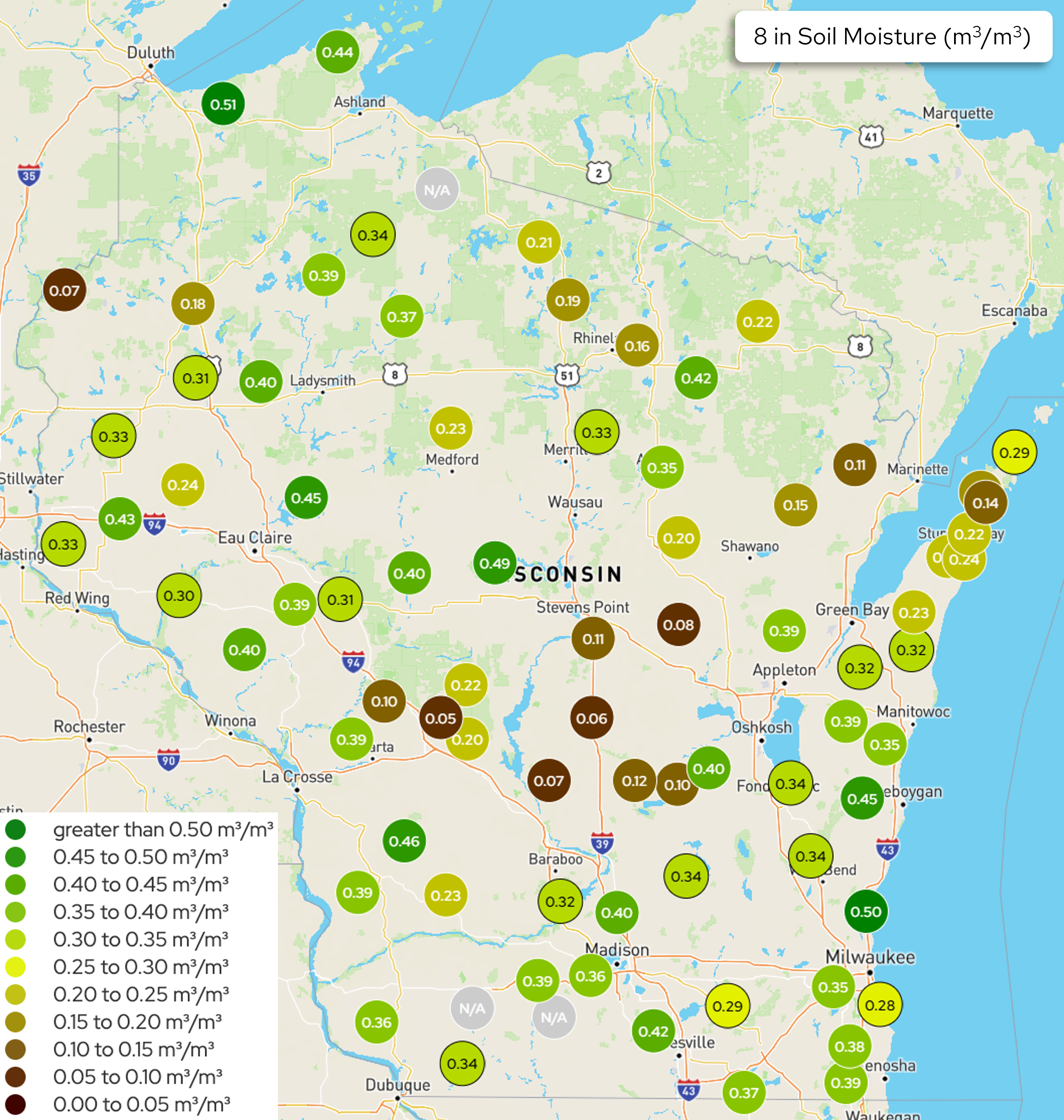
Image Description ↓
A color-coded dot map of Wisconsin displaying soil moisture measurements at 8 inches depth, measured in cubic meters per cubic meter (m³/m³). Each dot represents a monitoring station with its numeric reading displayed in white text. Dot colors follow an 11-category legend ranging from dark brown (very dry, 0.00–0.05) through olive/yellow-green (moderate, 0.20–0.35) to dark green (very wet, above 0.50). The majority of stations fall in the 0.30–0.45 range (light to medium green). Notable readings include:
Driest areas: Western-central Wisconsin shows several low readings (0.05–0.11), with one station at 0.07 in the far west
Wettest areas: Northern Wisconsin stations reach 0.51 (near Duluth) and 0.49 (central Wisconsin)
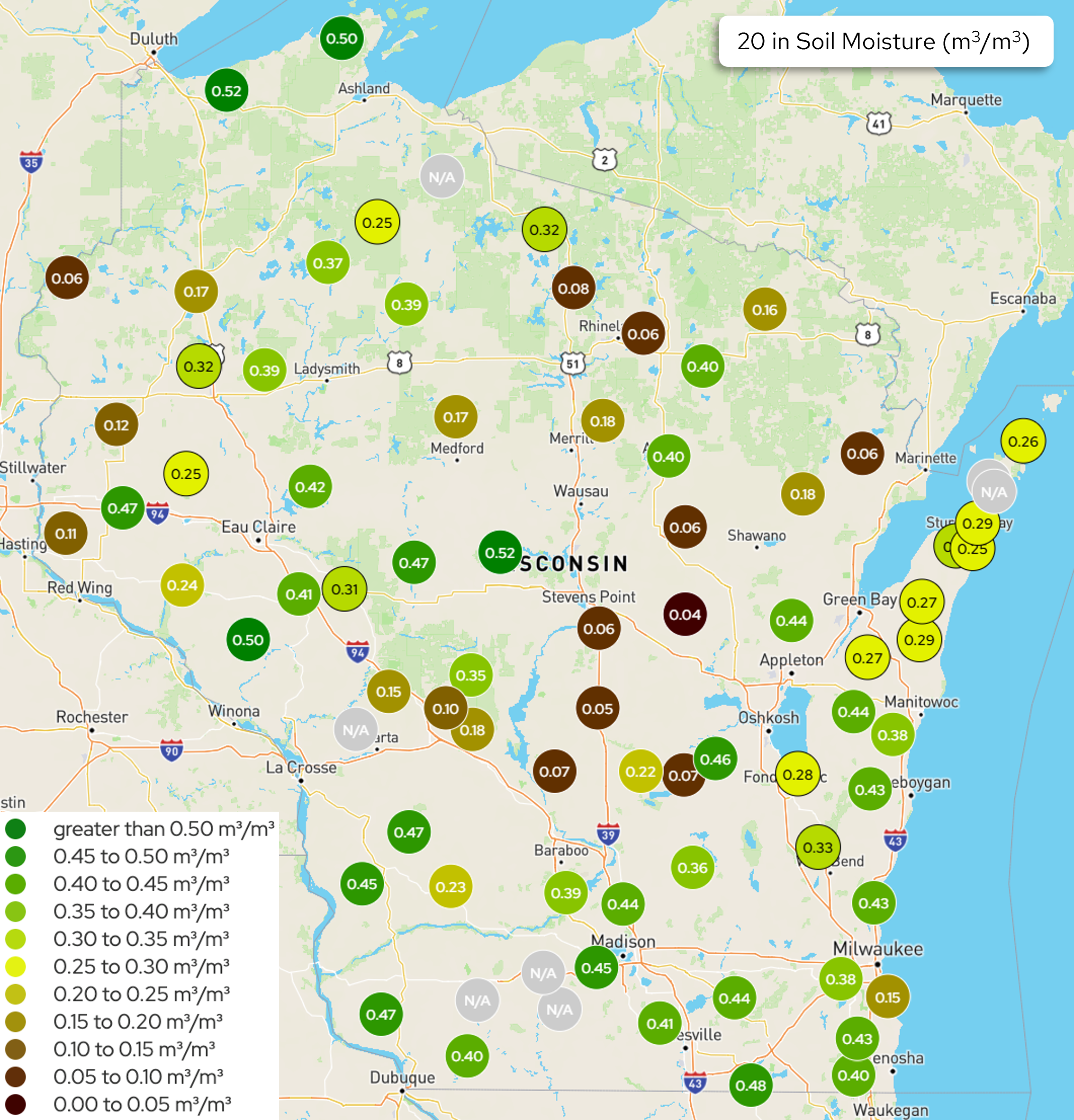
Image Description ↓
Image description: A color-coded dot map of Wisconsin showing soil moisture readings at 20 inches depth, measured in m³/m³. Dots are placed at monitoring station locations across the state and colored by moisture level according to an 11-category legend:
Several stations marked N/A (gray) in south-central Wisconsin near Madison and La Crosse
Dark green (>0.50): Northwestern Wisconsin near Duluth/Superior corridor (0.52) and central-west (0.52 near Stevens Point area)
Medium green (0.45–0.50): Multiple stations in west-central and south-central regions (0.47, 0.50, 0.48)
Yellow-green through yellow (0.25–0.45): Scattered broadly across the state
Olive/tan (0.15–0.25): Several stations in northern and central areas
Brown to dark brown (0.04–0.15): Concentrated in central Wisconsin (notably 0.04, 0.05, 0.06 near Wausau/Stevens Point corridor), indicating very dry conditions at depth
- The maps show Wisconet soil moisture conditions on April 28th @ 10:30 am.
- The table shows total precipitation and changes in soil moisture from April 21st (Start) to April 28th (End).
- Units of map & change values are {Volume of water}/{Volume of soil}.
| Research Farm | County | Total Precipitation (in.) | 4″ Start | 4″ End | 8″ Start | 8″ End | 20″ Start | 20″ End |
|---|---|---|---|---|---|---|---|---|
| Arlington | Columbia | 1.06 | 0.41 | 0.43 | 0.39 | 0.41 | 0.43 | 0.45 |
| Black River Falls | Jackson | 1.13 | 0.11 | 0.10 | 0.17 | 0.11 | 0.27 | 0.19 |
| Dairy Forage ARS | Sauk | 0.46 | 0.31 | 0.25 | 0.35 | 0.33 | 0.40 | 0.39 |
| Hancock | Waushara | 0.35 | 0.07 | 0.05 | 0.08 | 0.06 | 0.06 | 0.05 |
| Kemp | Oneida | 1.04 | 0.19 | 0.23 | 0.18 | 0.21 | 0.08 | 0.08 |
| Lancaster | Grant | 1.01 | 0.33 | 0.33 | 0.37 | 0.36 | 0.47 | 0.47 |
| Marshfield | Marathon | 0.64 | 0.43 | 0.45 | 0.48 | 0.49 | 0.52 | 0.52 |
| O.J. Noer (Turfgrass) | Dane | 0.44 | 0.37 | 0.33 | 0.38 | 0.37 | 0.45 | 0.45 |
| Peninsular | Door | 0.01 | 0.31 | 0.26 | 0.29 | 0.23 | 0.41 | 0.31 |
| Rhinelander | Oneida | 0.40 | 0.20 | 0.21 | 0.17 | 0.17 | 0.07 | 0.06 |
| Spooner | Washburn | 2.23 | 0.26 | 0.30 | 0.17 | 0.20 | 0.16 | 0.18 |
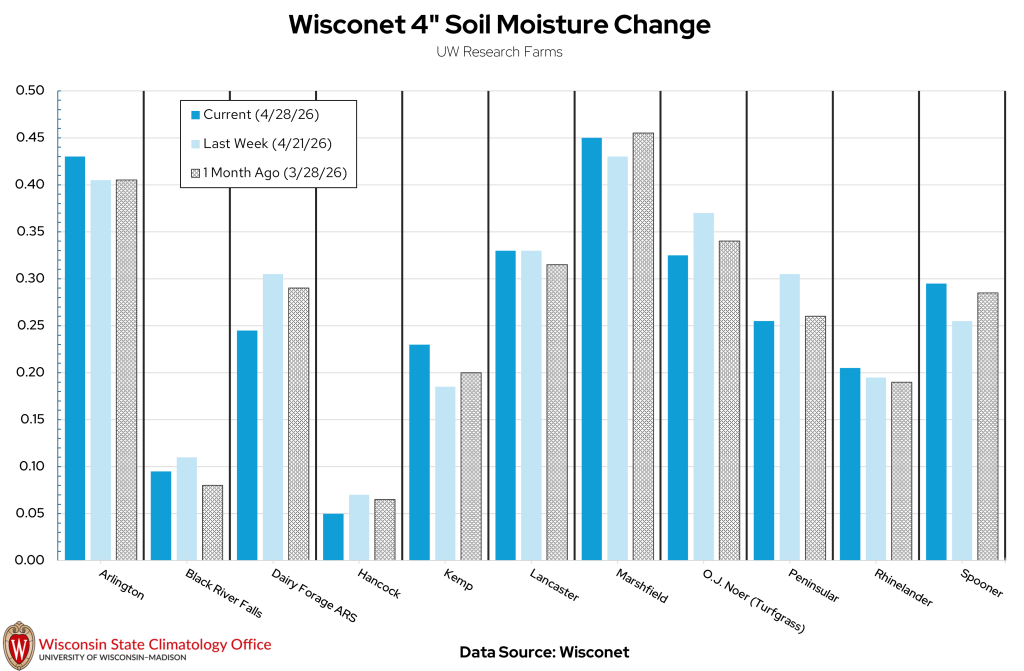
| Research Farm | Current 4″ Soil Moisture | Last Week’s 4″ Soil Moisture | 1 Month Ago 4″ Soil Moisture |
|---|---|---|---|
| Arlington | 0.43 | 0.41 | 0.41 |
| Black River Falls | 0.10 | 0.11 | 0.08 |
| Dairy Forage ARS | 0.25 | 0.31 | 0.29 |
| Hancock | 0.05 | 0.07 | 0.07 |
| Kemp | 0.23 | 0.19 | 0.20 |
| Lancaster | 0.33 | 0.33 | 0.32 |
| Marshfield | 0.45 | 0.43 | 0.46 |
| O.J. Noer (Turfgrass) | 0.33 | 0.37 | 0.34 |
| Peninsular | 0.26 | 0.31 | 0.26 |
| Rhinelander | 0.21 | 0.20 | 0.19 |
| Spooner | 0.30 | 0.26 | 0.29 |
USDA Soil Moisture Reports
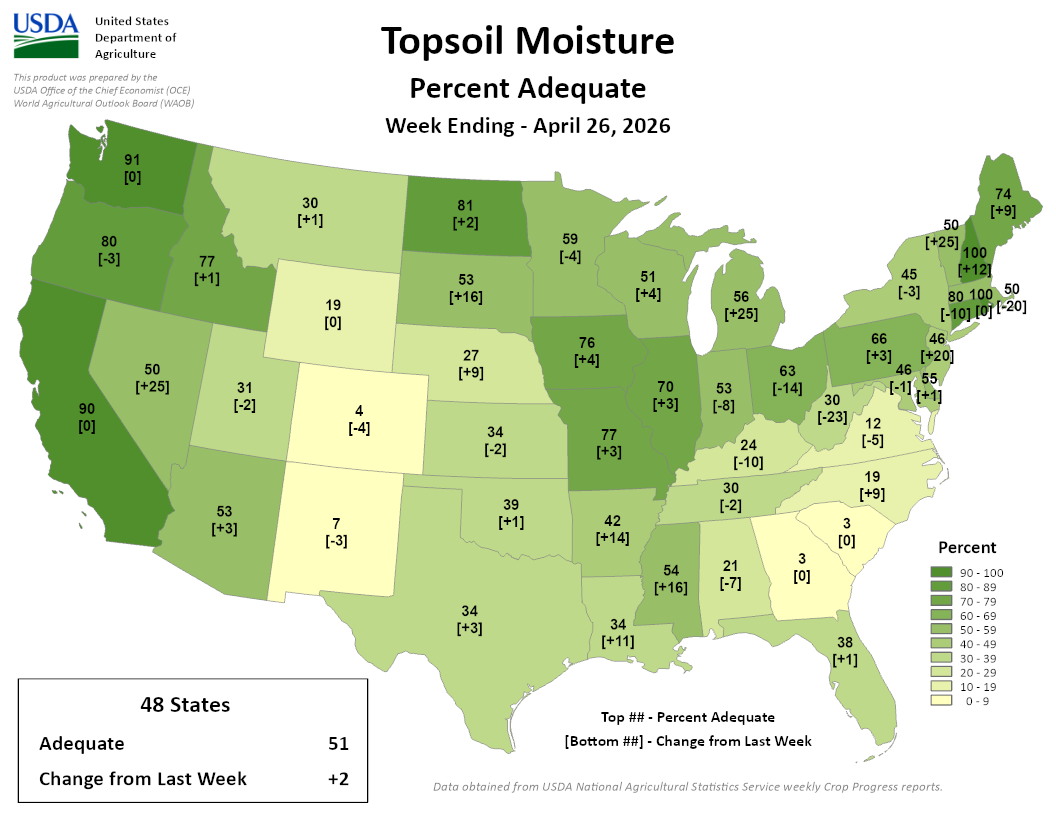
Image Description ↓
Image description: USDA choropleth map showing topsoil moisture percent adequate by state for the week ending April 26, 2026, produced by the USDA Office of the Chief Economist. Each state displays two values: percent adequate (top) and change from the previous week in brackets (bottom).
Midwest: Iowa 76% (+4), Missouri 77% (+3), Minnesota 59% (−4)
Color scale ranges from dark green (90–100%) to pale yellow (0–9%), with Wyoming and New Mexico appearing notably dry.
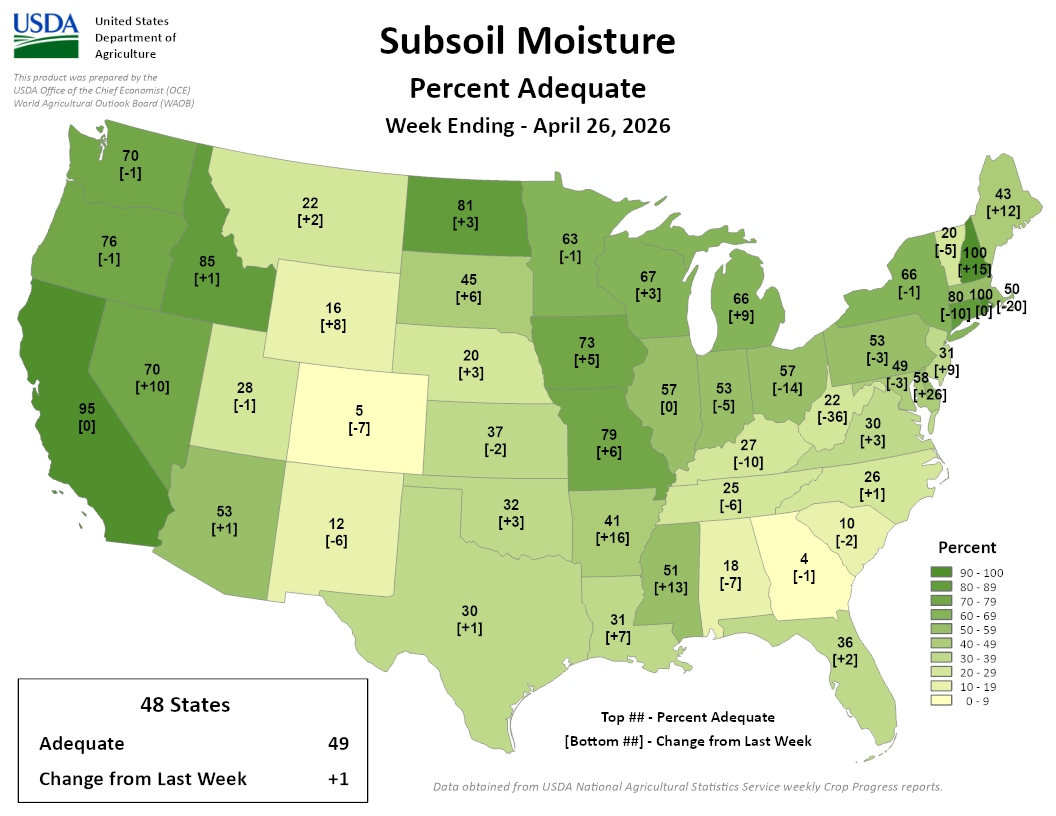
Image Description ↓
USDA choropleth map showing subsoil moisture “Percent Adequate” for 48 contiguous US states for the week ending April 26, 2026. The national average is 49% adequate, up +1 from the prior week. Each state displays two values: percent adequate (top) and change from last week in brackets (bottom). Color coding ranges from dark green (90–100%) to pale yellow (0–9%).
Midwest: Iowa 79% (+6), Illinois 73% (+5), Wisconsin 67% (+3), Michigan 66% (+9)
- 51% and 67% of agricultural soils in the state are reported as having adequate topsoil and subsoil moisture, respectively.
- 48% and 32% of agricultural soils in the state are reported as having surplus topsoil and subsoil moisture, respectively.
Wisconet Soil Temperature
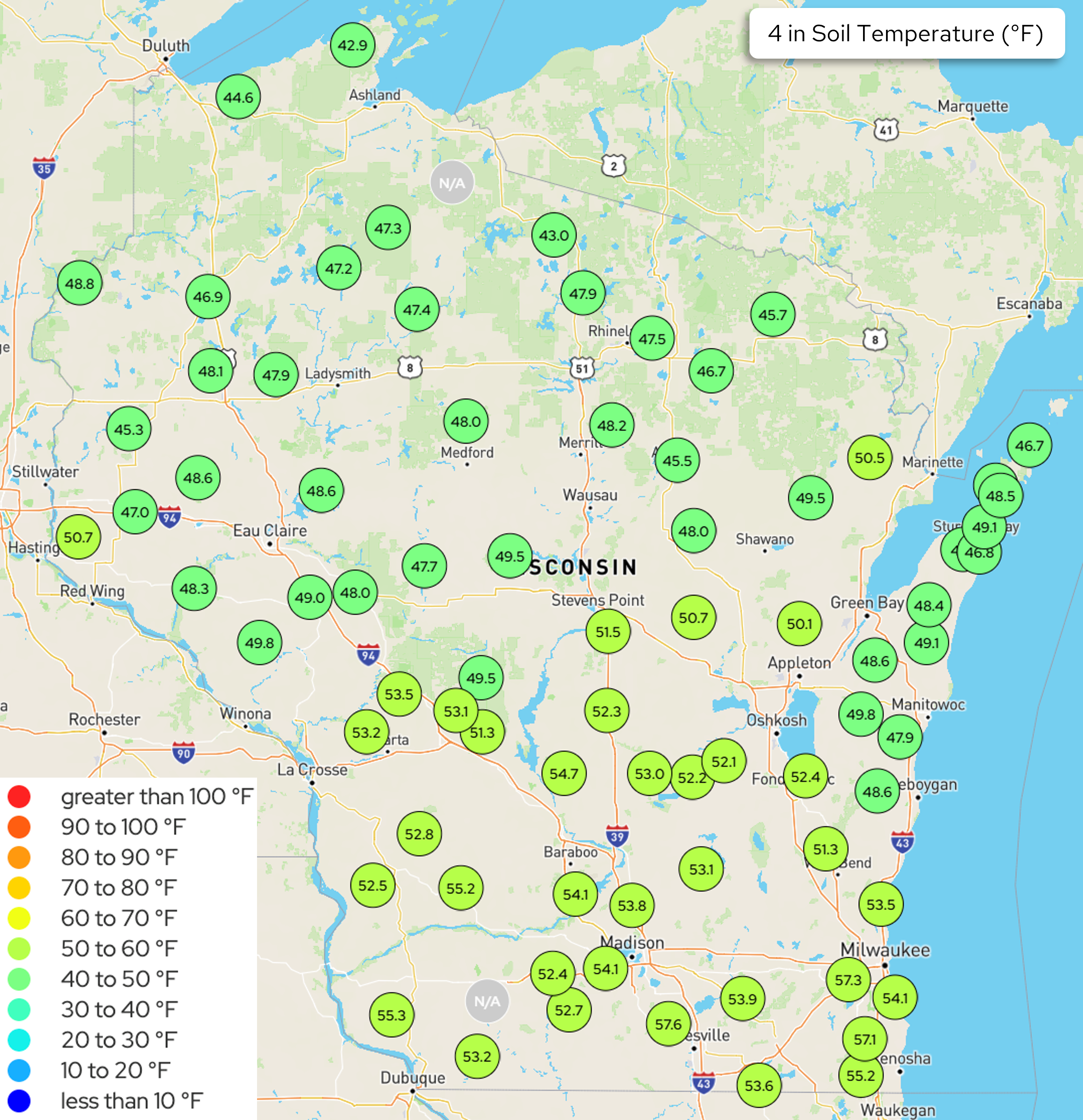
Image Description ↓
Map of Wisconsin displaying current 4-inch depth soil temperatures in °F at weather station locations, represented as color-coded circles. Temperatures range from approximately 42.9°F in the far north (near Duluth/Ashland area) to 57.6°F in the southeast (near Janesville/Milwaukee). The majority of stations fall in the 40–60°F range, shown in green and yellow-green. Southern stations cluster in the low-to-mid 50s; northern stations cluster in the mid-to-upper 40s. One station near Rhinelander and one in southwest Wisconsin are marked “N/A.” The color legend ranges from dark blue (less than 10°F) through cyan, teal, green shades, yellow, orange, and red (greater than 100°F), though only green and yellow-green values are active in this dataset.
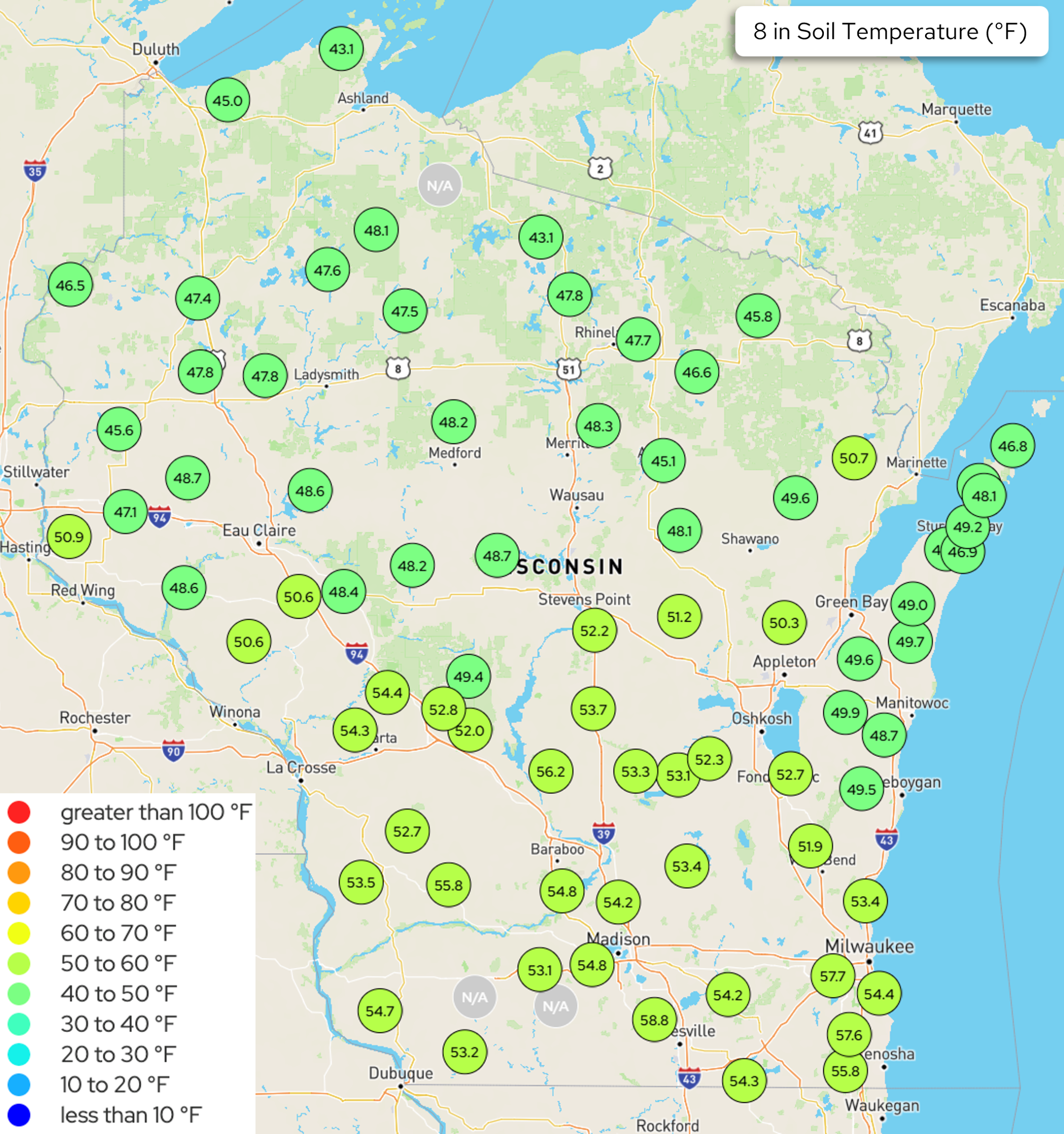
Image Description ↓
Map of Wisconsin displaying 8-inch depth soil temperatures from the Wisconsin Environmental Resources Network (WiscNet). Color-coded markers range from green (40–50°F) in the north to yellow-green (50–60°F) in the south. Northern stations report temperatures in the mid-to-upper 40s°F (e.g., 43.1 near Ashland, 45.0 northwest). Central Wisconsin shows values of 48–52°F. Southern Wisconsin is warmer, with readings of 53–58°F near Madison, Milwaukee, and the Illinois border. Two stations marked “N/A” appear in south-central Wisconsin. The full color legend spans less than 10°F (dark blue) to greater than 100°F (red); no stations currently fall outside the 40–60°F range.
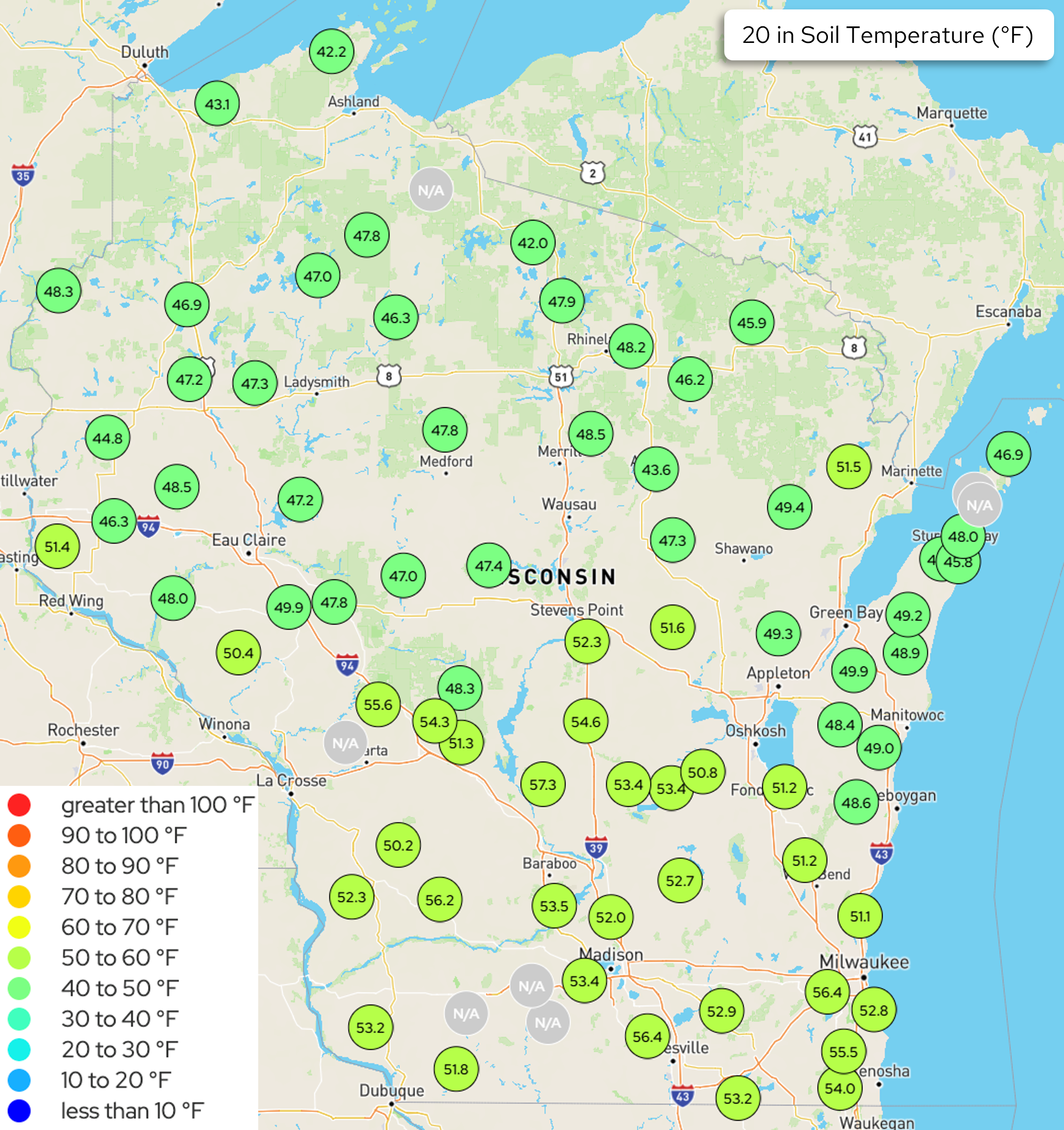
Image Description ↓
A color-coded map displaying 20-inch depth soil temperatures across Wisconsin and border areas, dated to current conditions. Circular markers show numeric readings at individual weather stations. The majority of stations fall in the 40–50°F range (medium green) and 50–60°F range (yellow-green), with no stations in extreme ranges. Key regional patterns:
- Northern Wisconsin (Ashland, Rhinelander area): 42.0–48.2°F
- Central Wisconsin (Wausau, Stevens Point area): 47.3–54.6°F
- Southern Wisconsin (Madison, Milwaukee area): 51.1–57.3°F
- Western edge (Eau Claire, La Crosse area): 47.8–56.2°F
- Eastern/Green Bay corridor: 45.8–51.6°F
Several stations display “N/A” (no data). The legend lists 11 temperature ranges from “less than 10°F” (dark blue) to “greater than 100°F” (red); only the 40–50°F and 50–60°F categories are represented in the data shown.
- The maps show Wisconet soil temperature conditions on April 28th @ 10:30 am.
U.S. Drought Monitor
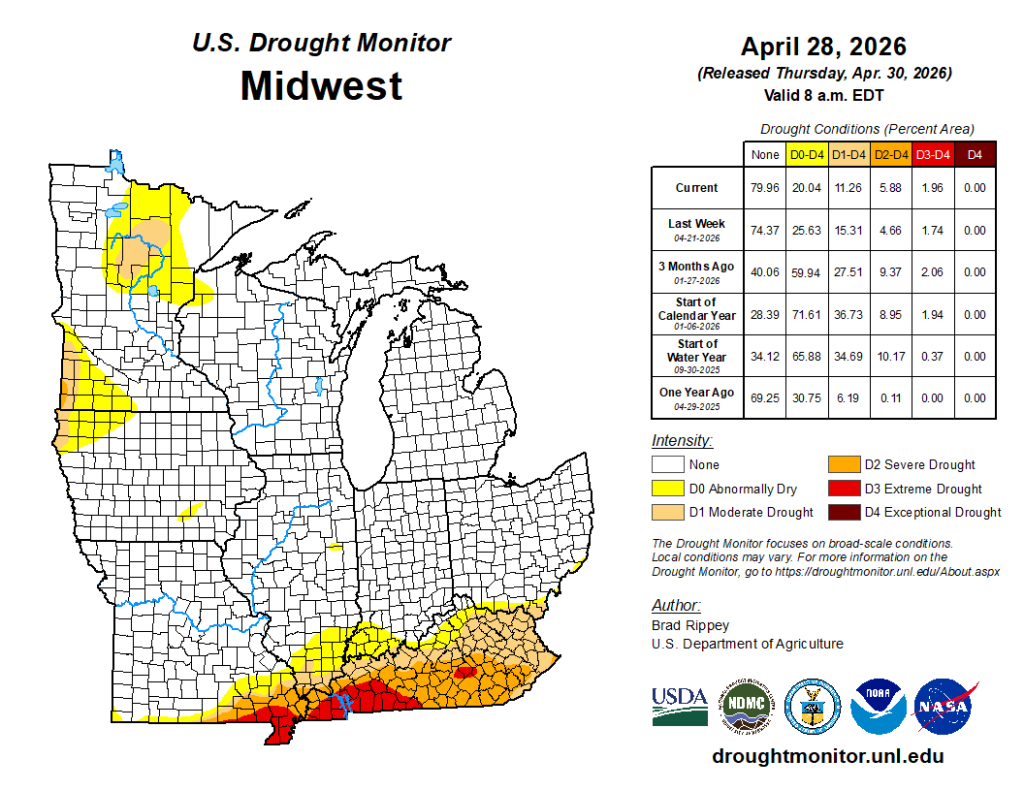
Image Description ↓
U.S. Drought Monitor map of the Midwest region dated April 28, 2026, released April 30, 2026. The map uses color coding to show drought intensity by county. The northwestern region (western Minnesota, eastern North Dakota border area) shows D0 Abnormally Dry (yellow) and D1 Moderate Drought (tan/beige) conditions. The southern tier — particularly southern Missouri, western Kentucky, and adjacent areas — shows D2 Severe Drought (orange), D3 Extreme Drought (red), and isolated D4 Exceptional Drought (dark red/maroon).
A data table shows drought conditions as percent of area:
- Current: 79.96% none, 20.04% D0–D4, 11.26% D1–D4, 5.88% D2–D4, 1.96% D3–D4, 0.00% D4
- One Year Ago (04-29-2025): 69.25% none, 30.75% D0–D4 — indicating overall improvement except in the south
- 3 Months Ago (01-27-2026): only 40.06% drought-free, showing significant recent improvement region-wide
Source: USDA, authored by Brad Rippey. Data from droughtmonitor.unl.edu.
Compared to last week:
- Midwest: Drought coverage (D1-D4) decreased by 4% from last week. One class improvement was observed across portions of Minnesota, Iowa, Wisconsin, Missouri, and along the Ohio River. Parts of Missouri and Kentucky remain in D3 or Extreme Drought.
- 88.7% of the Midwest region is drought free (~11.3% in D1-D4).
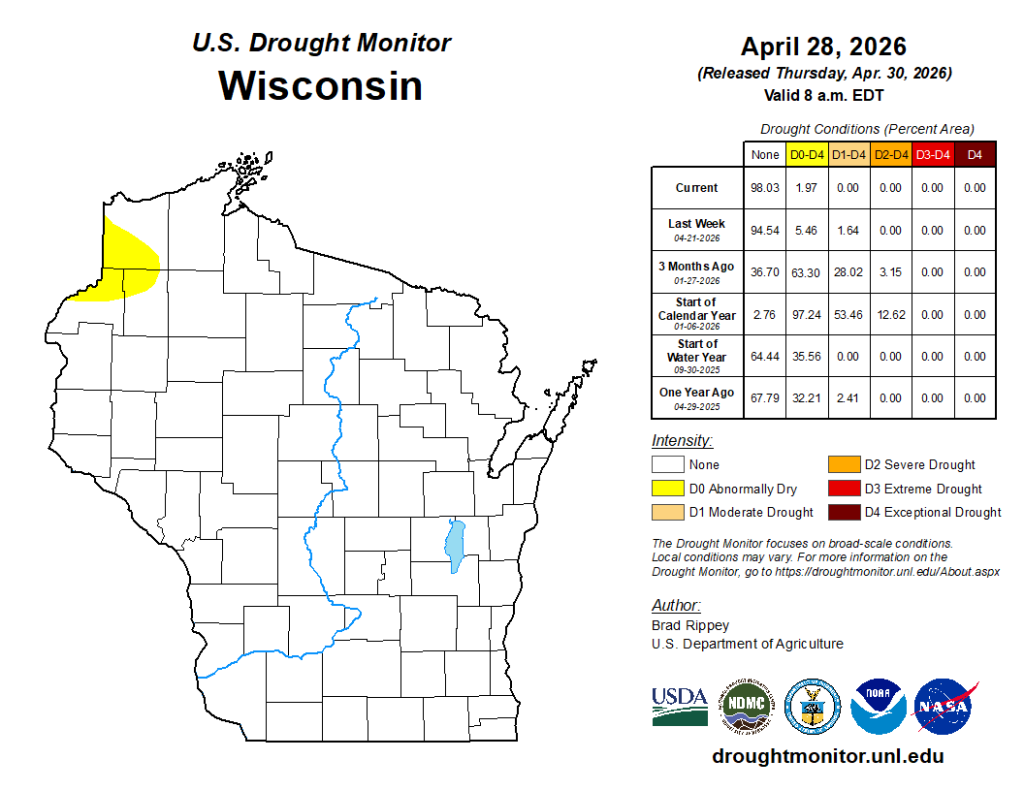
Image Description ↓
U.S. Drought Monitor map of Wisconsin dated April 28, 2026 (released April 30, 2026). A small yellow area in the northwest corner of the state indicates D0 (Abnormally Dry) conditions. The remainder of the state shows no drought.
The accompanying data table shows drought conditions as percent of area:
- Current: 98.03% None, 1.97% D0–D4, 0% at D1 or worse
- Last Week (04-21-2026): 94.54% None, 5.46% D0–D4, 1.64% D1–D4
- 3 Months Ago (01-27-2026): 36.70% None, 63.30% D0–D4, 28.02% D1–D4, 3.15% D2–D4
- Start of Calendar Year (01-06-2026): 2.76% None, 97.24% D0–D4, 53.46% D1–D4, 12.62% D2–D4
- Start of Water Year (09-30-2025): 64.44% None, 35.56% D0–D4
- One Year Ago (04-29-2025): 67.79% None, 32.21% D0–D4, 2.41% D1–D4
Published by Brad Rippey, USDA. Source: droughtmonitor.unl.edu.
- Wisconsin: The state is drought-free after D1 drought was eliminated in the northwest. This is the first time that Wisconsin has been drought free since 9/30/25.
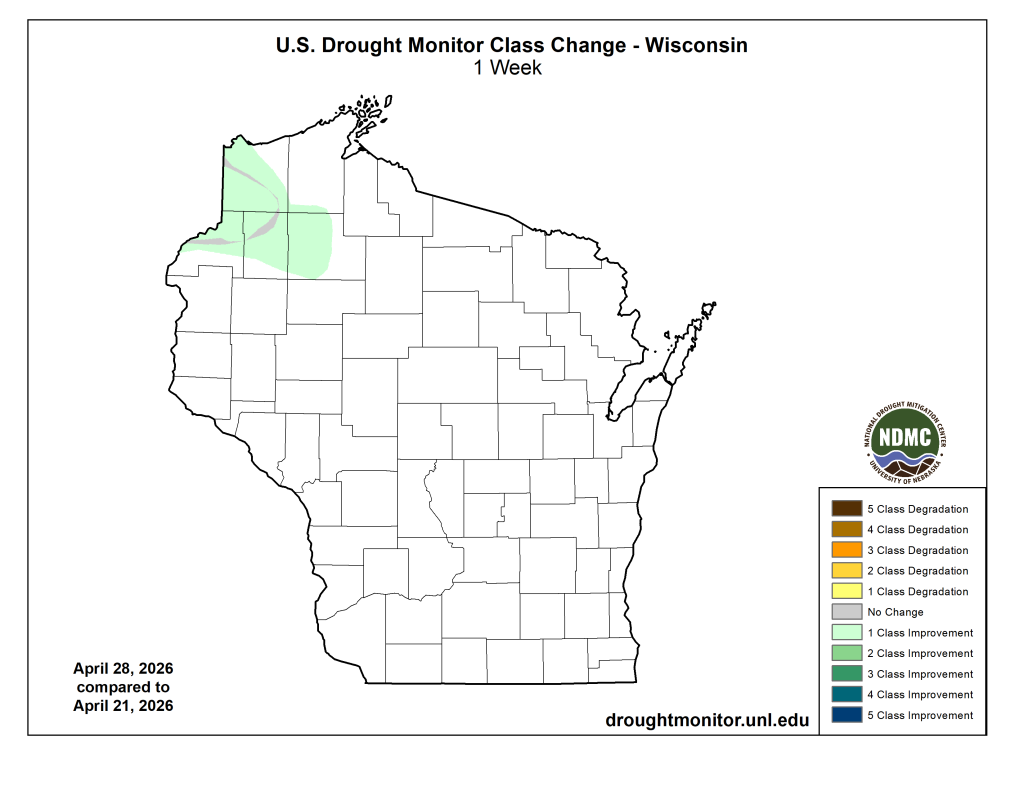
Image Description ↓
U.S. Drought Monitor Class Change map for Wisconsin showing a 1-week comparison between April 21 and April 28, 2026. A light green shaded area indicating 1 Class Improvement appears in the northwestern corner of the state, spanning portions of Douglas and Burnett counties. The remainder of the state shows no change (unshaded/white). The legend includes 11 categories ranging from 5 Class Degradation (dark brown) to 5 Class Improvement (dark navy blue). Map produced by the National Drought Mitigation Center, University of Nebraska.
- Improvement of 1 class in northwestern Wisconsin.
U.S. Drought Monitor Time Series
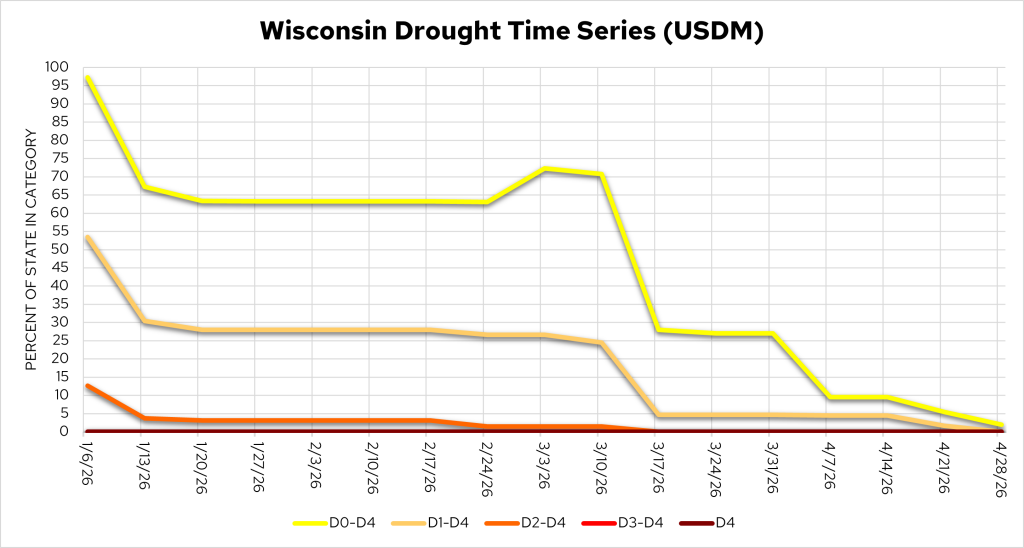
Image Description ↓
Line chart showing the percent of Wisconsin in each USDM drought category from 1/6/26 to 4/28/26. Five lines are plotted: D0–D4 (yellow), D1–D4 (tan), D2–D4 (orange), D3–D4 (red), and D4 (dark red). D0–D4 begins near 97%, holds around 63–65% through February, rises briefly to ~71% in early March, then drops sharply to ~27% by 3/17/26 and continues declining to approximately 2% by 4/28/26. D1–D4 starts near 53%, stabilizes around 27–29% through mid-March, then falls to near 0% by late April. D2–D4 begins around 13%, drops to roughly 3–5% by mid-January, remains low through the period, and reaches 0% by late April. D3–D4 and D4 remain at or near 0% throughout the entire period.
- 2% of the state remains abnormally dry (D0), all in Douglas, Burnett, and Washburn Counties.
Temperature Trends
7 Day Temperatures
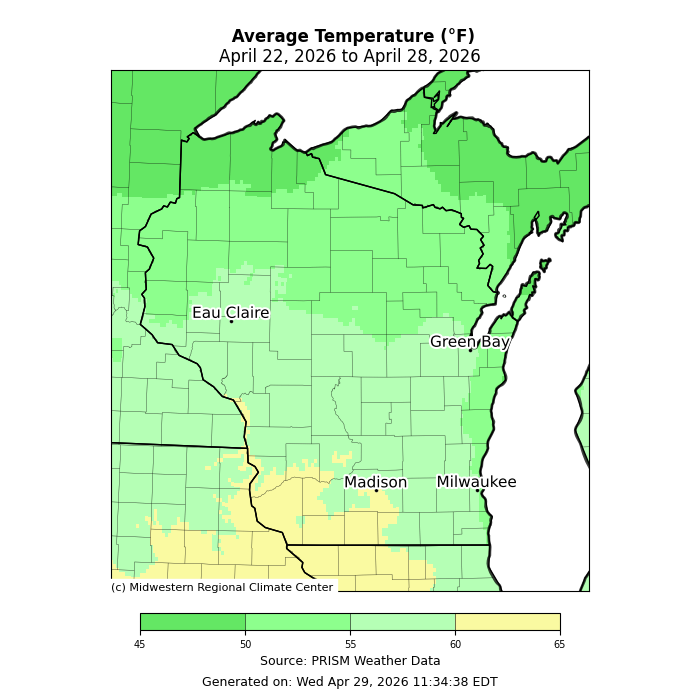
Image Description ↓
Map of Wisconsin showing average temperatures (°F) from April 22–28, 2026. Northern Wisconsin ranges from 45–55°F (darker green). Southern Wisconsin, including Madison and Milwaukee, ranges from 55–65°F (light green to yellow). The southern border region shows the warmest readings, approaching 65°F (yellow). Neighboring states visible along borders. Source: PRISM Weather Data via Midwestern Regional Climate Center.
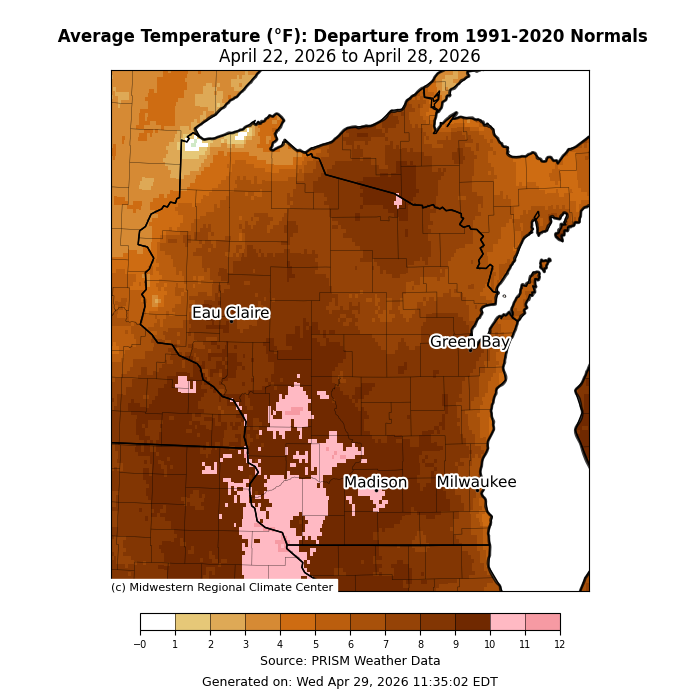
Image Description ↓
Map of Wisconsin showing average temperature departure from 1991–2020 normals, April 22–28, 2026. Most of the state is 8–12°F above normal (dark brown). A pink area centered on Madison and extending south indicates 0–3°F above normal, likely due to urban heat island effects or local weather patterns. Cities labeled: Eau Claire, Green Bay, Madison, Milwaukee. Source: PRISM Weather Data via Midwestern Regional Climate Center.
- Average temperatures ranged from 60-65°F in the southwest corner of the state to 45-50°F in the far northwest corner and in Door County.
- Temperatures were 5-10°F above normal across most of Wisconsin, with regions of 10-12°F above normal in the southwest.
30 Day Temperatures
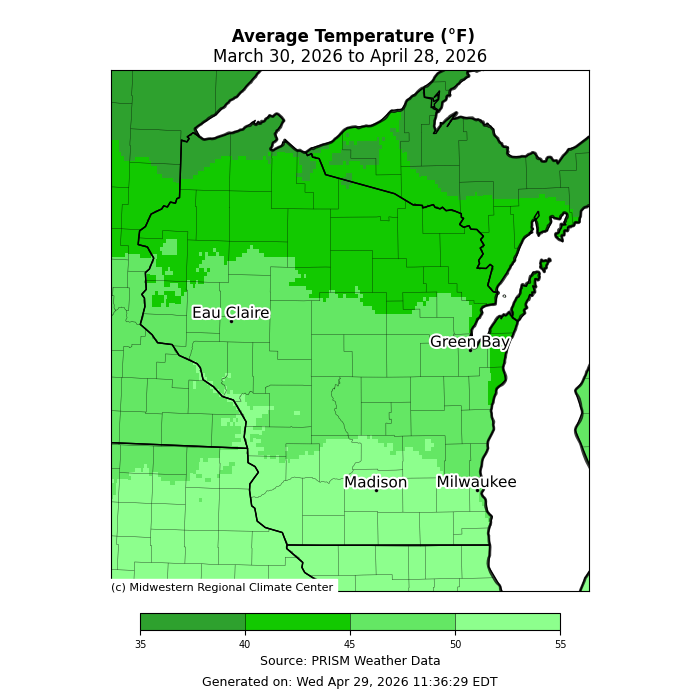
Image Description ↓
Map of Wisconsin showing average temperatures (°F) from March 30–April 28, 2026. Northern Wisconsin: 35–45°F (dark green). Central: 45–50°F. Southern Wisconsin including Madison and Milwaukee: 50–55°F (light green). Source: PRISM Weather Data via Midwestern Regional Climate Center.
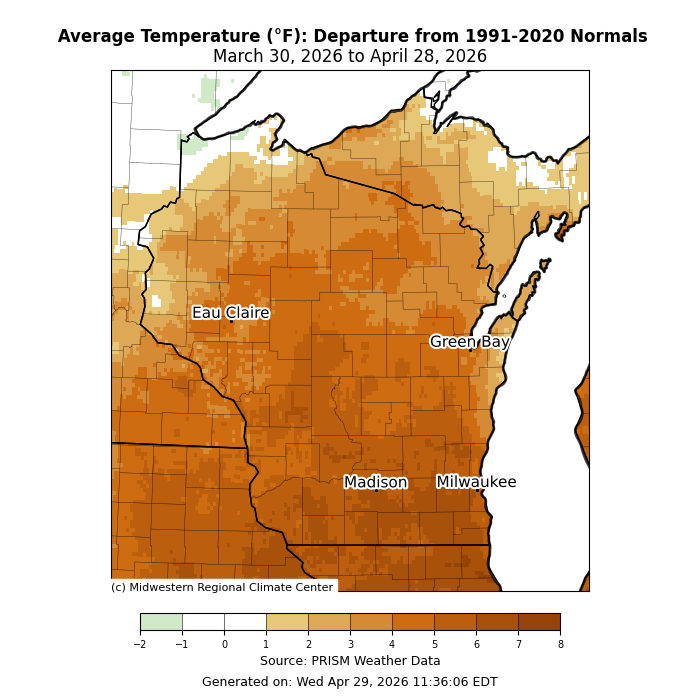
Image Description ↓
Choropleth map of Wisconsin and adjacent Minnesota border counties showing average temperature departure from the 1991–2020 climatological normals for the 30-day period ending April 28, 2026. Nearly the entire state displays warm anomalies of +3°F to +7°F above normal, represented in medium to dark orange-brown shading. The greatest departures (approximately +6°F to +8°F) appear across central and south-central Wisconsin, including the Madison and Milwaukee areas. Northern Wisconsin shows slightly lower anomalies of +2°F to +4°F. A small area of near-normal or slightly below-normal temperatures (light green, 0°F to −1°F) appears in far northwestern Minnesota and the extreme northeastern Wisconsin/Upper Michigan border region. Cities labeled: Eau Claire, Green Bay, Madison, Milwaukee. Color scale ranges from −2°F (green) to +8°F (dark brown). Source: PRISM Weather Data, Midwestern Regional Climate Center. Generated April 29, 2026.
Last Spring Freeze
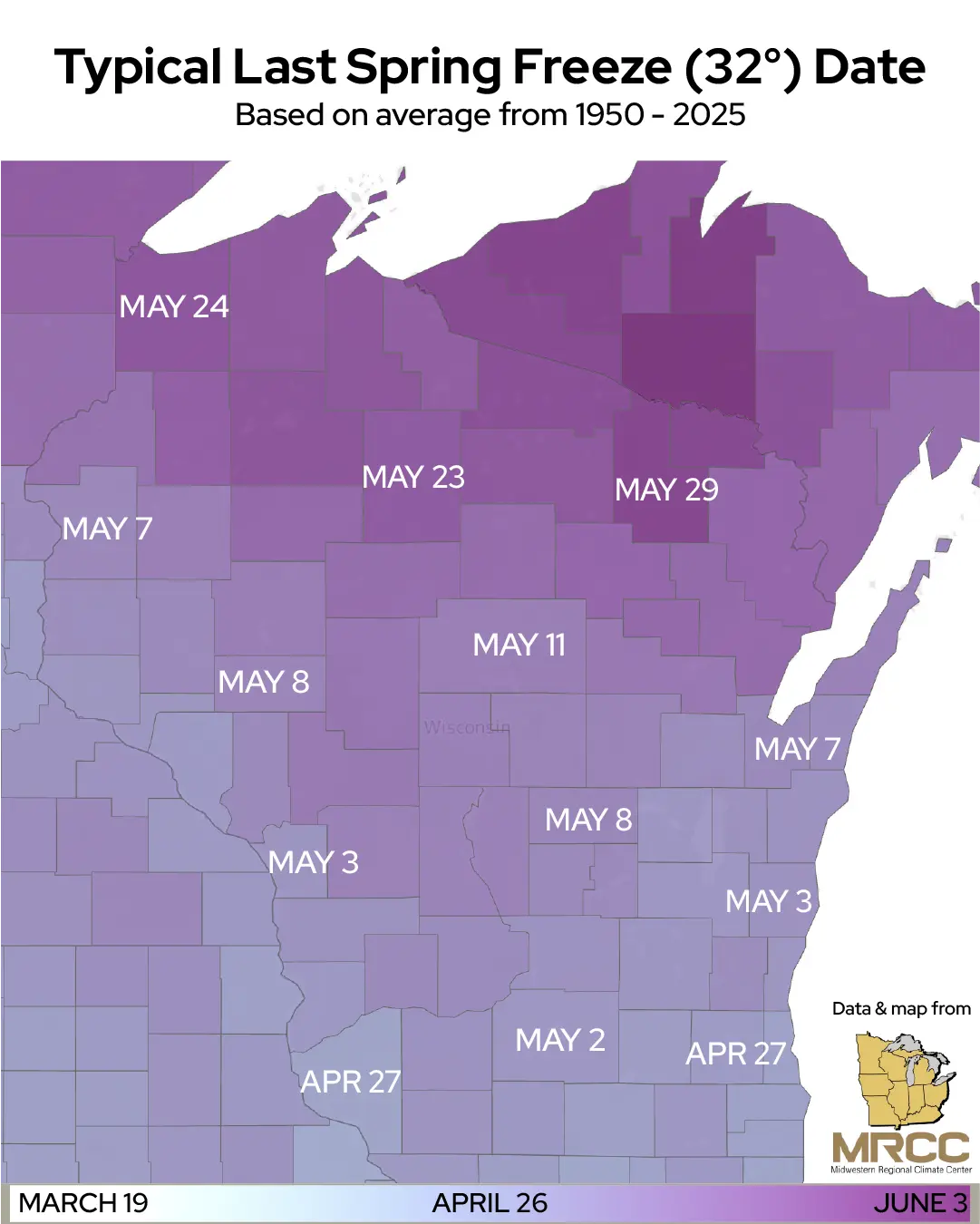
Image Description ↓
The map is titled “Typical Last Spring Freeze (32°) Date” with a subtitle stating it is based on averages from 1950–2025. It shows Wisconsin divided by counties, shaded in a purple gradient indicating the average date of the last 32°F spring freeze. Dates are labeled across the state. Southern Wisconsin shows earlier last freeze dates, mainly late April (for example, April 26–27 and May 2–3). Central Wisconsin shows early to mid‑May dates, such as May 7, May 8, and May 11. Northern Wisconsin, including areas near Lake Superior, shows later dates from mid‑ to late May, including May 23, May 24, and May 29. A color bar at the bottom indicates a progression from March 19 on the early end to June 3 on the late end. The Midwestern Regional Climate Center (MRCC) logo and a small Wisconsin locator map appear at the lower right.
- To explore data on when the last spring freeze typically occurs in your county, please check out the interactive MRCC Freeze Date Tool.
- To view an interactive map of where conditions may be favorable for frost formation over the next seven days, check out the National Weather Service Frost & Freeze Decision Support Tool.
Crop Progress and Condition
Crop Progress Report for Wisconsin for the Week Ending on April 19th
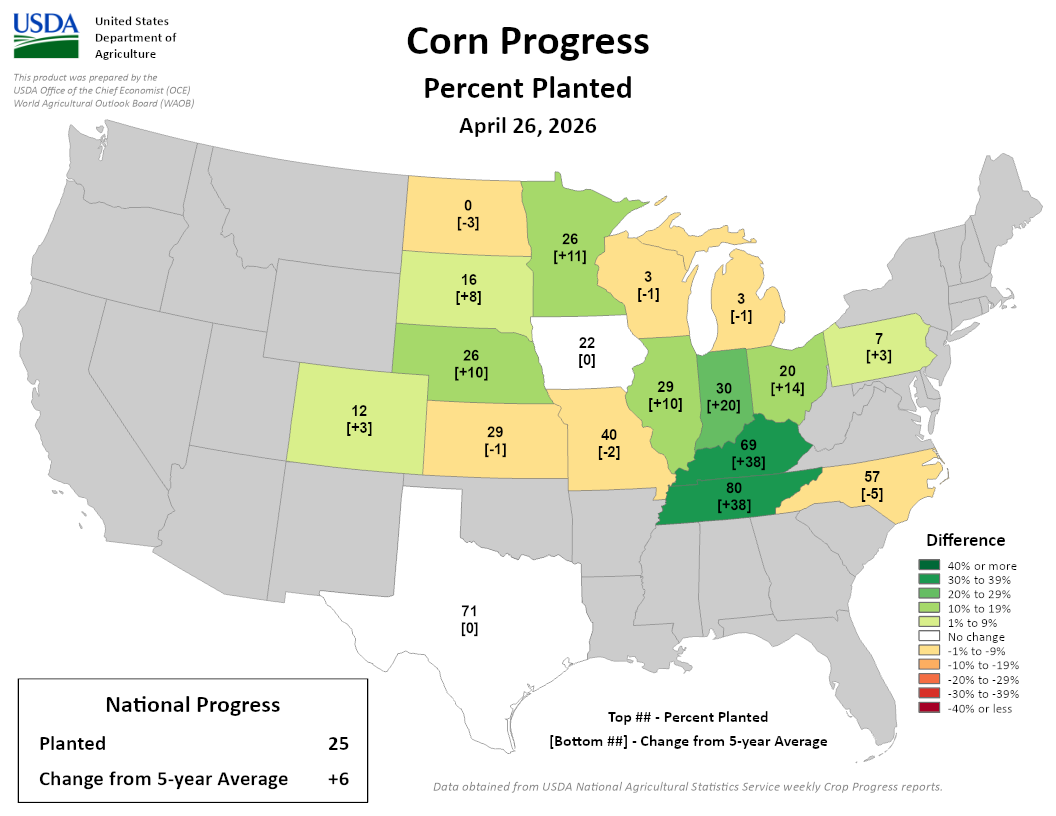
Image Description ↓
USDA choropleth map showing corn planting progress by state as of April 26, 2026. National progress: 25% planted, +6 percentage points above the 5-year average. Color coding shows deviation from 5-year average (dark green = +40% or more; red = -40% or less).
State data (percent planted [change from 5-year average]):
Michigan: 3% [−1] — light orange
Tennessee: 80% [+38] — dark green
Kentucky: 69% [+38] — dark green
Texas: 71% [0] — white (no change)
Missouri: 40% [−2] — light orange
Illinois: 30% [+20] — medium green
Indiana: 20% [+14] — light green
Ohio: 29% [+10] — light green
Nebraska: 26% [+10] — light green
Minnesota: 26% [+11] — medium green
South Dakota: 16% [+8] — light green
Kansas: 29% [−1] — light orange
Iowa: 22% [0] — white
North Carolina: 57% [−5] — light orange
Pennsylvania: 7% [+3] — yellow-green
Colorado: 12% [+3] — yellow-green
North Dakota: 0% [−3] — light orange
Wisconsin: 3% [−1] — light orange
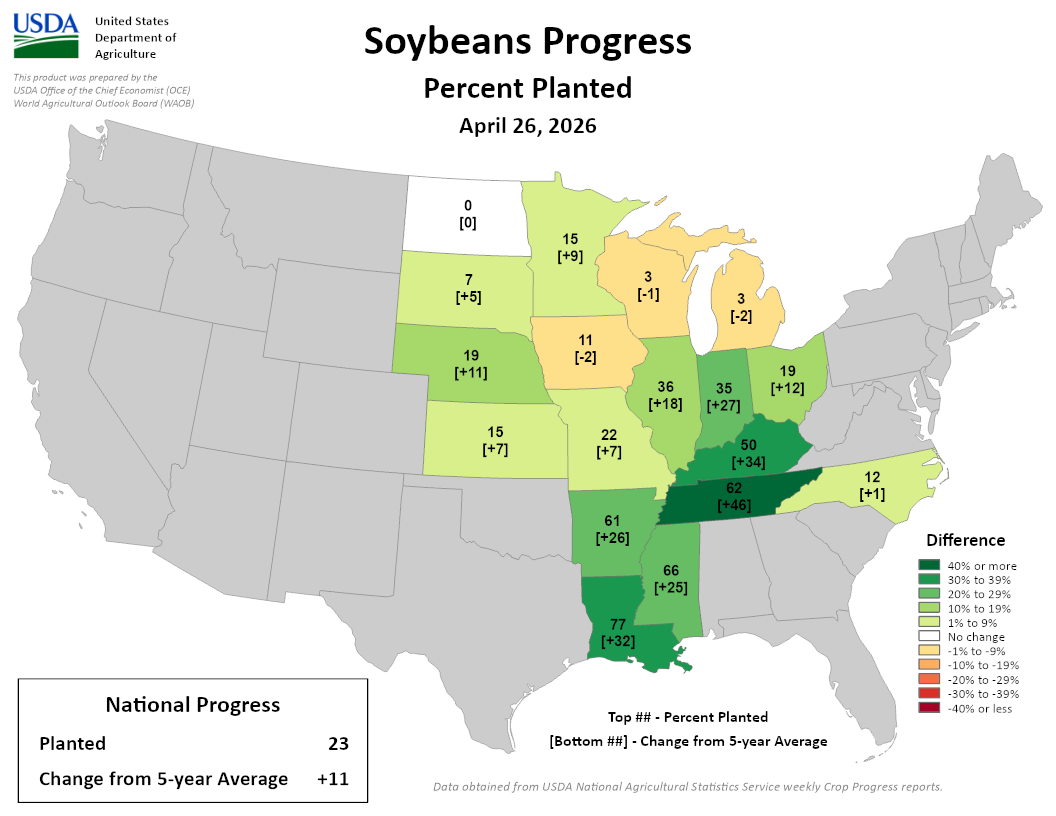
Image Description ↓
USDA choropleth map of the contiguous U.S. showing soybean planting progress by state as of April 26, 2026. Each state displays two values: percent planted (top) and change from the 5-year average in percentage points (bottom, in brackets). National progress is 23% planted, +11 above the 5-year average.
State data from north to south, west to east:
- North Dakota: 0% [+0]
- South Dakota: 7% [+5]
- Nebraska: 19% [+11]
- Kansas: 15% [+7]
- Minnesota: 15% [+9]
- Iowa: 11% [-2]
- Missouri: 22% [+7]
- Wisconsin: 3% [-1]
- Michigan: 3% [-2]
- Illinois: 36% [+18]
- Indiana: 35% [+27]
- Ohio: 19% [+12]
- Kentucky: 50% [+34]
- Tennessee: 62% [+46]
- North Carolina: 12% [+1]
- Arkansas: 61% [+26]
- Mississippi: 66% [+25]
- Louisiana: 77% [+32]
Color legend indicates difference from 5-year average: dark green (≥40%), medium greens (10–39%), light greens (1–9%), white (no change), yellow/orange (behind average), red shades (further behind).
- Wisconsin had 3.3 days suitable for fieldwork statewide. This was an increase from the previous week, with just 1.1 days suitable for fieldwork.
- Corn planting is at 3% complete, up from 1% last week.
- Soybean planting is underway, now at 3% complete.
- Oat planting jumped up 9 percentage points to 14% complete. However, this is still well behind average planting pace.
- Pasture and range were rated 45% good to excellent, up 7 percentage points from last week.
- Winter wheat was rated 53% good to excellent, up 4% from last week.
- Read the full USDA report.
Forecasts and Outlooks
7 Day Precipitation Forecast
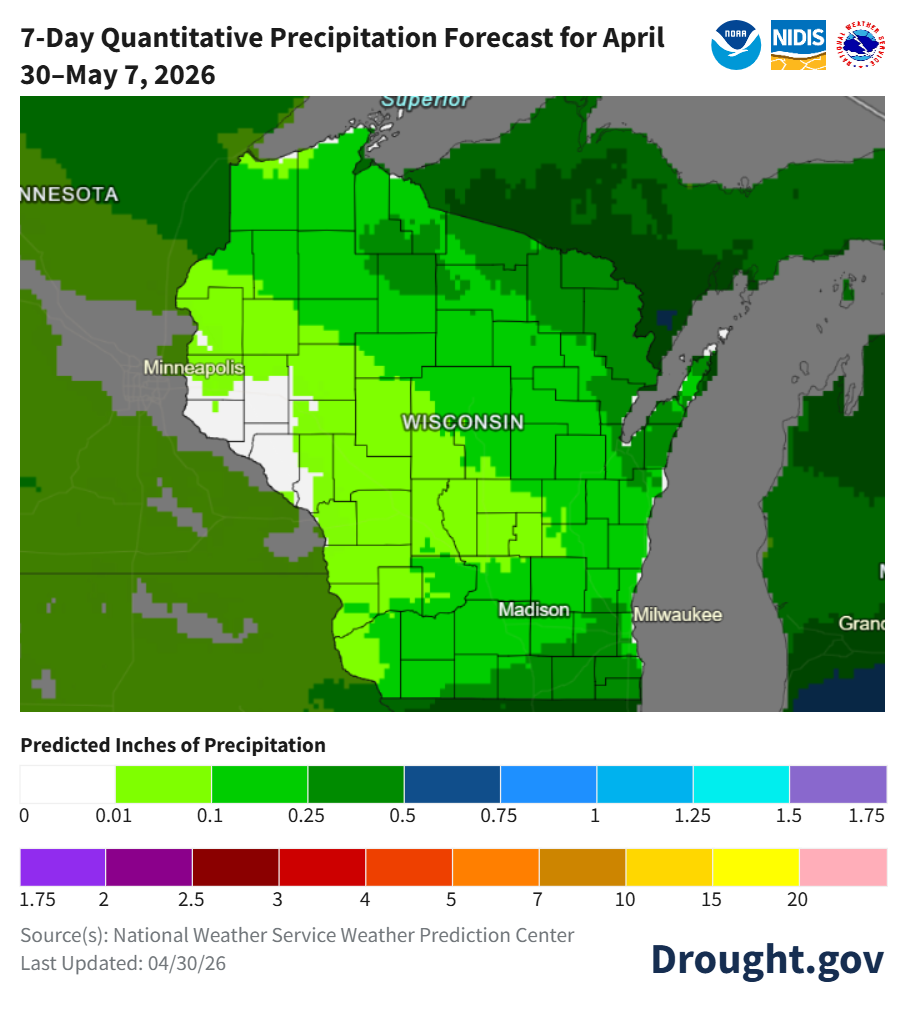
Image Description ↓
NOAA/NWS 7-day quantitative precipitation forecast map for April 30–May 7, 2026, covering Wisconsin and surrounding states. Most of Wisconsin is forecast to receive 0.25–0.75 inches of rainfall, shown in light to medium green. Northern Wisconsin and the Lake Superior shoreline show darker green, indicating higher totals near 0.5–1 inch. The Madison and Milwaukee areas appear in lighter green, suggesting 0.1–0.5 inches. A small area near Minneapolis shows near-zero precipitation in white/very light shading. The color scale ranges from 0 inches (white) through greens (up to 1.75 inches), then blues, cyans, purples, reds, oranges, and yellows for higher totals up to 20+ inches. Source: National Weather Service Weather Prediction Center, last updated 04/30/26.
- When? – multiple chances for scattered rainfall over the next 7 days
- Where? – highest chances in southeast and northeast counties; lesser in west-central counties.
- Check your local forecast for details on totals and timing.
- Average precip (1991-2020) for this week: 0.82”.
8-14 Day Temperature and Precipitation Outlook
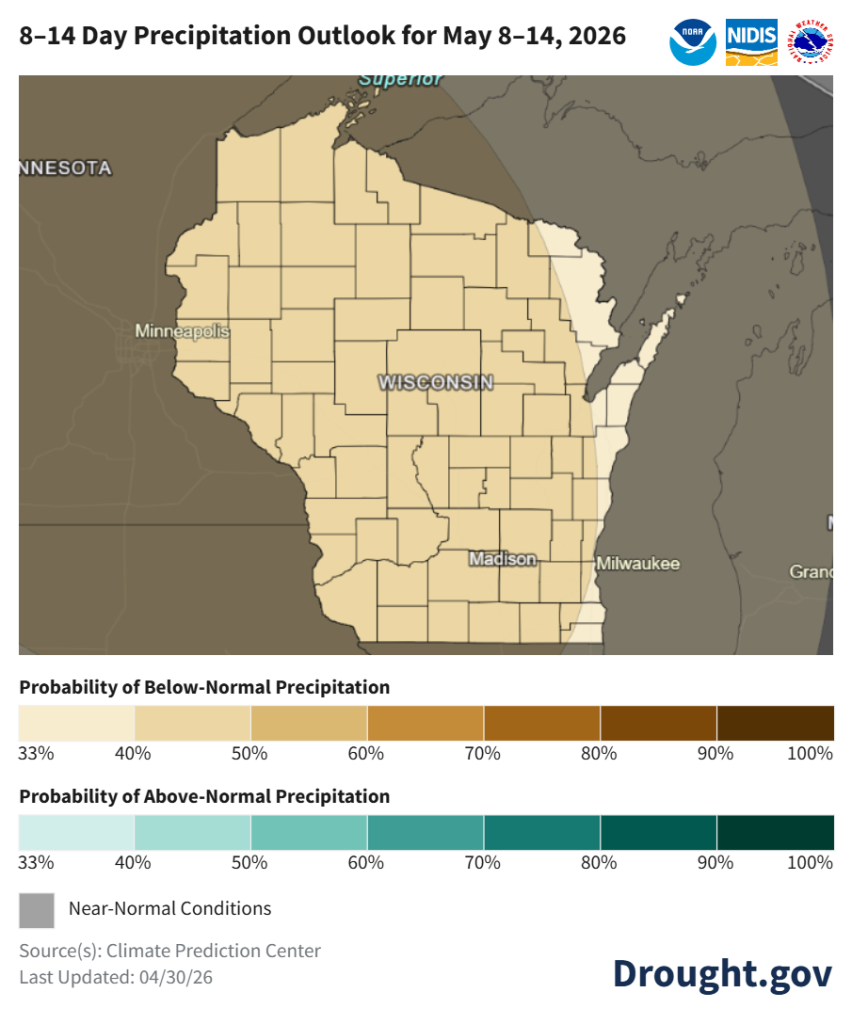
Image Description ↓
NOAA/NIDIS map showing Wisconsin’s 8–14 day precipitation outlook for May 8–14, 2026. Most of the state is shaded light tan, indicating a 33–40% probability of below-normal precipitation. The eastern lakeshore counties near Milwaukee show a gray area indicating near-normal conditions. No above-normal precipitation is forecast for any part of the state. A color scale shows below-normal probability ranging from 33% (light tan) to 100% (dark brown), and above-normal probability from 33% (light teal) to 100% (dark teal). Madison and Milwaukee are labeled on the map. Source: Climate Prediction Center, last updated 04/30/26.
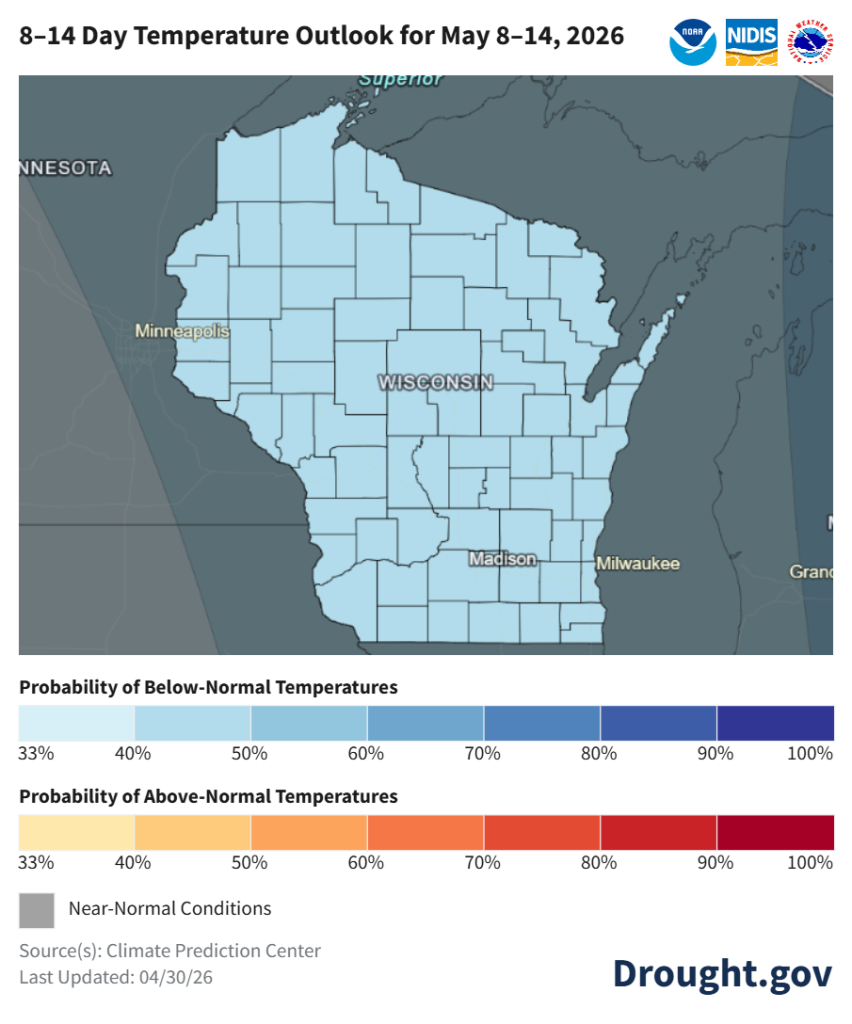
Image Description ↓
NOAA 8–14 day temperature outlook map for Wisconsin, May 8–14, 2026. The entire state is shaded light blue, indicating a 33–40% probability of below-normal temperatures statewide. Cities labeled include Superior, Madison, Milwaukee, and Minneapolis. Color scales shown: light-to-dark blue for below-normal (33–100%) and yellow-to-dark red for above-normal (33–100%); gray indicates near-normal conditions. Source: Climate Prediction Center. Last updated 04/30/26.
- Early-to-Mid May: Temperatures are leaning toward below average statewide (33-40% chance), with precipitation also leaning towards below average (33-40% in the far east; 40-50% elsewhere).
- Statewide normals (1991-2020) for May 8-14 are 53.6°F and 0.84”.
30 Day Temperature and Precipitation Outlook
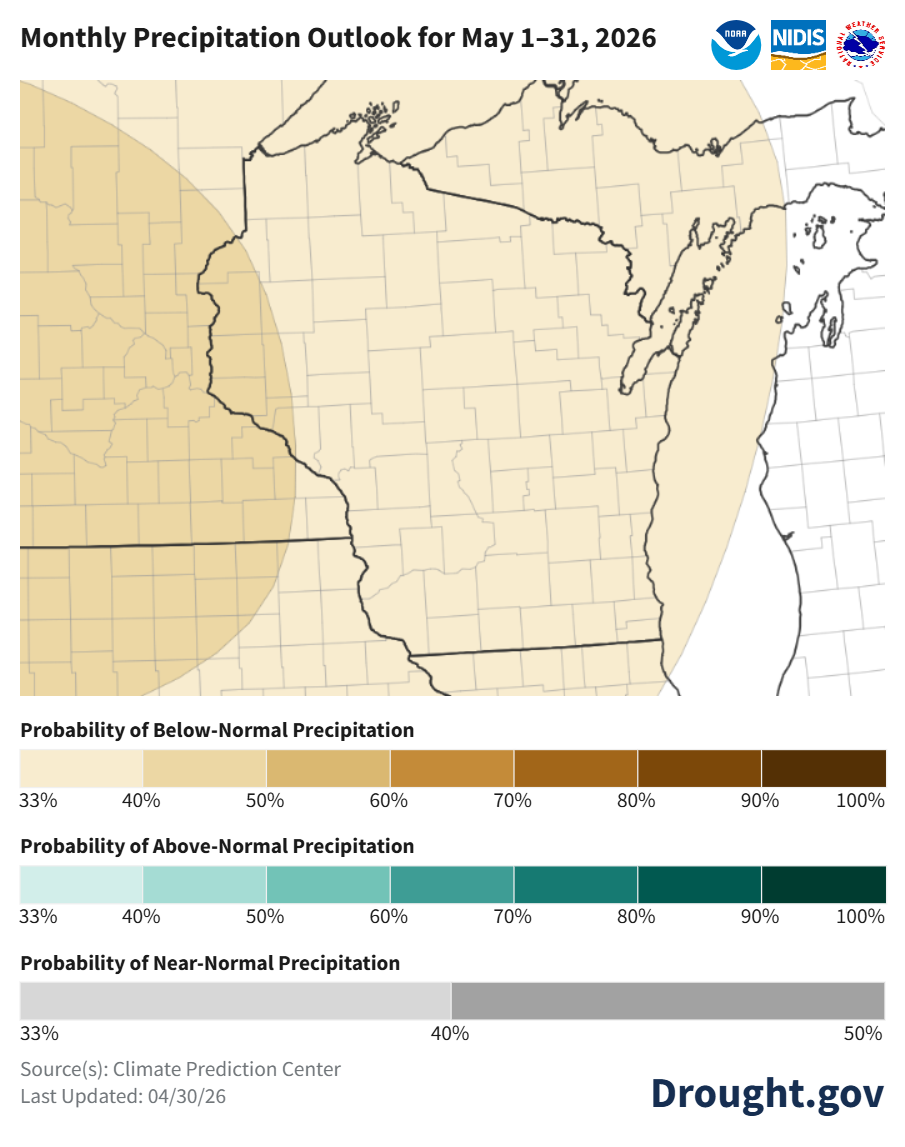
Image Description ↓
NOAA/NIDIS Climate Prediction Center monthly precipitation outlook map for May 1–31, 2026, last updated April 30, 2026. The map centers on Wisconsin and surrounding states. The majority of Wisconsin is shaded in the lightest tan, indicating a 33–40% probability of below-normal precipitation. A larger tan circle overlapping western Wisconsin and extending into Minnesota and Iowa shows a slightly higher probability of below-normal precipitation in the 40–50% range. No areas on the map show above-normal or near-normal precipitation signals. The white/unshaded areas to the east (Michigan, Illinois) fall outside the outlook signal zone. The color scale runs from light tan (33%) to dark brown (100%) for below-normal, teal shades for above-normal, and gray for near-normal precipitation probabilities.
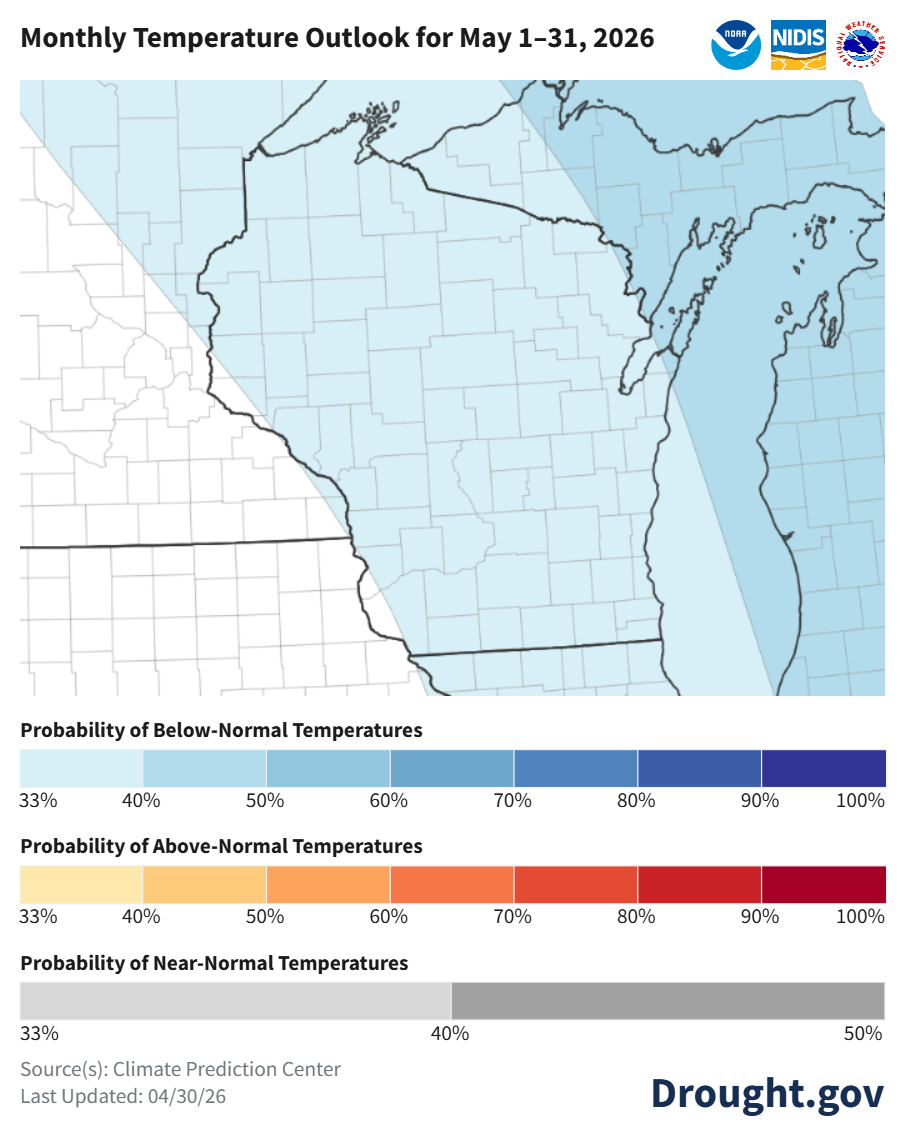
Image Description ↓
NOAA/NIDIS Monthly Temperature Outlook map for May 1–31, 2026, sourced from the Climate Prediction Center (last updated 04/30/26). The map focuses on Wisconsin and surrounding states. Wisconsin and Michigan are shaded in light to medium blue, indicating a 40–50% probability of below-normal temperatures throughout the month. Areas immediately east of Wisconsin along Lake Michigan show slightly darker blue, suggesting a modestly higher probability (50–60%) of below-normal temperatures. States to the west and southwest (portions of Minnesota, Iowa, Illinois) appear white/unshaded, indicating equal chances across temperature categories. A color scale below the map shows blue shades representing 33–100% probability of below-normal temperatures, orange-to-red shades for above-normal, and gray for near-normal. No above-normal temperature signals are present in the mapped region.
- May: Temperatures are leaning toward below average statewide (33-40% chance for most), with precipitation also leaning towards below average (40-50% in the far west; 33-40% elsewhere).
- Statewide normals (1991-2020) for May 1-31 are 55.4°F and 3.93”.
90 Day Temperature and Precipitation Outlook
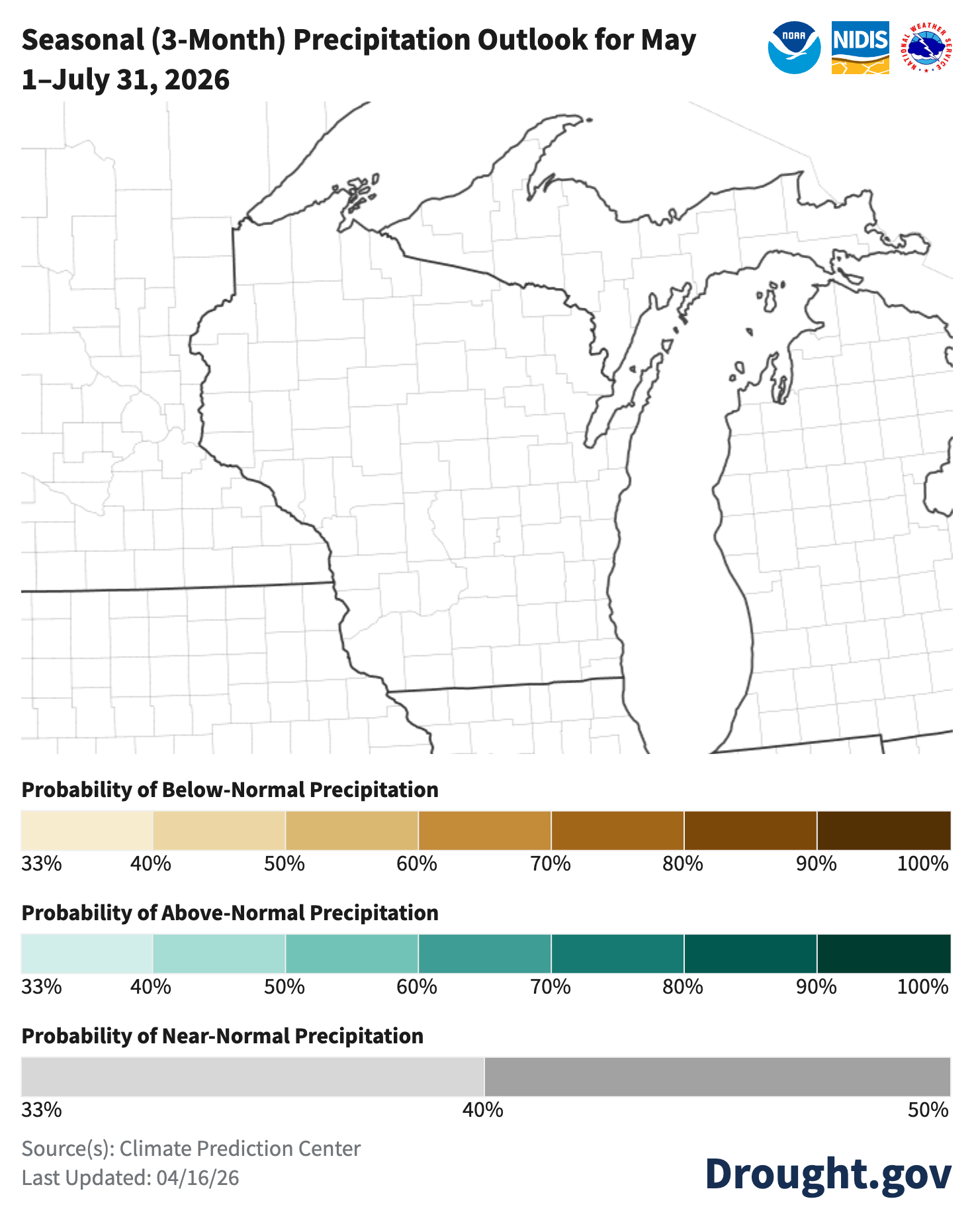
Image Description ↓
A NOAA/NIDIS Climate Prediction Center map covering the Great Lakes states (Wisconsin, Michigan, Illinois, Indiana, Ohio, and parts of neighboring states) for the 3-month period May 1 through July 31, 2026. The map displays no colored shading, indicating the entire region falls into the “equal chances” category — meaning no statistically significant tilt toward below-normal, near-normal, or above-normal precipitation is forecast. Three color scale legends appear below the map: below-normal precipitation (tan to dark brown, 33%–100%), above-normal precipitation (light teal to dark teal, 33%–100%), and near-normal precipitation (light to medium gray, 33%–50%). Source: Climate Prediction Center. Last updated 04/16/26.
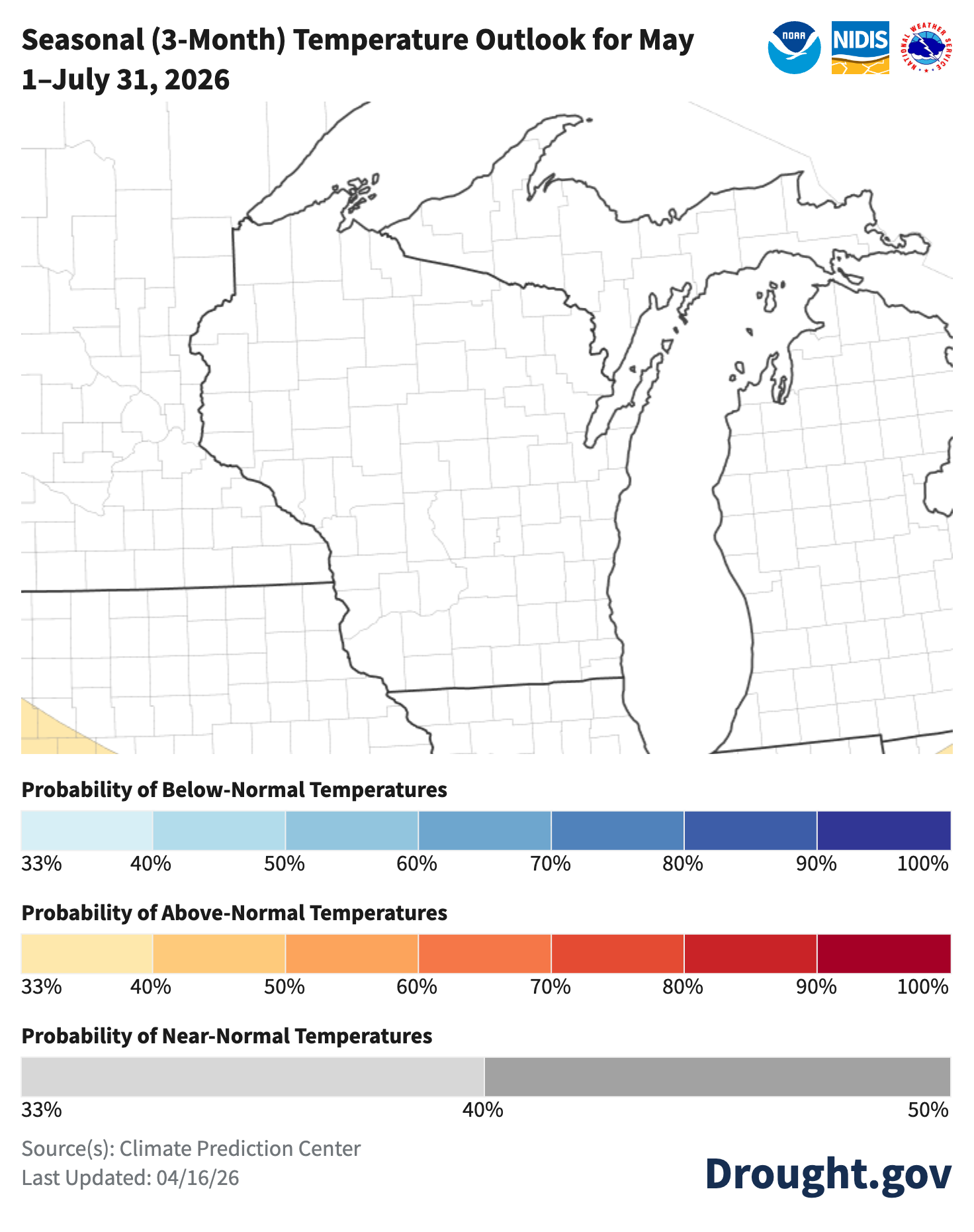
Image Description ↓
NOAA/NIDIS Climate Prediction Center map of the upper Midwest and Great Lakes region displaying the 3-month seasonal temperature outlook for May 1 through July 31, 2026, last updated April 16, 2026. The mapped area — which includes Wisconsin, Michigan, Illinois, Indiana, Ohio, and surrounding states — appears unshaded (white), indicating a forecast of near-normal temperatures with approximately 33–40% probability. A small area in the far lower-left corner shows light yellow shading, indicating a slight probability of above-normal temperatures. Three color scale legends are shown below the map: blue tones (33%–100%) for below-normal probability, orange-to-red tones (33%–100%) for above-normal probability, and gray tones (33%–50%) for near-normal probability. Source: Climate Prediction Center. Site: Drought.gov.
- May-July: Uncertainty for temperatures and precipitation statewide with equal chances for above-, near-, or below-normal conditions.
- Statewide normals (1991-2020) for May-July are 63.2°F and 12.67”.
User Survey
Are you a regular user of the Ag Weather Outlook for Wisconsin (AgWOW)? Or maybe you are viewing these slides for the first time this week? Either way, we want to hear your feedback on this resource! Please take a few minutes and fill out this survey. Your feedback will help us better serve your ag-weather data needs through AgWOW.
If you have any trouble accessing or filling out the survey, please email Josh Bendorf at jbendorf@wisc.edu. Thank you!