
Skip to content
UW Crest

Crops and Soils

Division of Extension

  • Topics
    • Economics, Budgets and Financials
    • Emerging Crops
    • Forage Production and Management
    • Fruit and Vegetable Production
    • Grain Production and Management
    • Grazing
    • On-Farm Research
      • Nitrogen Optimization Pilot Program
    • Pest Management
    • Soils, Nutrient Management, and Soil Health
  • Events
    • Events Calendar
    • UW Forage and Cover Crop Field Day
    • Agronomy and Soils Field Day
    • Wisconsin Extension Weed Management Workshop
    • WWASH Conference
    • Badger Crops and Soils Update Meetings
  • News
    • News
    • Get Connected
      • The Wisconsin Crop Manager
    • Hay Market Report
    • Ag Weather Outlook for Wisconsin
  • Programs
    • Webinars
      • Badger Crop Connect
      • Emerging Crops Webinars
      • Focus on Forage
      • Foundational Crop Scouting Training
      • Vegetable Production Webinars
    • Podcasts
  • Articles
  • People
  • About
  • Contact Us
Search
University of Wisconsin-Extension

(7/26) WI ⚠🐛 – Scout for Japanese Beetles

Written by Emily N Bick Posted on July 26, 2024November 25, 2024
Share
  • Share:
  • Share on Facebook
  • Share on X (Twitter)
  • Share via Email
  • Copy Link

Copied!

Learn more and sign up for alerts

Potential Adult Damage
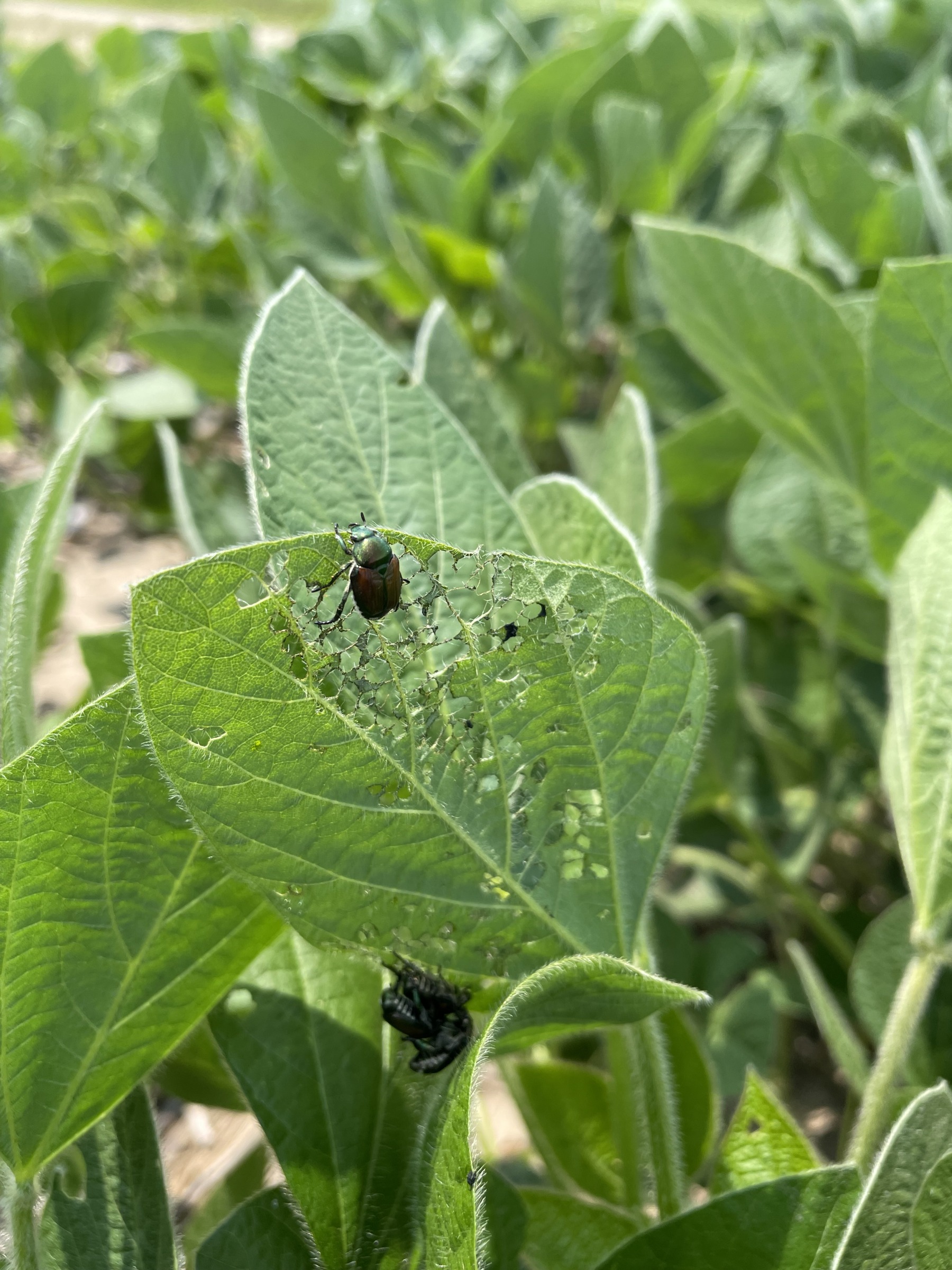
Photo of adult Japanese beetles feeding on soybeans. Photo credit: Laura Flandermeyer

Adult Japanese beetles are flying around corn and soybean fields! On corn, Japanese beetles decrease pollination through silk feeling. On soybeans, adults skeletonized leaves, harming the crop. If you have silking corn or are growing soybeans, it’s time to scout your fields, so this damage does not surprise you. Be aware that damage may be below economic threshold.

Critical Economic Information

For Corn: The economic threshold is 3 beetles per ear actively feeding . Moreover, silks must be <1/2 an inch long & pollination less than 50% complete.

For Soybeans: The economic threshold is  20% leaf defoliation for plants that have bloomed and 30% in those that have not.

Chemical control:

Refer to A3646, Pest Management in Wisconsin Crops, by following these links for Japanese beetle insecticide recommendations in corn (pg. 72) and soybeans (pg. 132). 

Scouting

For corn, be sure to check 5 sets of 20 plants for feeding beetles. Note the tassel length, pollination progress, and number of beetles per ear.

For soybeans, scout 10 plants throughout the field. Look at those in the trifoliate stage and examine the upper, middle, and lower canopy on each plant, noting the extent of the damage.

Remember never use baited traps to scout!

Learn more with UW-Madison Extension’s Japanese beetle resource and DATCP’s Field Note’s section on Japanese beetles.

If you found this information online, you can sign up for insect pest text alerts here.
Print This Page
Categorized: Insect Pest Alert, News

Division of Extension

Connecting people with the University of Wisconsin

  • Agriculture
  • Community Development
  • Health & Well-Being
  • Families & Finances
  • Natural Resources
  • Positive Youth Development
University of Wisconsin-Madison      |        Explore Extension: Agriculture Community Development Families & Finances Health Natural Resources Youth
Connect With Us
Support Extension
Extension Home

We teach, learn, lead and serve, connecting people with the University of Wisconsin, and engaging with them in transforming lives and communities.

Explore Extension »

County Offices

Connect with your County Extension Office »

Map of Wisconsin counties
Staff Directory

Find an Extension employee in our staff directory »

staff directory
Social Media

Get the latest news and updates on Extension's work around the state

facebook iconFacebook

twitter icon Follow on X


Facebook
Follow on X

Feedback, questions or accessibility issues: info@extension.wisc.edu | © 2026 The Board of Regents of the University of Wisconsin System
Privacy Policy | Non-Discrimination Statement & How to File a Complaint | Disability Accommodation Requests

The University of Wisconsin–Madison Division of Extension provides equal opportunities in employment and programming in compliance with state and federal law.