

This spring has been a scramble in the Upper Midwest. Between long periods when rain seemed to never end, farmers worked tirelessly on the few favorable days to get the ground worked and plant their acres. Across Wisconsin, alfalfa went in the ground with plenty of moisture, followed by long spells of rain. While some areas of the state report strong establishment, we have also seen numerous reports of stands struggling to establish, and I have heard similar reports from neighboring states.
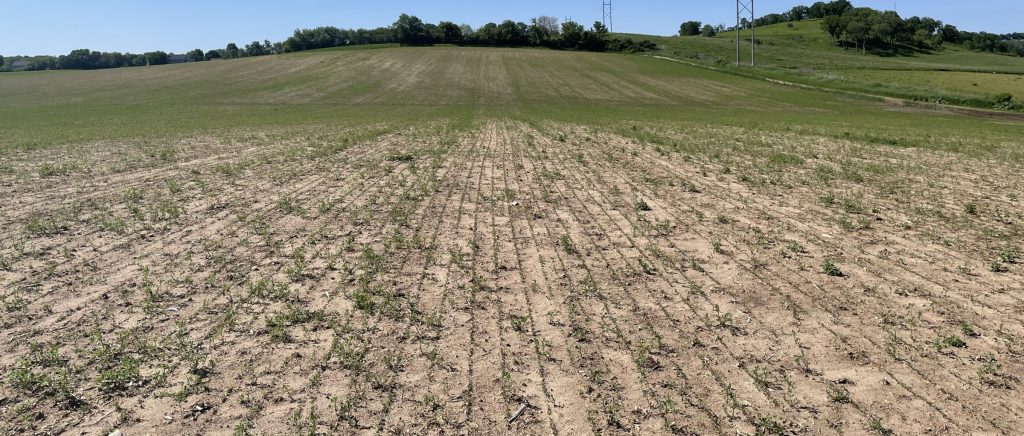
Conditions are well suited to disease
From reports we have received, stand failures are nearly field-wide, with few plants remaining. Several factors likely led to these issues. The first partial contributor might be seedling pathogens. Several important alfalfa seedling pathogens thrive in wet, cold soils and are mobile in the soil when free water is present in the profile. Colder than average temperatures in April and May meant less vigorous seedling growth and, along with waterlogging, you have a recipe for seedling disease. While disease pressure is often not field-wide, conditions like this can lead to widespread disease challenges in a field. More information on seedling diseases can be found on the Crop Protection Network.
Many pathogens are present: who is causing the problem?
In samples sent to the University of Wisconsin plant pathology diagnostic lab, we have identified a cocktail of seedling pathogens. These include Pythium, Phytophthora, Aphanomyces, and Rhizoctonia, all in the same sample! While there is resistance to some of these, Pythium resistance is still not present in alfalfa varieties. Management of Pythium is left to fungicide treatments on the seed and cultural practices. Excessive moisture can often leave these management practices largely ineffective. Unlike other crops which are hybrids or inbreds, alfalfa is a population. Each plant is genetically unique in an established stand of a single ‘variety’. This means that resistance traits are not necessarily present in all individuals. For example, in a variety with an HR rating (>50% resistance) for Phytophthora, Aph 1, and Aph 2, the likelihood of resistance to all three pathogens in the same plant is 12.5%. Thus, when several pathogens are present and conditions are right, damage to stands can be widespread even with a resistant variety.
Other factors are possible. What about residual herbicide damage?
This year’s large rain events may have brought physical damage to stands, with washout occurring, tender seedlings being damaged by deluge, or soil crusting making emergence challenging. Another factor we are increasingly concerned about is herbicide carryover, this being the unintended residual effect on alfalfa seedlings of soil-incorporated herbicides used in previous crops to control weeds.
The presence of herbicide-resistant weed species on more farms has pushed widespread use of aggressive pre-emergence chemistries (Group 4, 14, and 27). As moisture is needed for breakdown of these chemistries, a dry 2023 may have led to less breakdown and could lead to undesirable effects on alfalfa establishment. Management that minimizes soil disturbance can also preserve concentrations in the top of the soil profile. From a recent study at UW, there is some evidence of potential interaction between herbicide damage and pathogen presence, with damage from either leading to greater susceptibility to the other. It is important to consult the label on rotational restrictions. You can find a reference to common herbicides with rotational restrictions for alfalfa here.
There is likely no “silver bullet” for the alfalfa establishment issues seen in some areas this spring. It is a complex combination of several factors. Pathogen presence, prior crop and herbicide applications, tillage practices, soil type, field drainage and of course local weather are all factors that could affect seeding success.
Evaluate New Seedings
Stand evaluation and monitoring are key to assessing planting success. Noting symptoms shown on the way to stand failure may be useful to identify the potential cause(s). While a favorable count for new seedings is around 45 plants/ft2, a stand with just 15-20 strong seedlings/ft2 could still provide the recommended 55 stems/ft2 by the end of the year, though it will leave you more susceptible to attrition to other factors throughout the year.
Should I Replant?
This is a personal risk assessment, and not knowing the exact factors leading to prior stand failure can make this difficult to judge. If poor establishment is due in part to pathogens, warmer temperatures may decrease this risk, though waterlogged soils could still prove a challenge. More time for residual herbicide breakdown may limit the risk of continued damage if this appears to be an issue. Warmer temperatures will increase seedling vigor, giving a better chance of battling through these challenges. Probably the greatest risk with planting so late is moisture. Seedlings are quite susceptible to drying, and if weather patterns change, this could lead to stand failures. I don’t think there is a field in Wisconsin without adequate or higher moisture deep into the profile. Once roots reach this point, weather becomes less of a factor, but the first two to three weeks of germination will require some fortune with the weather. While there is no predicting the future, outlooks of continued wet weather seem favorable.
If you choose to replant, doing so with a no-till drill will preserve soil moisture. If you have had a failed seeding this spring, get in touch with your seed supplier to see if they offer discounts for replant seeds. I believe this situation also stresses the potential value of forage seeding insurance to mitigate risk in scenarios like this.